Approximate Solutions to Equations Worksheets
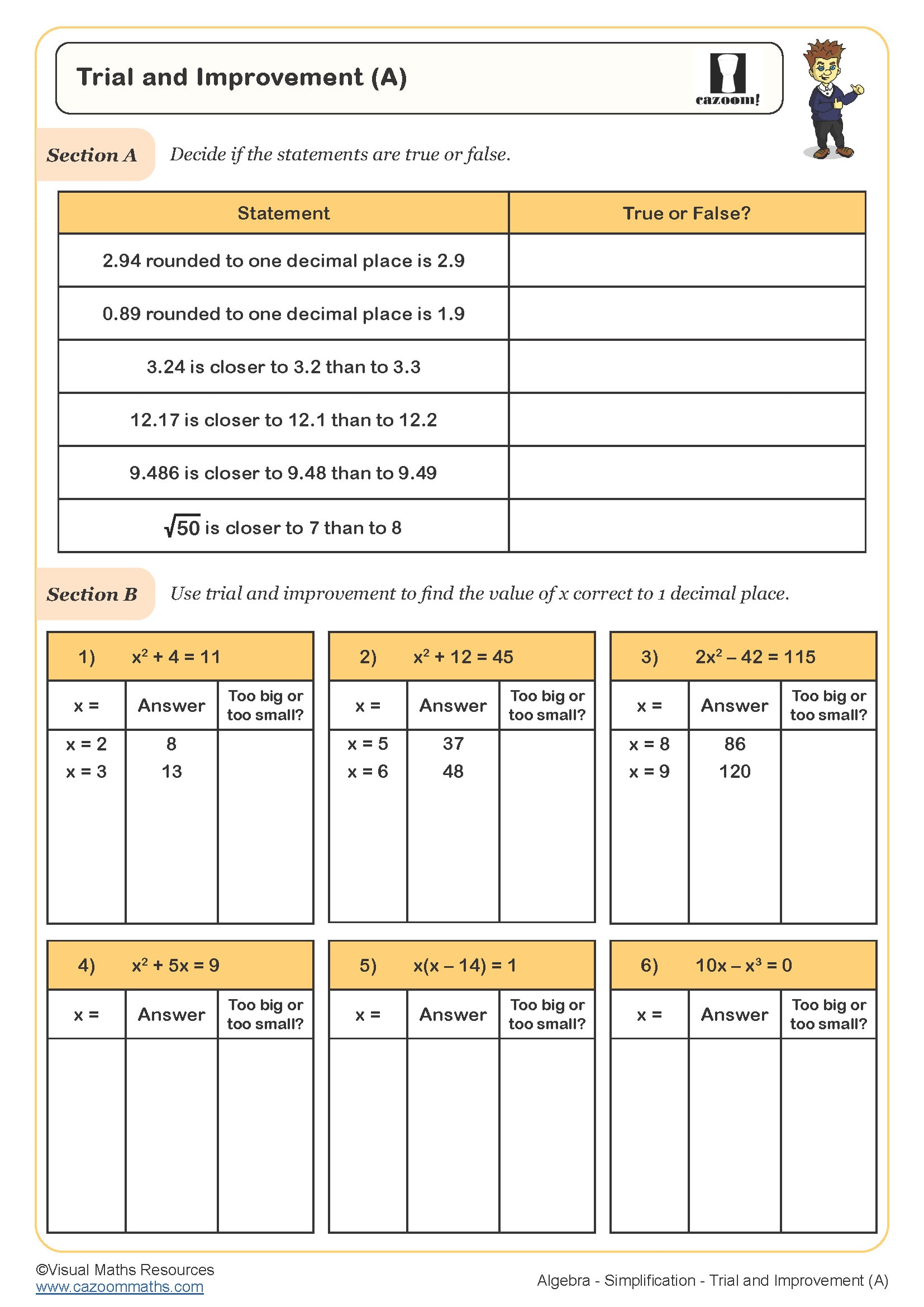
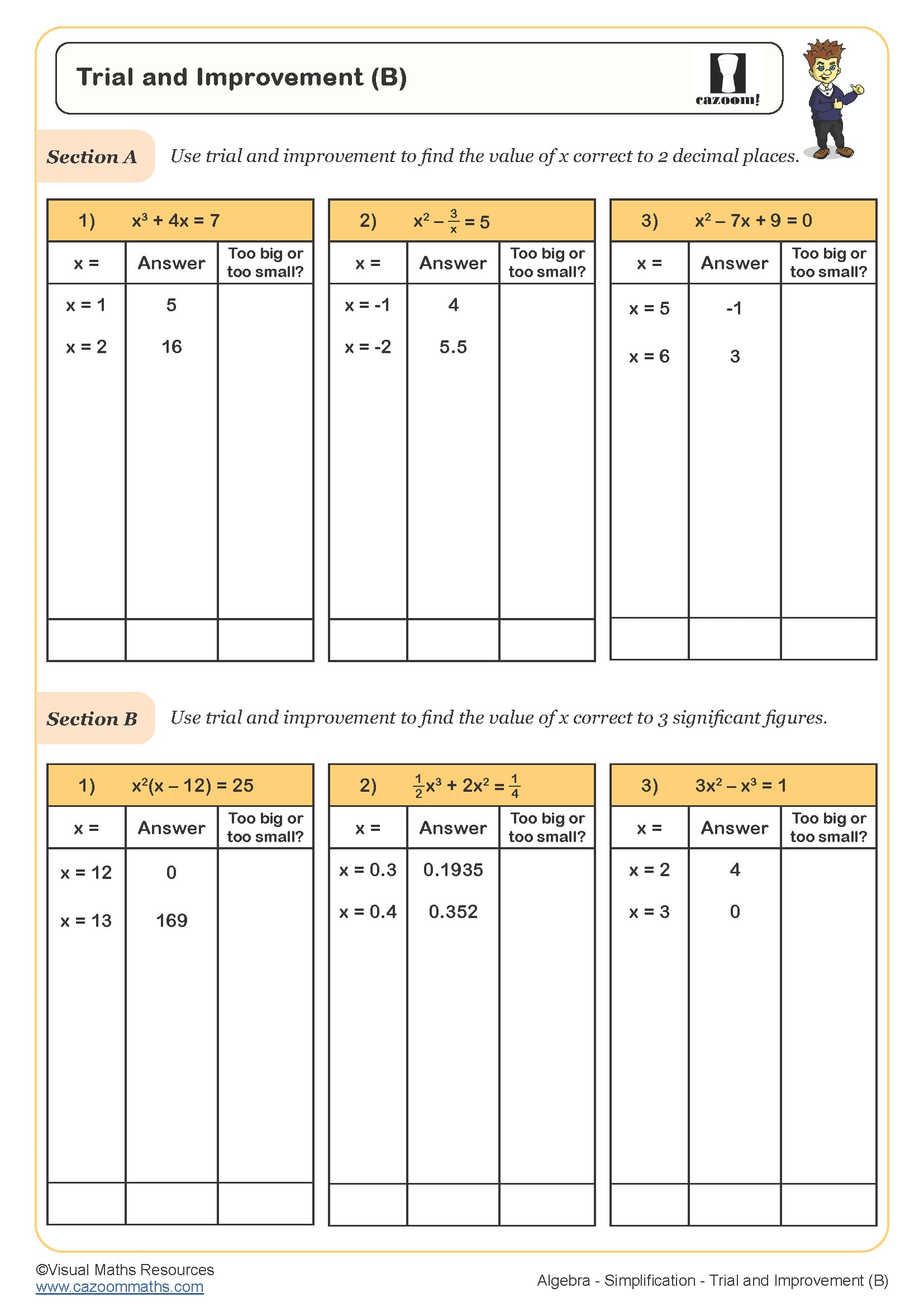
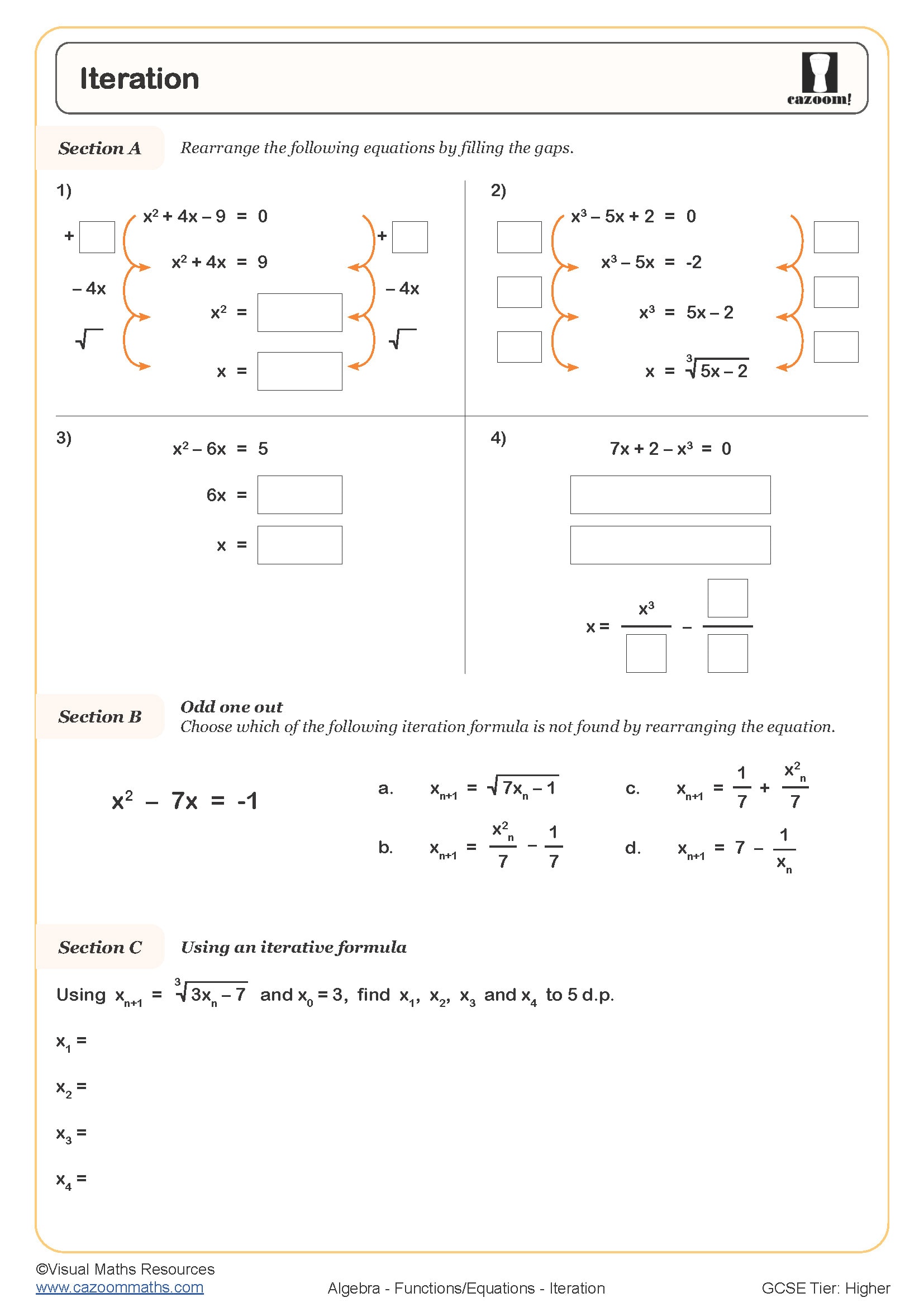
All worksheets are created by the team of experienced teachers at Cazoom Maths.
What Are Approximate Solutions to Equations?
Approximate solutions are methods used to find estimated values for equations that cannot be solved using standard algebraic techniques. Unlike linear or simple quadratic equations, many algebraic expressions—particularly cubic equations, trigonometric equations, or combinations of different function types—require iterative approaches. Students learn to narrow down solutions systematically by testing values and observing sign changes.
The National Curriculum introduces these techniques at Key Stage 3, with more rigorous applications appearing in GCSE specifications. Trial and improvement, decimal search methods, and graphical interpretation all feature prominently. Understanding these methods prepares students for numerical analysis in further mathematics and helps develop logical reasoning skills applicable across problem-solving contexts.
Which Year Groups Study Approximate Solutions to Equations?
These worksheets cover Year 8 through Year 11, spanning both Key Stage 3 and Key Stage 4. Year 8 students typically encounter basic trial and improvement with simple equations, learning to refine estimates systematically. By Year 9, learners work with more complex expressions and begin to understand convergence and accuracy requirements.
At Key Stage 4, Year 10 and Year 11 students tackle GCSE-level problems involving iterative methods with cubic and reciprocal functions. They learn to identify change of sign intervals, interpret graphs to find approximate roots, and express solutions to specified decimal places. The progression ensures students build confidence gradually whilst meeting curriculum expectations for higher-tier GCSE mathematics.
How Do Students Use Trial and Improvement Methods?
Trial and improvement involves making an initial estimate, substituting it into the equation, then refining the guess based on whether the result is too high or too low. Students learn to organise their working systematically, often using tables to track iterations. They test values either side of the expected solution, narrowing the interval until they achieve the required accuracy.
Our worksheets provide structured practice starting with equations where solutions lie between integer values, progressing to problems requiring answers to one, two or three decimal places. Students develop judgement about efficient starting points and learn to recognise when they've achieved sufficient precision. This methodical approach strengthens numerical fluency and builds resilience when tackling unfamiliar equation types.
What's Included in These Worksheets?
Each worksheet contains carefully sequenced exercises covering different aspects of finding approximate solutions. Questions progress from guided examples with suggested starting values through to independent problems where students must identify appropriate methods themselves. Graphical interpretation tasks appear alongside purely algebraic approaches, ensuring balanced coverage of GCSE assessment objectives.
Complete answer sheets accompany every worksheet, showing full working and explanations for each solution. Teachers can use these for marking or share them with students for self-assessment. The PDF format means worksheets print clearly and can be used repeatedly across different classes. This makes them suitable for differentiated homework, intervention sessions, or revision before assessments.