Changing the Base Worksheets
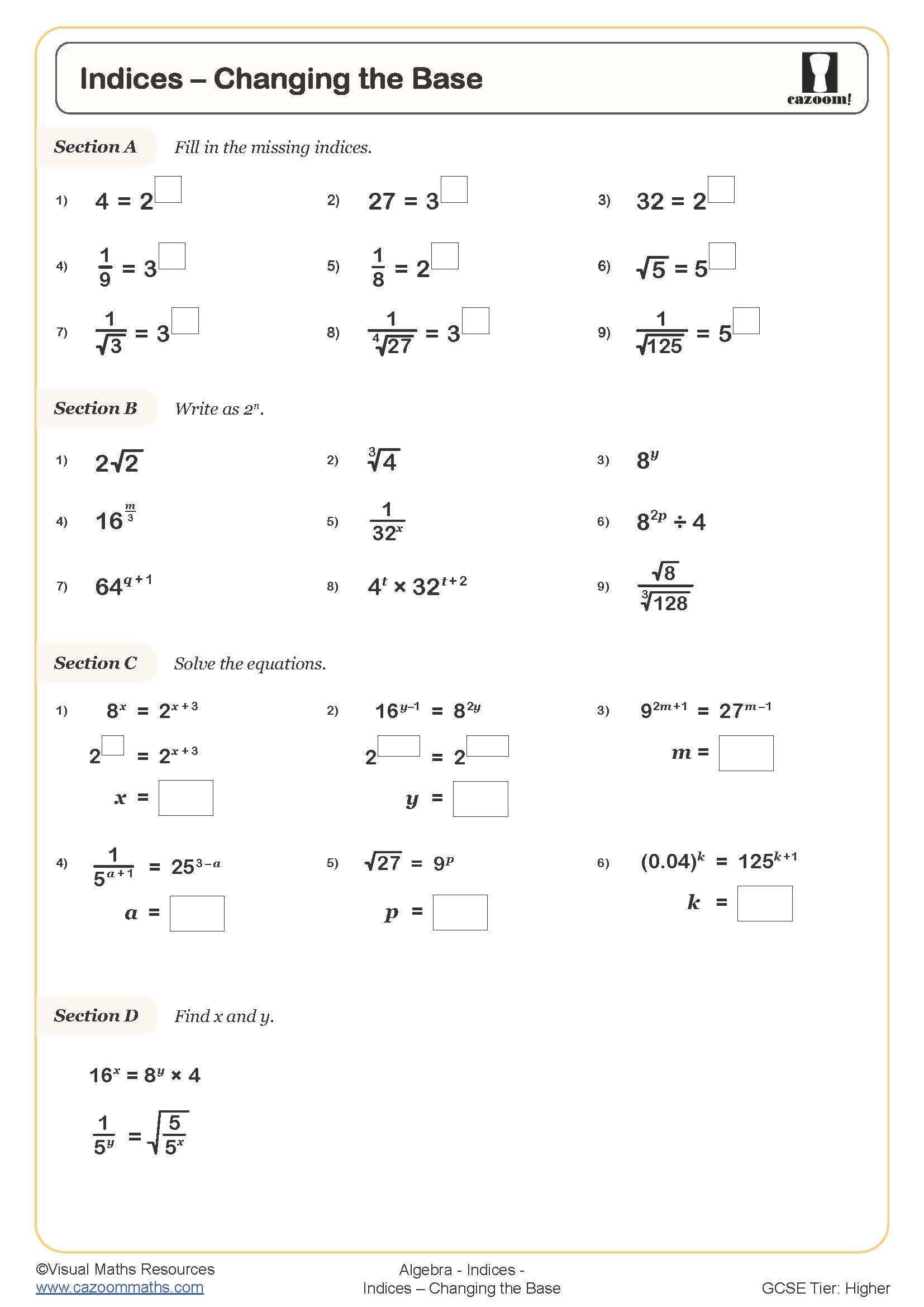
All worksheets are created by the team of experienced teachers at Cazoom Maths.
Where can I find number bases questions and answers pdf resources for GCSE?
These worksheets provide structured number bases questions and answers pdf materials specifically aligned with the KS4 curriculum. The change of base formula allows students to evaluate logarithms in any base using their calculator's log or ln functions, a requirement for GCSE higher tier mathematics. Questions progress from straightforward conversions to more complex applications involving algebraic manipulation.
Students frequently make sign errors when applying the formula, particularly writing log_a(b) as log(a)/log(b) rather than log(b)/log(a). Exam mark schemes consistently penalise this reversal, even when subsequent working is correct. The answer sheets help students identify where their understanding breaks down, whether in formula recall, calculator input, or simplifying the resulting expressions.
Which year groups study changing the base in the UK curriculum?
Changing the base appears in the KS4 curriculum for Year 10 and Year 11 students studying GCSE higher tier mathematics. This topic sits within the algebra strand and builds directly on students' earlier work with indices and logarithms. Most schools introduce the change of base formula in Year 11 once students have established confidence with basic logarithmic rules.
The difficulty increases as students move from simple numerical conversions to expressions requiring algebraic manipulation. Early questions typically ask students to evaluate specific logarithms using the change of base formula, whilst more advanced problems involve simplifying expressions with multiple logarithmic terms in different bases. Questions may also require students to work backwards, finding a base when given the logarithm's value.
What is the change of base formula and why do we need it?
The change of base formula states that log_a(b) = log_c(b)/log_c(a), allowing conversion of logarithms to any convenient base. Students typically convert to base 10 or base e since these match their calculator functions. This algebraic tool proves essential when equations involve logarithms in different bases or when evaluating expressions where the base doesn't match calculator capabilities.
This technique has direct applications in information technology and data science, where logarithms in base 2 appear frequently in algorithm complexity and data compression. Computer scientists regularly convert between bases when calculating binary search efficiency or storage requirements. Understanding how to manipulate logarithmic bases also underpins work in chemistry when handling pH calculations and in physics when dealing with decibel scales, where different reference points effectively create different logarithmic bases.
How do these worksheets help students learn to change logarithmic bases?
The worksheets provide structured practice that moves systematically through different applications of the change of base formula. Questions begin with direct conversions before introducing expressions that require students to simplify after applying the formula. This scaffolded approach helps students recognise when the change of base is necessary and which target base will simplify calculations most effectively.
Many teachers use these worksheets during small group intervention sessions where students can work through problems whilst receiving immediate feedback from the answer sheets. They work equally well for homework when students need additional practice before assessments or as starter activities to refresh the technique after school holidays. Paired work proves particularly effective, with students comparing their application of the formula at each step before checking against the complete solutions provided.