Collecting Like Terms Worksheets
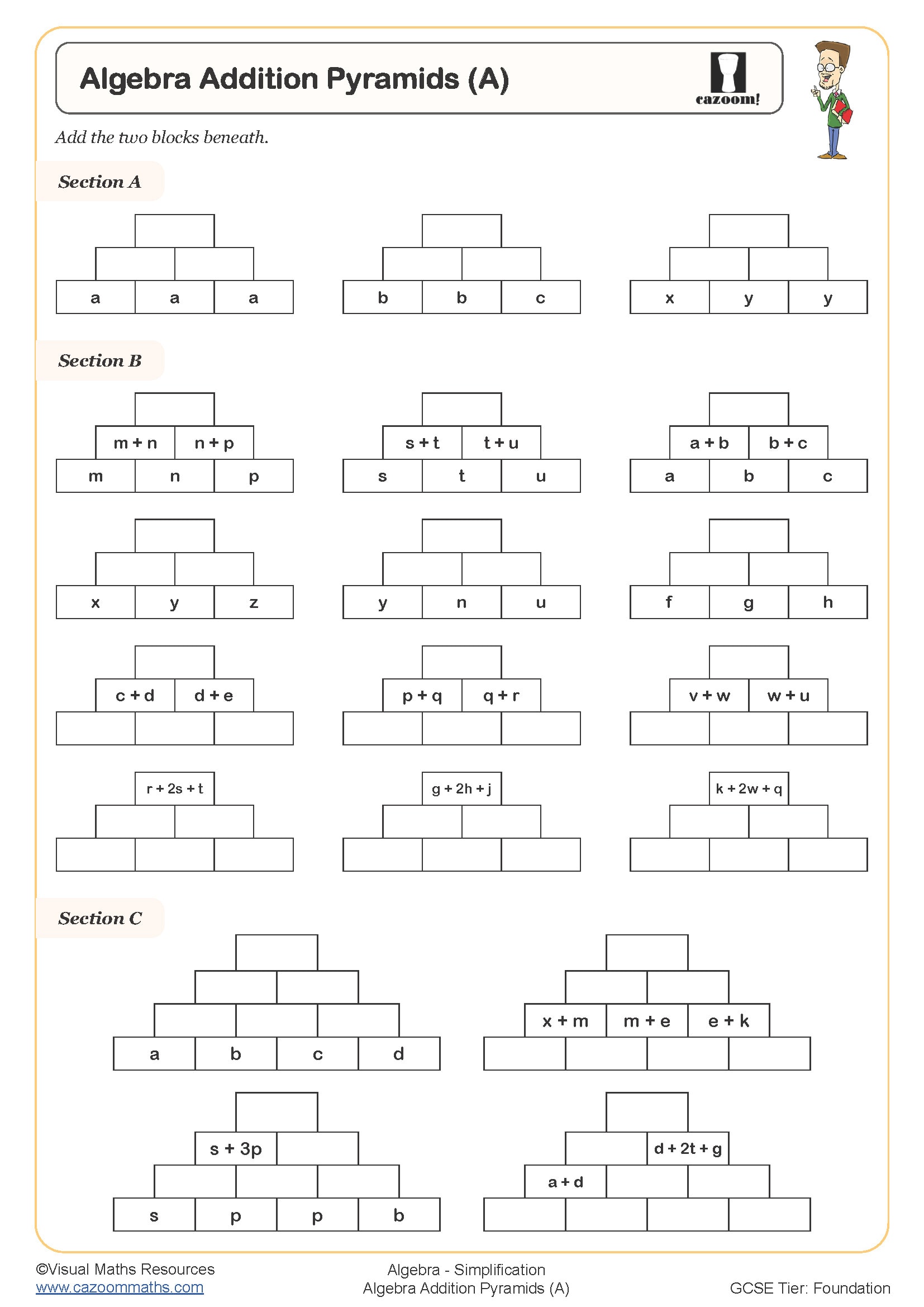
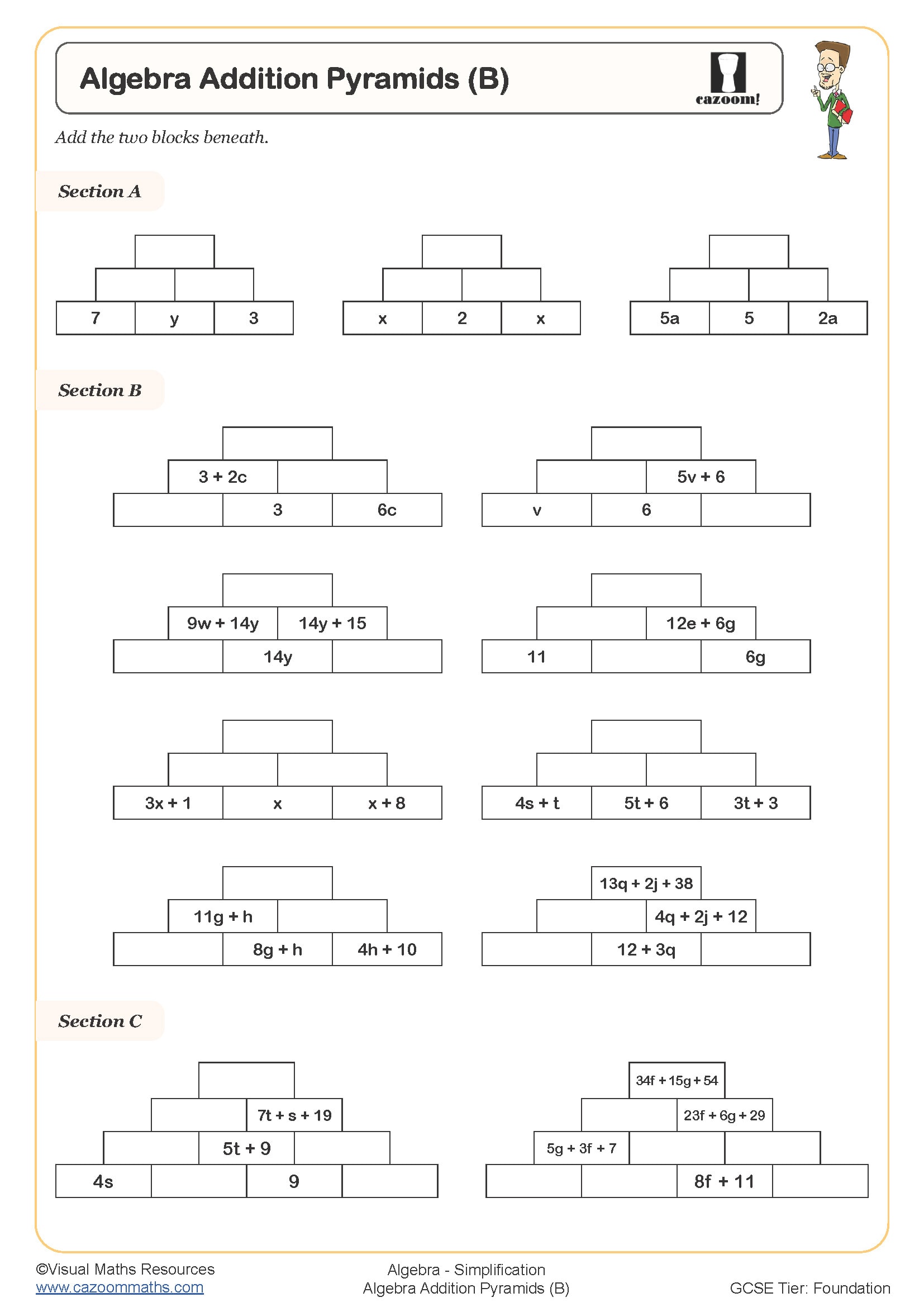
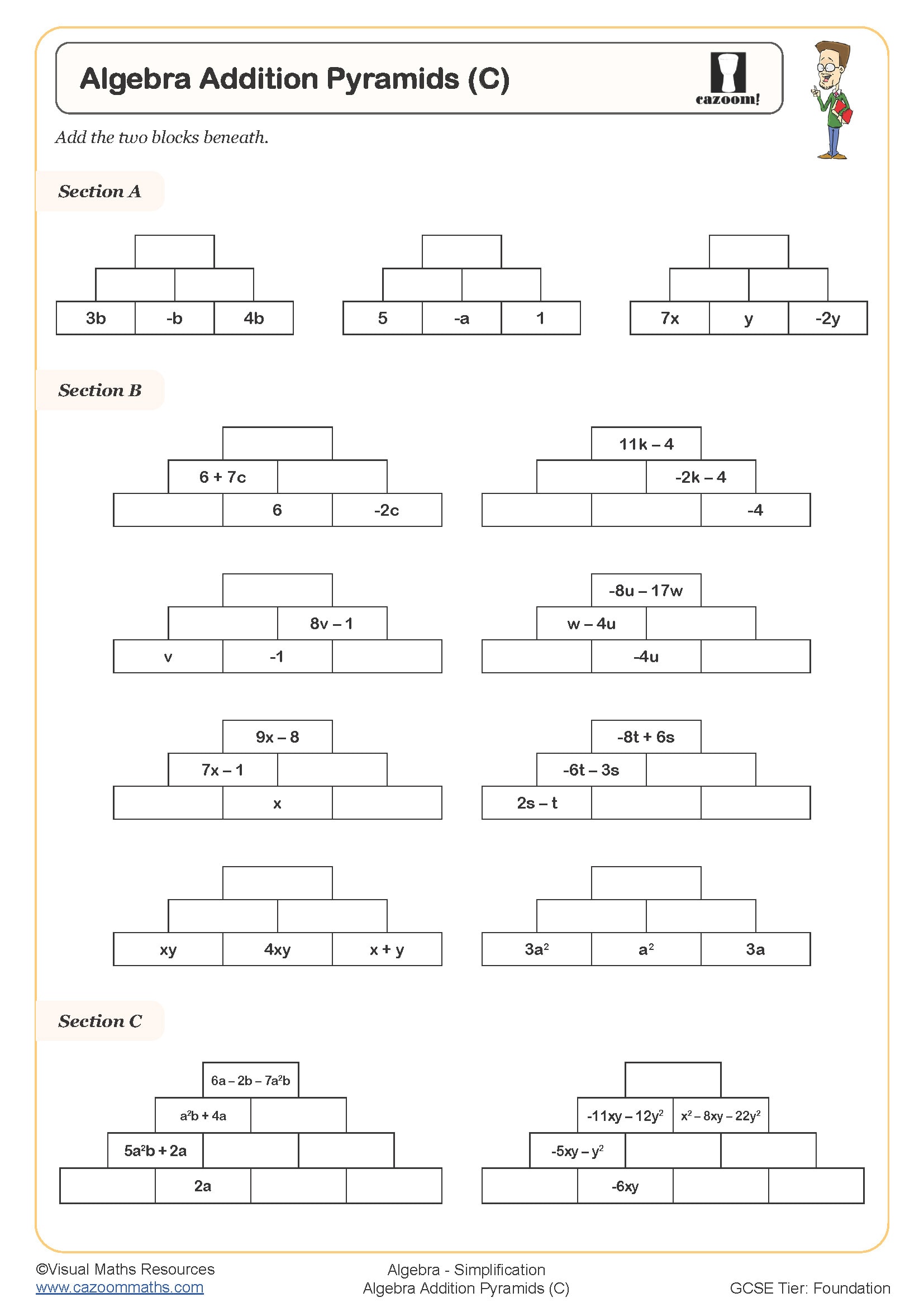
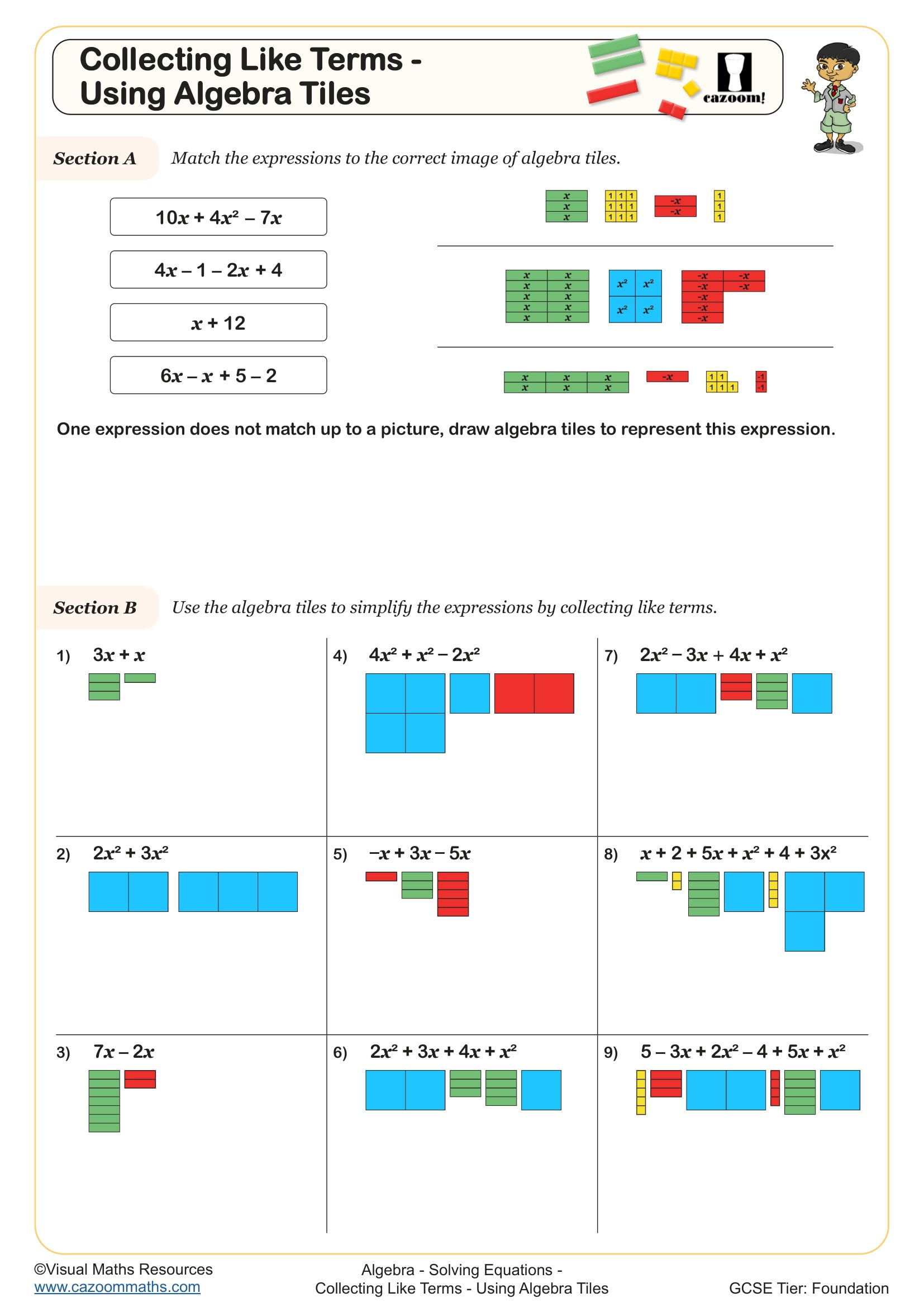
All worksheets are created by the team of experienced teachers at Cazoom Maths.
What does collecting like terms mean in algebra?
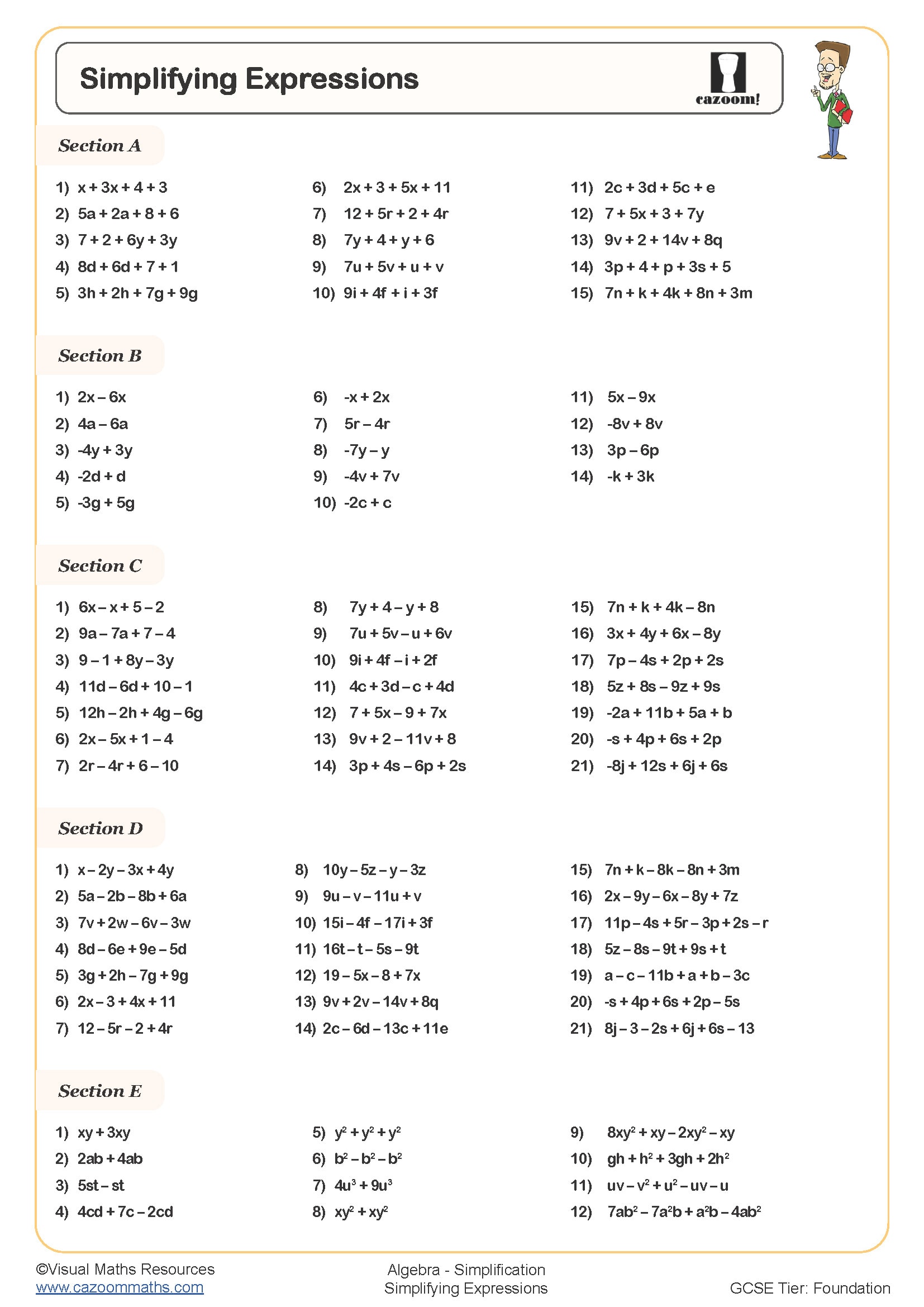
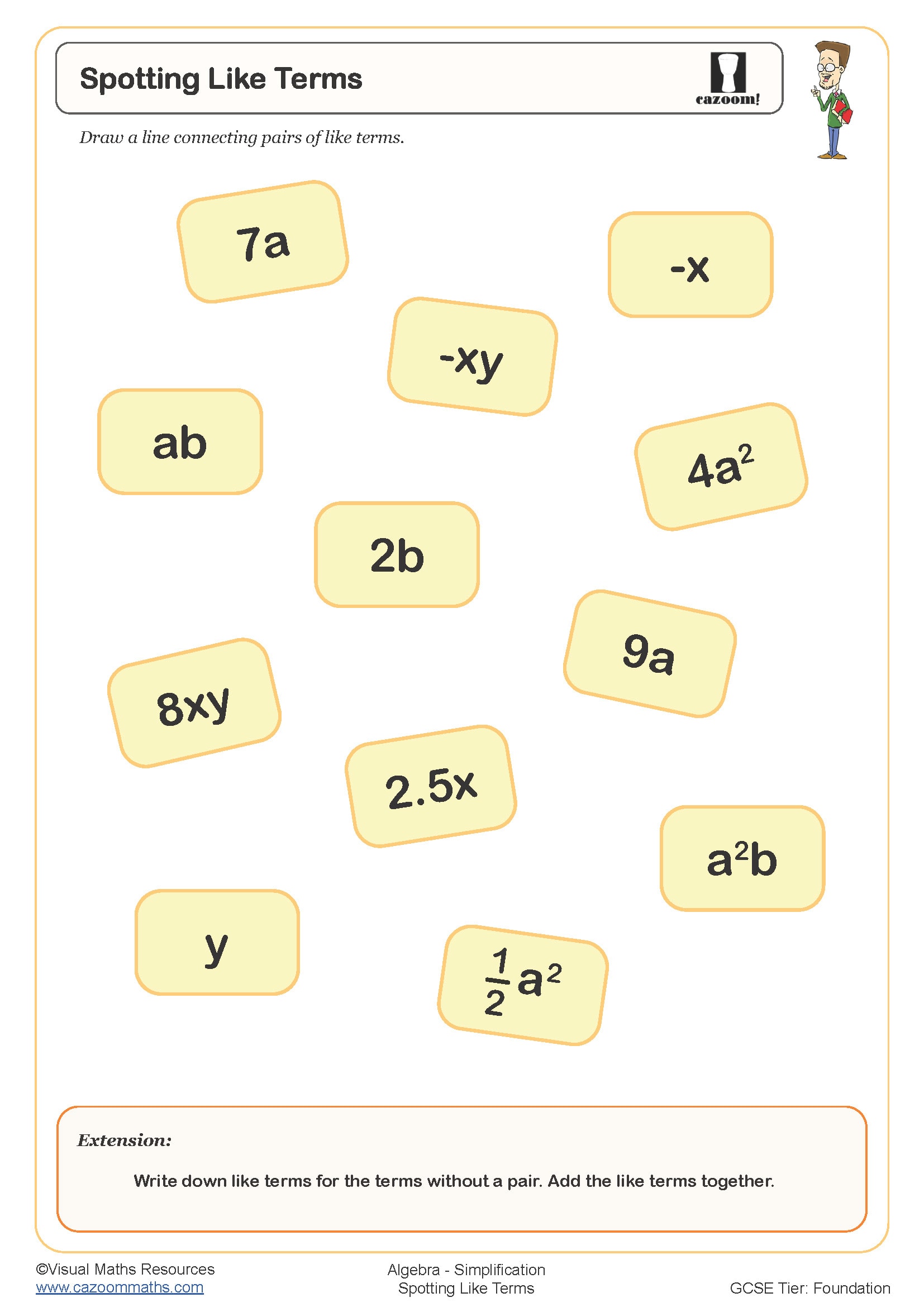
Collecting like terms means simplifying algebraic expressions by combining terms that have exactly the same variable part. Terms like 4x and 7x are 'like terms' because they both contain x, so they can be added to make 11x. However, 4x and 7y cannot be combined because the variables differ. This forms the basis of algebraic manipulation in the KS3 curriculum and appears throughout Key Stage 4 when solving equations and working with formulae.
A common misconception arises when students see 2x + 3x² and attempt to combine them into 5x³ or 5x². Teachers observe this happens because students focus on the letter rather than the full variable part. The terms 2x and 3x² are not like terms because x and x² represent different quantities (x means 'one lot of x' whilst x² means 'x multiplied by itself'). Mark schemes consistently penalise this error in GCSE exam questions.
Which year groups learn collecting like terms?
Collecting like terms appears in both Year 7 and Year 8 as part of the KS3 algebra curriculum. Year 7 students typically begin with straightforward expressions involving one or two variables and positive coefficients, building confidence with the mechanics of identifying matching terms. By Year 8, students encounter expressions with multiple variables, negative terms, and fractional coefficients, which require more careful tracking of signs.
The progression across these year groups reflects the National Curriculum's emphasis on gradual algebraic development. Year 7 worksheets might feature expressions like 5a + 3b + 2a, where terms are clearly separated, whilst Year 8 materials introduce expressions such as 4x - 7y + 2x - 3y, where students must manage subtraction and combine terms that aren't adjacent. This prepares students for solving linear equations and manipulating formulae in Year 9.
How do you collect like terms with negative numbers?
Collecting like terms with negative numbers requires students to treat subtraction as adding a negative value. In an expression like 6x - 2x, students rewrite this as 6x + (-2x), then combine to get 4x. When expressions contain multiple negative terms, such as 7y - 4y - 3y, students must track each negative sign carefully, combining to get 7y + (-4y) + (-3y) = 0y, which simplifies to 0. Teachers notice that students often lose marks by treating minus signs inconsistently or dropping them entirely.
This skill connects directly to real-world contexts in finance and stock control. If a business has 150x items in stock, sells 45x items, receives 30x items, then sells another 20x items, the final stock level is 150x - 45x + 30x - 20x = 115x. Understanding how to handle negative terms when collecting like terms allows students to model situations involving increases and decreases, which extends into STEM fields like engineering (forces in opposite directions) and computer science (incrementing and decrementing values).
How should teachers use these collecting like terms worksheets?
The worksheets provide structured practice that builds from recognising like terms to simplifying increasingly complex expressions. Each worksheet includes varied examples that prevent students from simply memorising patterns, whilst the included answer sheets allow for immediate feedback during lessons or enable students to self-mark during independent work. Teachers can use the progression across worksheets to identify exactly where individual students begin to struggle, whether with basic collection or with managing negative coefficients.
Many teachers deploy these worksheets as starter activities to refresh prior learning before tackling equations, or as targeted intervention for students who rush through collection and make careless errors. The worksheets work effectively for homework when students need deliberate practice without teacher support, and the answer sheets help parents support home learning. Some teachers use them for paired work where one student simplifies whilst their partner checks against the answers, encouraging mathematical discussion about which terms can combine.