Completing the Square Worksheets
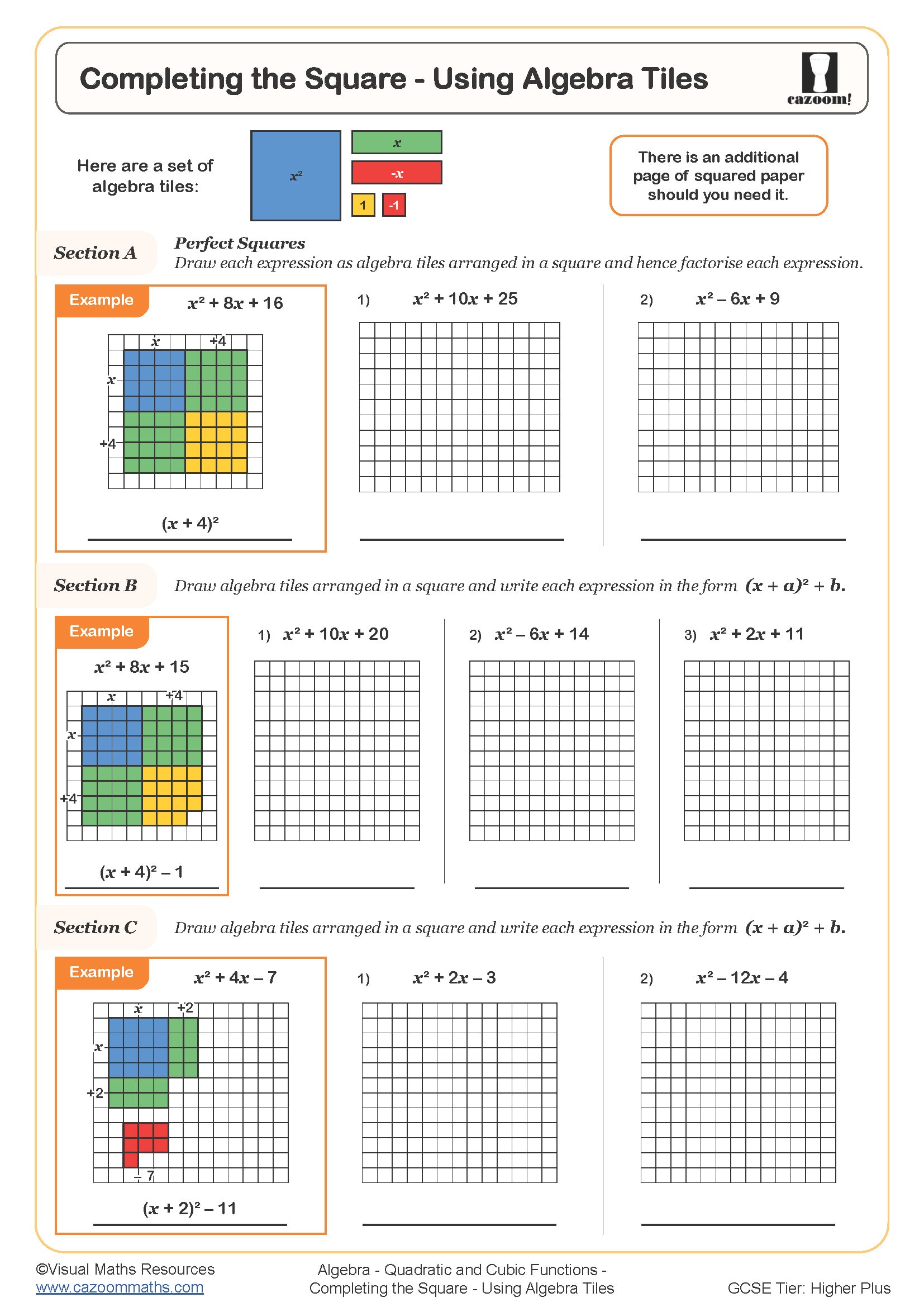
-Worksheet.jpg?w=3840)
-Worksheet.jpg?w=3840)
All worksheets are created by the team of experienced teachers at Cazoom Maths.
What is completing the square and why do students need it?
Completing the square is an algebraic method for rewriting quadratic expressions in the form a(x + p)² + q, which reveals key features like the vertex of a parabola and enables efficient equation solving. This technique appears throughout Higher GCSE, particularly in topics like quadratic graphs, solving equations without the formula, and optimisation problems. Teachers need to establish this skill in Year 10 because it underpins circle equations and coordinate geometry at A-level.
A common misconception occurs when students treat the squared bracket as (x + 3)² = x² + 9, forgetting the middle term. Students frequently lose marks on exam questions by not squaring the entire binomial correctly, or by forgetting to subtract the squared constant outside the bracket. Mark schemes expect clear algebraic steps showing the halving process and the compensating subtraction.
Which year groups study completing the square?
Completing the square worksheets suit Year 10 and Year 11 students following the Higher tier GCSE curriculum. The technique typically appears in Year 10 after students have developed confidence with expanding and factorising quadratics, as it requires reverse-engineering the squared bracket form. Most schemes of work introduce it during the quadratics unit, positioned between factorising and applying the quadratic formula.
The progression across these year groups focuses on increasing complexity rather than introducing new concepts. Year 10 work concentrates on expressions where the x² coefficient is 1, building confidence with the core method. By Year 11, students tackle expressions with coefficients greater than 1, requiring them to factor out the coefficient before completing the square, and apply the technique to solve equations and find turning points of graphs.
How does using algebra help when completing the square?
Using algebra to complete the square requires students to manipulate expressions symbolically rather than relying on trial and error. The algebraic process involves halving the coefficient of x, squaring this value, then both adding and subtracting it to maintain equivalence. This systematic approach develops algebraic reasoning and shows students that rearranging expressions preserves mathematical relationships, a fundamental principle throughout higher mathematics.
This algebraic skill connects directly to physics and engineering contexts where optimising quadratic models is essential. When engineers design parabolic satellite dishes or suspension bridge cables, they use completed square form to identify the vertex position and determine optimal dimensions. In projectile motion, physicists complete the square to find maximum height and range, demonstrating how pure algebraic technique translates into solving real-world optimisation problems across STEM fields.
How can teachers use these completing the square worksheets effectively?
These worksheets support learning through carefully structured questions that build from straightforward expressions to more challenging problems. Teachers find that starting with expressions where the x² coefficient is 1 allows students to grasp the core halving and squaring process before confronting additional complications. The answer sheets enable students to check their working step-by-step, helping them identify exactly where errors occur in their algebraic manipulation.
Many teachers use these resources for targeted intervention with students who struggle to visualise the method, assigning specific questions that isolate particular difficulties like sign errors or bracket expansion. The worksheets work effectively as homework following initial teaching, allowing students to consolidate the technique independently. Some teachers also use them for paired work, where one student completes the square whilst their partner checks each algebraic step against the answer sheet, developing both accuracy and mathematical communication skills.