Composite Functions Worksheets
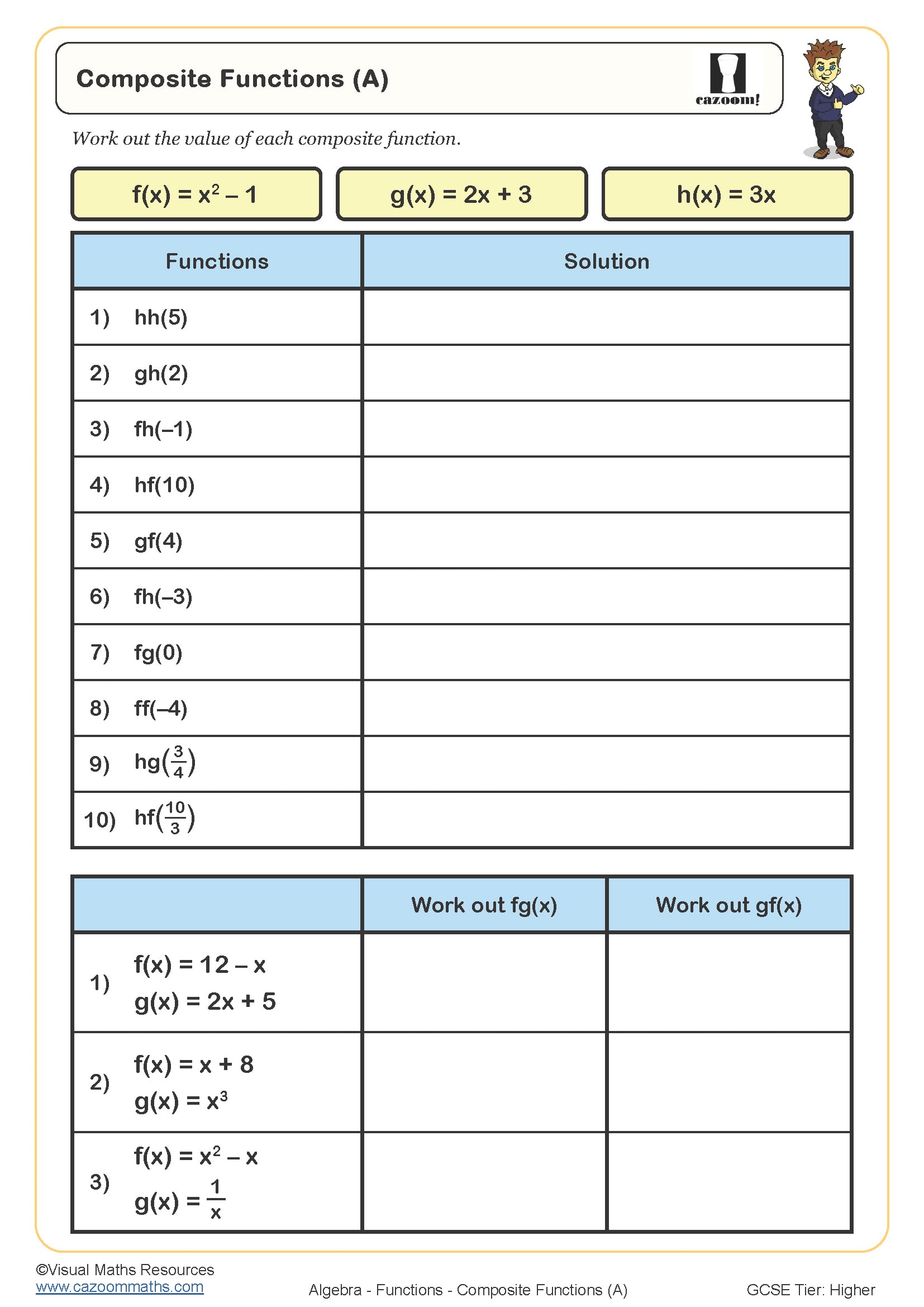
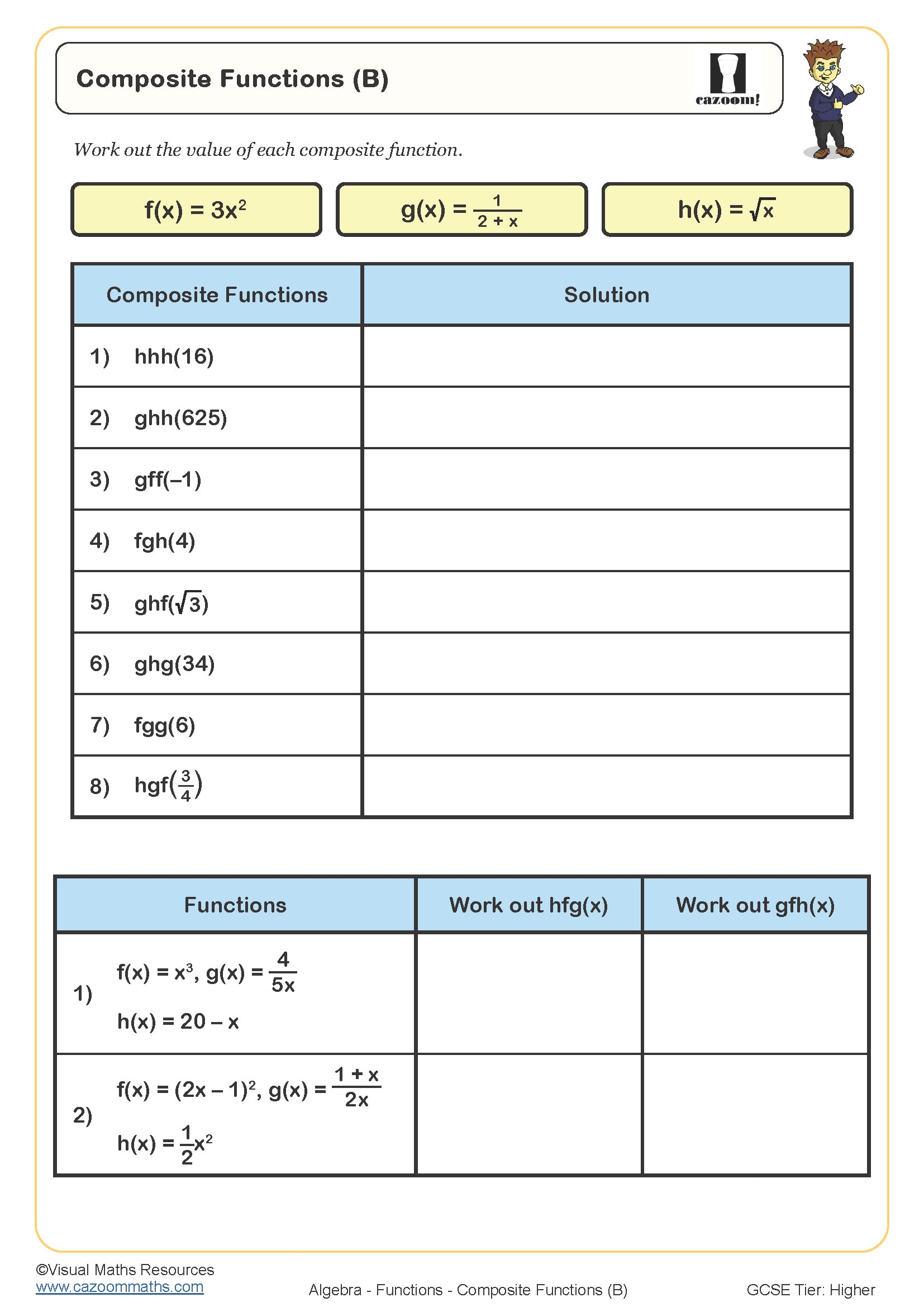
All worksheets are created by the team of experienced teachers at Cazoom Maths.
What are composite functions in GCSE maths?
Composite functions involve combining two or more functions to create a new function, written as fg(x) or (f ∘ g)(x), which means 'apply function g first, then apply function f to that result'. This appears in the GCSE Higher Tier algebra content, where students must understand that fg(x) is not the same as gf(x), and that the order of composition matters significantly.
A typical error occurs when students see fg(3) and attempt to work out f(3) multiplied by g(3), treating it as multiplication rather than composition. Exam mark schemes expect students to substitute the entire expression for g(x) into function f, then simplify. Many students also forget to show this substitution step explicitly, which costs them method marks even when their final answer is correct.
Which year groups study composite functions?
Composite functions worksheets are designed for Year 10 and Year 11 students following the GCSE Higher Tier pathway at KS4. This topic builds directly on earlier work with function notation and substitution from Year 9, where students first encounter the concept of functions as mathematical relationships and learn to evaluate f(x) for given values.
The progression across these year groups typically sees Year 10 students working with straightforward linear and quadratic compositions, whilst Year 11 students tackle more complex scenarios including compositions with three functions, finding inverse composite functions, and solving equations involving composite functions. Teachers often introduce this topic after students are confident with inverse functions, as the two concepts frequently appear together in examination questions.
How do you find the domain of a composite function?
Finding the domain of a composite function fg(x) requires checking two conditions: first, that x-values are valid for function g, and second, that the outputs from g(x) are valid inputs for function f. Students must consider restrictions from both functions, such as denominators that cannot be zero or square roots that require non-negative values, then determine which x-values satisfy both sets of constraints.
This concept connects directly to computer programming and data processing, where functions often feed output into subsequent operations. Software engineers regularly check input validation at each stage to prevent errors, exactly as mathematicians verify domain restrictions. In digital signal processing, composite functions model how audio or image data passes through multiple filters, where each filter's output range must match the next filter's acceptable input range to avoid distortion or system failures.
How can these composite functions worksheets support classroom teaching?
The worksheets provide structured practice that builds from evaluating simple compositions with numerical inputs through to working with algebraic expressions and solving composite function equations. Each worksheet includes worked examples showing the substitution process explicitly, which helps students see the correct order of operations and understand why fg(x) ≠ gf(x) through concrete examples rather than abstract explanations.
Teachers find these resources particularly useful for small-group intervention sessions where students need additional support with function notation before tackling composite functions. The answer sheets allow students to self-mark during independent practice or homework, encouraging them to identify exactly where their working differs from the model solution. Many teachers use selected questions as starter activities to check retention from previous lessons, or set differentiated homework where stronger students attempt inverse composite function problems whilst others consolidate basic composition skills.