Evaluating Functions Worksheets
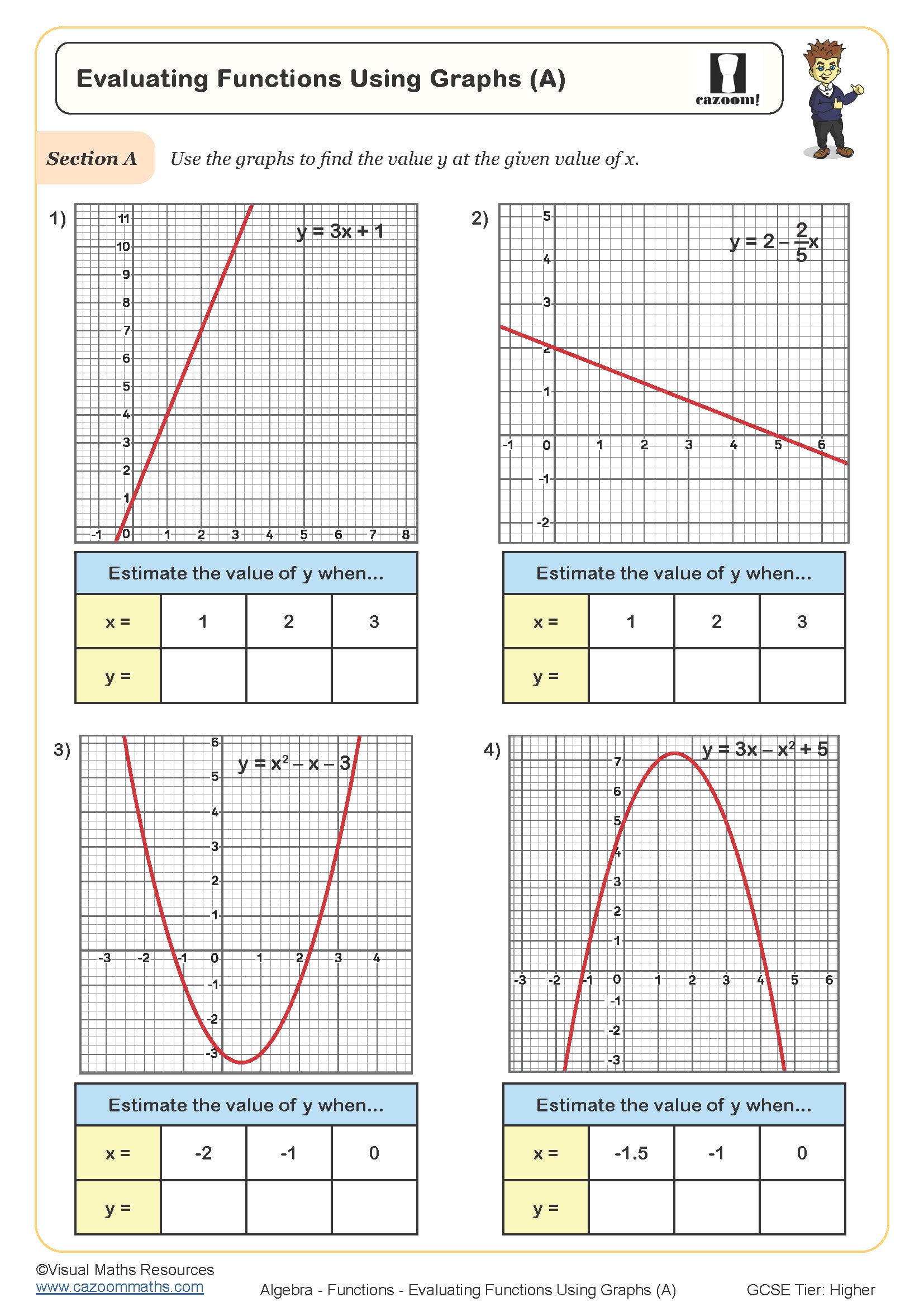
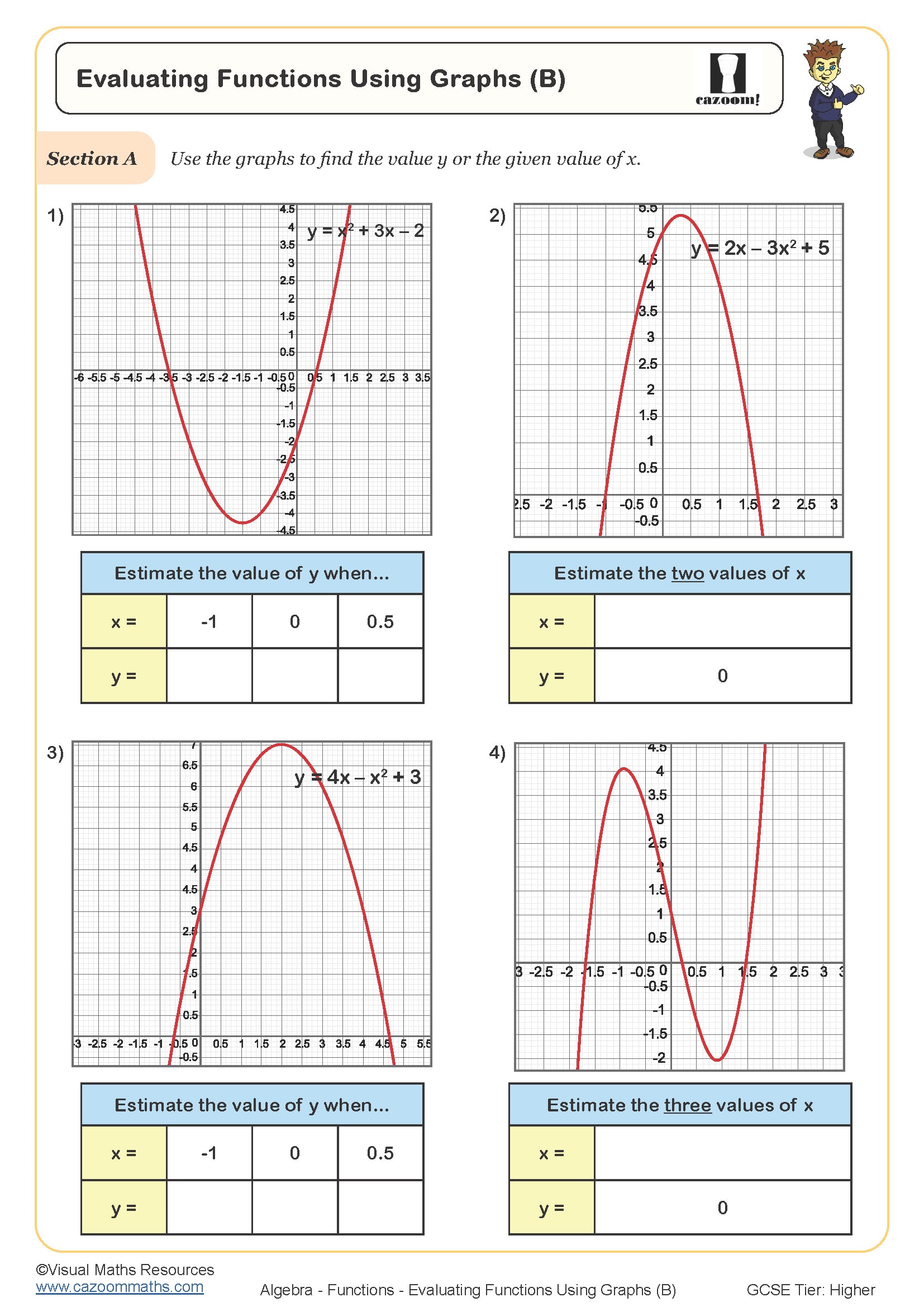
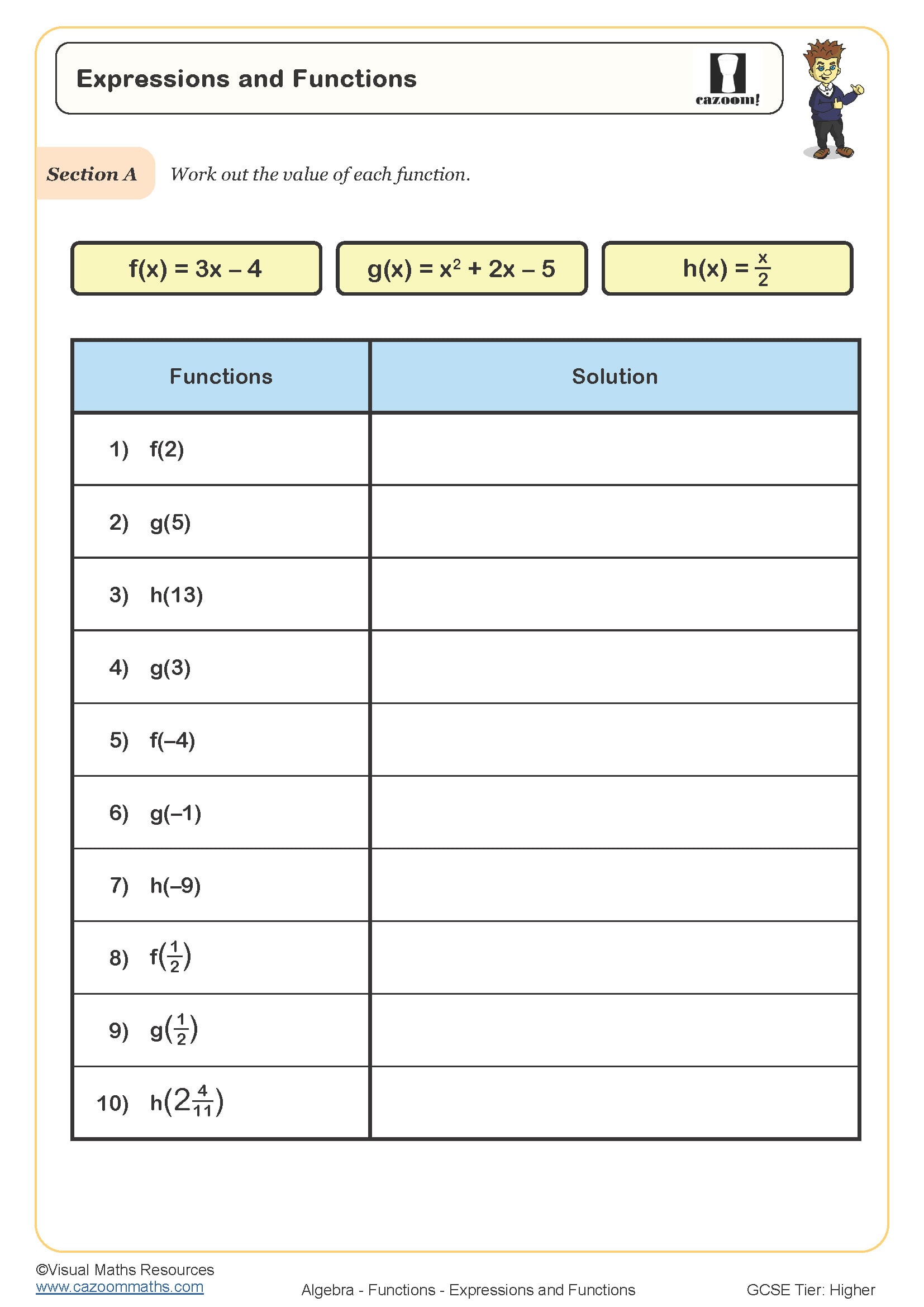
All worksheets are created by the team of experienced teachers at Cazoom Maths.
What does evaluating functions mean in maths?
Evaluating a function means finding the output value when you substitute a specific input into the function rule. For example, if f(x) = 2x + 5 and you're asked to evaluate f(3), you replace every x with 3 to get f(3) = 2(3) + 5 = 11. This appears throughout the KS3 and KS4 curriculum as students progress from simple linear functions to quadratic, cubic and eventually trigonometric functions at GCSE.
A common error occurs when students see f(3) and multiply the function by 3 instead of substituting. Students also lose marks in exams when they substitute correctly but make arithmetic mistakes with negative numbers, particularly when evaluating something like g(-2) = (-2)² - 3(-2), where they forget that (-2)² equals positive 4. Careful attention to brackets prevents most of these errors.
Which year groups study evaluating functions?
These worksheets cover Year 9, Year 10 and Year 11, spanning both KS3 and KS4. The topic typically introduces function notation in Year 9 as students become more confident with algebraic manipulation, then develops throughout Years 10 and 11 as functions become more complex and connect to graphs and transformations required for GCSE.
Progression moves from evaluating simple linear functions like f(x) = 3x - 7 in Year 9 to quadratic and other non-linear functions in Years 10 and 11. By Year 11, students evaluate composite functions such as fg(x), where they must first find g(x) then substitute that result into f(x). This layered approach builds the algebraic fluency needed for A-level mathematics, where function work becomes significantly more sophisticated.
How do you evaluate composite functions?
Composite functions combine two functions, written as fg(x) or sometimes f(g(x)), meaning you apply function g first, then substitute that result into function f. For example, if f(x) = x² and g(x) = 2x + 1, then fg(3) means first calculate g(3) = 2(3) + 1 = 7, then substitute that into f to get f(7) = 7² = 49. Students must work systematically from the inside out, showing each step clearly.
This concept connects directly to computer programming and data processing, where functions feed outputs into other functions to perform complex calculations. Engineers use composite functions when modelling systems where one process affects another, such as temperature affecting pressure, which then affects volume in gas behaviour. Understanding function composition helps students see how mathematical models build complexity from simpler components.
How can teachers use these evaluating functions worksheets effectively?
The worksheets provide structured practise that progresses from straightforward substitution through to multi-step problems involving negative numbers, fractions and composite functions. Each question requires students to show substitution clearly before simplifying, helping teachers identify whether errors stem from misunderstanding function notation or from arithmetic mistakes. The answer sheets allow students to self-assess and correct their method immediately.
Many teachers use these worksheets for targeted intervention with students who struggle to connect function notation to substitution, or as retrieval practise before introducing function graphs. They work well as homework to consolidate classwork or as starter activities to check understanding before moving to transformations of functions. The worksheets also suit paired work, where one student evaluates f(x) and their partner evaluates the same function for a different x-value, then they compare methods.