Expanding Double Brackets Worksheets
All worksheets are created by the team of experienced teachers at Cazoom Maths.
What is the method for expanding double brackets?
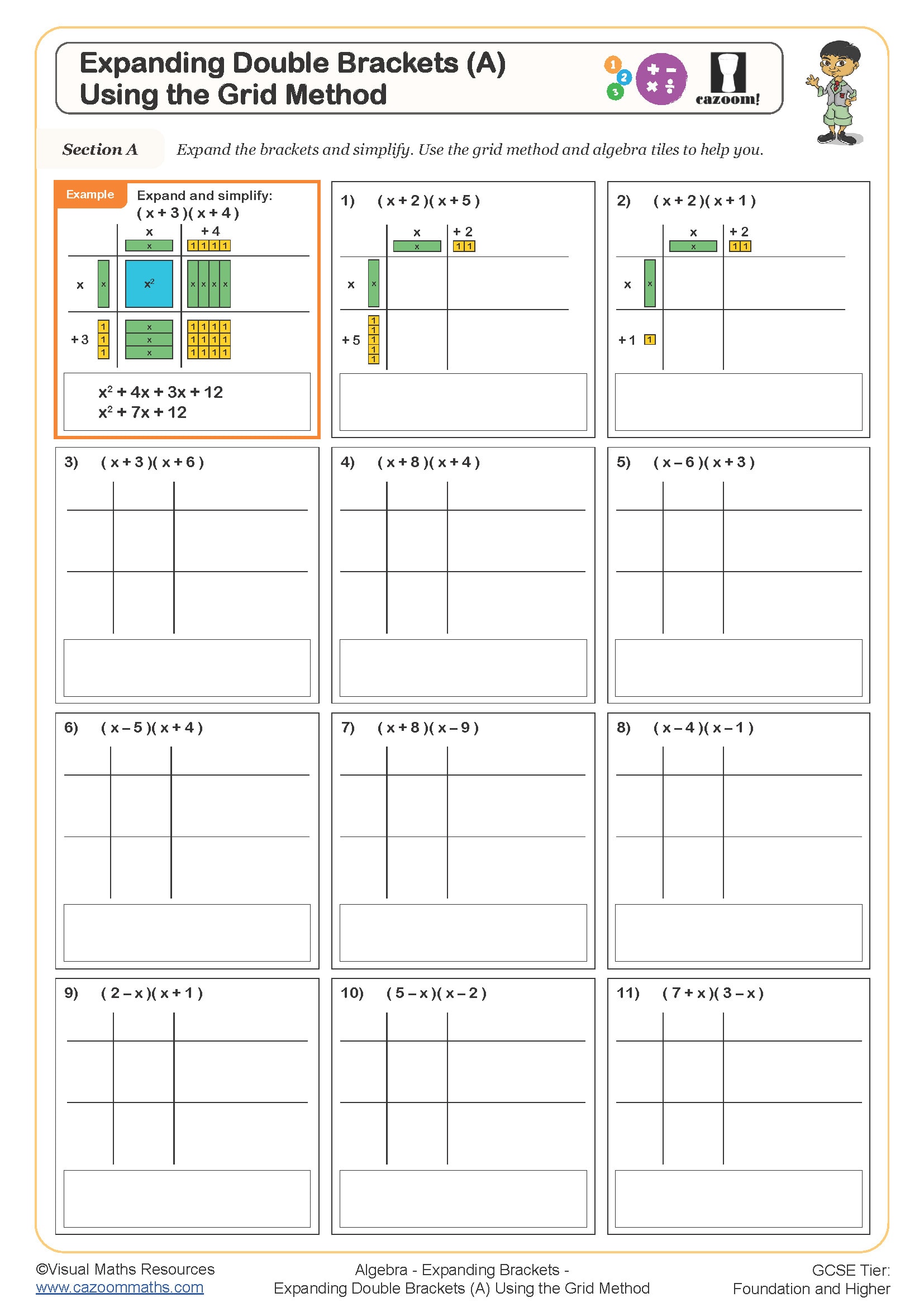
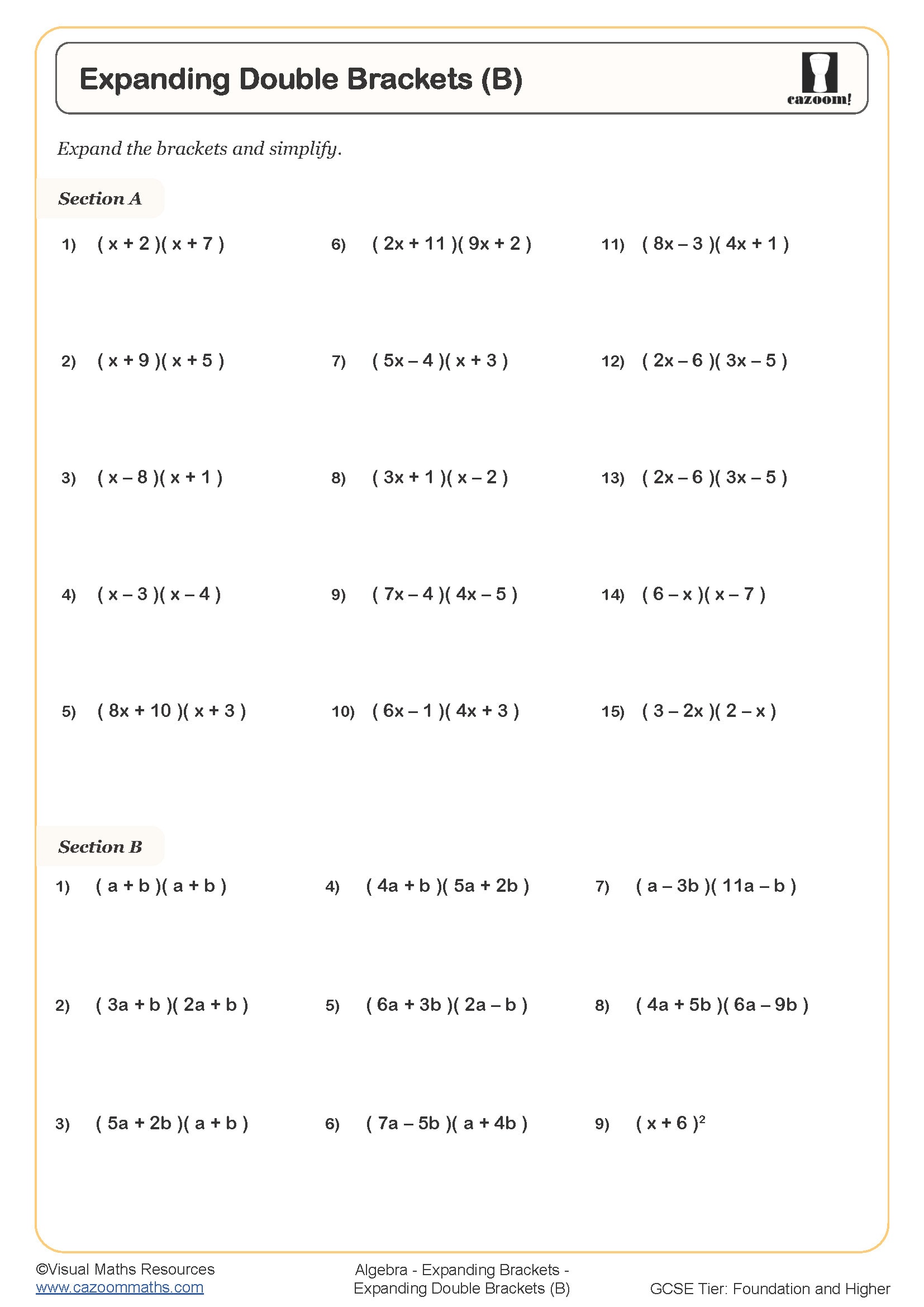
Expanding double brackets involves multiplying each term in the first bracket by each term in the second bracket, then collecting like terms. Many teachers introduce this using the FOIL method (First, Outer, Inner, Last) or the grid method, both of which ensure students multiply all four pairs systematically. For example, (x + 3)(x + 5) expands to x² + 5x + 3x + 15, which simplifies to x² + 8x + 15.
Students often lose marks on exam questions when they forget to multiply the last terms together or make errors with negative signs. A common mistake occurs with expressions like (x − 2)(x + 4), where students incorrectly write −2 × 4 as +8 instead of −8. Teachers find that encouraging students to write out all four products before simplifying reduces these errors significantly and builds confidence with the algebraic manipulation required at GCSE.
Which year groups study expanding double brackets?
Expanding double brackets appears in the National Curriculum from Year 8 onwards, with worksheets available here for Years 8, 9, 10, and 11 across Key Stages 3 and 4. Students typically encounter basic double bracket expansion in Year 8 as an extension of simplifying expressions and expanding single brackets, then revisit it with increased complexity through Years 9 and 10 as preparation for GCSE content.
The progression builds systematically: Year 8 focuses on positive integer coefficients, Year 9 introduces negative terms and fractional coefficients, whilst Years 10 and 11 include surds and more algebraic complexity. By Year 11, students need fluency with expanding brackets to factorise quadratics, complete the square, and solve equations. Many teachers notice that students who haven't secured this skill in Year 9 struggle disproportionately with higher-tier GCSE algebra topics.
How do you expand double brackets with surds?
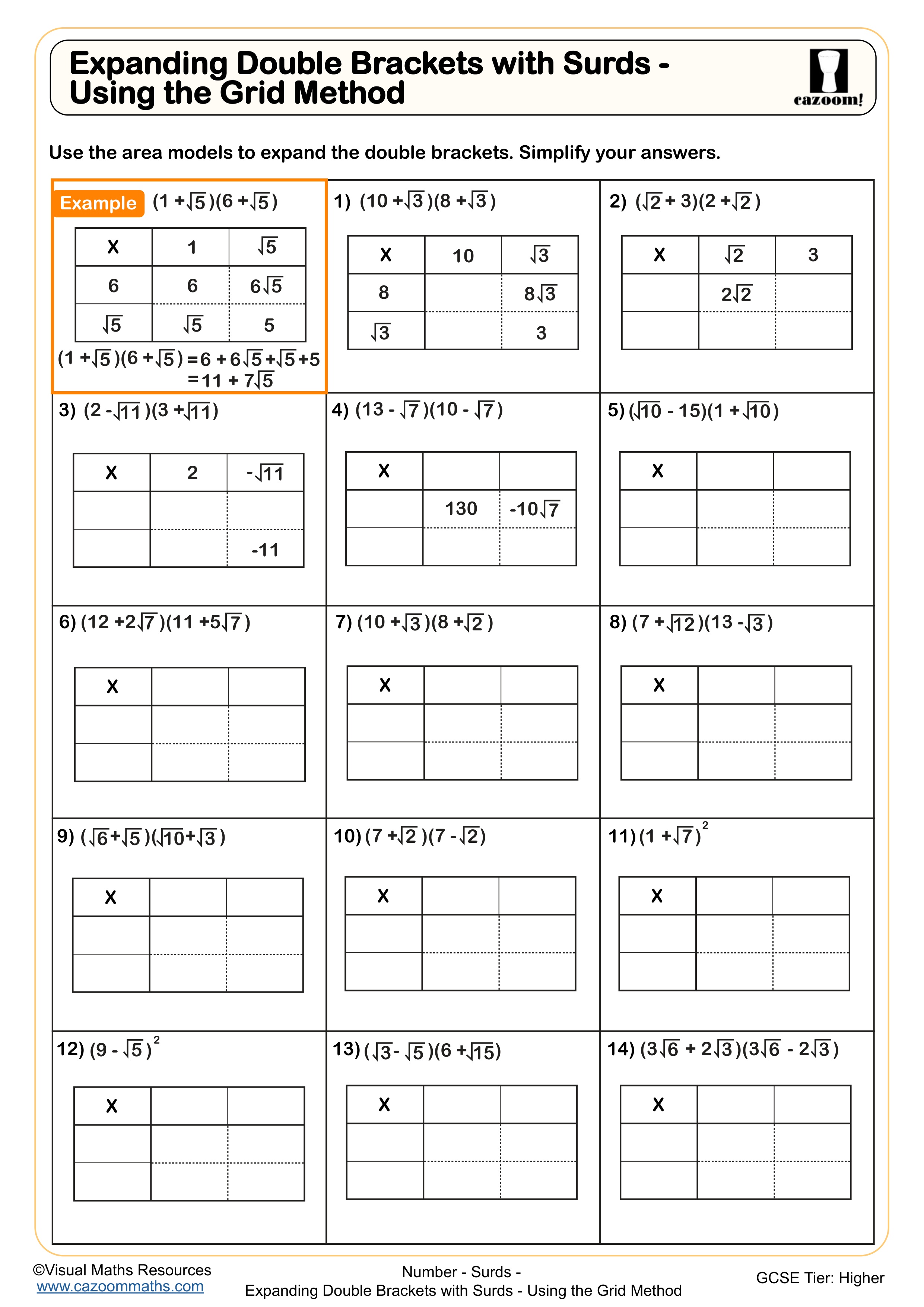
Expanding double brackets with surds follows the same multiplication process as with integers, but students must apply surd laws when simplifying. For instance, (√3 + 2)(√3 − 5) expands to (√3 × √3) + (√3 × −5) + (2 × √3) + (2 × −5), which simplifies to 3 − 5√3 + 2√3 − 10, giving −7 − 3√3. The key challenge is recognising that √3 × √3 = 3, not 3√3 or √9.
This skill connects directly to rationalising denominators and working with exact trigonometric values in GCSE and A-level mathematics. Engineers and physicists regularly manipulate surd expressions when calculating precise measurements without decimal approximations, particularly in wave mechanics and electrical engineering where exact values maintain accuracy. Teachers find that students who understand expanding brackets with surds develop stronger algebraic reasoning, which transfers to more abstract mathematical thinking required in STEM subjects.
How should teachers use these expanding double brackets worksheets?
The worksheets provide structured practise with carefully sequenced questions that build from straightforward examples to more demanding algebraic expressions. Each sheet includes worked solutions on the answer sheets, allowing students to identify specific steps where errors occurred rather than simply marking answers right or wrong. This self-checking approach helps students develop independence and recognise their own misconceptions about sign handling or term collection.
Many teachers use these worksheets for targeted intervention with students who struggle during whole-class teaching, as the progressive difficulty allows differentiation within a single topic. They work well as homework consolidation after introducing the method, or as revision material before assessments when students need focussed practise on a specific algebraic skill. Teachers also report success using them in paired work, where students expand different expressions then check each other's solutions against the answer sheets, promoting mathematical discussion about method and accuracy.