Expanding Single Brackets Worksheets
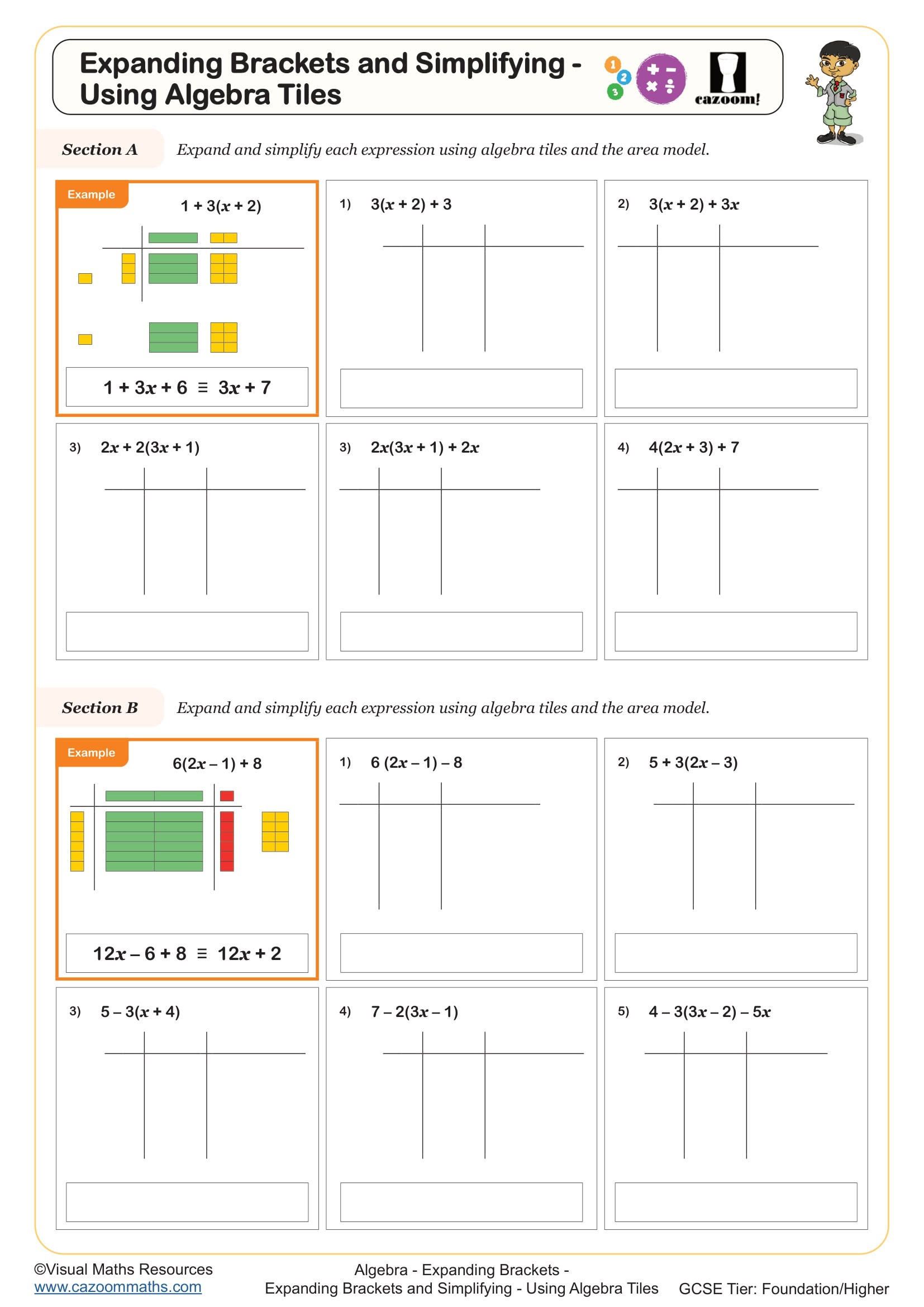
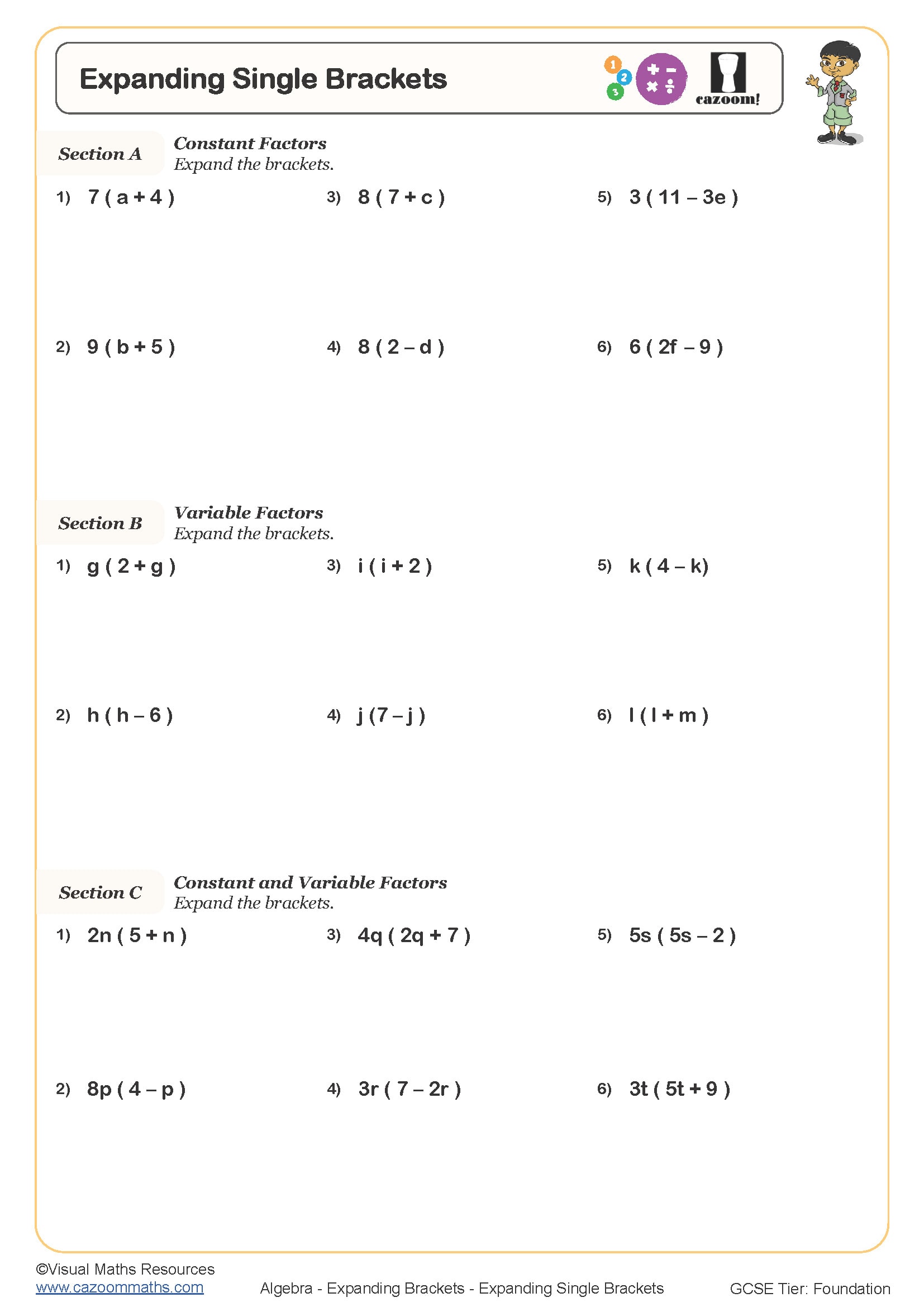
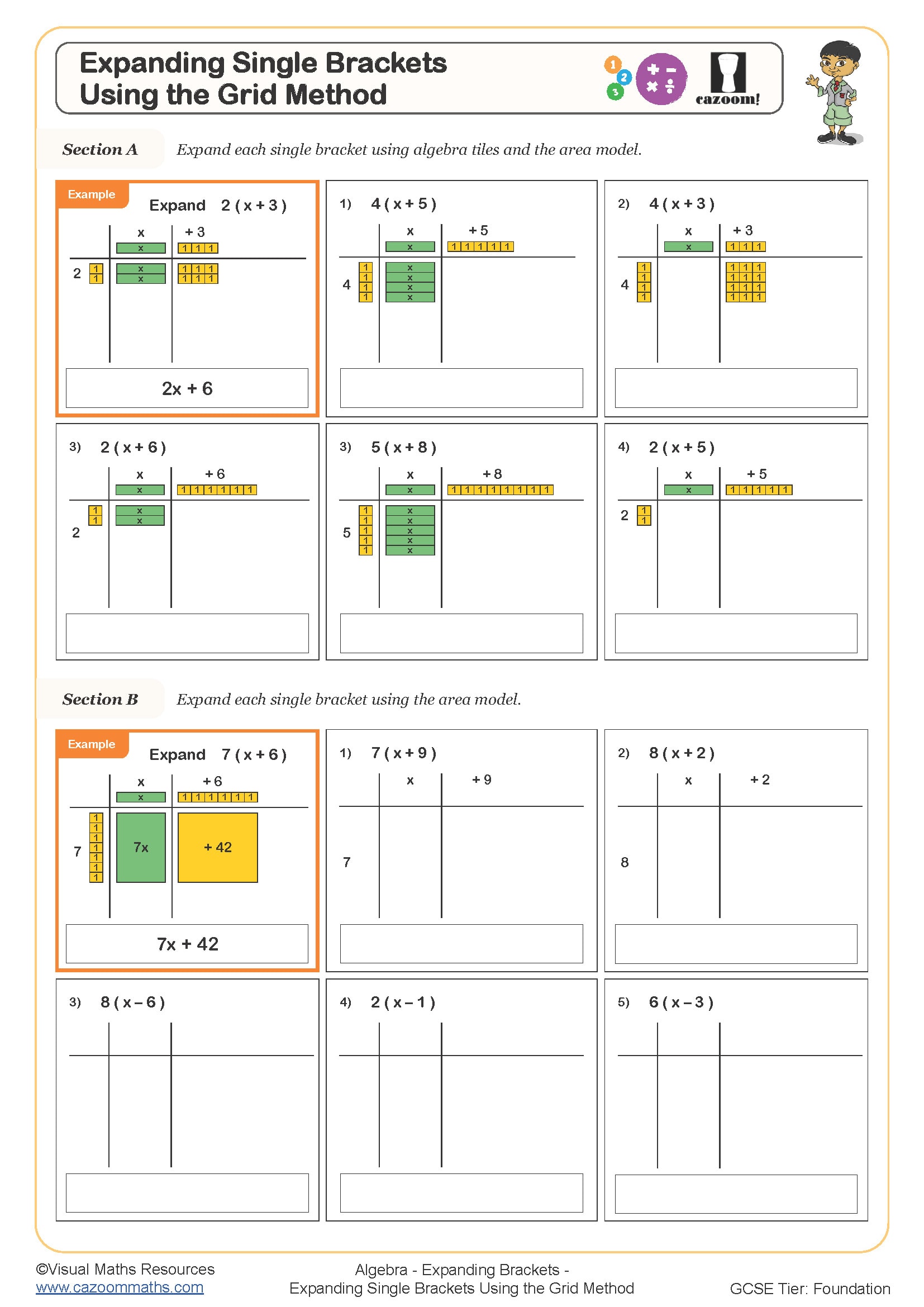
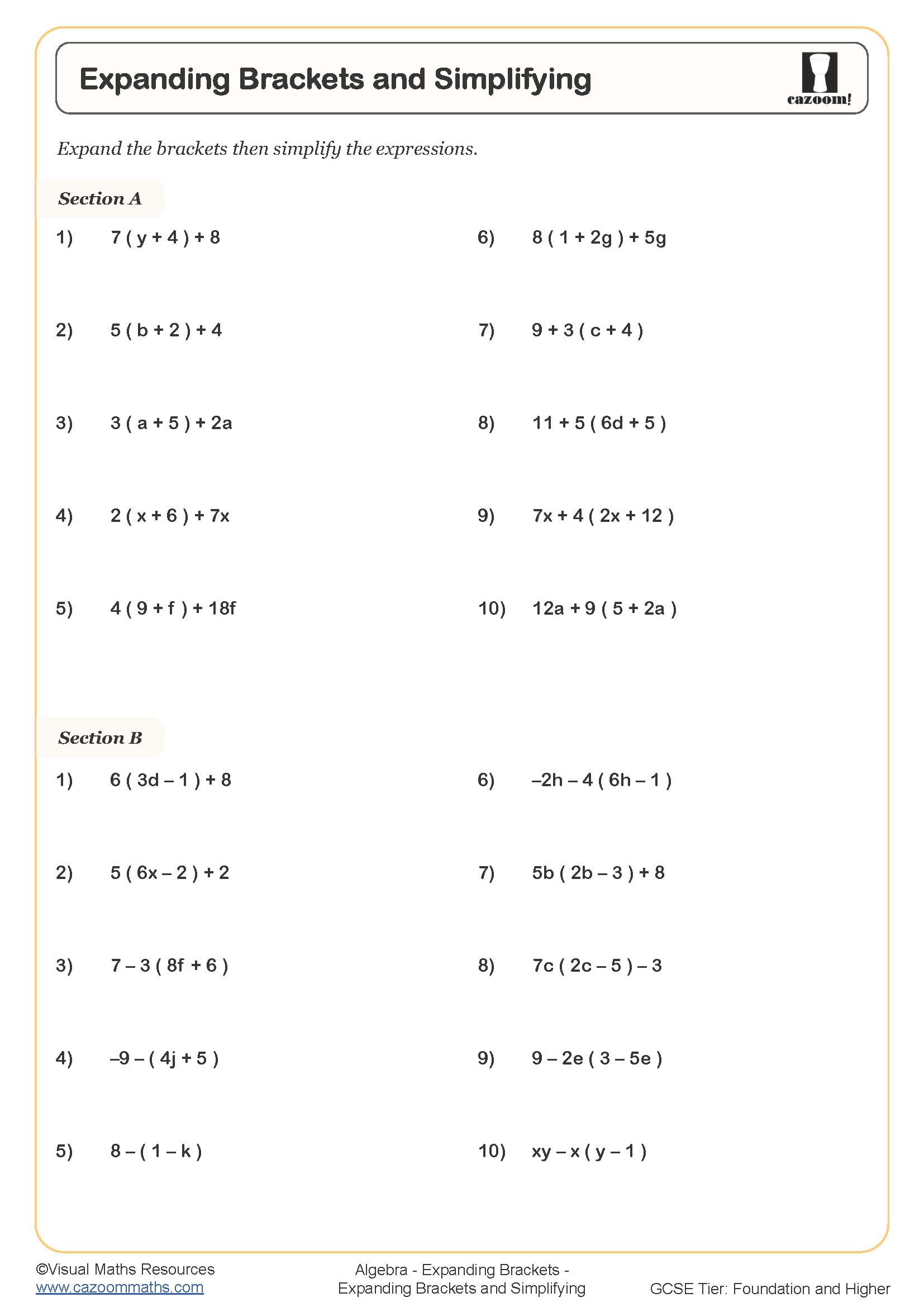
All worksheets are created by the team of experienced teachers at Cazoom Maths.
What is expanding single brackets in algebra?
Expanding single brackets means multiplying the term outside the bracket by each term inside, using the distributive law. For example, 3(x + 4) becomes 3x + 12, as the 3 multiplies both the x and the 4. This process removes the brackets and creates an equivalent expression, which students need to master before tackling more complex algebraic manipulation required in the National Curriculum from Year 8 onwards.
A common misconception occurs with expressions like -2(x + 5), where students correctly calculate -2x but write +10 instead of -10. They multiply the coefficient but forget that the negative sign applies to all terms. Mark schemes consistently penalise this error, particularly in GCSE questions where expanding brackets forms part of multi-step problems involving equations or simplifying expressions.
Which year groups learn expanding single brackets?
These expanding single brackets worksheets cover Year 8, Year 9, Year 10, and Year 11, spanning both Key Stage 3 and Key Stage 4. The National Curriculum introduces this skill in Year 8 as students transition from numerical operations to algebraic thinking, building on their understanding of the distributive property from arithmetic. By Year 9, students should expand brackets confidently as a routine algebraic technique.
Progression across year groups increases in complexity rather than introducing entirely new concepts. Year 8 worksheets typically feature whole number coefficients and straightforward terms, whilst Year 10 and Year 11 materials incorporate fractional and decimal multipliers, negative terms throughout, and brackets embedded within larger expressions that require simplification. Students working towards higher GCSE tiers regularly encounter brackets within contexts like forming and solving equations or working with geometric formulae.
How do you expand brackets with negative numbers?
Expanding brackets with negative multipliers requires students to multiply the negative coefficient by each term inside the bracket, which changes all the signs. For -4(2x - 3), multiply -4 by 2x to get -8x, then multiply -4 by -3 to get +12, giving -8x + 12. Teachers often notice students miss that multiplying two negative values produces a positive result, particularly when the bracket contains subtraction. The key understanding is that the negative outside distributes to everything within.
This skill connects directly to physics and engineering calculations where formulae involve subtracting grouped terms. When calculating displacement using velocity-time relationships, or determining temperature changes in thermodynamics, expressions often contain negative multipliers representing opposing directions or heat loss. Students who confidently expand negative brackets can rearrange these formulae accurately, making this algebraic technique essential for STEM progression beyond pure mathematics contexts.
How can these worksheets support classroom teaching?
The worksheets provide structured practice with gradual difficulty increases, allowing students to build confidence through repetition before tackling more challenging variations. Each question type appears multiple times with different values, helping students recognise patterns in the expansion process rather than memorising individual answers. The complete answer sheets enable students to identify exactly where errors occur in their working, whether in multiplying coefficients, handling negative signs, or simplifying the final expression.
Teachers use these resources flexibly across different classroom scenarios. They work well for intervention sessions with students who struggle to retain the expansion method, as homework to reinforce lesson content, or as starter activities to maintain fluency before moving to factorising. During paired work, students can complete alternate questions and check each other's answers, encouraging mathematical discussion about sign errors or coefficient mistakes. The range across Year 8 to Year 11 means the same resource bank supports both initial teaching and later GCSE revision.