Expanding Triple Brackets Worksheets
All worksheets are created by the team of experienced teachers at Cazoom Maths.
What is expanding triple brackets?
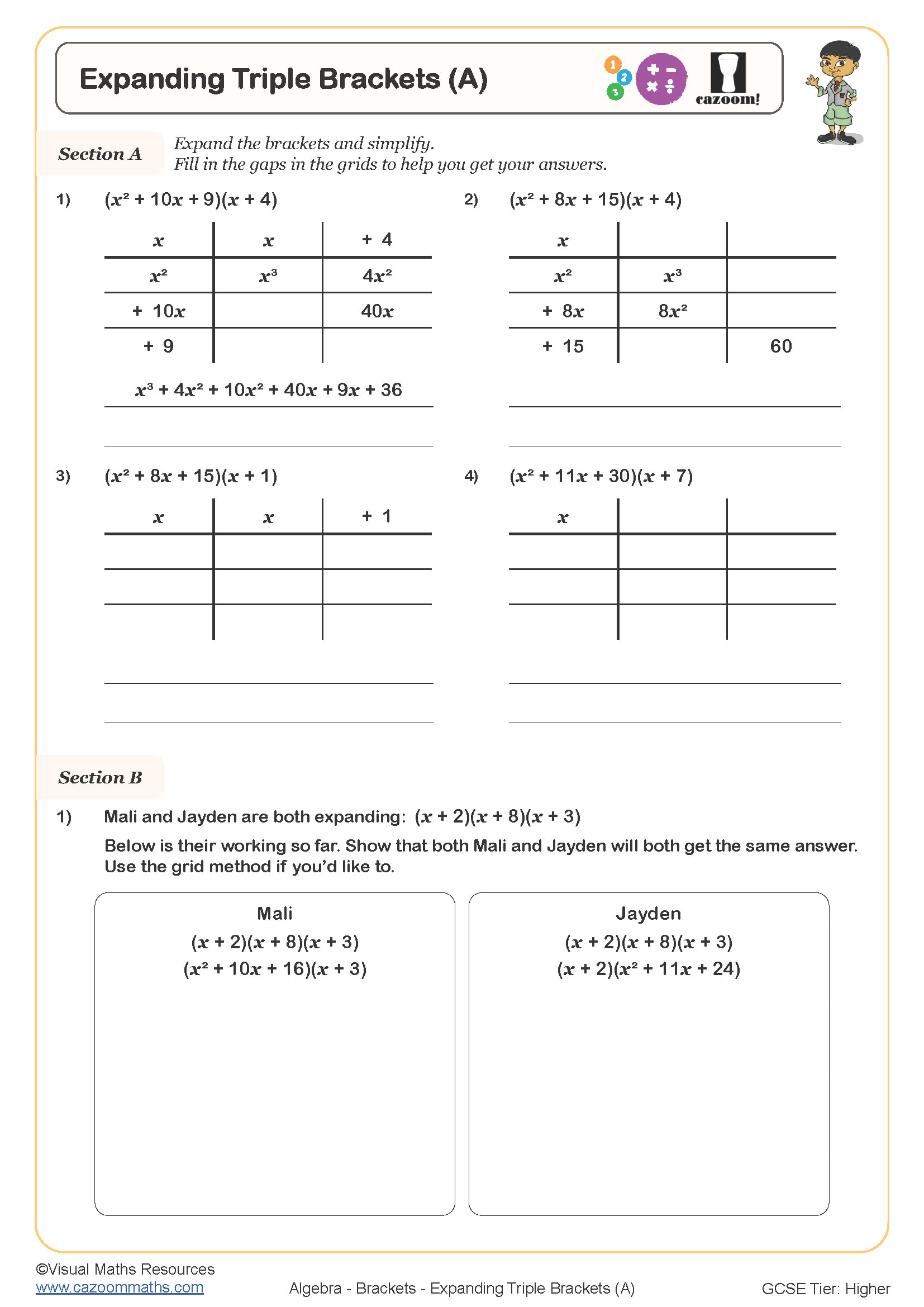
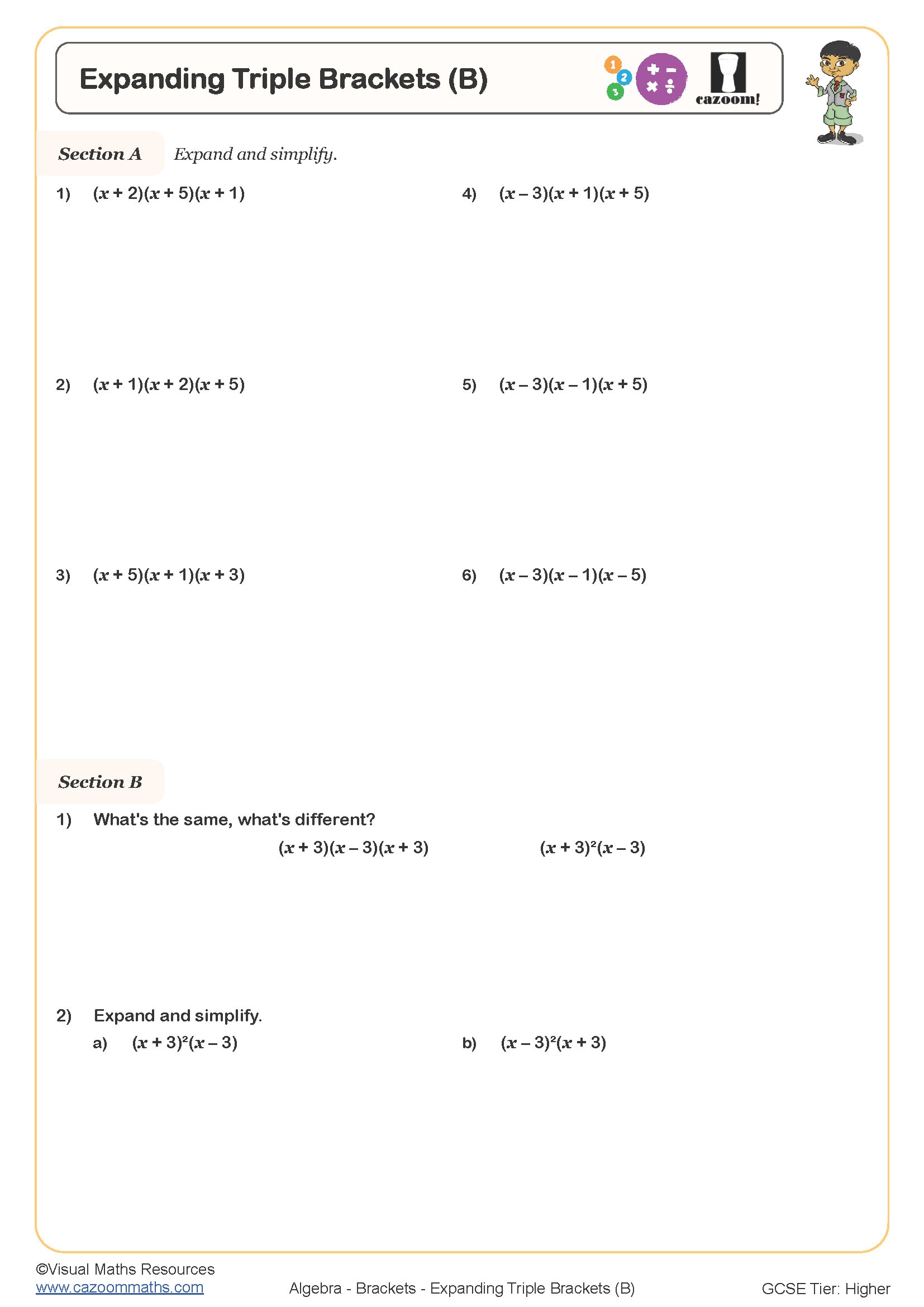
Expanding triple brackets means multiplying out three expressions, typically binomials, to create a single polynomial. Students first expand two of the brackets, then multiply the resulting quadratic expression by the third bracket. The process requires systematic collection of like terms and careful attention to positive and negative values throughout.
A common error occurs when students attempt to expand all three brackets simultaneously rather than working in stages. Exam mark schemes consistently penalise incomplete expansions where students correctly expand two brackets but then fail to multiply every term by the third bracket. Teachers observe that students who annotate their working, clearly showing the intermediate quadratic before final expansion, make fewer errors and can identify mistakes more easily during checking.
Which year groups learn expanding triple brackets?
Expanding triple brackets appears in Year 10 and Year 11 as part of the GCSE Higher tier curriculum. The National Curriculum requires students to manipulate algebraic expressions, including expanding products of multiple binomials. This topic builds directly on expanding double brackets and requires confident handling of quadratic expressions before attempting cubic polynomials.
The progression between Year 10 and Year 11 typically involves increasing complexity in coefficients and the introduction of more challenging simplification. Year 10 students often work with integer coefficients and positive leading terms, whilst Year 11 worksheets incorporate fractional or negative coefficients that demand greater algebraic fluency. By Year 11, students should recognise patterns in cubic expansions and connect this work to solving equations and sketching curves.
How do you expand three brackets step by step?
The standard method involves expanding any two brackets first to create a quadratic expression, then multiplying this result by the remaining bracket. For (x+a)(x+b)(x+c), students first expand (x+a)(x+b) to get x²+(a+b)x+ab, then multiply each term of this quadratic by both terms in (x+c). This generates six terms before simplification: the expansion produces an x³ term, an x² term, an x term, and a constant, which students must combine carefully.
This algebraic skill connects directly to product design and engineering contexts where volume calculations involve three variable dimensions. When designing packaging or calculating material requirements, engineers frequently multiply three expressions representing length, width, and height that each depend on a variable measurement. Understanding how these dimensions interact algebraically allows for optimisation of designs, demonstrating why systematic expansion techniques matter beyond examination requirements.
How can teachers use these expanding triple brackets worksheets effectively?
The worksheets provide graduated questions that allow students to build confidence with the expansion process before encountering more demanding coefficient combinations. Answer sheets enable immediate feedback, which proves particularly valuable when students practise independently or during intervention sessions. Teachers can use the worked solutions to model the expected layout and level of detail required in examination responses.
Many teachers assign these worksheets for targeted homework after introducing the topic, then use selected questions as starter activities in subsequent lessons to maintain fluency. The resources work well for paired work where one student expands whilst their partner checks each step against the answers, promoting discussion about method and common errors. During revision periods, these worksheets help students revisit algebraic manipulation alongside other GCSE topics, maintaining the skills needed for Paper 2 and Paper 3 questions.