Factorising into Double Brackets Worksheets
Difference of Two Squares
Year groups: 10, 11
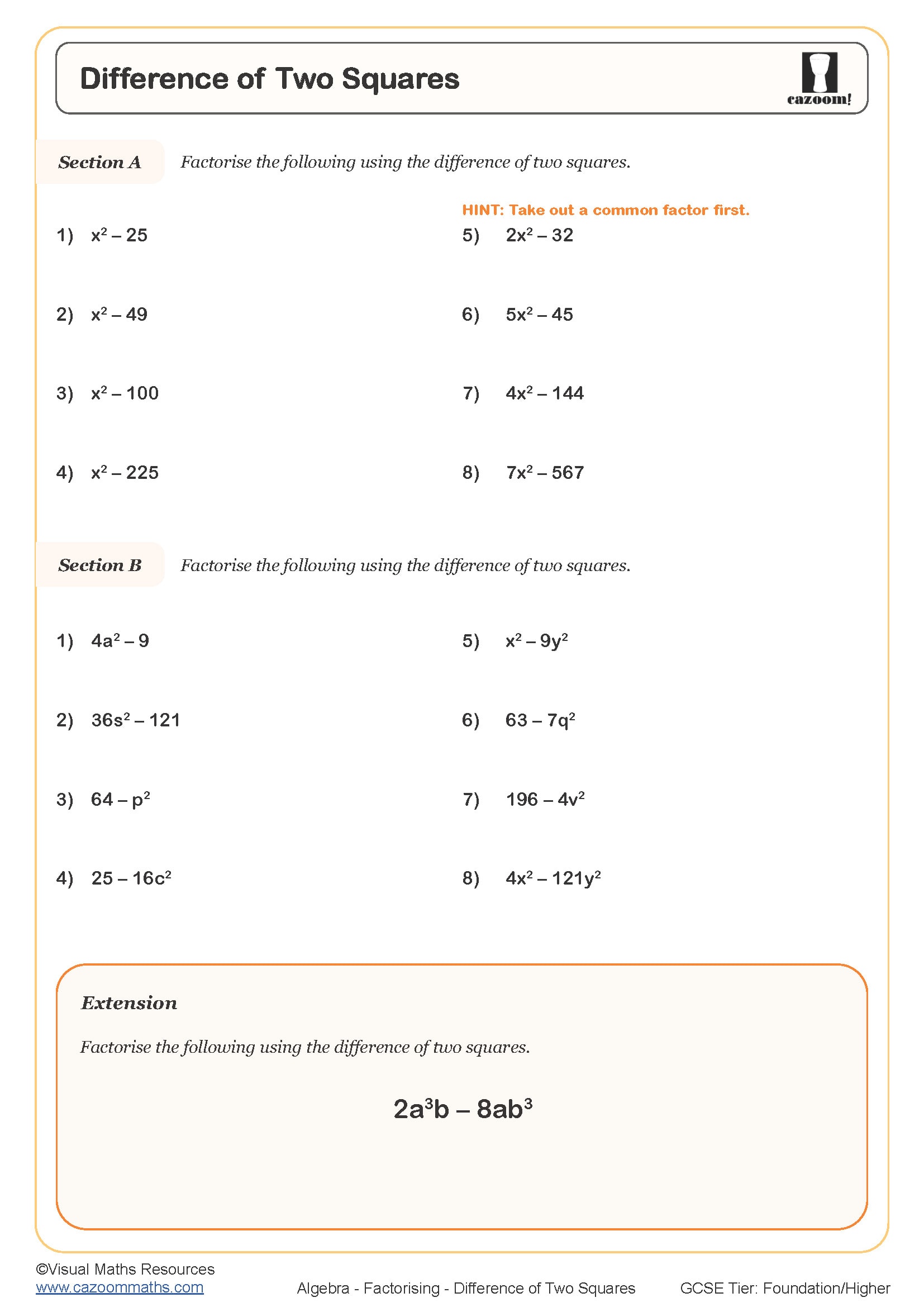
Factorising Quadratic Expressions - Splitting Down the Middle
Year groups: 10, 11
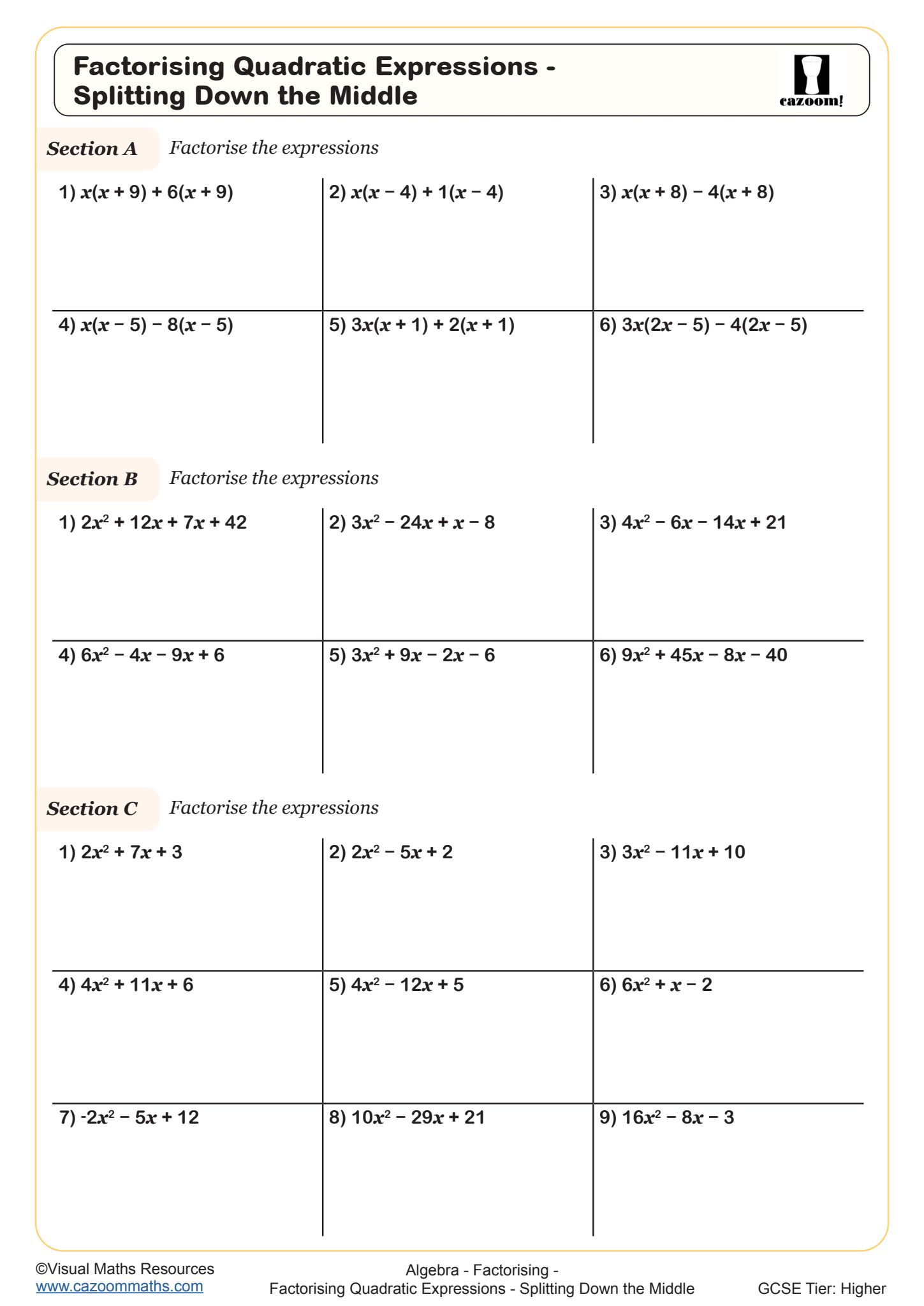
Factorising Quadratic Expressions - Using the Area Model (A)
Year groups: 10, 11
-Questions-1.jpg?w=3840)
Factorising Quadratic Expressions - Using the Area Model (B)
Year groups: 10, 11
-Worksheet.jpg?w=3840)
Factorising Quadratic Expressions (A)
Year groups: 10, 11
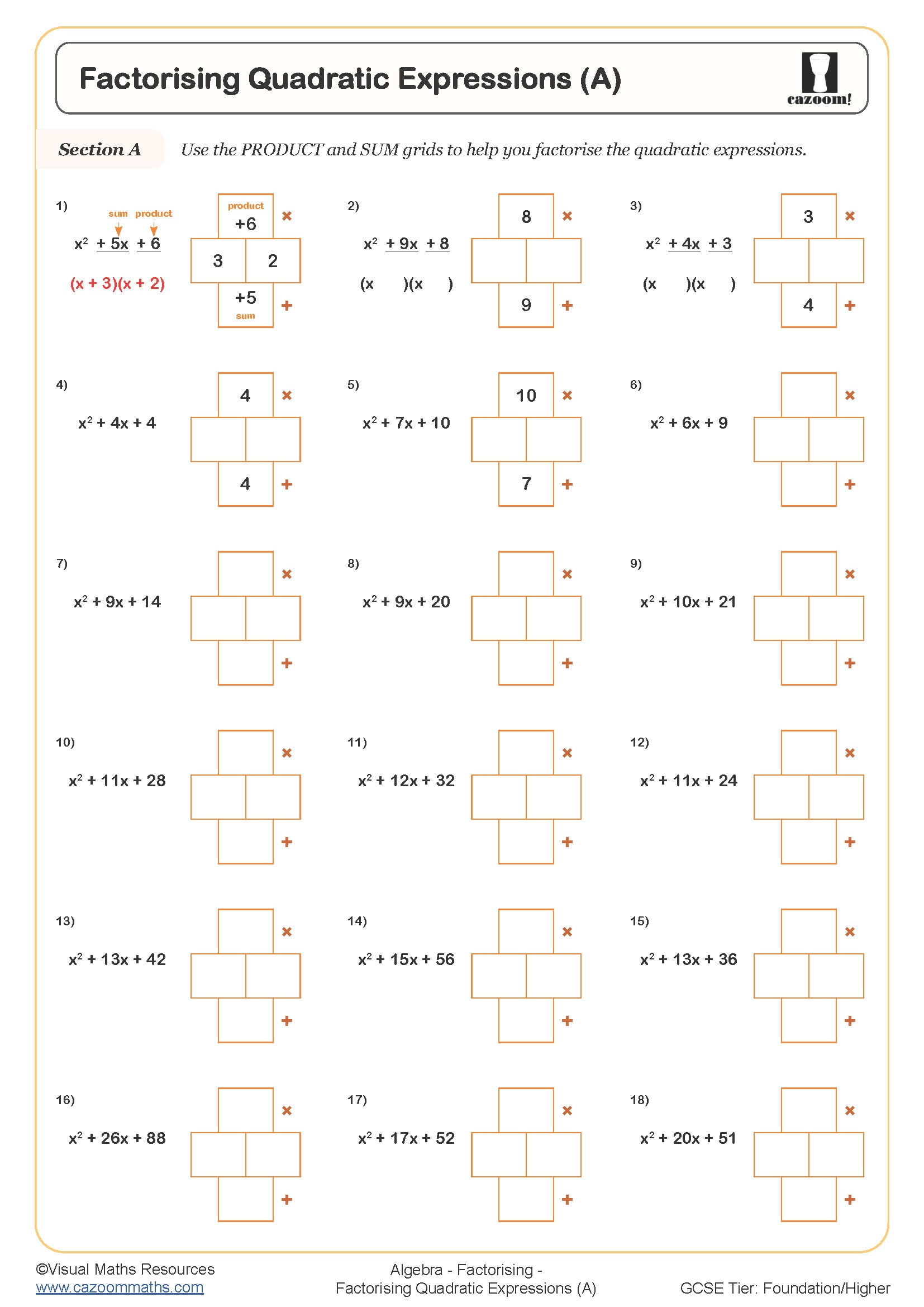
Factorising Quadratic Expressions (B)
Year groups: 10, 11
.jpg?w=3840)
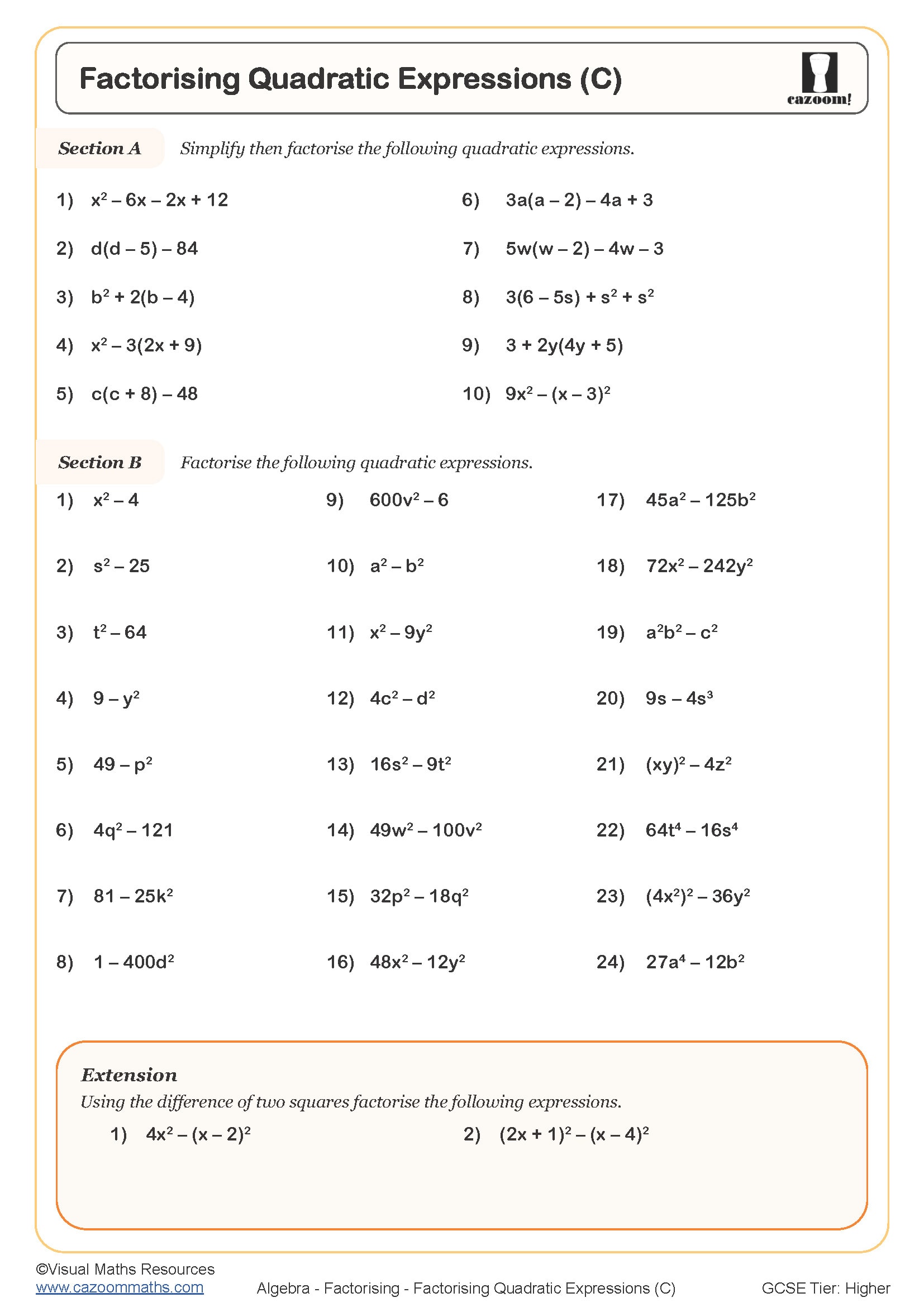
Factorising Quadratic Expressions (C)
Year groups: 10, 11
All worksheets are created by the team of experienced teachers at Cazoom Maths.
What is factorising into double brackets?
Factorising into double brackets means rewriting a quadratic expression as the product of two linear expressions in brackets. For example, x² + 5x + 6 becomes (x + 2)(x + 3). This reverse process of expanding brackets is fundamental to solving quadratic equations and simplifying algebraic fractions at GCSE level.
Students must identify two numbers that multiply to give the constant term and add to give the coefficient of x. For expressions where the coefficient of x² isn't 1, such as 2x² + 7x + 3, the process becomes more complex, requiring trial and improvement or systematic methods. Mastering this skill enables students to solve equations, sketch graphs, and tackle higher-level algebraic problems confidently.
Which year groups study factorising into double brackets?
Factorising into double brackets is taught in Years 10 and 11 as part of the KS4 algebra curriculum. Students typically encounter simpler examples where the coefficient of x² equals 1 during Year 10, then progress to more demanding expressions in Year 11 as they prepare for GCSE examinations.
This topic builds directly on prior knowledge of expanding brackets and requires solid understanding of number relationships and multiplication facts. Students need this skill for both Foundation and Higher tier GCSE papers, though Higher tier candidates face more challenging examples including negative coefficients and larger numbers. Regular practice across both year groups ensures students develop the fluency and accuracy required for examination success.
How do you factorise expressions with a coefficient greater than 1?
When factorising expressions like 3x² + 10x + 8, students must find factor pairs of both the first and last terms that combine correctly. Many use the 'ac method': multiply the coefficient of x² by the constant term (3 × 8 = 24), find factors of 24 that sum to 10 (4 and 6), then rewrite and group terms.
Alternatively, systematic trial of possible bracket combinations works effectively with practice. For 3x² + 10x + 8, students test options like (3x + 2)(x + 4) until finding the correct factorisation. Our worksheets provide structured practice in both approaches, helping students develop their preferred method whilst building accuracy. This skill proves essential for solving more complex quadratic equations at GCSE.
Do the worksheets include worked solutions?
Every worksheet includes comprehensive answer sheets showing complete solutions for all exercises. These allow students to check their factorised expressions, identify errors in their working, and understand where they've gone wrong. Teachers can use answer sheets for efficient marking, whilst parents supporting home learning can verify their child's work confidently.
The answer sheets prove particularly valuable for this topic because factorising errors often stem from systematic mistakes rather than simple calculation slips. By comparing their working against full solutions, students identify whether they're making sign errors, missing factor pairs, or applying incorrect methods. This immediate feedback accelerates learning and helps build the accuracy essential for GCSE success in algebra.