Finding the Equation of a Line Worksheets
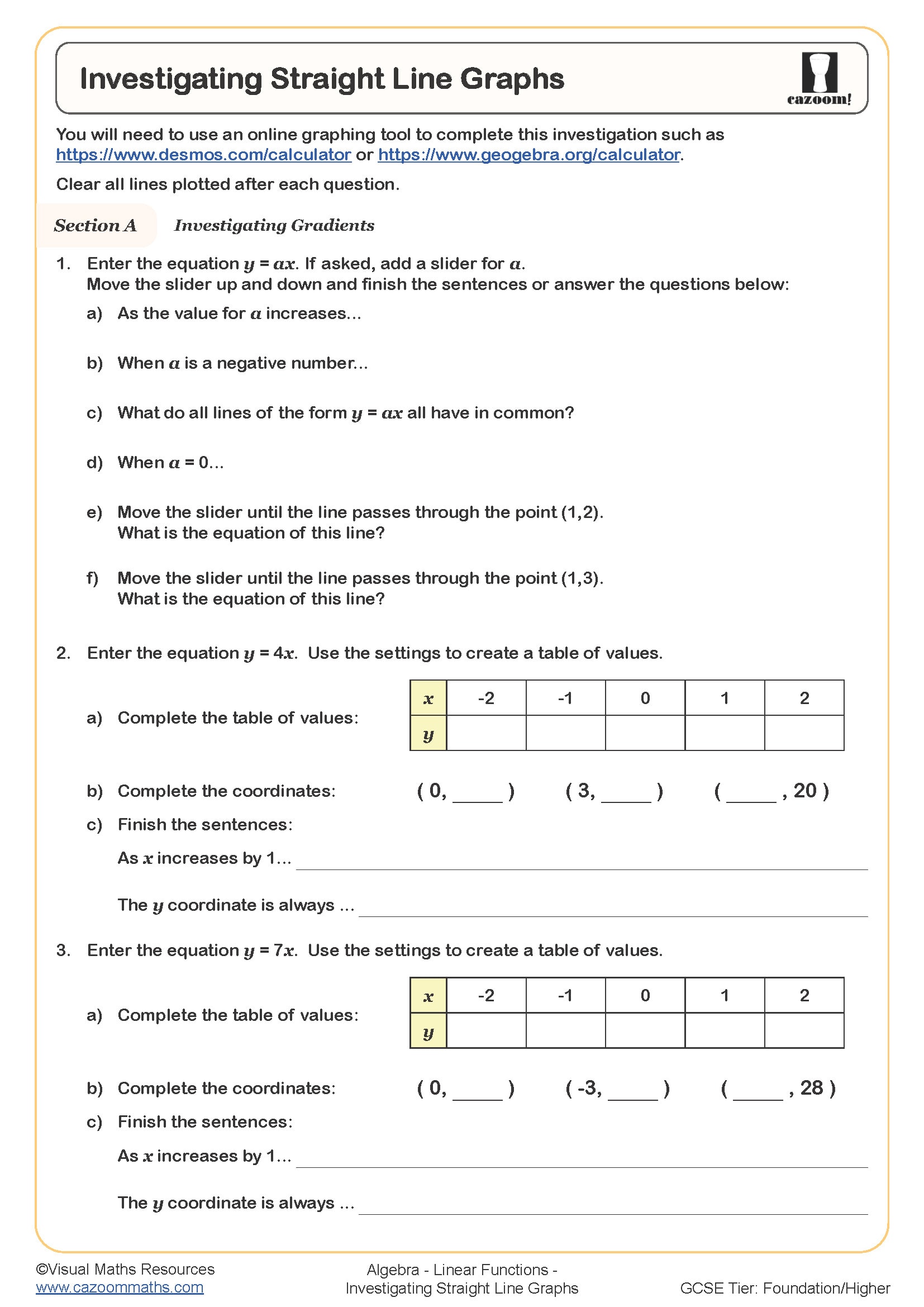
Investigating Straight Line Graphs
Year groups: 8, 9
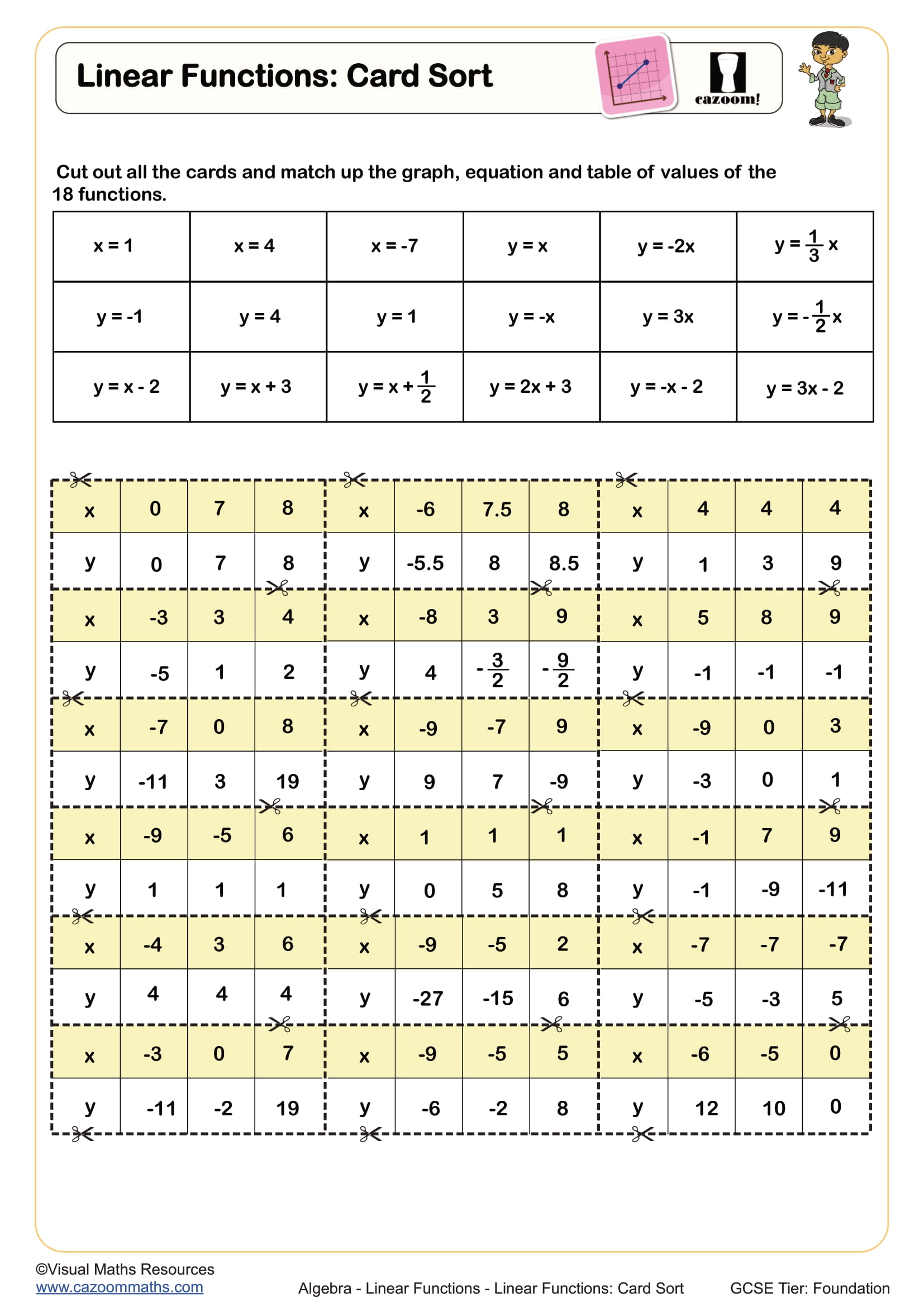
Linear Functions: Card Sort
Year groups: 8, 9
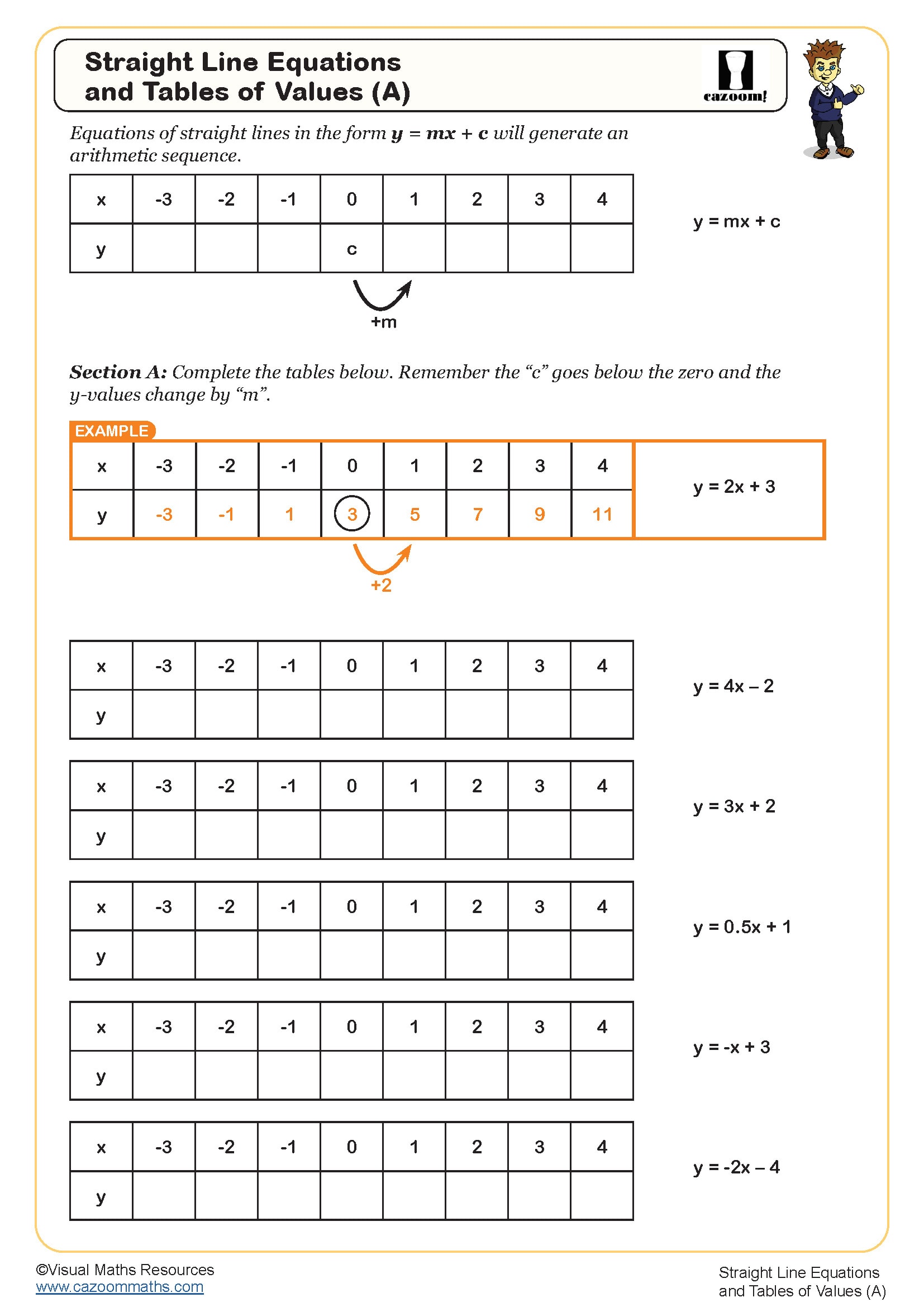
Straight Line Equations and Tables of Values (A)
Year groups: 8, 9
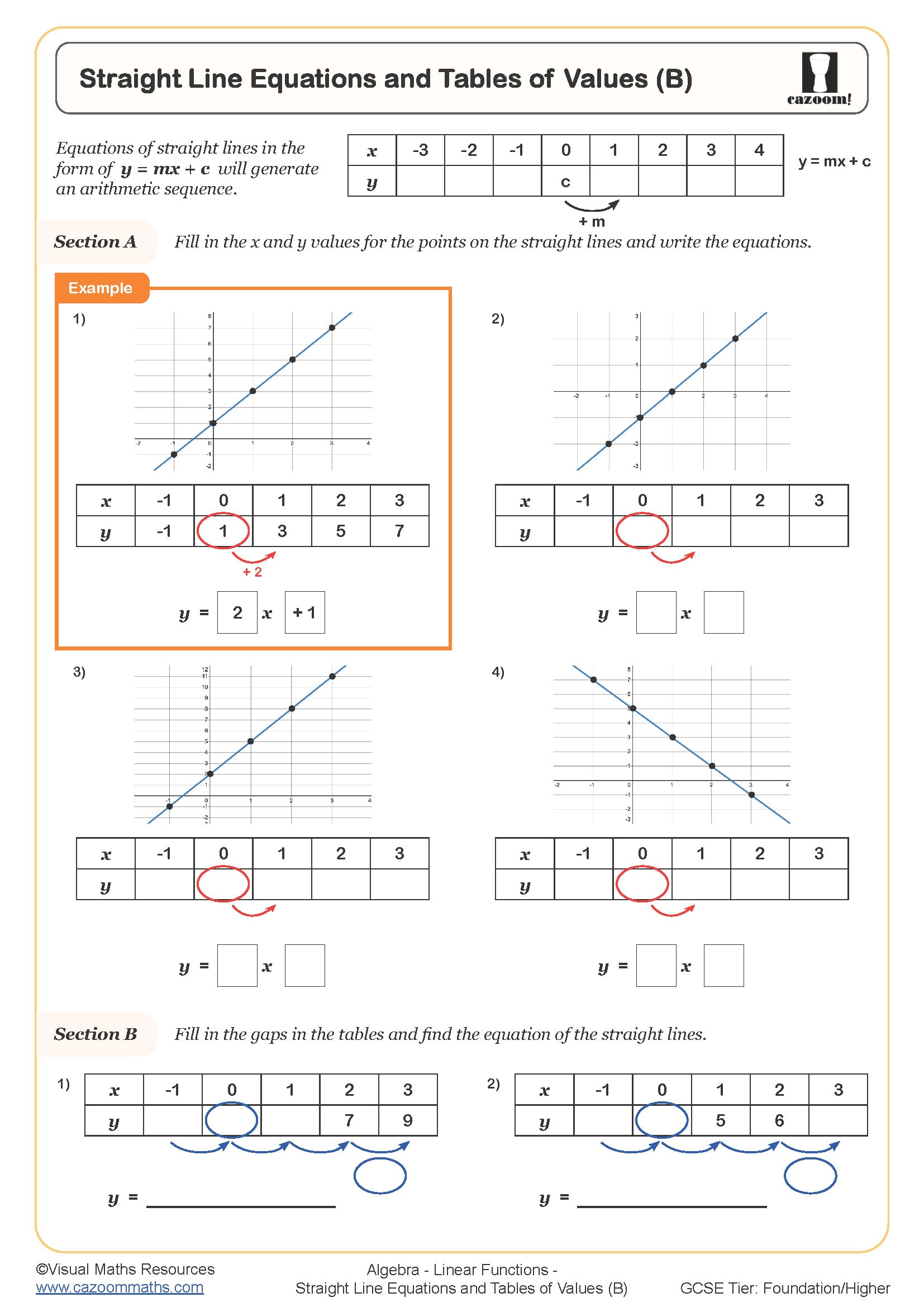
Straight Line Equations and Tables of Values (B)
Year groups: 8, 9
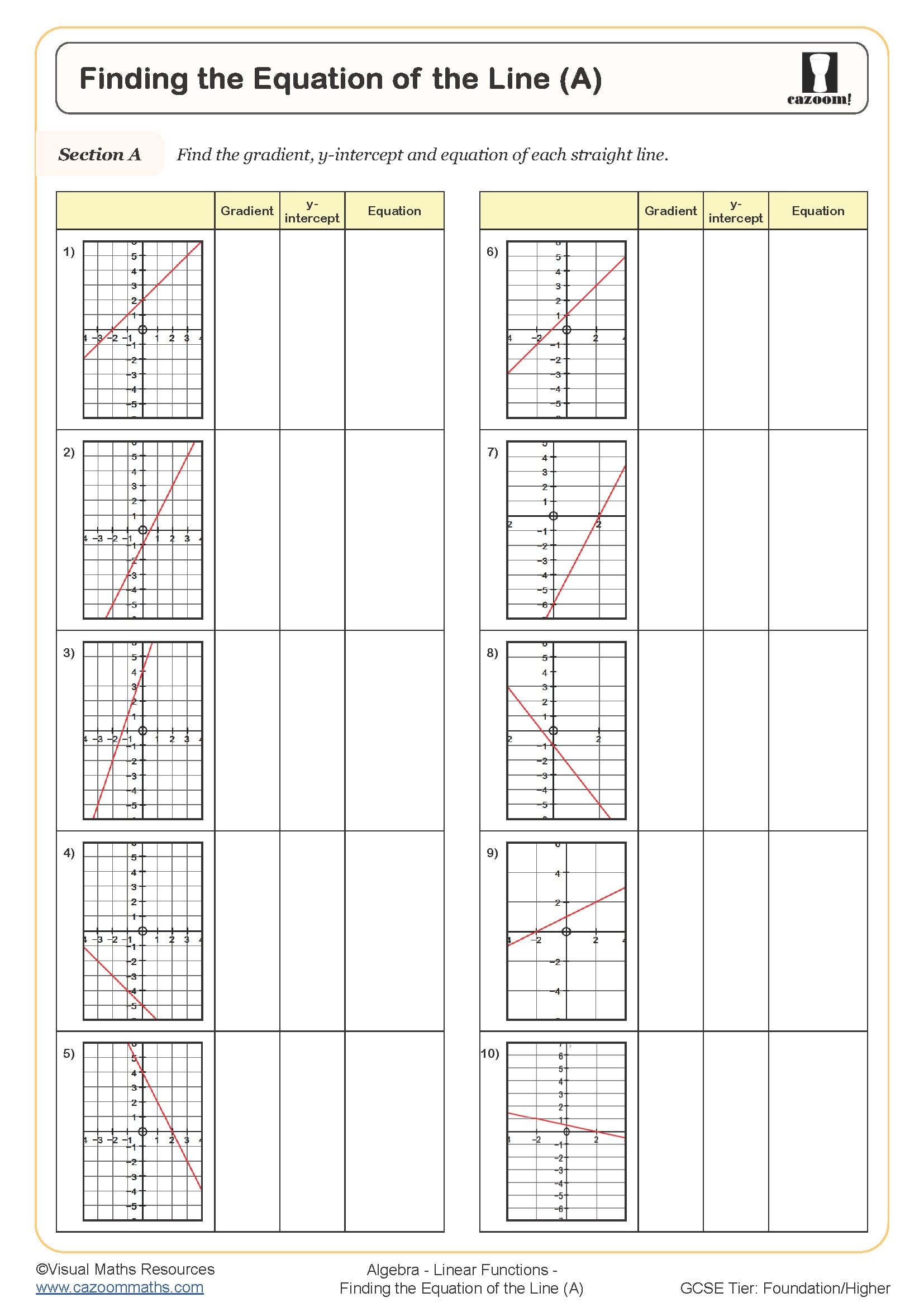
Finding the Equation of the Line (A)
Year groups: 9, 10, 11
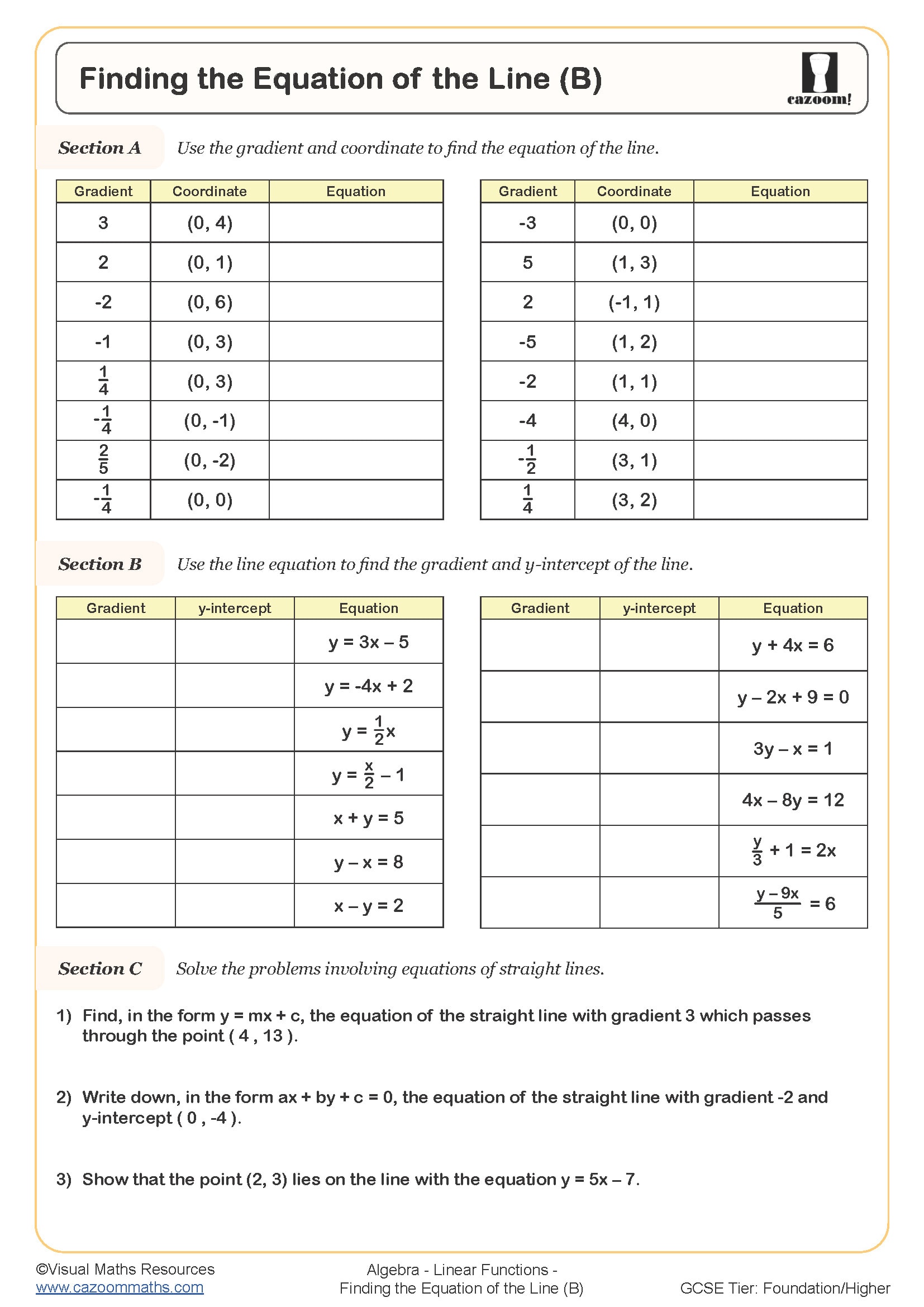
Finding the Equation of the Line (B)
Year groups: 9, 10, 11
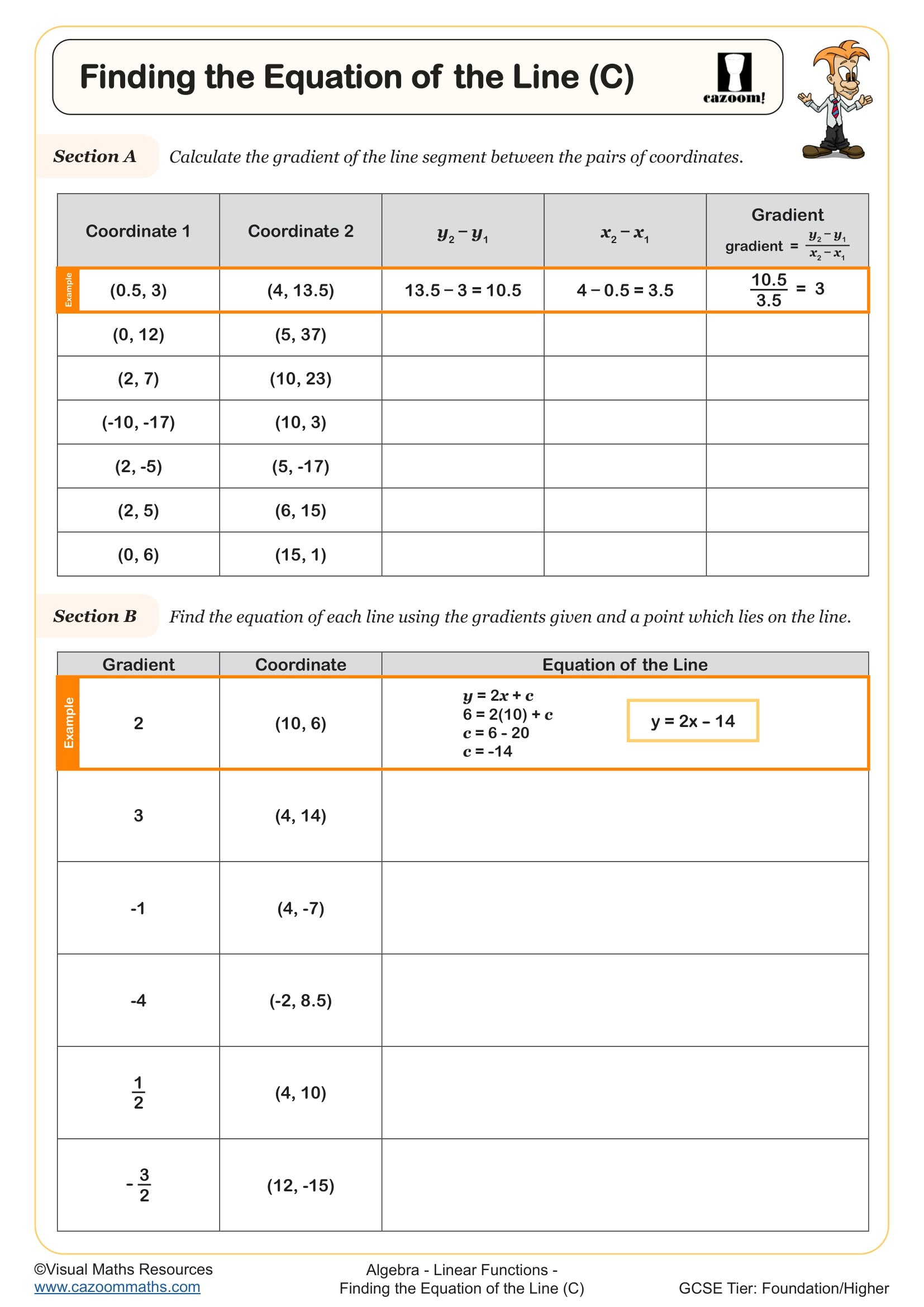
Finding the Equation of the Line (C)
Year groups: 10, 11
All worksheets are created by the team of experienced teachers at Cazoom Maths.
What methods are taught for finding the equation of a straight line?
Students learn several approaches depending on the information given. When provided with the gradient and y-intercept, they substitute directly into y = mx + c. If given two points, they calculate the gradient using (y₂ - y₁)/(x₂ - x₁), then substitute one point to find c. Our worksheets progress through these methods systematically, ensuring students recognise which approach suits different scenarios.
More advanced worksheets introduce finding equations of parallel lines (same gradient, different intercept) and perpendicular lines (gradients multiply to give -1). Students also practise rearranging equations into standard form and interpreting gradients in real-world contexts. This variety ensures thorough preparation for GCSE examination questions, where selecting the appropriate method is as important as accurate calculation.
Which year groups study finding the equation of a line?
This topic appears across Years 8-11, with complexity increasing through secondary school. Year 8 students typically begin with straightforward examples using y = mx + c when the gradient and intercept are clear. By Year 9, they're finding equations from two coordinates and working with negative gradients, developing stronger algebraic skills.
Years 10 and 11 tackle more sophisticated problems involving parallel and perpendicular lines, essential for GCSE Foundation and Higher tiers. Students at KS4 also work with equations in different forms, including rearranging into ax + by = c format. Our worksheets reflect these progression steps, with clearly differentiated resources matched to National Curriculum expectations at each stage.
How do you find the equation of a line passing through two points?
This requires a two-step process that students must master for GCSE. First, calculate the gradient by finding the difference in y-coordinates divided by the difference in x-coordinates: m = (y₂ - y₁)/(x₂ - x₁). Care with negative values is crucial here, as sign errors are common. Once you have the gradient, the equation becomes y = mx + c.
Next, substitute either coordinate pair into your equation alongside the gradient to solve for c, the y-intercept. For example, if m = 2 and the line passes through (3, 8), then 8 = 2(3) + c gives c = 2. Our worksheets provide structured practice with this method, including coordinates with negative values and fractional gradients that build examination confidence.
Do your worksheets include worked solutions?
Every worksheet includes comprehensive answer sheets showing the final equations. These allow students to check their work independently and identify where errors occurred. For teachers and parents, answer sheets save marking time whilst enabling quick identification of misconceptions that need addressing through additional practice or intervention.
The worksheets themselves are available as downloadable PDFs, making them convenient for printing or sharing digitally. Questions are carefully structured to build from accessible starting points toward more challenging problems, supporting differentiation in mixed-ability classes. This progression helps students consolidate methods before attempting examination-style questions that combine multiple skills, such as finding perpendicular lines through specific points.