Forming and Solving Equations Worksheets
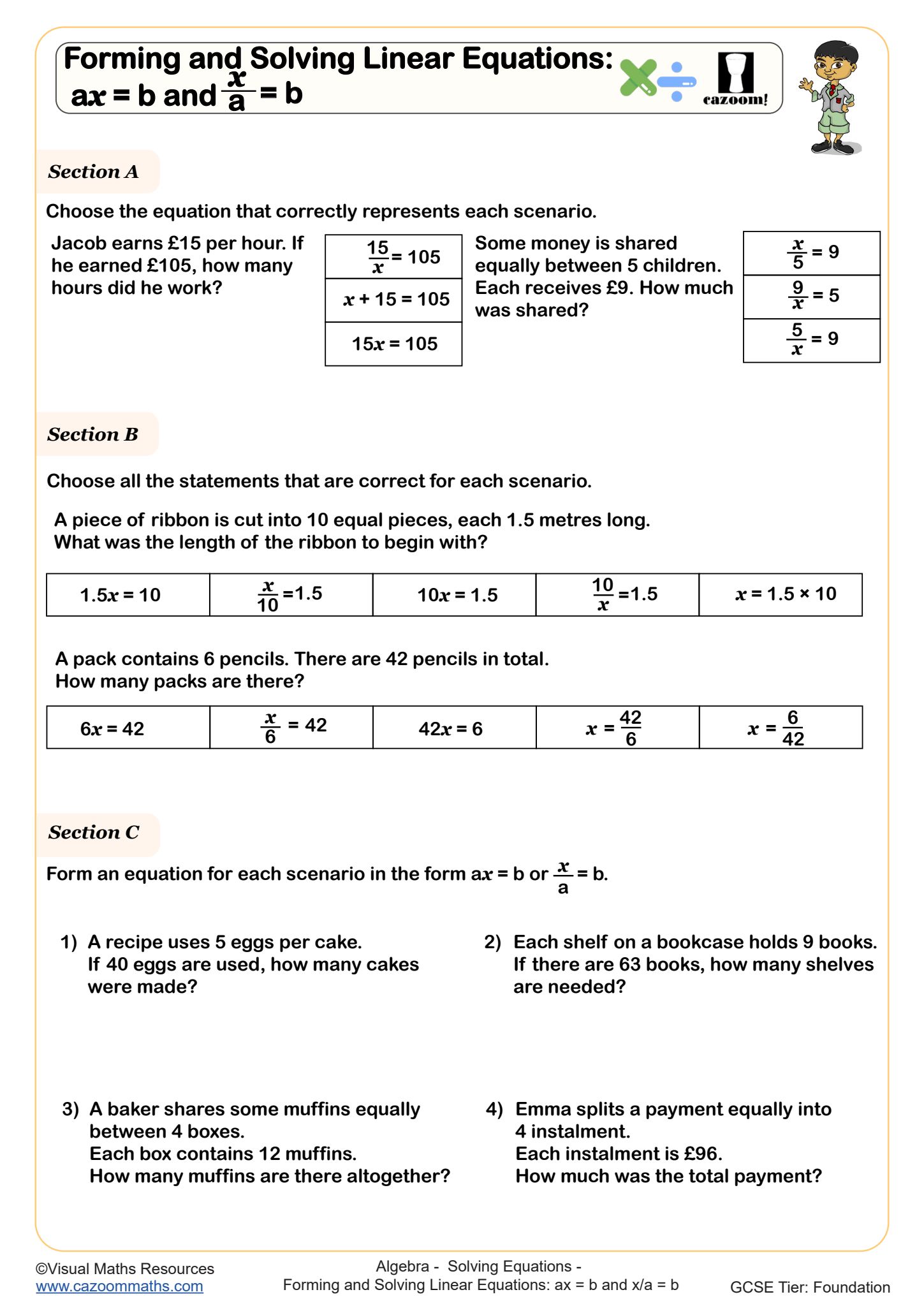
Forming and Solving Linear Equations: a𝑥 = b and 𝑥/a = b
Year groups: 7, 8
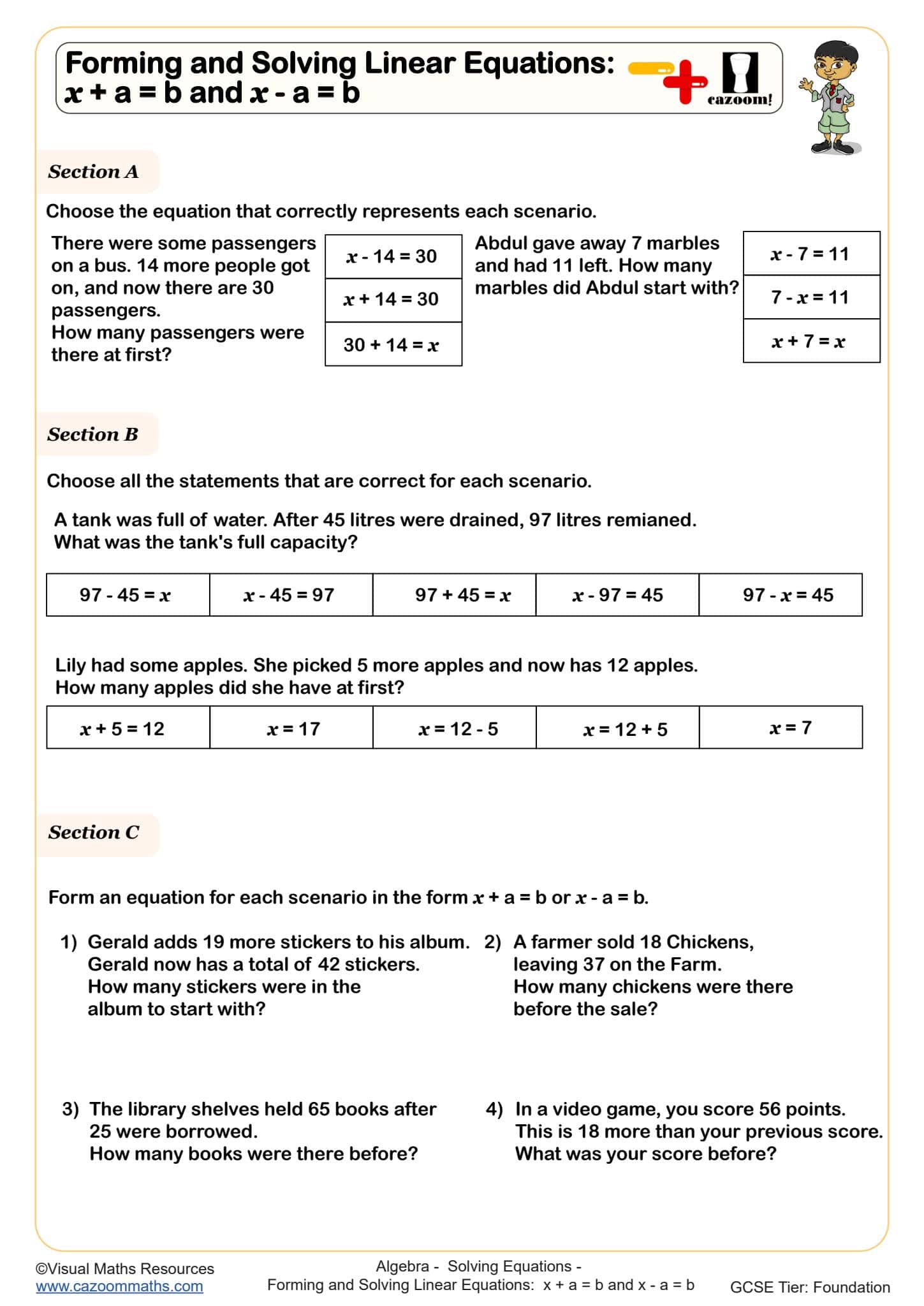
Forming and Solving Linear Equations: x + a = b and x - a = b
Year groups: 7, 8
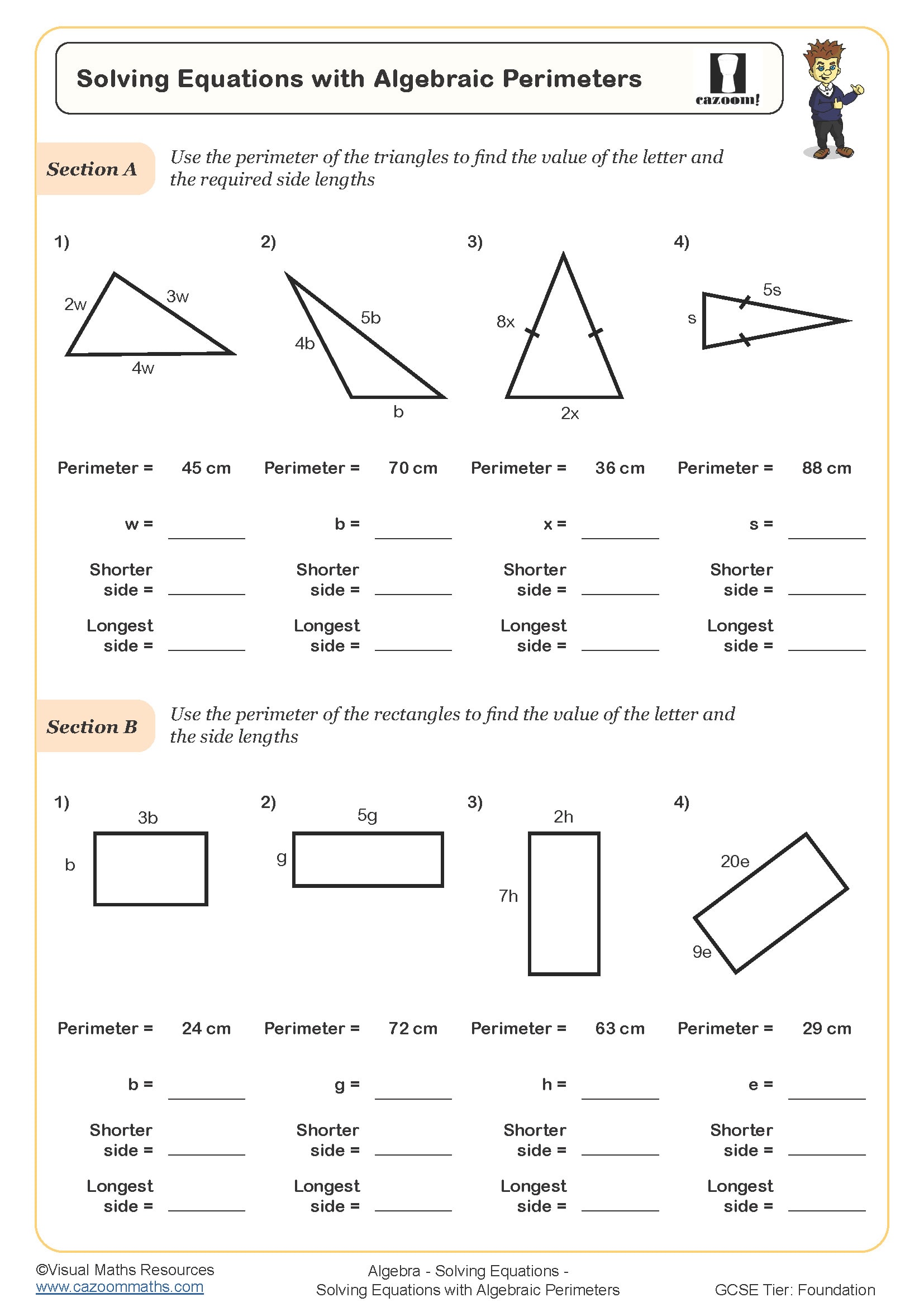
Solving Equations with Algebraic Perimeters
Year groups: 7, 8
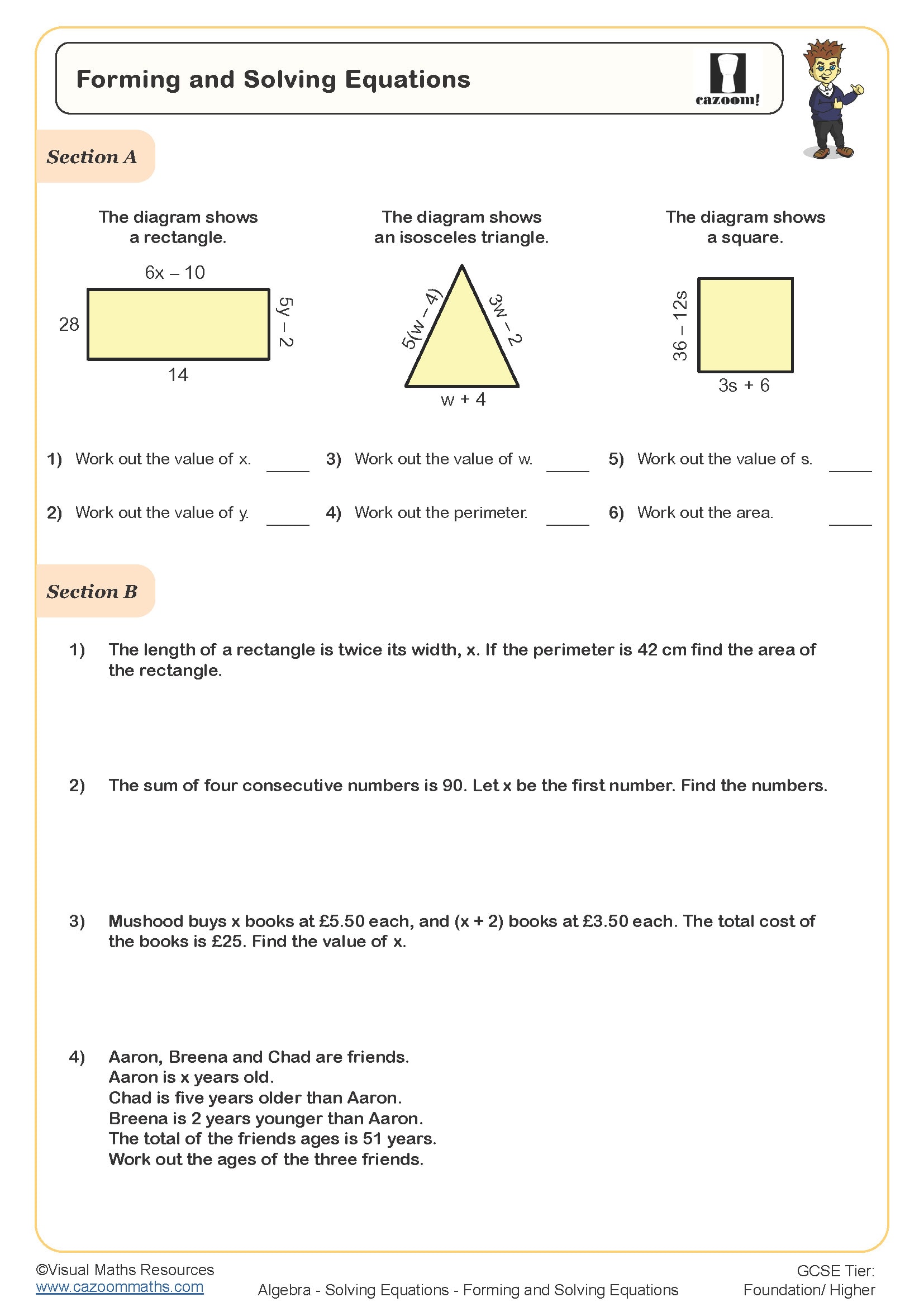
Forming and Solving Equations
Year groups: 8, 9
Forming and Solving Equations Involving Angles (A)
Year groups: 8, 9
-Worksheet.jpg?w=3840)
Forming and Solving Equations Involving Angles (B)
Year groups: 8, 9
-Worksheet.jpg?w=3840)
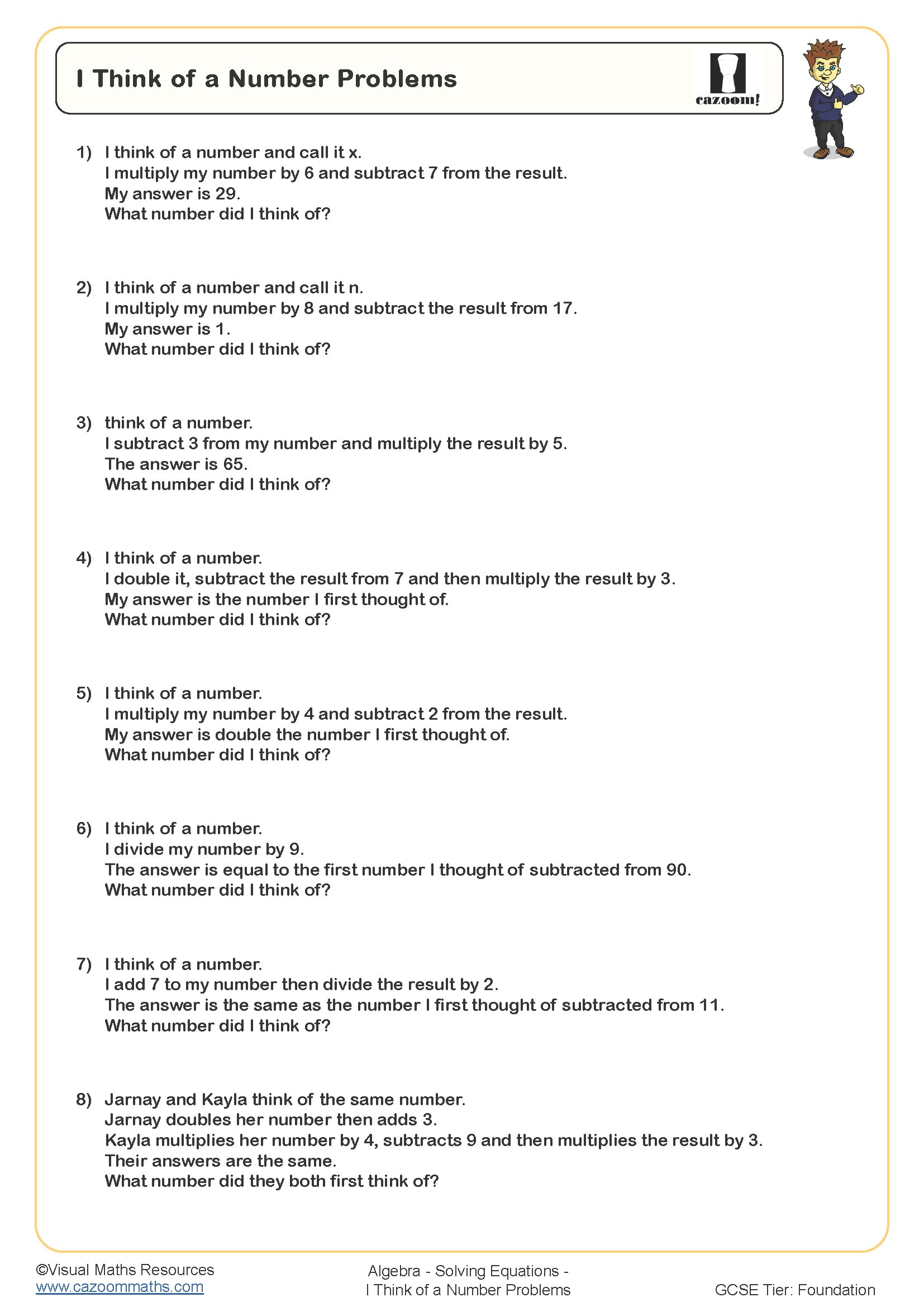
I Think of A Number Problems
Year groups: 8, 9
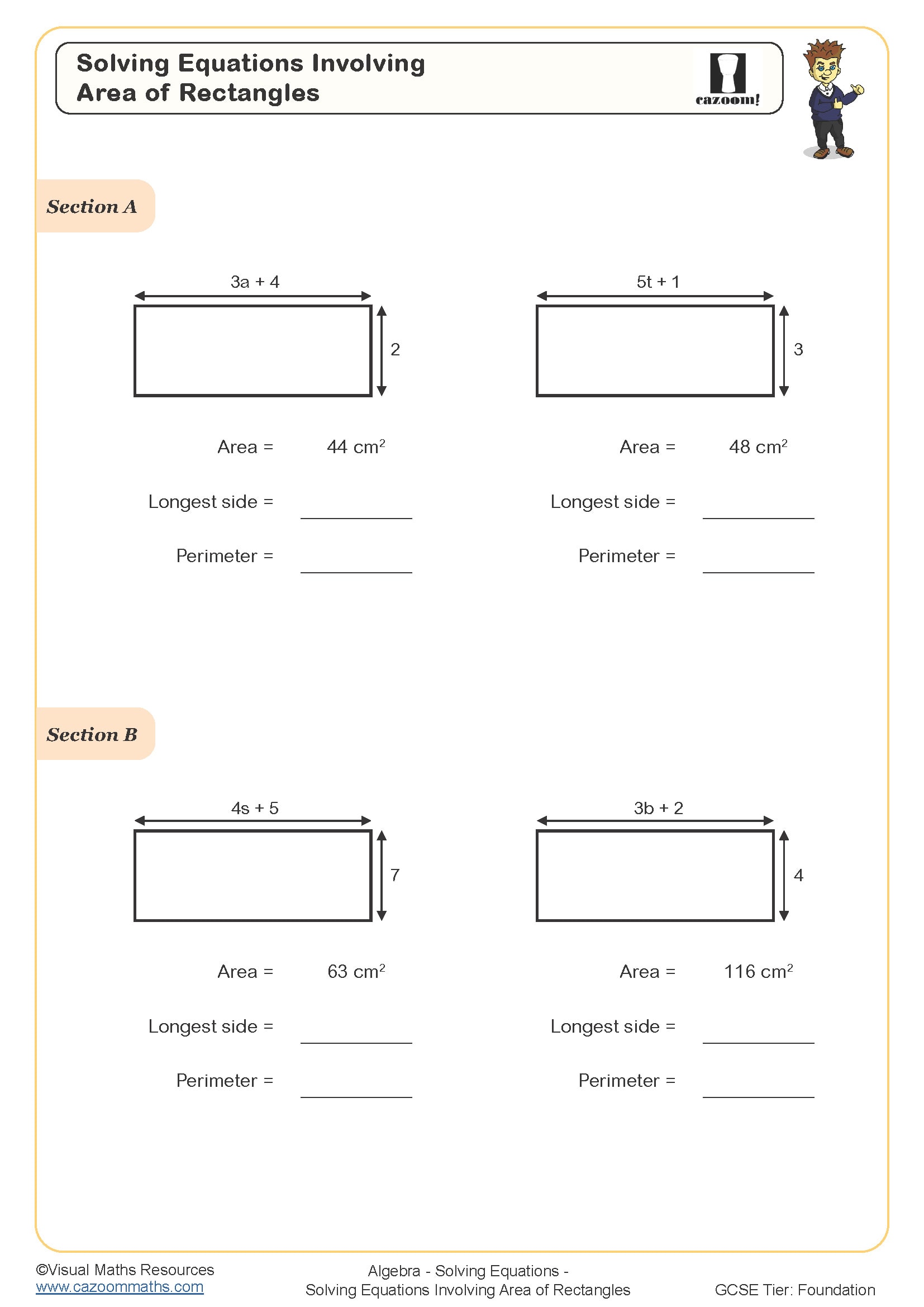
Solving Equations Involving Area of Rectangles
Year groups: 8, 9
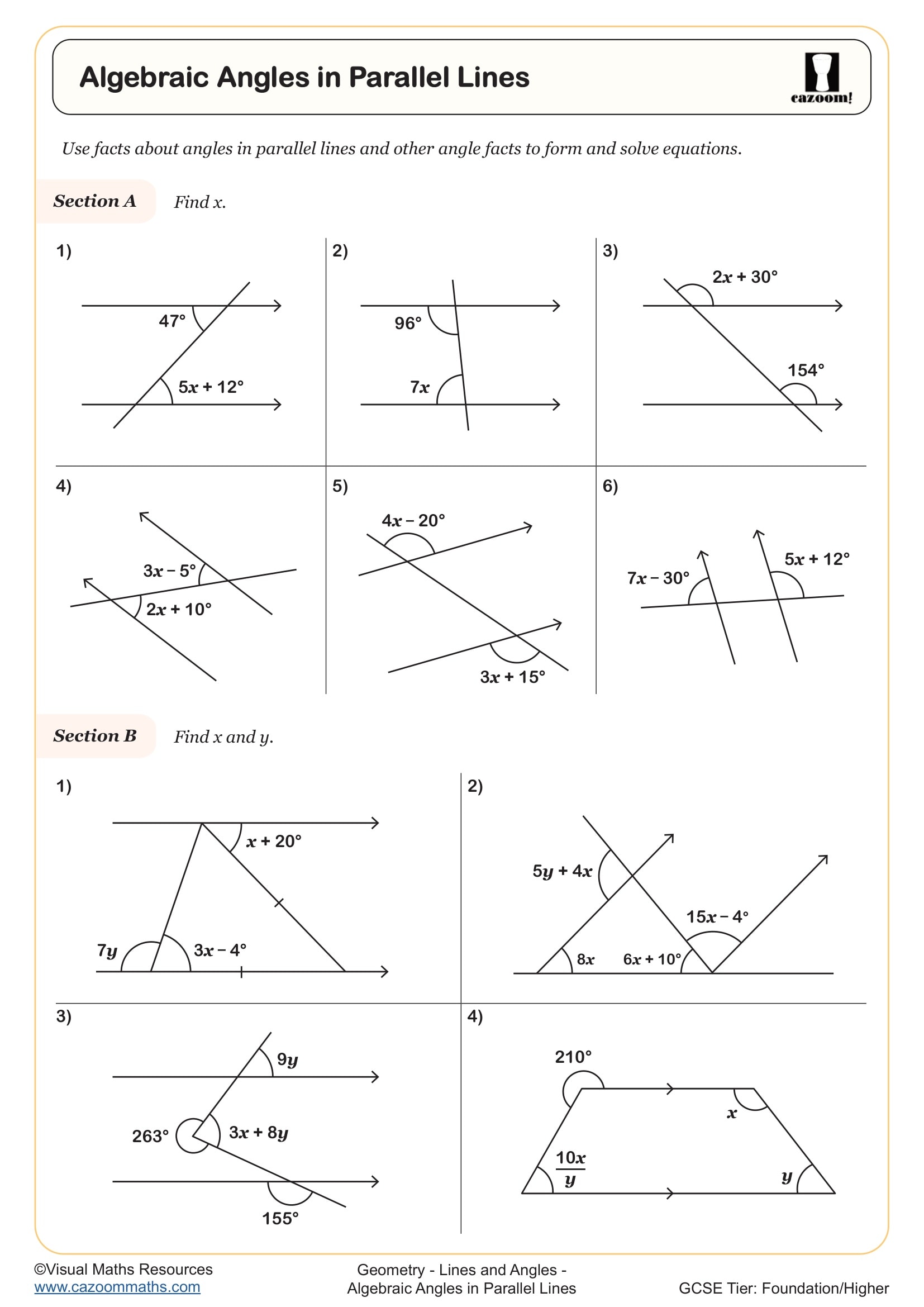
Algebraic Angles in Parallel Lines
Year groups: 9
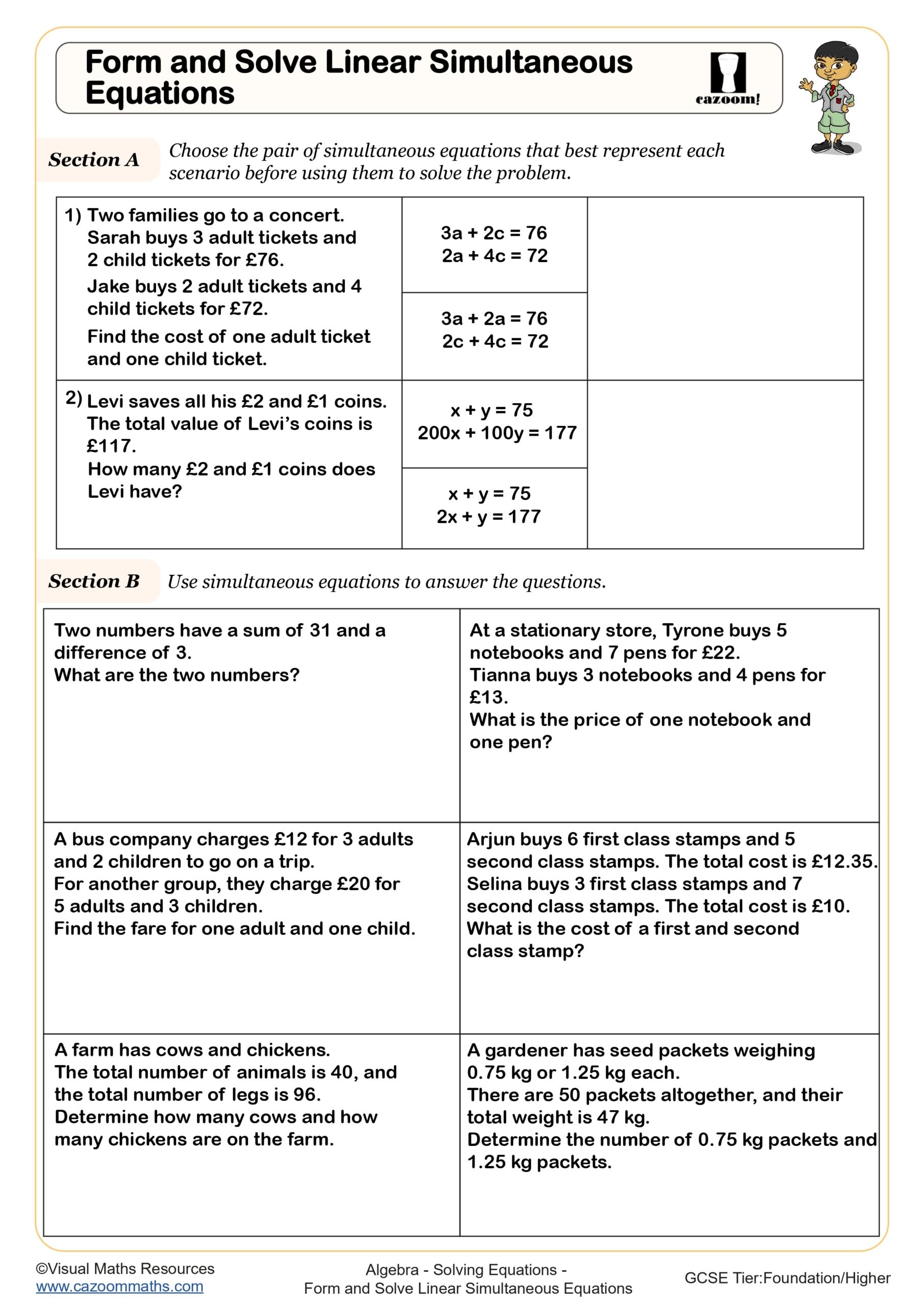
Form and Solve Linear Simultaneous Equations
Year groups: 10, 11
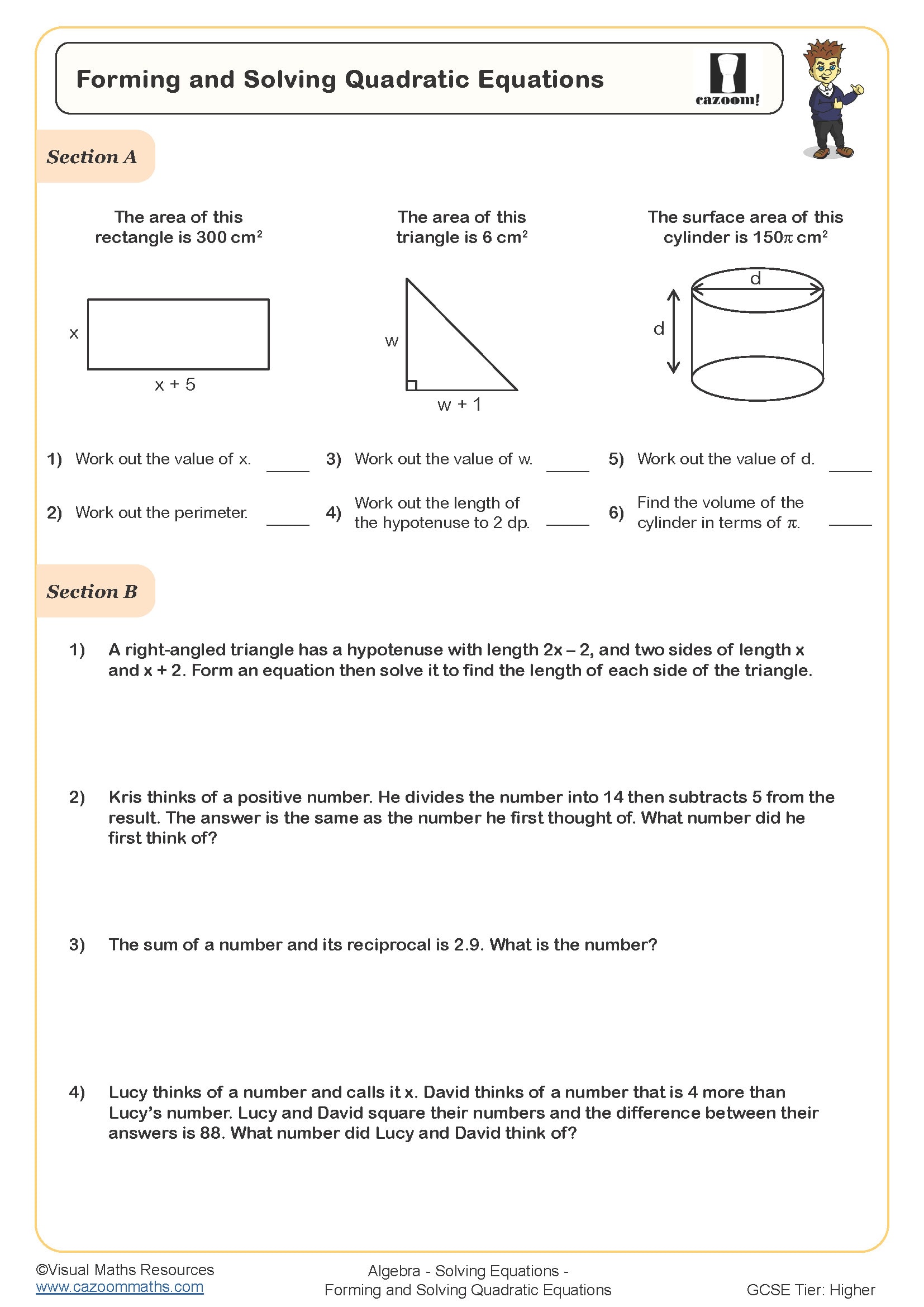
Forming and Solving Quadratic Equations
Year groups: 10, 11
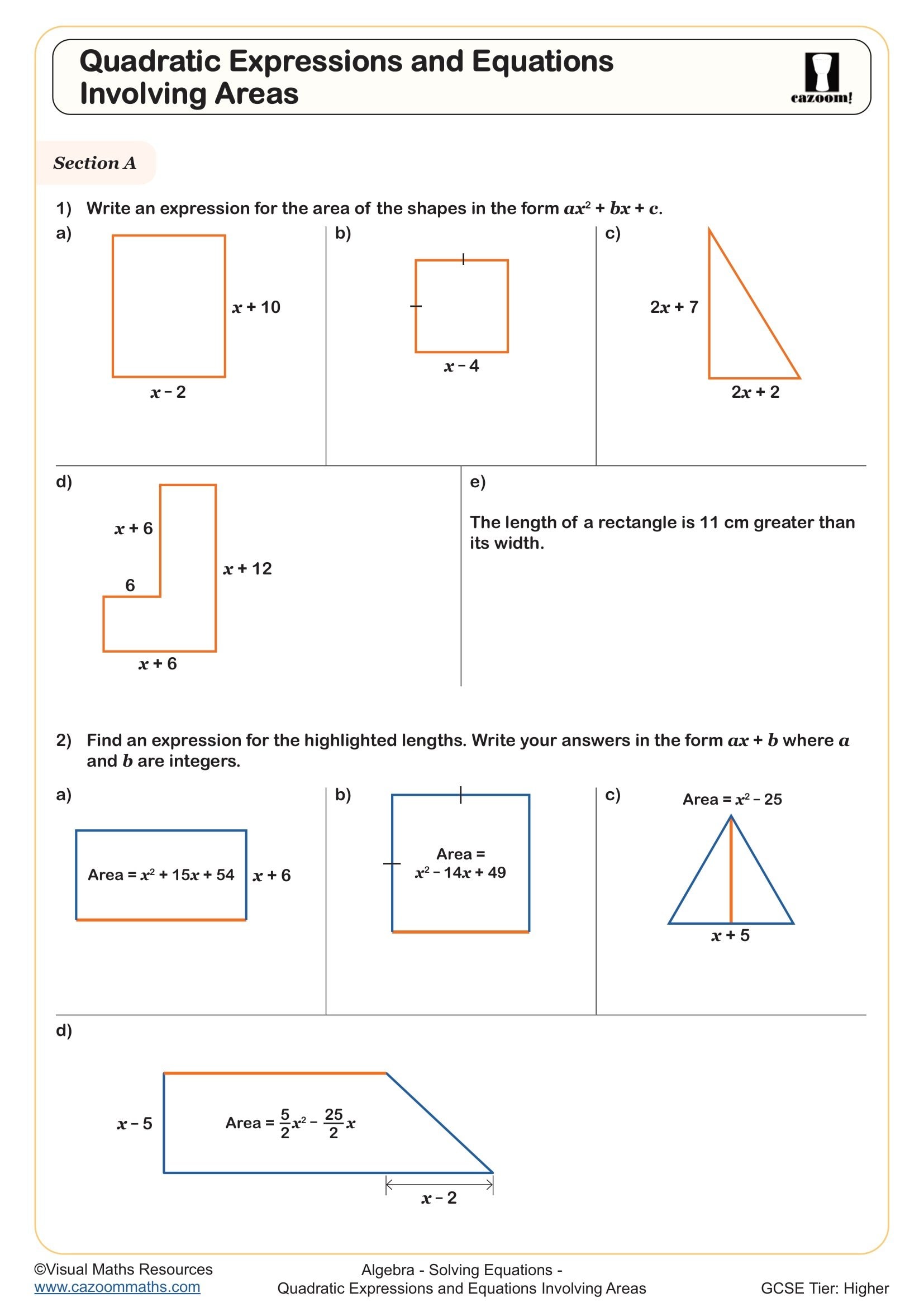
Quadratic Expressions and Equations Involving Areas
Year groups: 10, 11
All worksheets are created by the team of experienced teachers at Cazoom Maths.
What Does Forming and Solving Equations Involve?
Forming equations means translating word problems or visual representations into algebraic expressions with an unknown value. Students learn to identify key information, assign variables, and construct equations that model the situation accurately. This requires careful reading and an understanding of mathematical relationships such as equality, sum, difference, and proportion.
Solving equations involves finding the value of the unknown through systematic manipulation. Students apply inverse operations to isolate the variable, working through steps that might include expanding brackets, collecting like terms, and dealing with fractions. These worksheets develop both aspects progressively, starting with straightforward one-step equations and advancing to multi-step problems requiring several operations to reach the solution.
Which Year Groups Are These Worksheets Suitable For?
These forming and solving equations worksheets span Year 7 through to Year 11, covering both Key Stage 3 and Key Stage 4 of the National Curriculum. Year 7 and 8 students encounter foundational equation work, including one-step and two-step equations, whilst Year 9 pupils progress to equations with unknowns on both sides and more complex brackets.
Year 10 and 11 worksheets prepare students for GCSE requirements, incorporating challenging algebraic manipulation involving fractions, negative coefficients, and contextual problems. The collection allows teachers to differentiate effectively, selecting appropriate difficulty levels that match their students' current understanding. This progression ensures continuity as pupils move through secondary school, building on prior knowledge systematically.
How Do You Solve Equations with Unknowns on Both Sides?
Solving equations with unknowns on both sides requires collecting all variable terms on one side of the equation and all constant terms on the other. Students typically subtract the smaller variable term from both sides first, which avoids working with negative coefficients initially. This simplifies the equation to a standard form where the unknown appears only once.
Once simplified, students apply inverse operations to isolate the variable completely. These worksheets provide structured practice in choosing the most efficient approach, checking solutions by substitution, and recognising when to expand brackets before collecting terms. This skill is fundamental for GCSE success and appears frequently in both calculator and non-calculator examinations across Foundation and Higher tiers.
What's Included with Each Worksheet?
Every worksheet in this collection comes with a complete answer sheet showing all solutions clearly. The downloadable PDF format means you can print multiple copies for whole-class teaching, homework distribution, or targeted intervention groups. Each resource is carefully structured to provide progressive difficulty within the worksheet, allowing students to build confidence before tackling more demanding problems.
The worksheets include a variety of question types, from basic equation solving to forming equations from written descriptions and diagrams. This variety ensures students develop both procedural fluency and problem-solving skills. Teachers can use the answer sheets for quick marking or provide them to students for self-assessment, supporting independent learning and allowing pupils to identify areas needing further practice.