Fractional and Negative Indices Worksheets
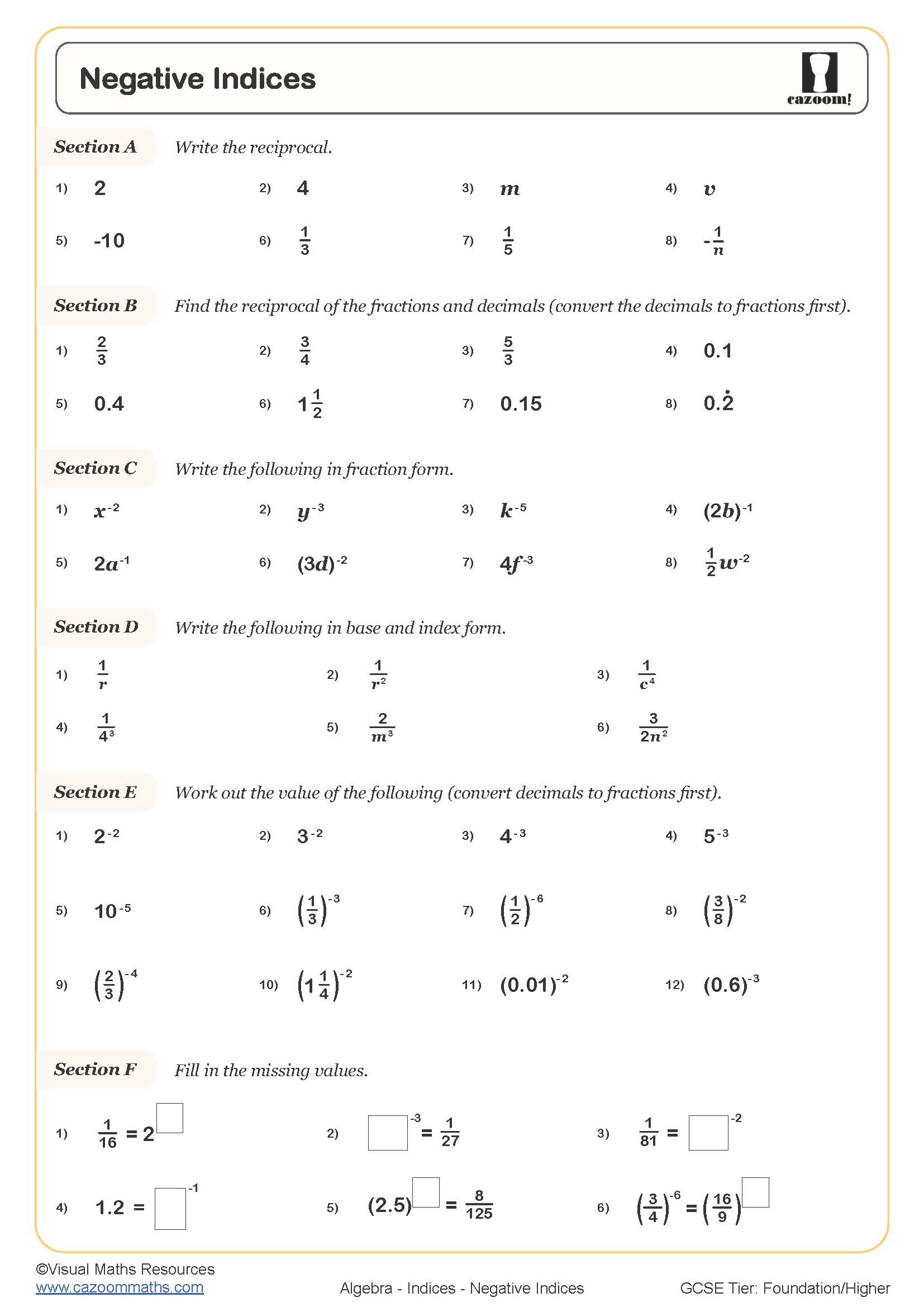
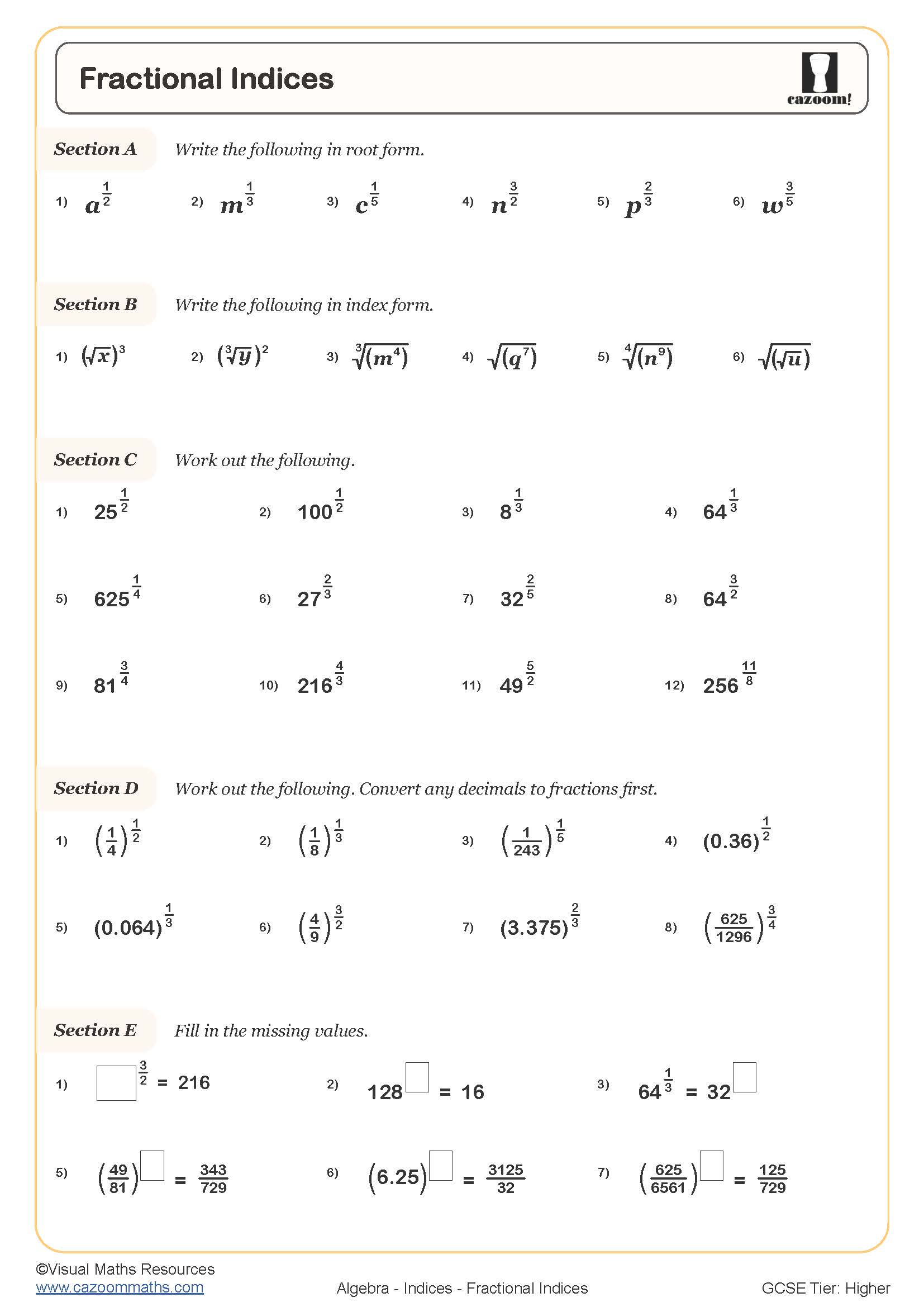
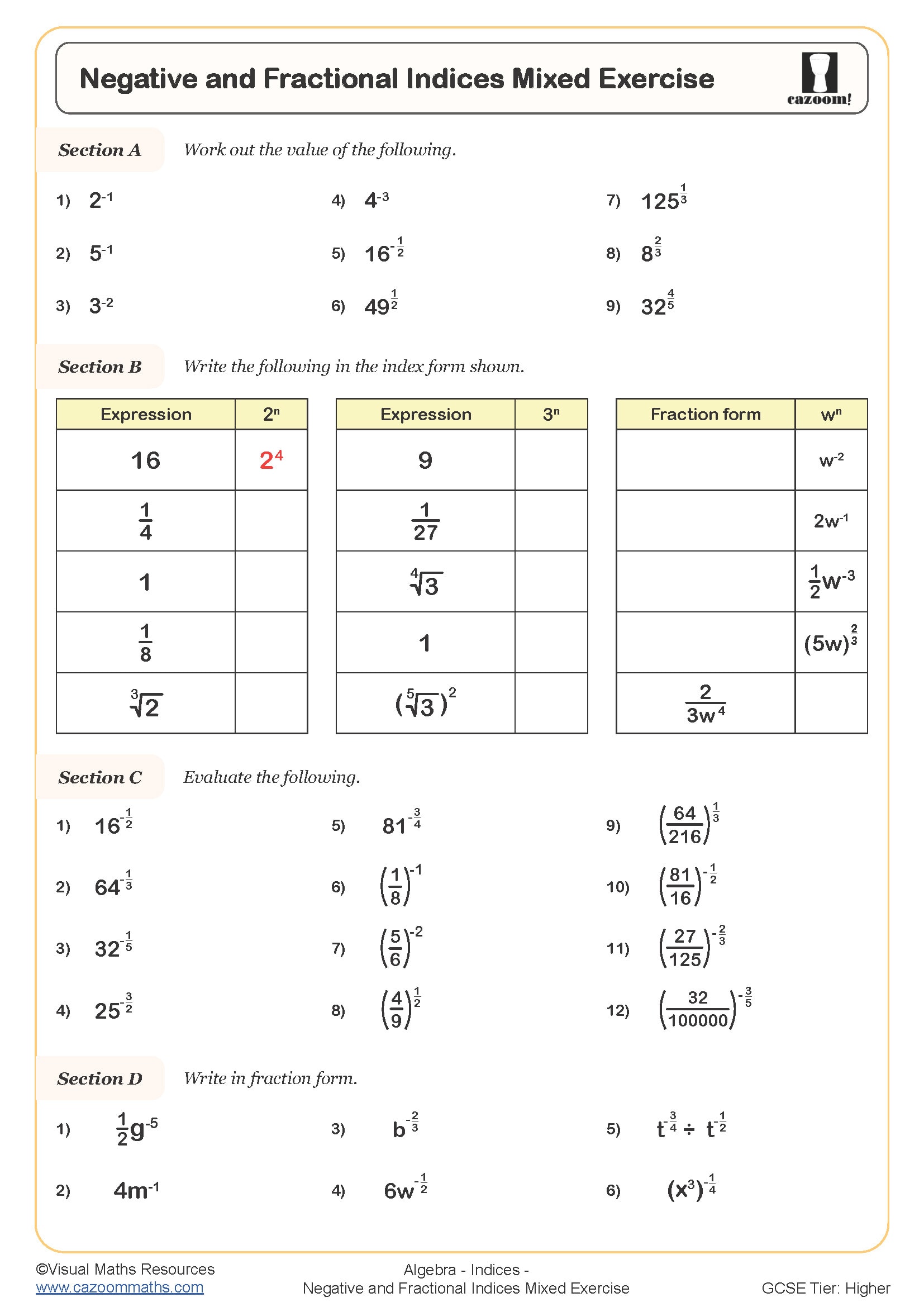
All worksheets are created by the team of experienced teachers at Cazoom Maths.
What are the key indices rules students need to master?
The laws of indices form the foundation for algebraic manipulation at both KS3 and KS4 levels. Students must understand that x^m × x^n = x^(m+n), x^m ÷ x^n = x^(m-n), (x^m)^n = x^mn, x^0 = 1, x^-n = 1/x^n, and x^(1/n) = ⁿ√x. These rules apply whether dealing with whole number, fractional, or negative indices.
Teachers frequently notice students applying the index laws mechanically without understanding why x^-2 equals 1/x² rather than -x². This conceptual gap becomes particularly evident when students encounter mixed expressions combining positive, negative, and fractional indices in the same problem, leading to errors in GCSE algebra questions.
Which year groups study negative and fractional indices?
Negative indices typically appear in Year 8 or 9 as part of KS3 algebra, while fractional indices are usually introduced in Year 10 or 11 during GCSE preparation. The progression moves from understanding that 3^-2 = 1/9 to recognising that 8^(2/3) = (∛8)² = 4, requiring students to connect indices with roots and powers.
Many schools introduce negative indices through patterns, showing how the sequence 2³, 2², 2¹, 2⁰ continues logically to 2^-1, 2^-2. Teachers find this approach helps students grasp why negative indices produce reciprocals. Fractional indices build on this foundation, typically appearing alongside surds and requiring students to convert between radical and index notation.
How do fractional indices connect to surds in GCSE mathematics?
Fractional indices provide an alternative notation for roots and radicals, with x^(1/n) equivalent to ⁿ√x and x^(m/n) representing (ⁿ√x)^m or ⁿ√(x^m). This connection becomes crucial when simplifying complex expressions that combine surds and indices, particularly in GCSE non-calculator papers where students must demonstrate fluency with both forms.
Teachers observe that students often struggle to recognise when switching between surd and index notation simplifies calculations. For example, simplifying √(8³) becomes more manageable when written as 8^(3/2) = (2³)^(3/2) = 2^(9/2) = 2⁴√2. This skill proves important for topics like exponential functions and logarithms in further mathematics.
How can teachers use these worksheets most effectively in lessons?
The worksheets work best when used progressively, starting with concrete numerical examples before moving to algebraic expressions. Teachers report success when students first practise evaluating expressions like 4^-2 and 27^(1/3) before attempting to simplify x^-3 × x^5 or (y^2)^(-3/4). The answer sheets enable peer marking and immediate feedback, which proves particularly valuable for building confidence with these abstract concepts.
Many teachers use the worksheets for targeted intervention, identifying students who confuse negative indices with negative coefficients or who struggle to connect fractional indices with root notation. The systematic progression allows teachers to pinpoint exactly where misconceptions arise and provide focused support before students attempt more complex GCSE-style problems involving multiple index laws.