Function Machines Worksheets
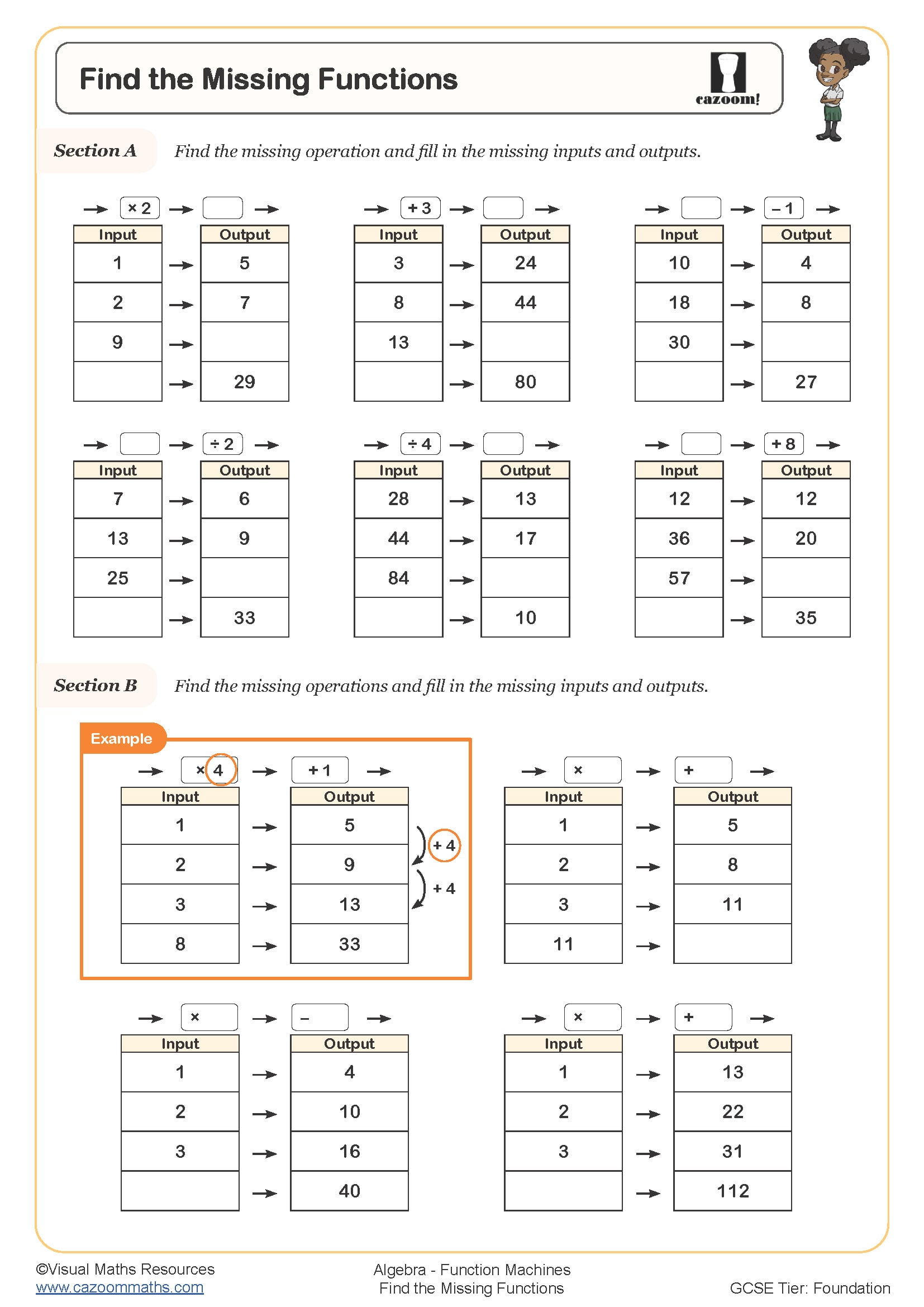
Find the Missing Functions
Year groups: 7, 8
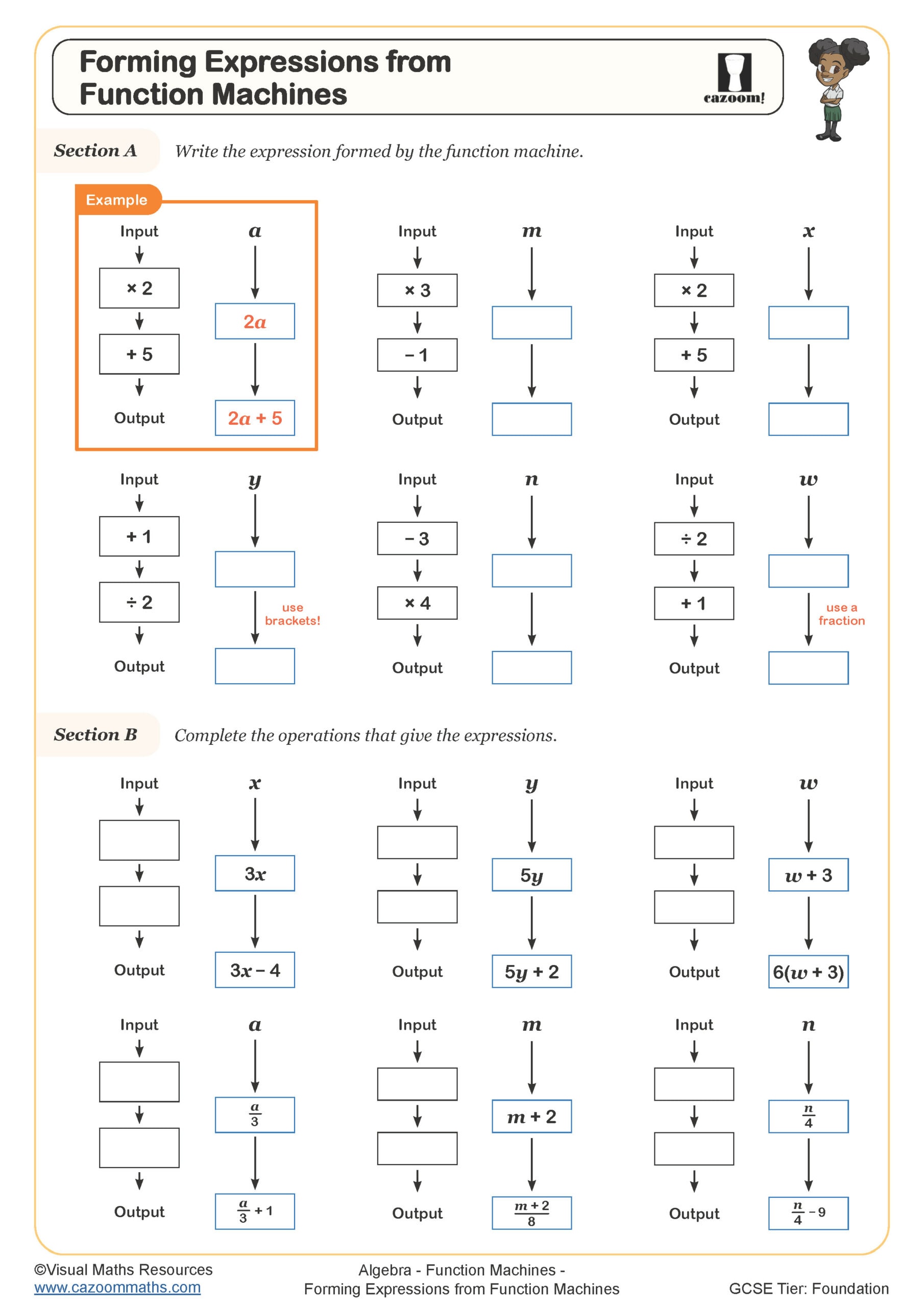
Forming Expressions from Function Machines
Year groups: 7, 8, 9
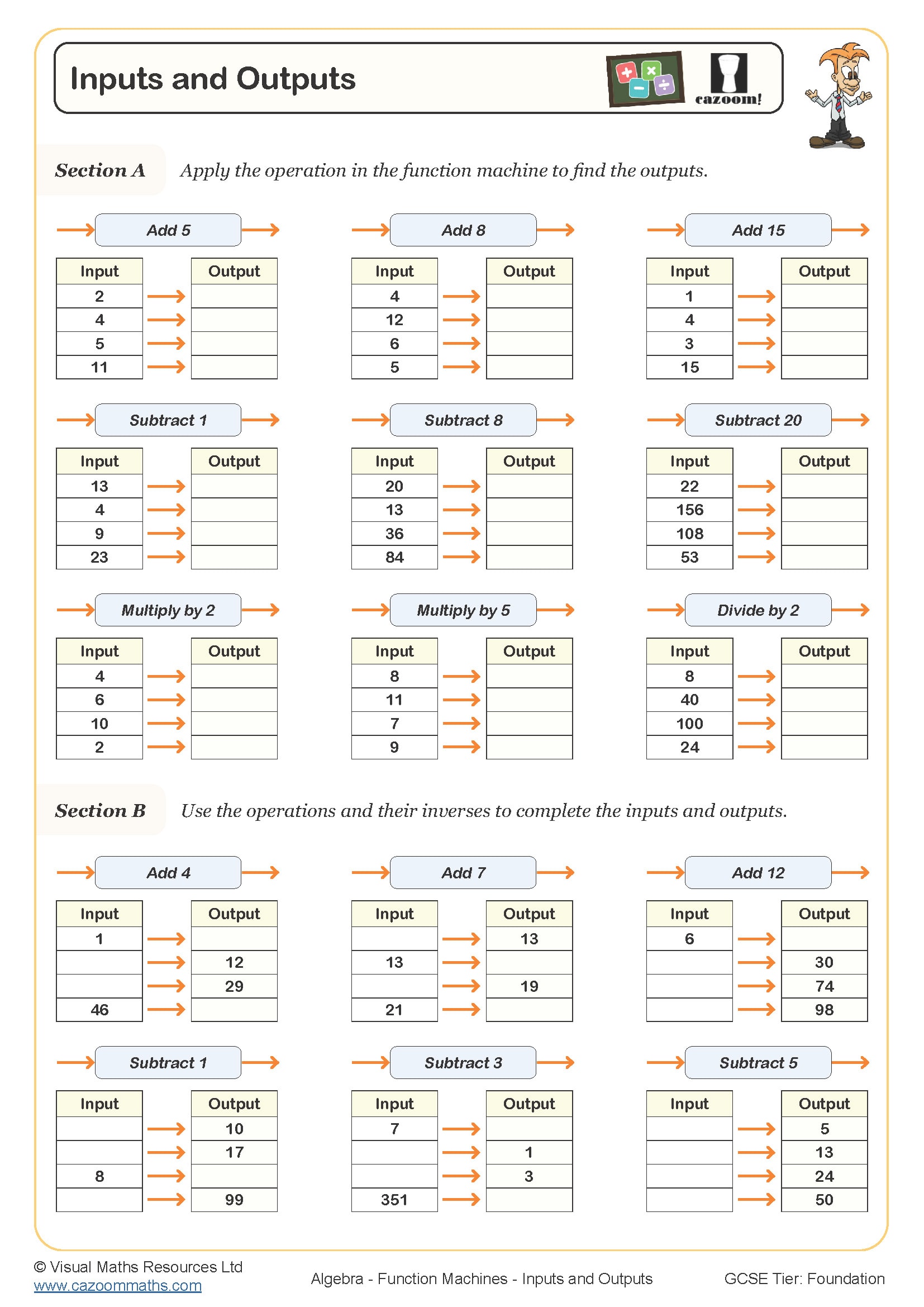
Inputs and Outputs
Year groups: 7, 8
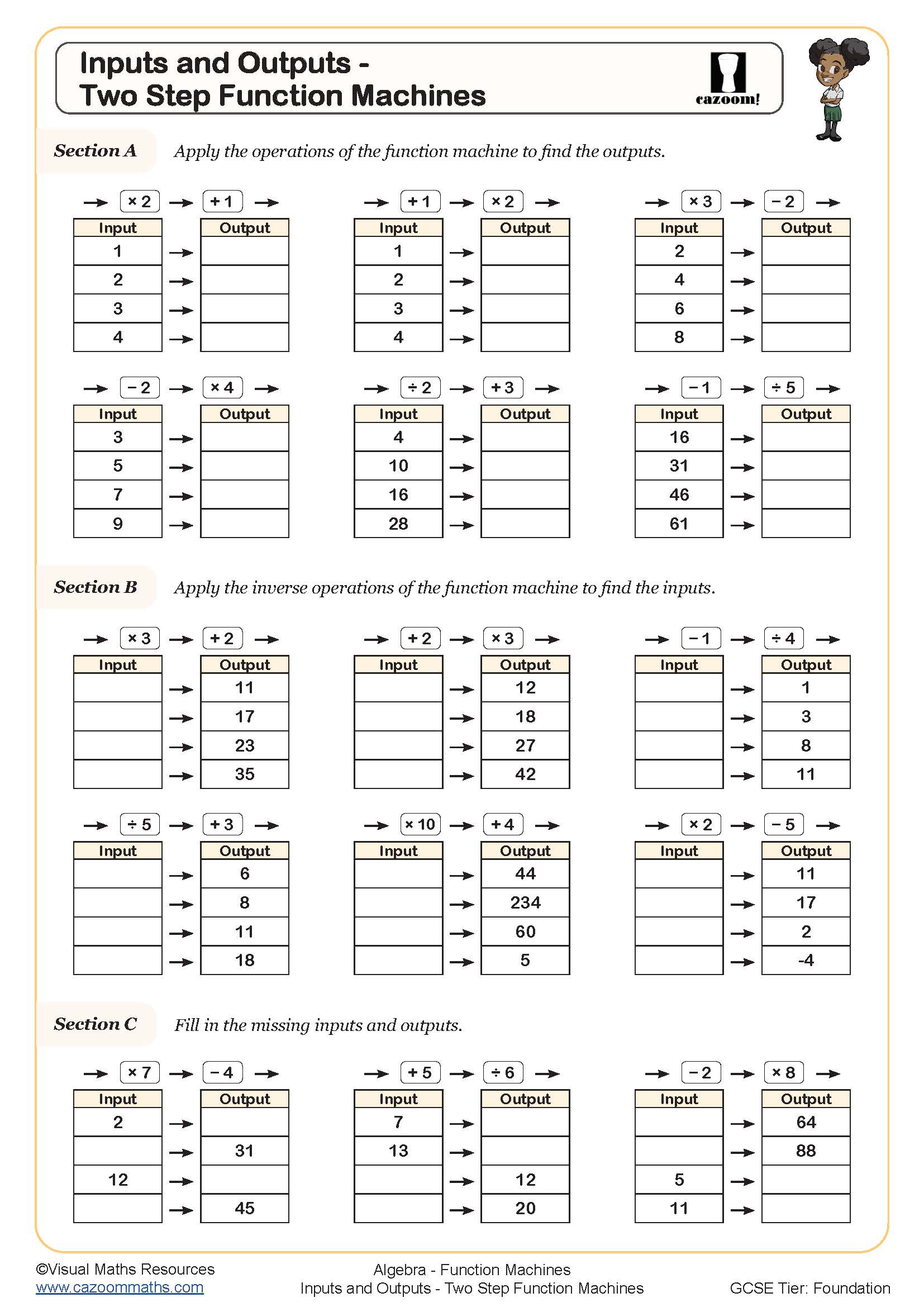
Inputs and Outputs - Two Step Function Machines
Year groups: 7, 8
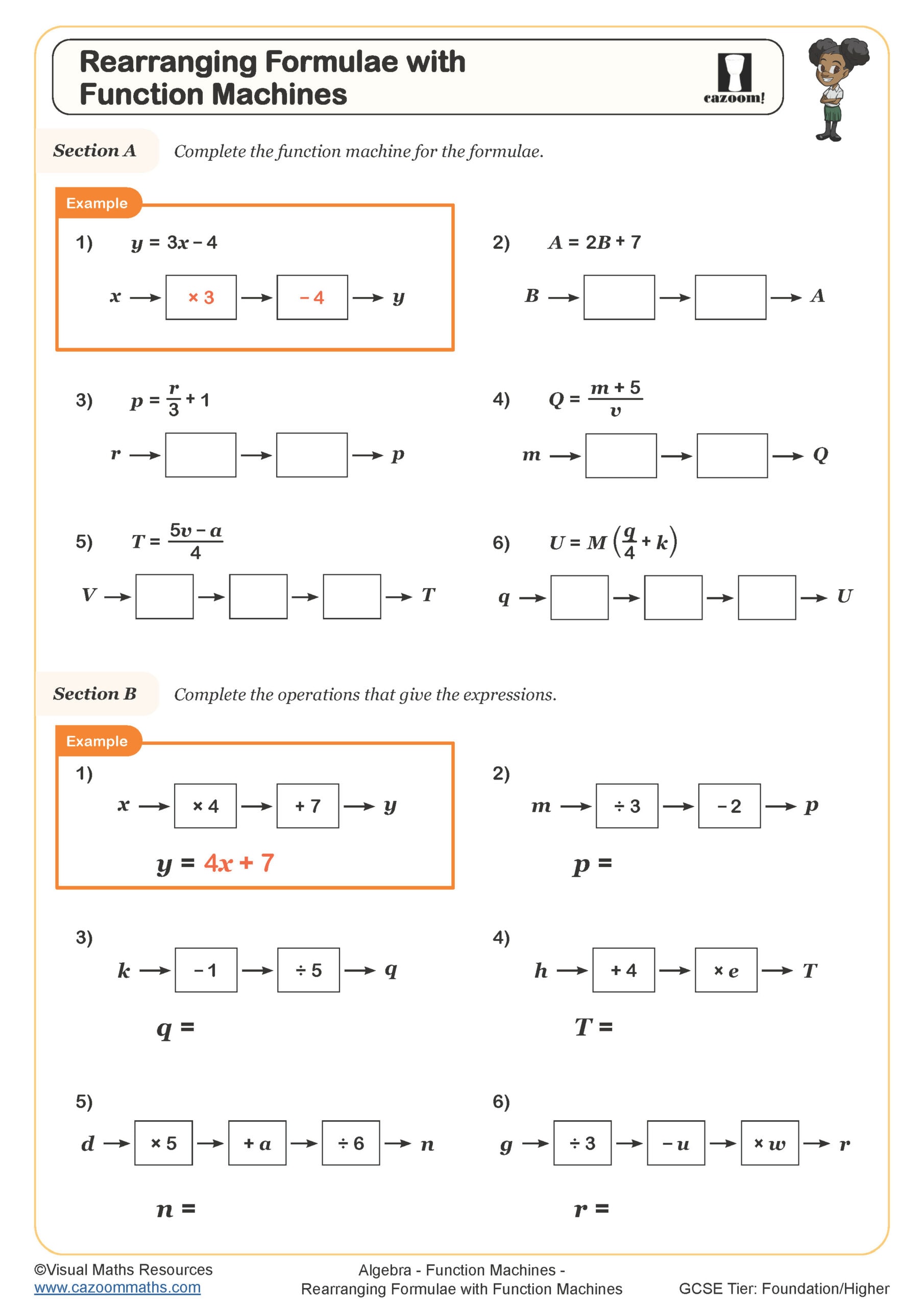
Rearranging Formulae with Function Machines
Year groups: 9, 10
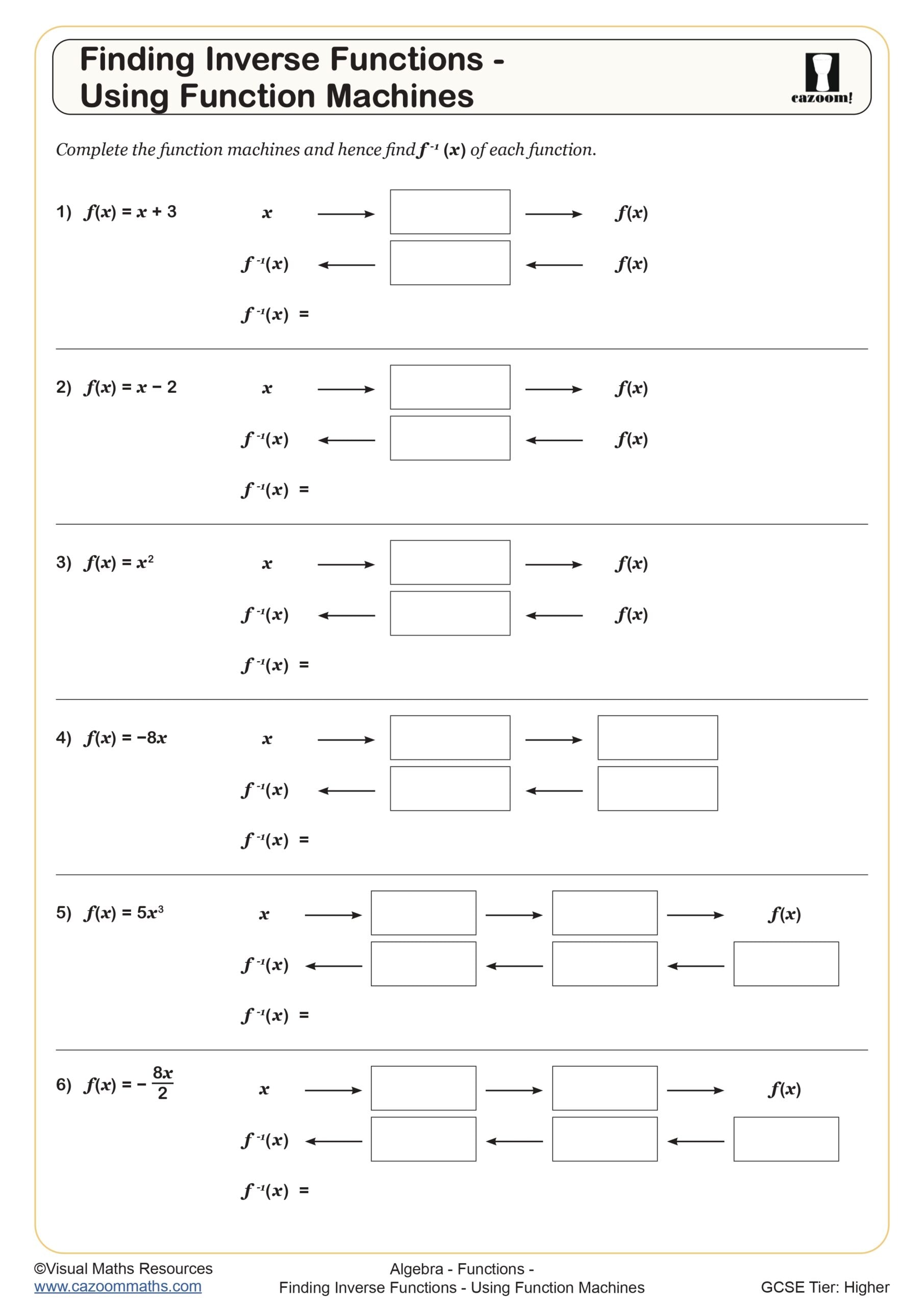
Finding Inverse Functions - Using Function Machines
Year groups: 10, 11
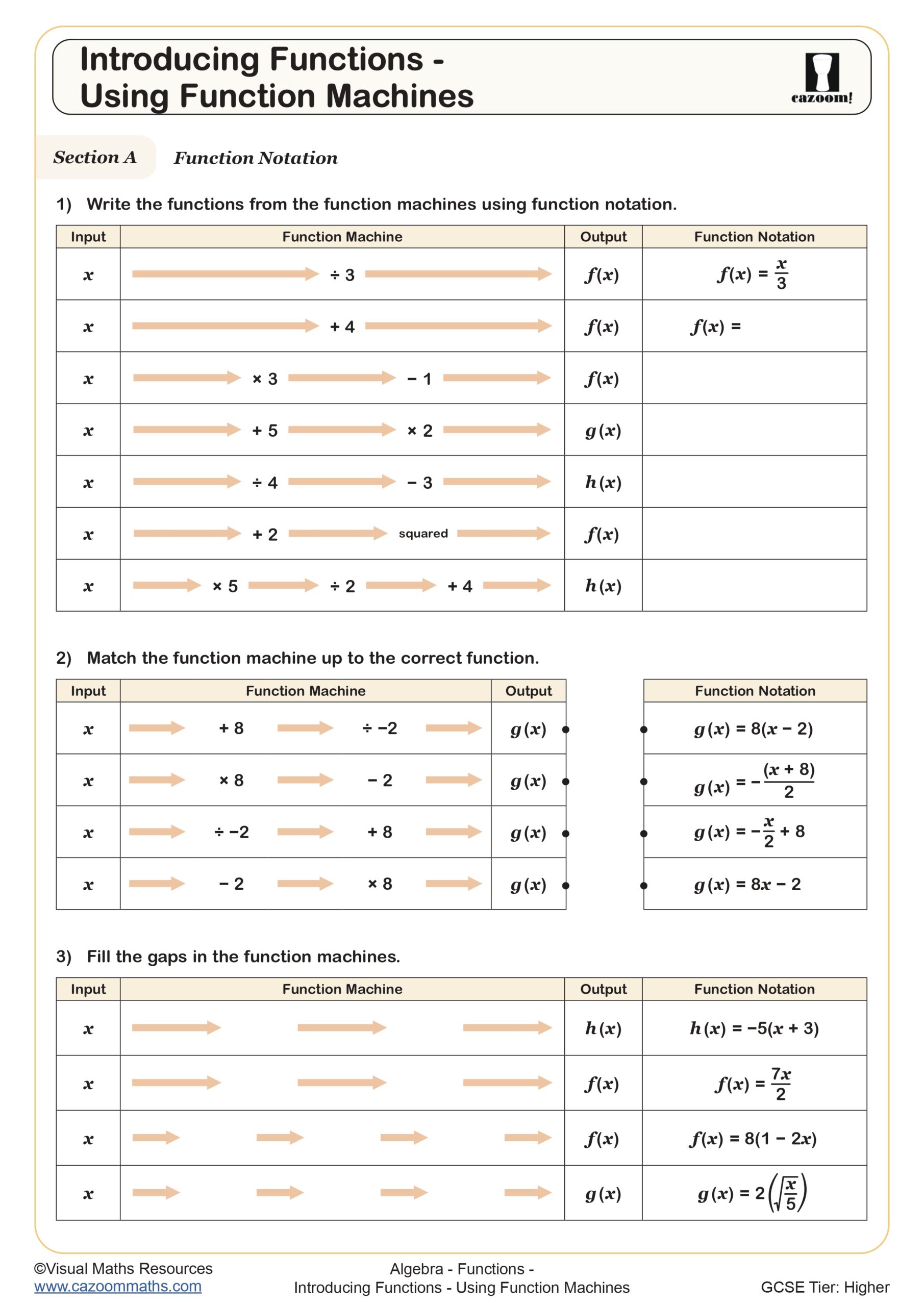
Introducing Functions - Using Function Machines
Year groups: 10, 11
All worksheets are created by the team of experienced teachers at Cazoom Maths.
What makes an effective function machine worksheet for KS3 students?
An effective function machines worksheet should progress systematically from concrete examples to abstract algebraic thinking. The best function machine questions begin with simple single operations like 'add 5' or 'multiply by 3' before introducing combinations such as 'multiply by 2, then subtract 4'. This scaffolded approach allows students to build confidence with the visual representation before tackling more complex function machine algebra.
Teachers consistently observe that students benefit most when worksheets include a mixture of forward operations (finding outputs) and inverse problems (finding inputs or missing operations). Many pupils initially treat each box in a function machine as separate, rather than understanding the connected flow of operations. Well-designed function machines worksheets with answers help students self-check their understanding and identify where their reasoning breaks down.
Which year groups should use function machine worksheets?
Function machines typically appear in Year 7 as an introduction to algebraic thinking, though some schools introduce them in Year 6 to bridge primary and secondary mathematics. The visual nature of function machines makes abstract algebra more accessible to 11-13 year olds who may struggle with traditional algebraic notation. By Year 8, students should confidently work with two-step function machines and begin connecting them to linear equations.
The progression continues through to GCSE, where function machines support understanding of composite functions and function notation like f(x). Teachers find that even Year 11 students benefit from returning to function machine representations when tackling complex transformations or inverse functions. The concrete visual model helps students who struggle with purely symbolic manipulation to maintain their understanding of mathematical relationships.
How do function machines connect to inverse operations and equation solving?
Function machines provide students with a visual model for understanding inverse operations, which directly supports equation-solving techniques. When working backwards through a function machine, students naturally apply inverse operations in reverse order - exactly the same process used when solving linear equations. This connection helps pupils understand why they subtract before dividing when solving equations like 2x + 3 = 11.
Many teachers observe that students who master function machines find algebraic manipulation more intuitive. The 'undo' thinking required to work backwards through function machines transfers directly to isolating variables in equations. Students begin to see equations as function machines written in a different format, making the transition from arithmetic thinking to algebraic reasoning much smoother.
How should teachers use function machine worksheets to maximise learning?
Effective use of function machines worksheets begins with concrete examples using actual numbers before introducing algebraic variables. Teachers achieve better results when they encourage students to verbalise their thinking - asking 'what operation transforms 3 into 8?' rather than immediately showing the function machine. This approach develops mathematical reasoning alongside procedural fluency.
Using function machines worksheet pdf resources allows teachers to easily differentiate tasks and provide immediate feedback through answer sheets. Many experienced teachers pair visual function machine work with algebraic notation, showing students that 'input → ×3 → +2 → output' is identical to y = 3x + 2. This dual representation strengthens understanding and prepares students for more advanced algebraic concepts while maintaining the supportive visual scaffold.
How to Determine if a Graph is a Function?
Students can figure out whether a graph is a function by using what’s known as a vertical line test. Because a function can only have one output for each input, students only need to analyze the curve of the graph’s line. If the graph’s vertical line intersects a curve more than once, it does not represent a function.
The best way to use the vertical line test is to use a ruler to draw a line parallel to the y-axis. If that line only intersects the graph once, no matter where it’s placed, it is a graph of a function. If the vertical line intersects the curve more than once, it is not a function.
The History of Functions
There is some debate about when the concept of functions was developed, but most scholars use it as a distinguishing feature of “modern” mathematics. Scholar W. L. Schaaf goes even further, saying that: “The keynote of Western culture is the function concept, a notion not even remotely hinted at by any earlier culture.” Students can thus understand the need to learn how to find functions and how to use functions machines not only as a practical necessity but also as a means of celebrating Western culture and modern mathematics.
Download a Function Machine Worksheet From Cazoom Maths
The best way for parents and tutors to help young scholars with a function machine project is to help them work through examples. Download a function machine worksheet pdf from Cazoom Maths or find a function machine template and teach the student how to use it. Over time, the concept of functions will be solidified in the student’s mind and he or she will find the entire process to be quite straightforward.