Geometric Sequences Worksheets
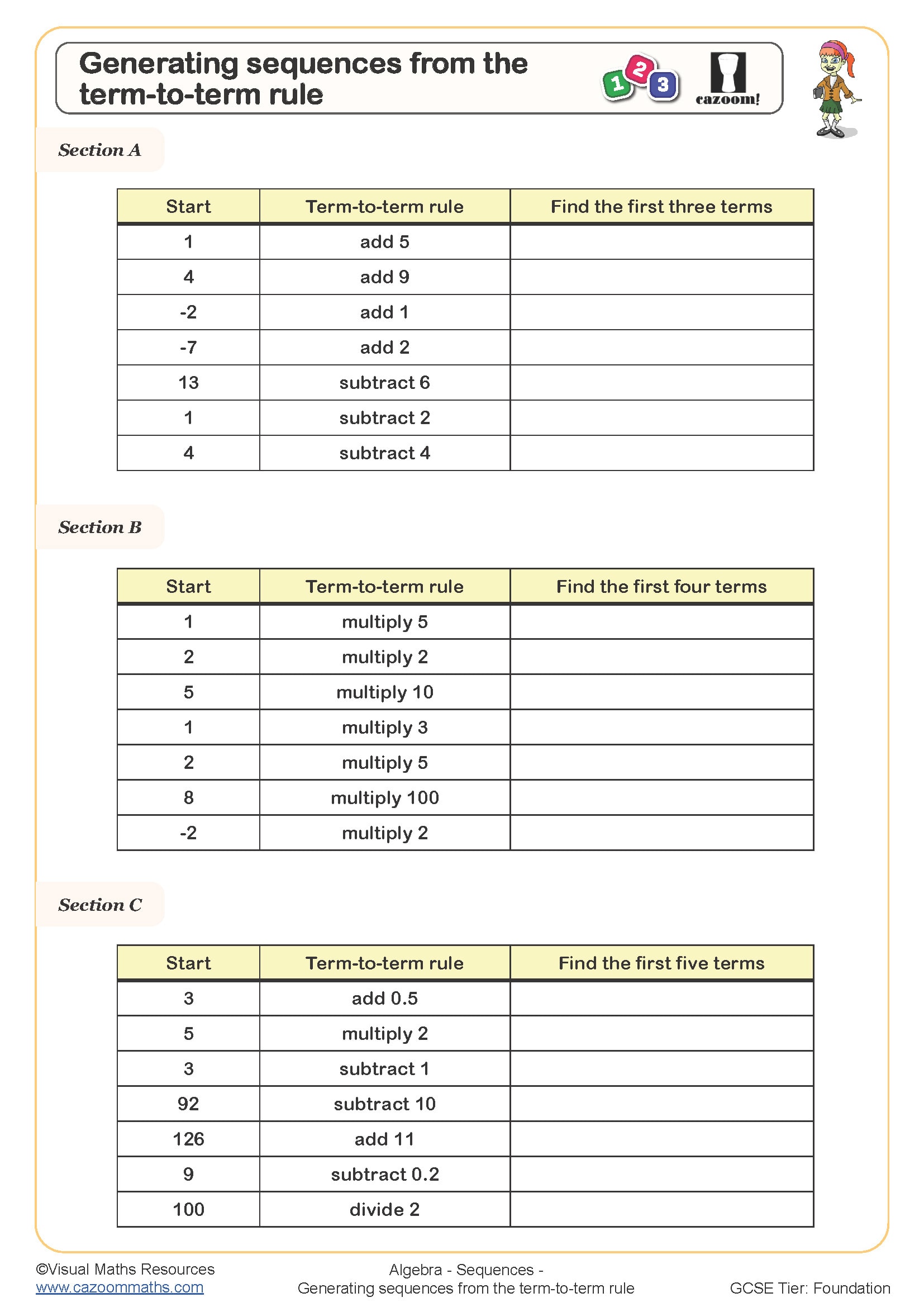
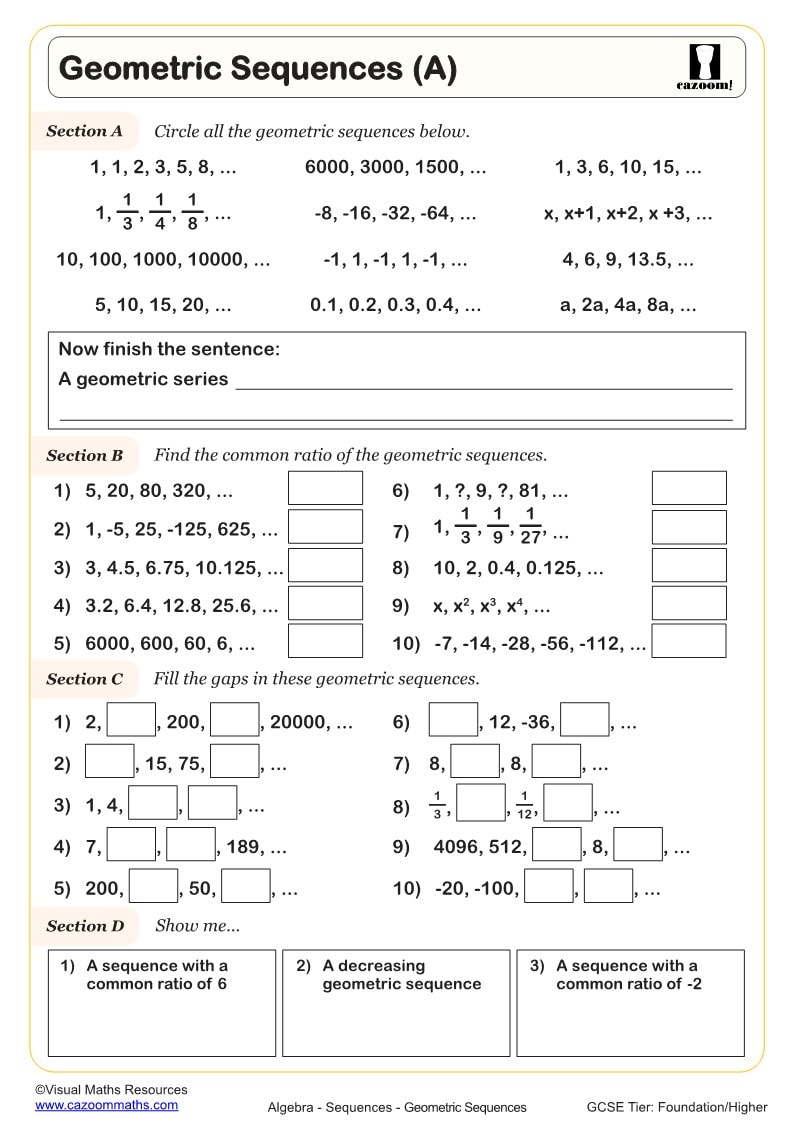
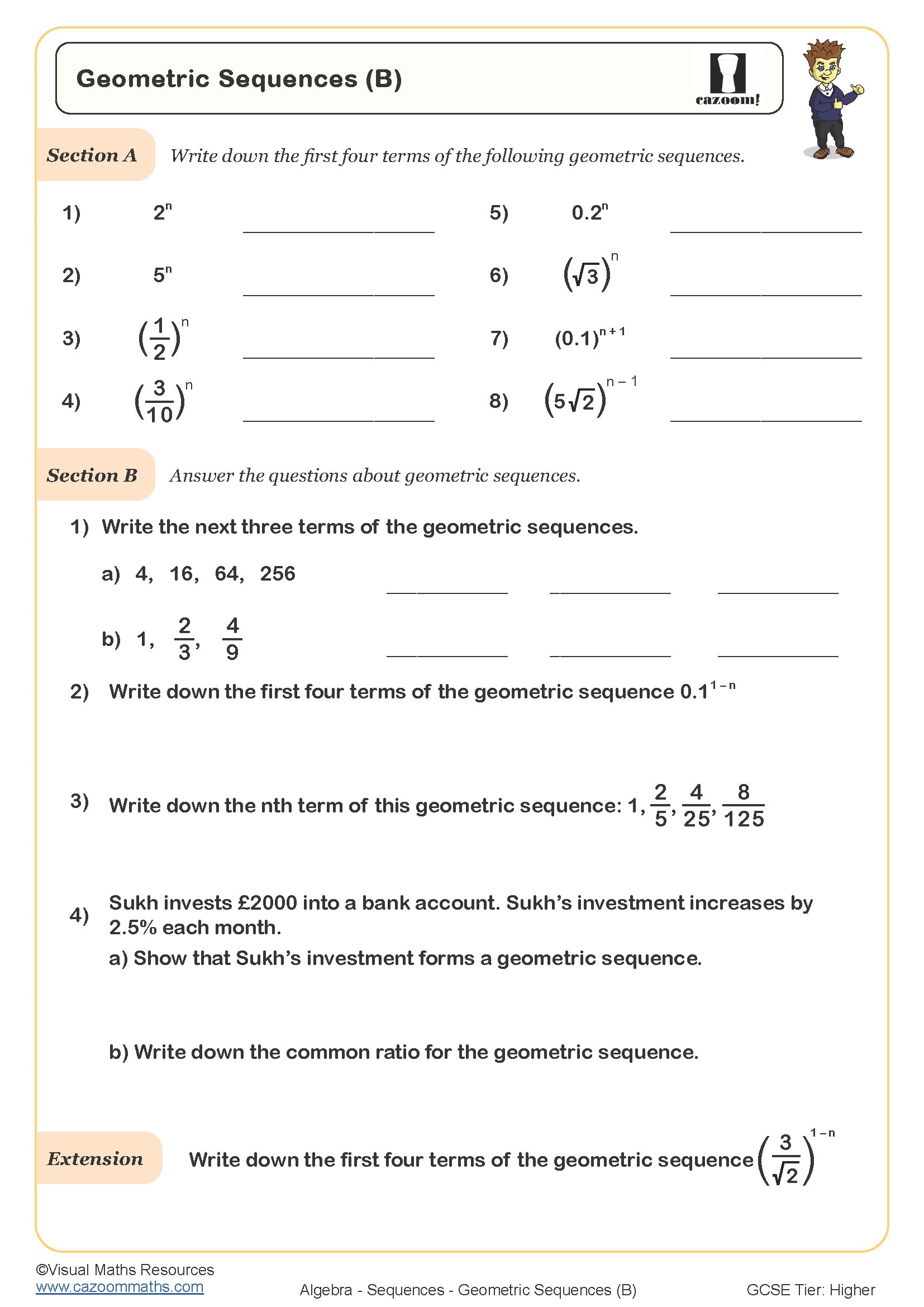
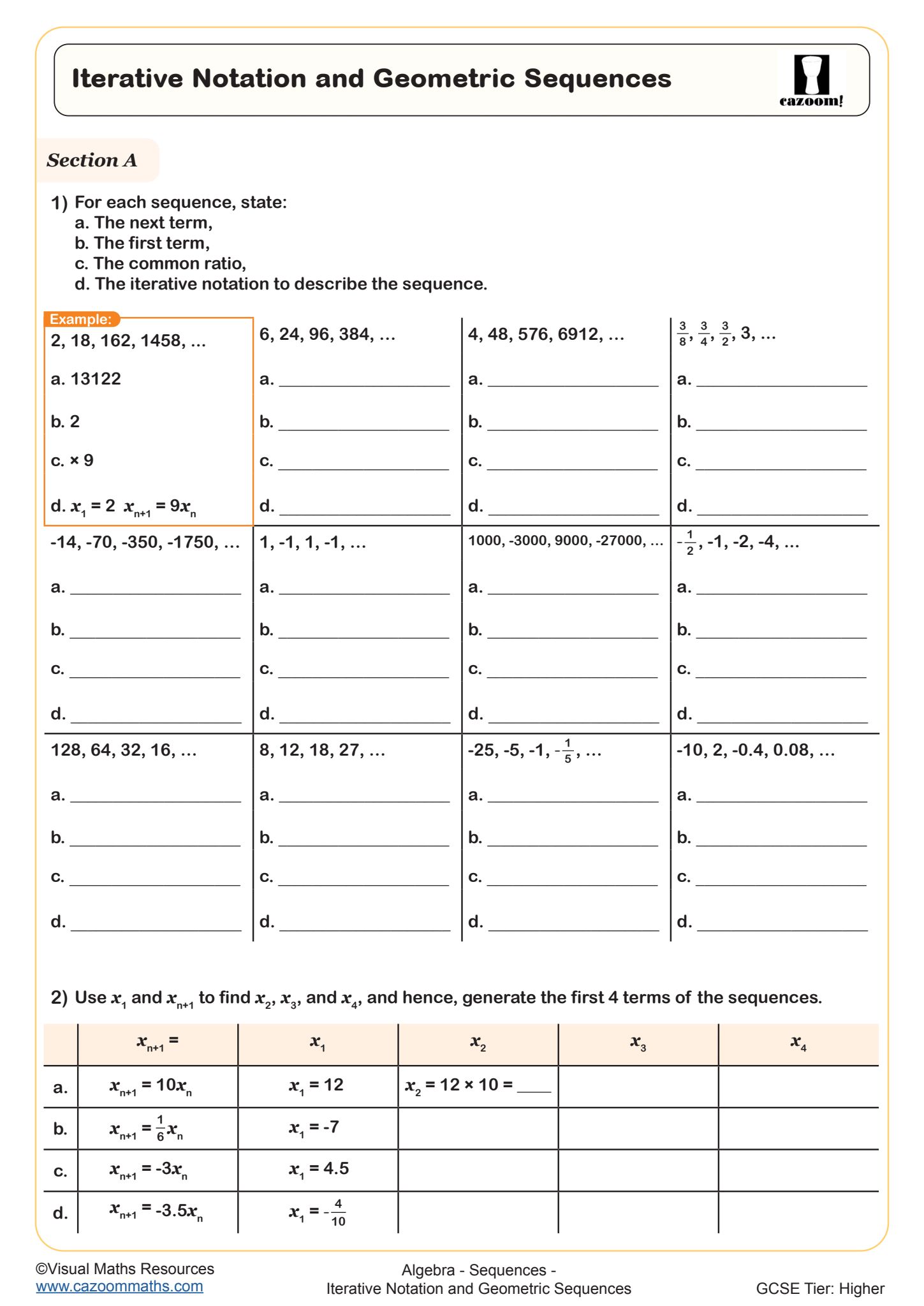
All worksheets are created by the team of experienced teachers at Cazoom Maths.
What is a geometric sequence in maths?
A geometric sequence is a sequence of numbers where each term is found by multiplying the previous term by a fixed number called the common ratio. For example, in the sequence 3, 6, 12, 24, each term is multiplied by 2 to get the next term, making the common ratio 2. Geometric sequences differ from arithmetic sequences, where you add the same amount each time rather than multiply.
Understanding geometric sequences is fundamental for GCSE algebra and appears throughout the Key Stage 3 and Key Stage 4 curriculum. Students learn to identify the common ratio, generate terms in a sequence, and use the nth term formula to find any term without listing all previous terms. These skills connect to exponential growth, compound interest, and other real-world applications of mathematics.
Which year groups study geometric sequences?
Geometric sequences are introduced in Year 7 as part of the KS3 algebra curriculum, where pupils first encounter the concept of multiplying by a constant to generate terms. Students in Year 8 and Year 9 develop these skills further, working with increasingly complex sequences and learning to identify common ratios that may be fractions or decimals.
At Key Stage 4, Year 10 and Year 11 students revisit geometric sequences with greater depth, particularly when preparing for GCSE examinations. They work with the nth term formula for geometric sequences and solve problems requiring them to find specific terms or determine whether a number belongs to a sequence. Our worksheets cover all these year groups with appropriately differentiated content.
How do you find the common ratio in a geometric sequence?
To find the common ratio in a geometric sequence, divide any term by the previous term. For instance, in the sequence 5, 15, 45, 135, dividing 15 by 5 gives 3, confirming the common ratio is 3. This method works throughout the sequence—45 divided by 15 also equals 3. Students should check multiple pairs of consecutive terms to verify they're working with a genuine geometric sequence.
Our worksheets provide systematic practice in identifying common ratios, including sequences where the ratio is a fraction (such as ½) or a decimal. Pupils learn to recognise when sequences are decreasing geometric sequences, where the common ratio is between 0 and 1. Mastering this skill is essential before progressing to using the nth term formula and tackling GCSE-level questions.
Do the geometric sequences worksheets include answers?
Yes, every geometric sequences worksheet comes with a complete answer sheet. This allows teachers to mark work quickly and enables students to check their understanding independently, making these resources ideal for both classroom teaching and homework assignments. The answer sheets show full solutions, helping pupils identify where they've made errors and understand the correct methods.
All worksheets are available as downloadable PDFs, making them easy to print for whole classes or individual students. Teachers can use these resources flexibly—for starter activities, main lesson practice, intervention work, or revision sessions. The inclusion of answers also makes our geometric sequences worksheets valuable for parents supporting home learning, as they can confidently guide their children through the material without needing extensive mathematical knowledge themselves.