Indices Worksheets
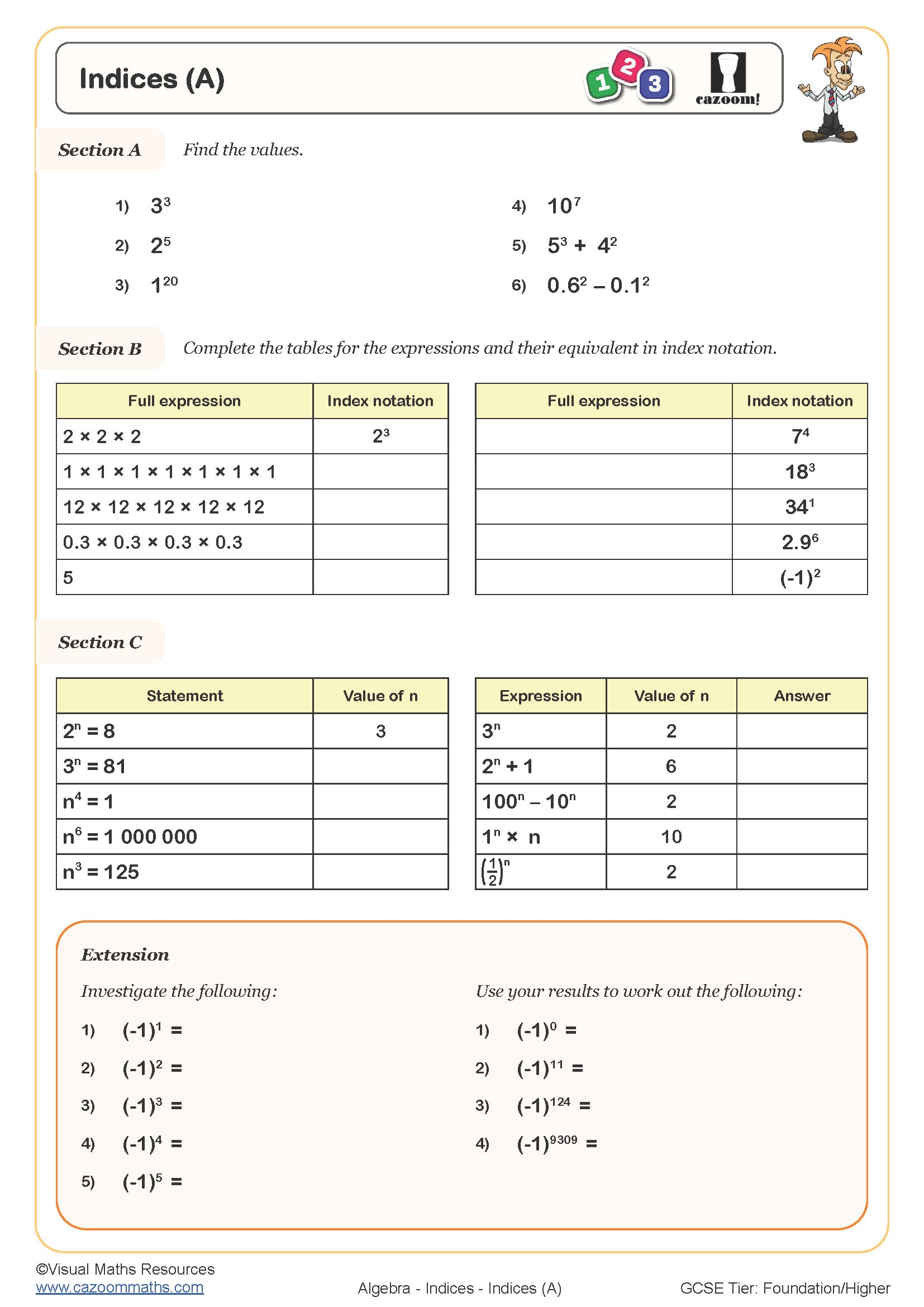
Indices (A)
Year groups: 8, 9
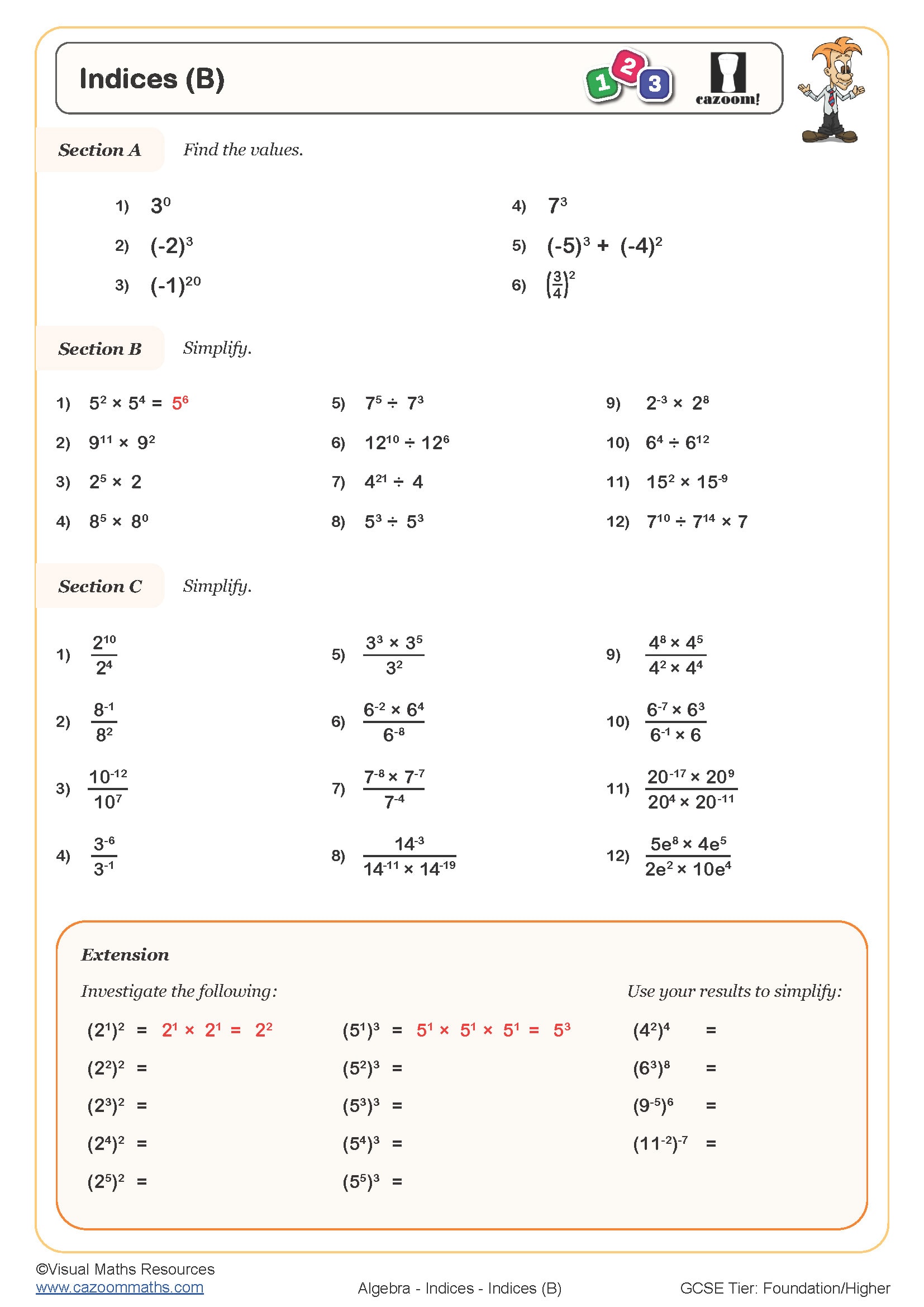
Indices (B)
Year groups: 8, 9, 10
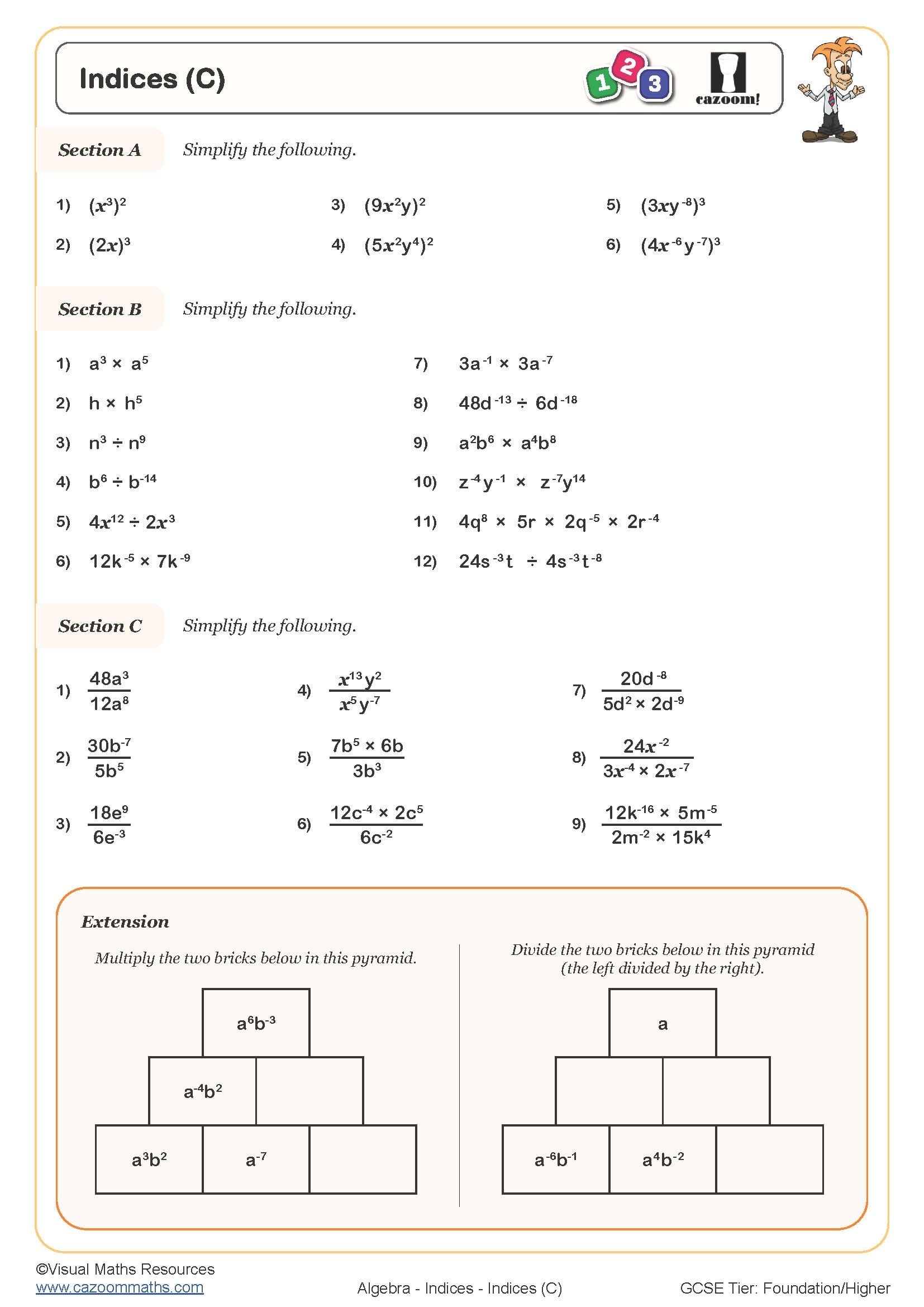
Indices (C)
Year groups: 9, 10, 11
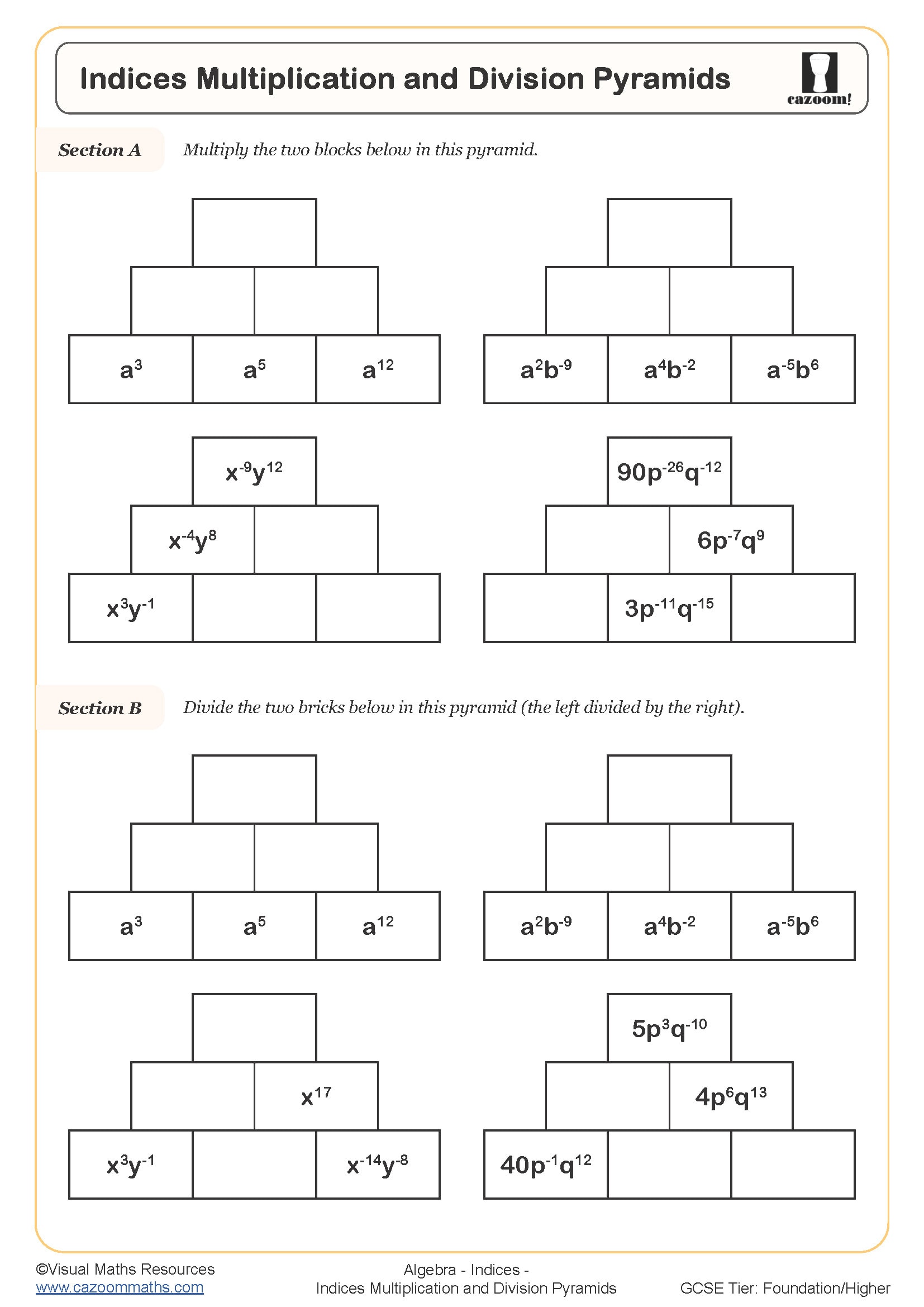
Indices Multiplication and Division Pyramids
Year groups: 9, 10, 11
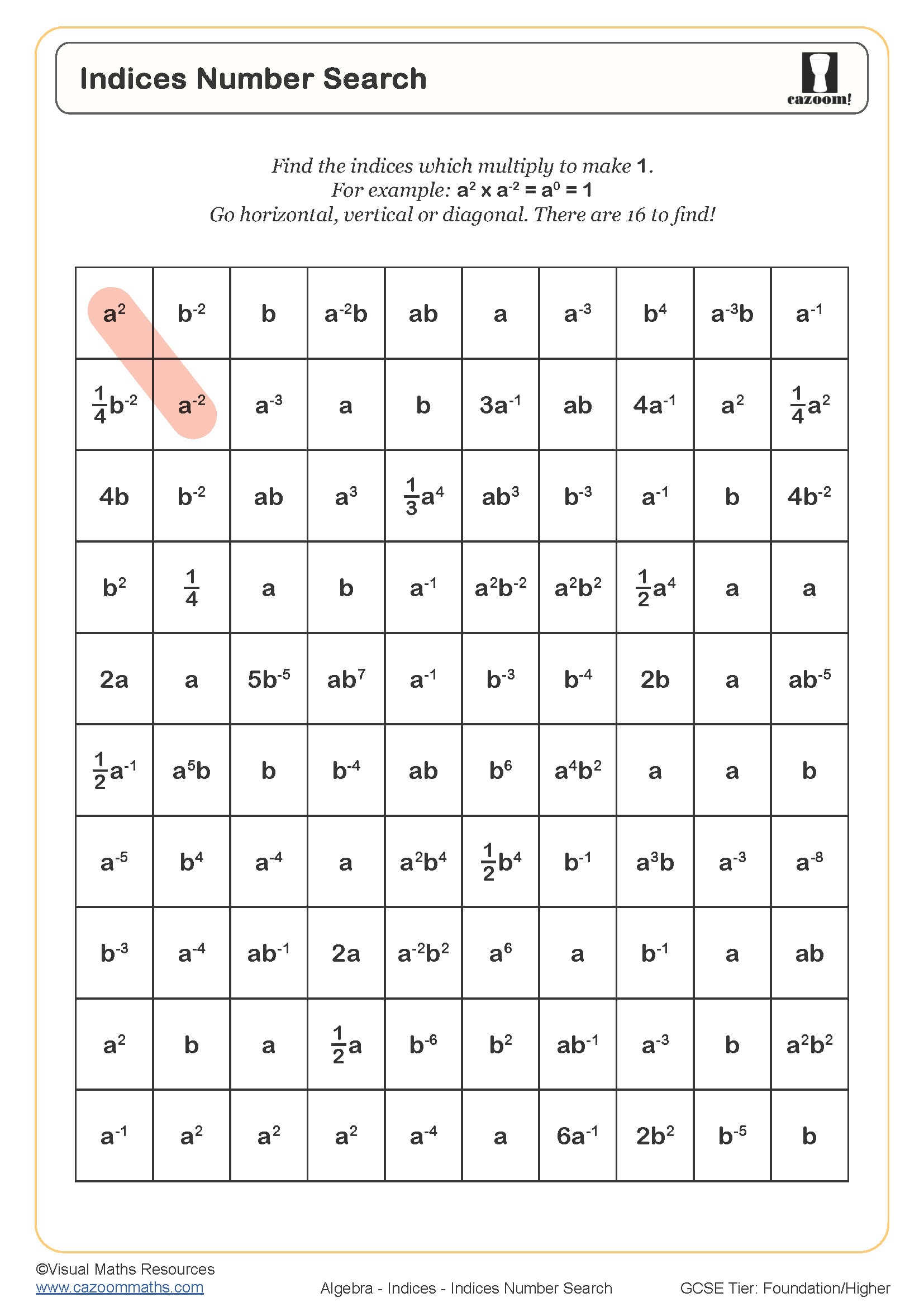
Indices Number Search
Year groups: 9, 10, 11
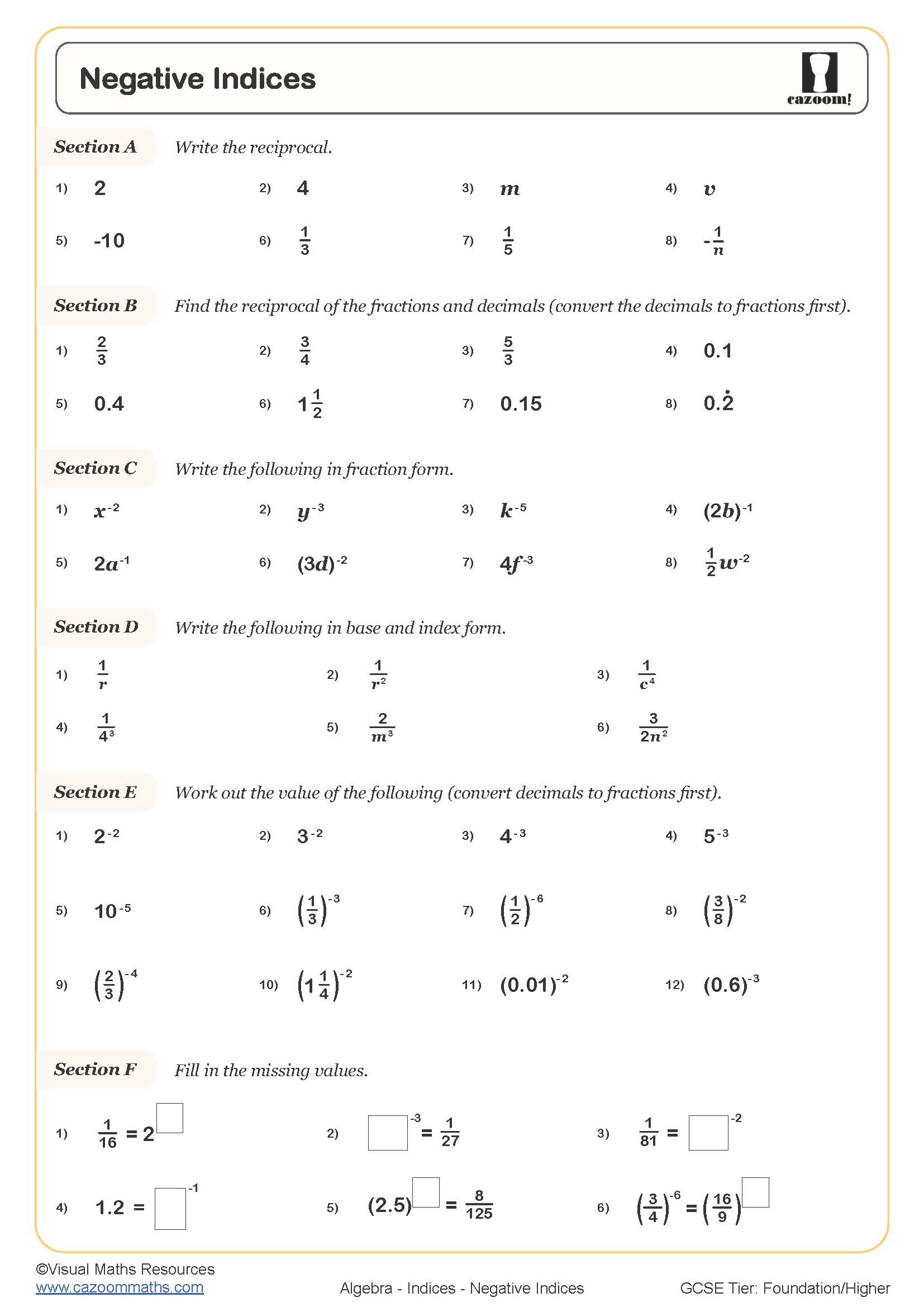
Negative Indices
Year groups: 9, 10
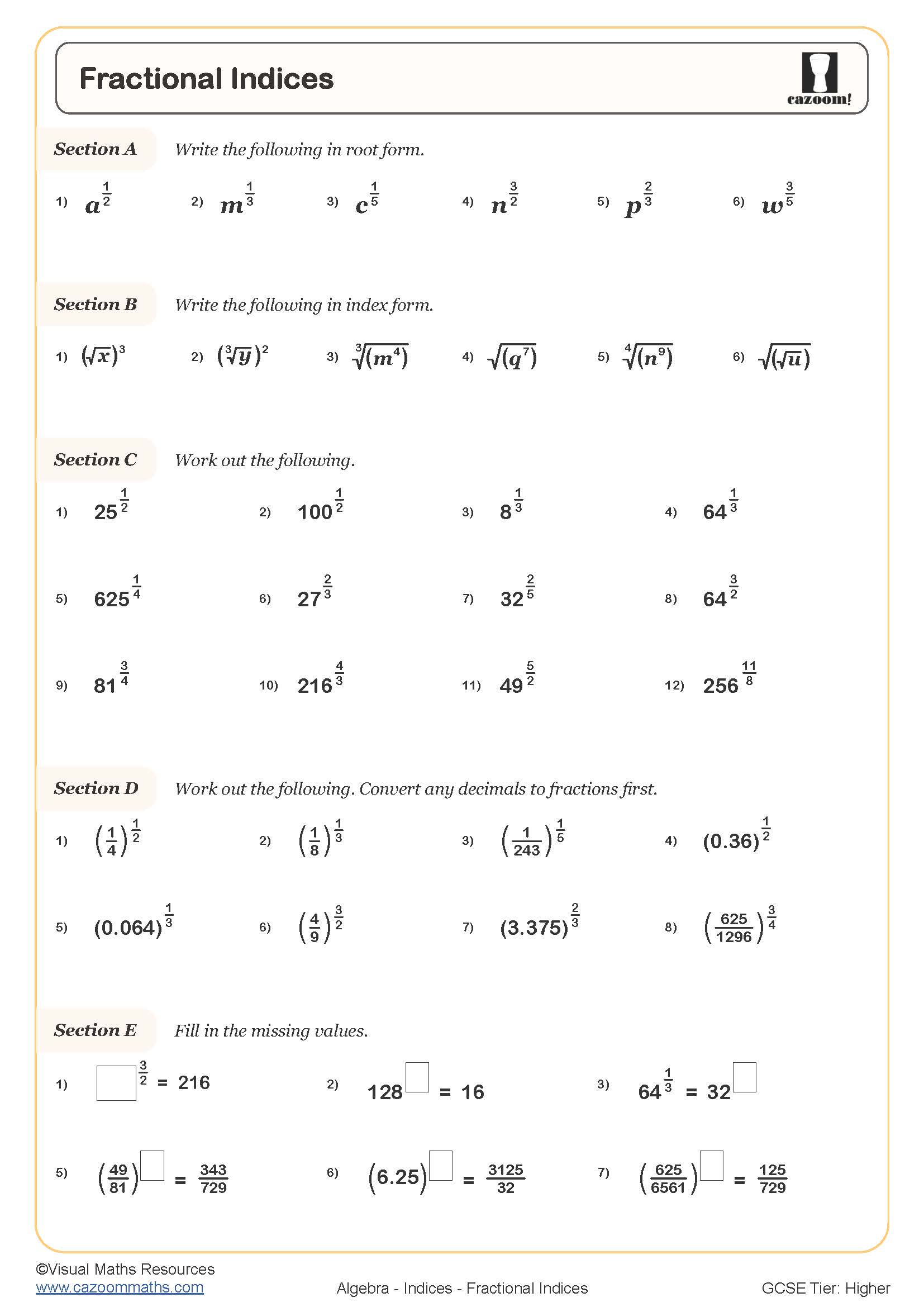
Fractional Indices
Year groups: 10, 11
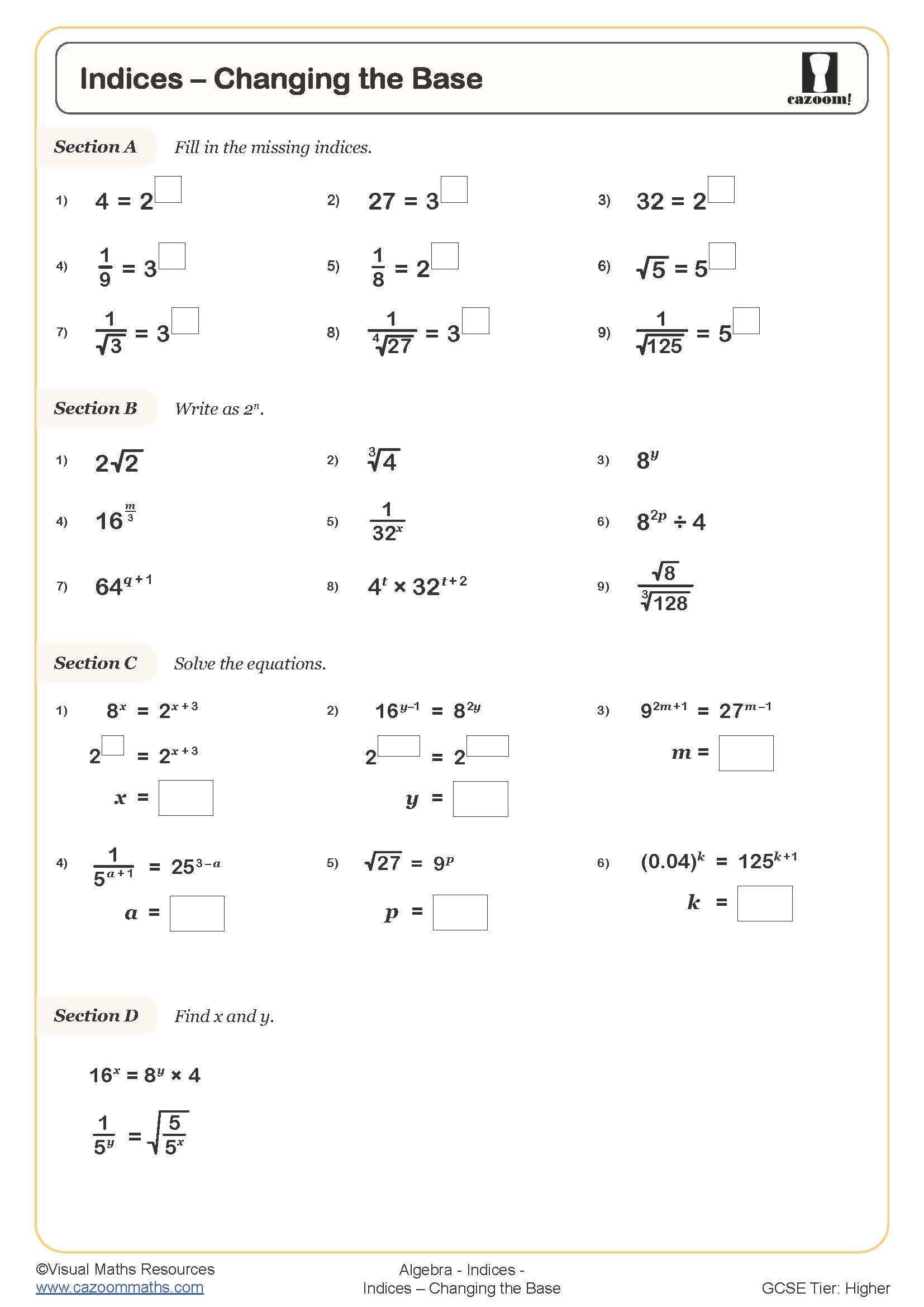
Indices - Changing the Base
Year groups: 10, 11
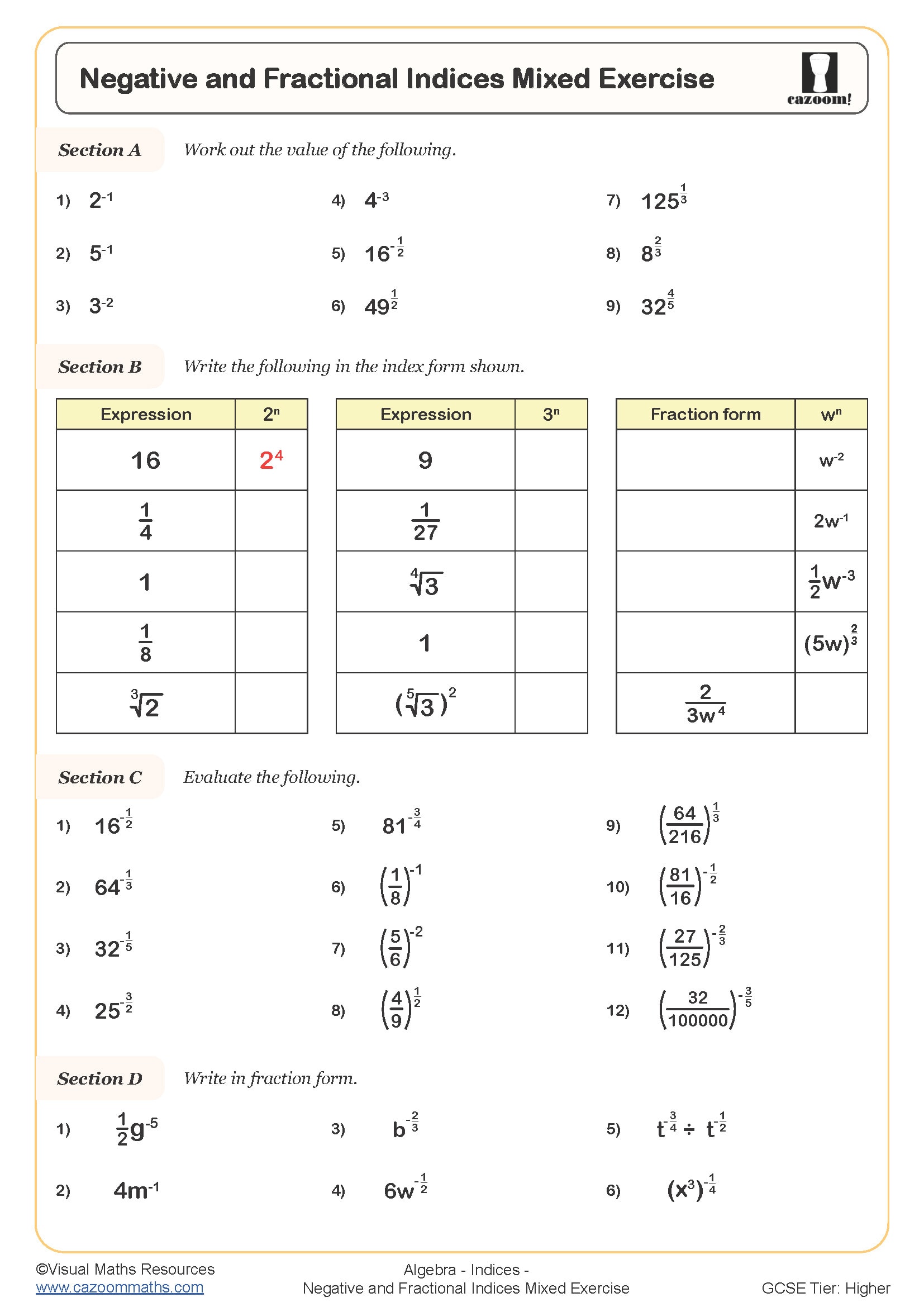
Negative and Fractional Indices Mixed Exercise Worksheet
Year groups: 10, 11
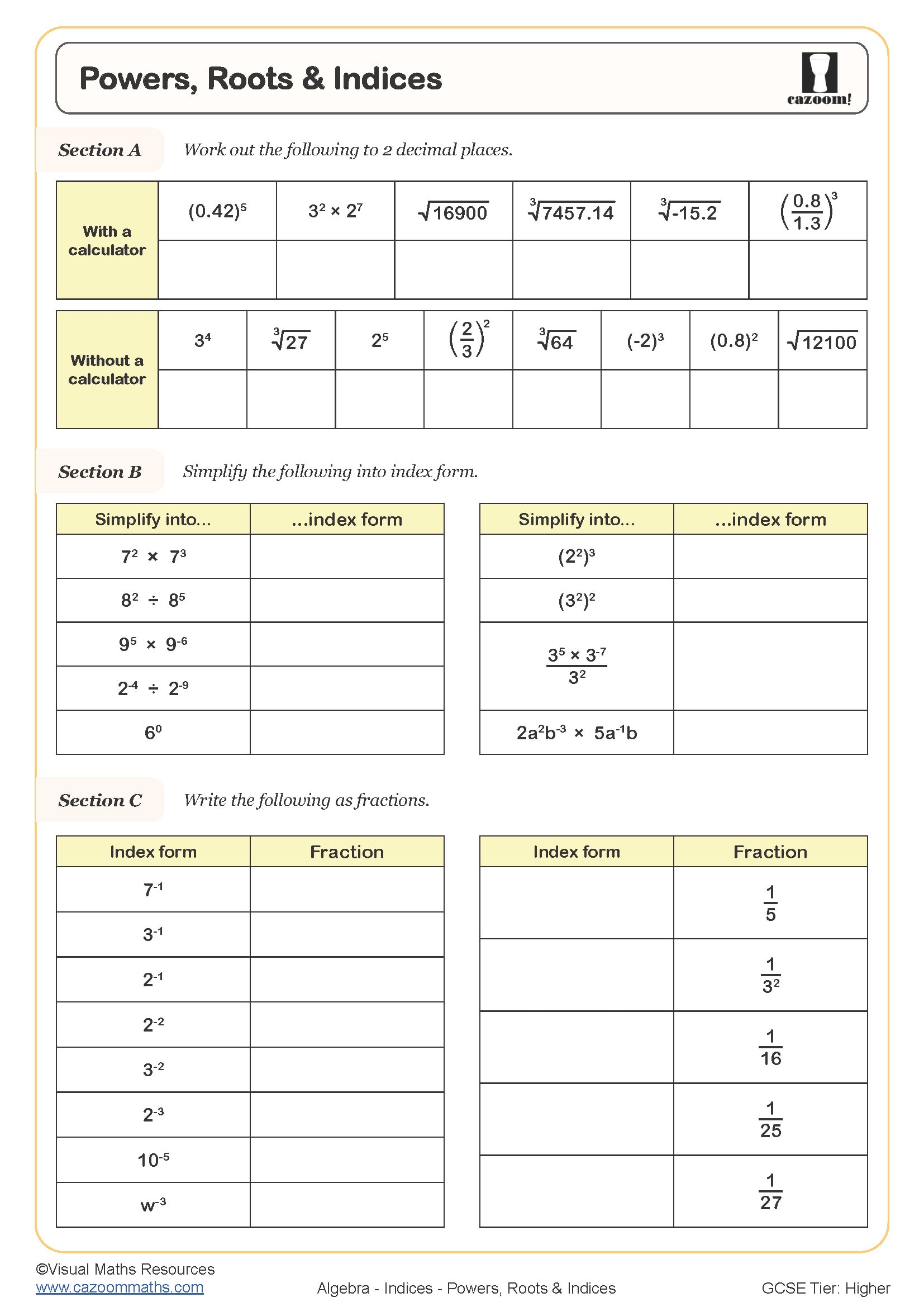
Powers, Roots and Indices
Year groups: 10, 11
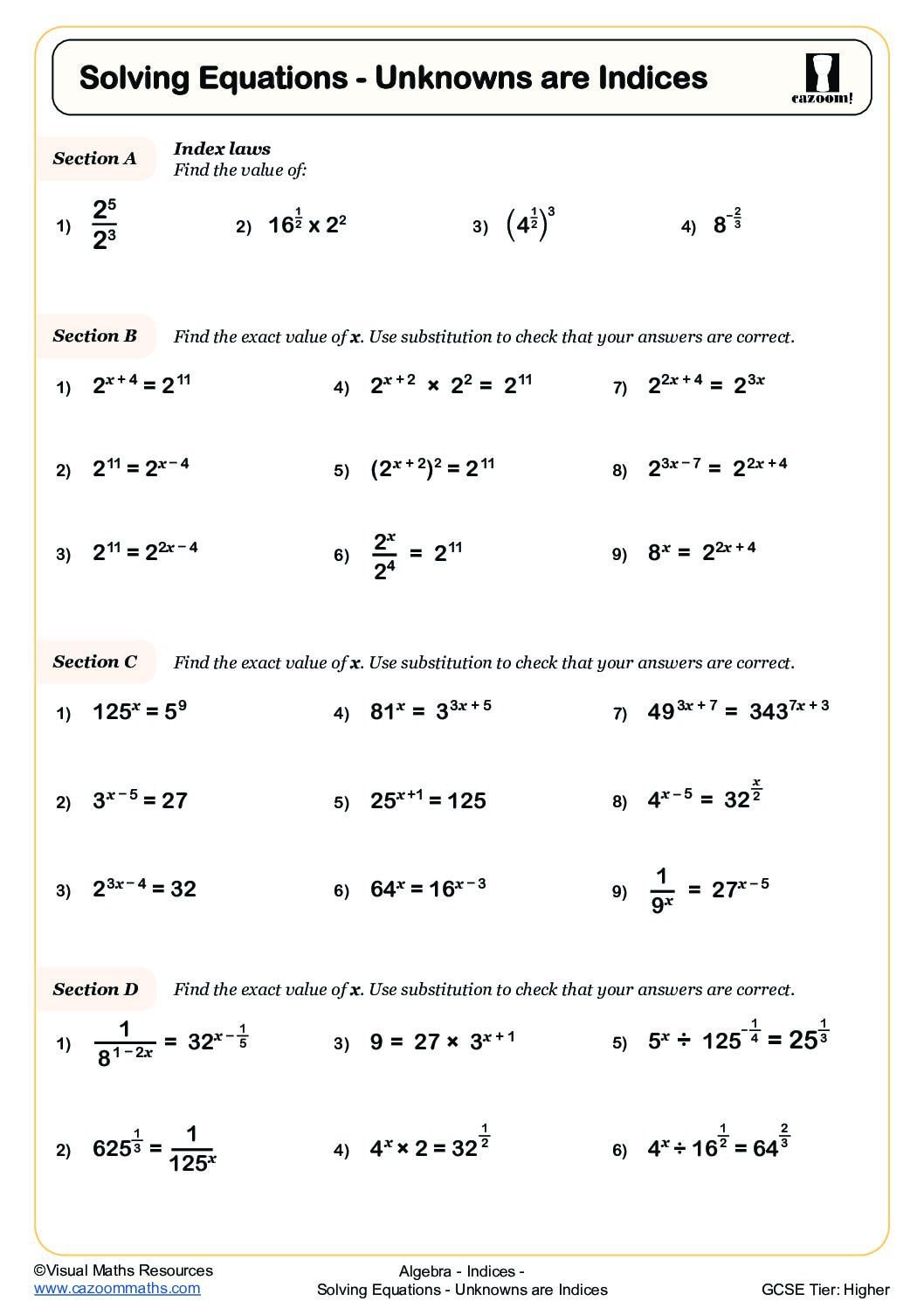
Solving Equations - Unknowns are Indices
Year groups: 10, 11
All worksheets are created by the team of experienced teachers at Cazoom Maths.
What makes an effective indices worksheet for KS3 and KS4 students?
An effective indices worksheet balances conceptual understanding with procedural fluency, starting with numerical examples before progressing to algebraic expressions. At KS3, students need to grasp that 3⁴ means 3 × 3 × 3 × 3, whilst KS4 work extends to expressions like (2x³)⁴ and negative or fractional indices that appear in GCSE examinations.
Teachers frequently notice that students make errors when applying multiple index rules simultaneously, such as simplifying (x²)³ ÷ x⁴. Quality worksheets include stepped examples that break down compound operations, helping students identify which law of indices applies at each stage before attempting more complex algebraic manipulations.
Which year groups should use indices worksheets and how does the topic progress?
Indices typically begin in Year 7 with simple powers of whole numbers, progressing through Year 8 to include basic laws like x^m × x^n = x^(m+n). Year 9 students encounter zero and negative indices, whilst Years 10-11 work with fractional indices and complex expressions that appear in GCSE papers.
The progression requires careful scaffolding as students often confuse different operations. Teachers report success when introducing each law separately before combining them, particularly when moving from arithmetic examples like 2³ × 2⁴ = 2⁷ to algebraic versions like a³ × a⁴ = a⁷, ensuring students understand the underlying mathematical relationships rather than memorising procedures.
How can students master negative indices effectively?
Negative indices often cause confusion because students struggle to understand why x⁻³ equals 1/x³. Teachers find that demonstrating the pattern through division helps: x³ ÷ x⁶ = x⁻³, which must also equal 1/x³ from fundamental fraction principles. This connection makes the rule logical rather than arbitrary.
Practice worksheets should include converting between forms, such as writing 2⁻⁴ as 1/16 and vice versa. Students frequently make sign errors when dealing with expressions like (-3)⁻² versus -3⁻², so targeted practice distinguishing these cases proves valuable. Real-world applications in scientific notation, particularly with very small measurements in biology or physics, help students see the practical value of negative indices.
How should teachers use these indices worksheets most effectively in lessons?
Begin each topic with worked examples on the board before distributing worksheets, ensuring students understand the mathematical reasoning behind each law of indices. Teachers report better outcomes when students attempt a few problems independently before peer discussion, allowing them to identify their own misconceptions before seeking help.
The answer sheets enable students to self-assess their work during lessons, but teachers should encourage students to show their working steps rather than just checking final answers. This approach reveals where errors occur in multi-step problems. Using worksheets for homework consolidation works well, but brief starter activities using similar problems help maintain fluency across multiple lessons, particularly important given how indices underpin logarithms and exponential functions in advanced courses.