Introducing Algebra Worksheets
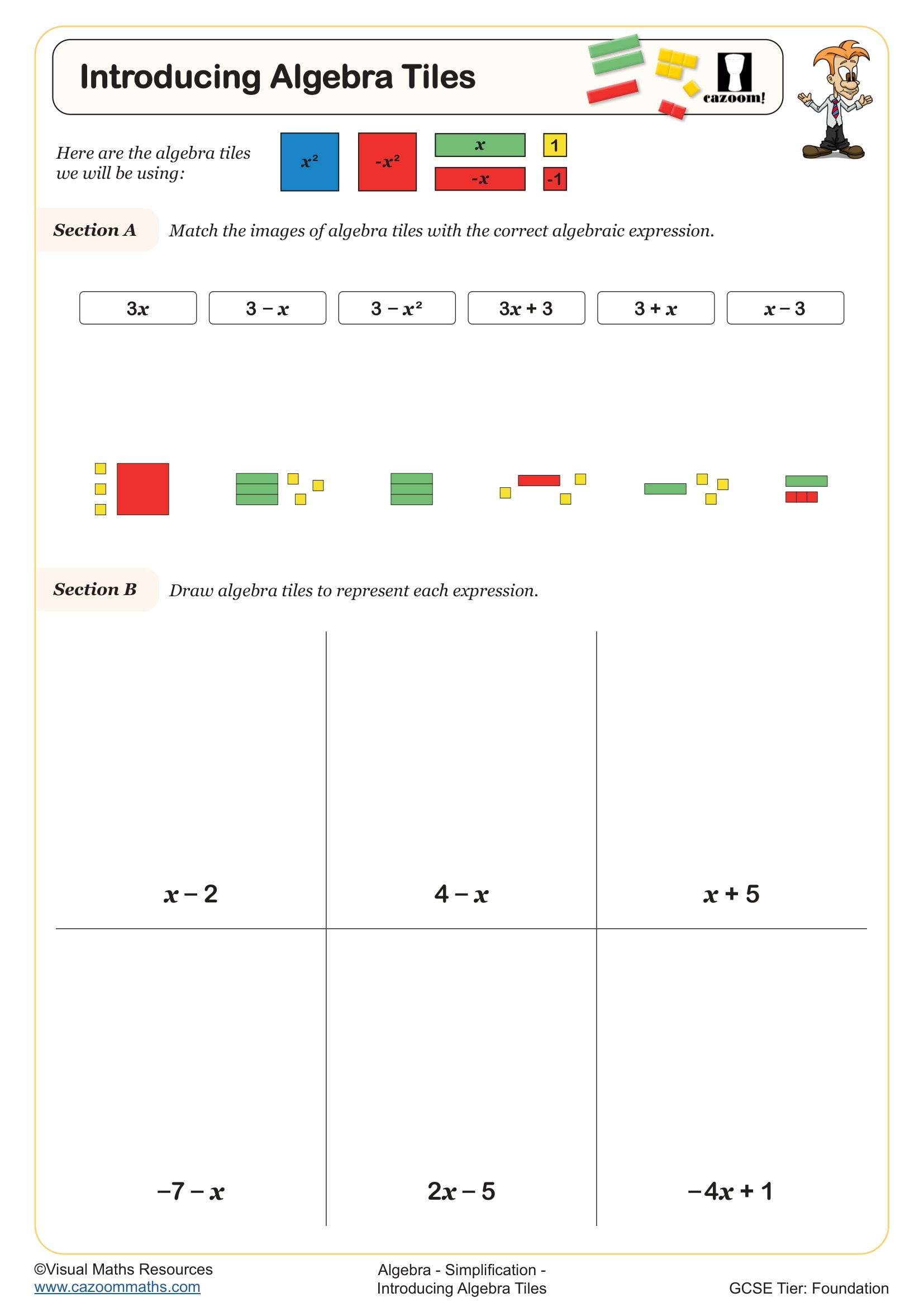
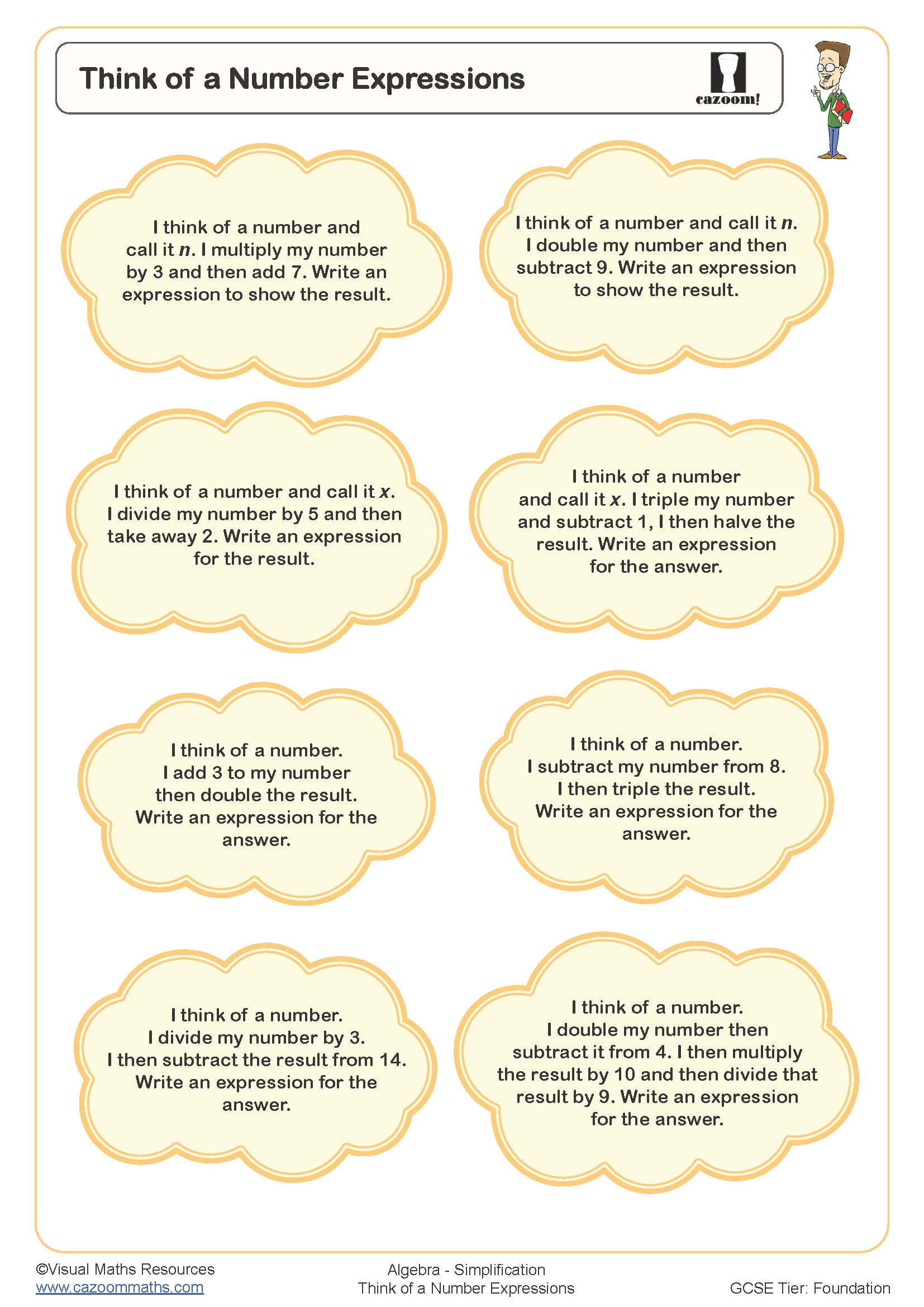
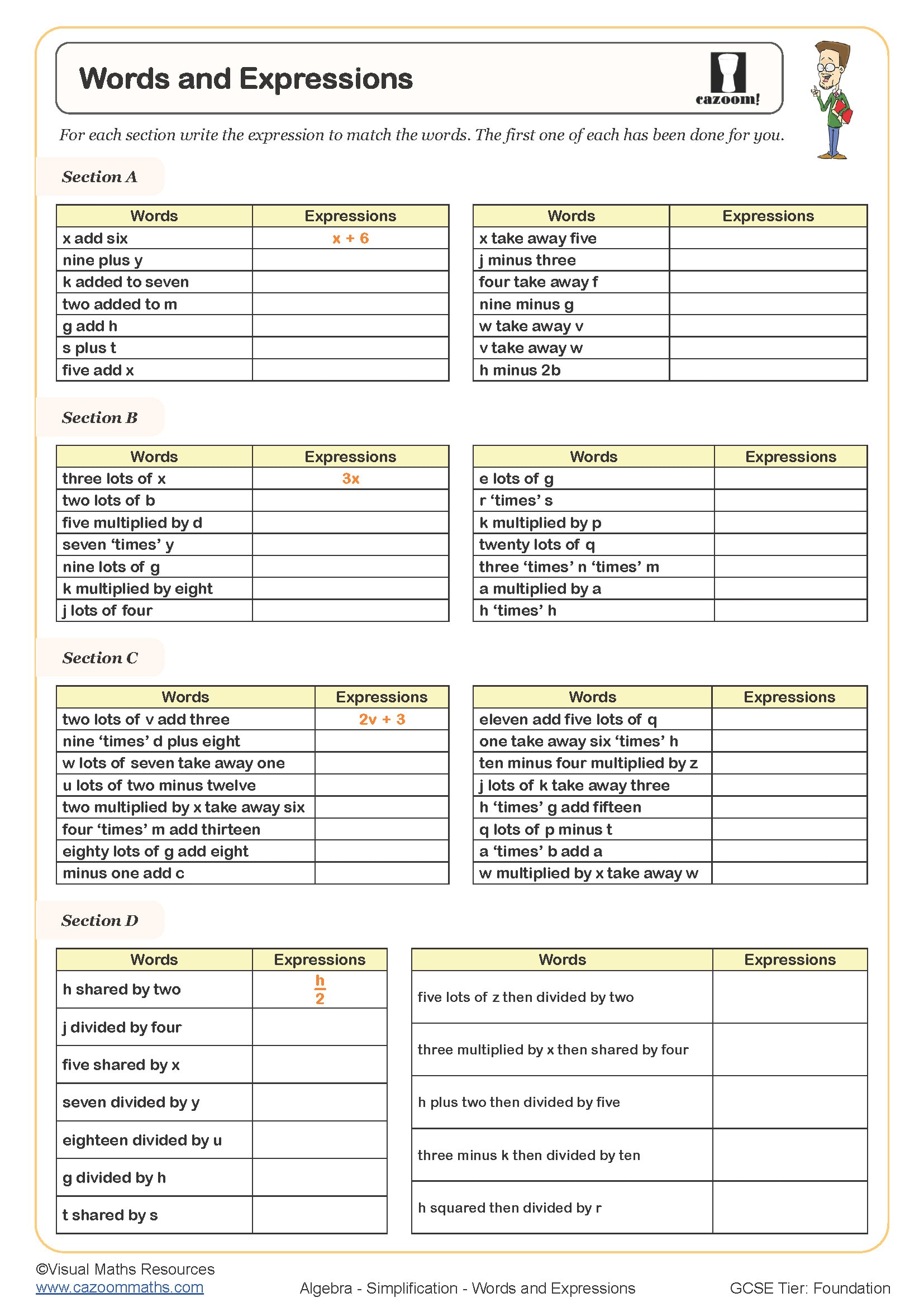
All worksheets are created by the team of experienced teachers at Cazoom Maths.
What is introducing algebra in KS3 maths?
Introducing algebra at KS3 marks the shift from working with known numbers to representing unknown or variable quantities with letters. Students learn to write and simplify algebraic expressions, substitute numerical values into formulae, and understand conventions such as writing 3a instead of a+a+a. This foundation appears in the National Curriculum from Year 7 onwards and underpins every GCSE algebra topic.
A common misconception occurs when students treat 3a+2b as 5ab, combining unlike terms as though they were addition. Teachers observe this particularly when students confuse the compact notation of algebra with the combining rules they know from arithmetic. Worksheets that explicitly contrast correct and incorrect simplifications help students recognise why terms must share the same letter part to be combined.
Which year groups study introducing algebra?
These worksheets cover introducing algebra for Year 7 and Year 8, aligning with the KS3 programme of study. Year 7 students typically encounter algebraic notation for the first time, learning to form and simplify expressions using single letters. By Year 8, students extend this to more complex expressions involving multiple terms and begin working with basic algebraic manipulation.
The progression across these year groups sees students move from recognising that 5n means five lots of n to confidently simplifying expressions like 4x+3y-2x+y and substituting values into formulae with multiple variables. Year 8 worksheets introduce negative coefficients and require students to collect like terms across longer expressions, building the fluency needed for solving equations in Year 9.
Why do we use letters in algebra?
Letters in algebra represent quantities that can vary or are unknown, allowing mathematicians to write general rules and relationships that work for multiple situations. Instead of writing separate calculations for different values, an expression like 2n+3 describes a pattern that applies universally. This abstraction lets students move beyond specific numbers to understand mathematical structure and create formulae.
This skill connects directly to STEM fields where variables represent real measurements. Engineers use algebraic expressions to calculate material costs (if c is cost per metre, then 5c represents five metres of material), whilst scientists write formulae linking quantities like speed, distance and time. Understanding that letters can represent changing values rather than fixed unknowns prepares students for mathematical modelling across science, technology and economics.
How do these worksheets help students learn algebra?
The worksheets build understanding through structured progression, starting with straightforward expressions involving single operations before introducing multiple terms and different letters. Each sheet includes questions that require students to translate between words and algebra, write expressions from given information, and simplify by collecting like terms. Answer sheets allow students to check their working independently and identify where errors occur in their simplification process.
Teachers use these resources for targeted intervention with students who struggle to make the leap from numerical to algebraic thinking, as homework to consolidate lesson content, or as starter activities to assess prior knowledge. The worksheets work particularly well for paired discussion, where students can articulate why certain terms combine whilst others do not, strengthening their conceptual understanding alongside procedural fluency.