Introduction to Indices Worksheets
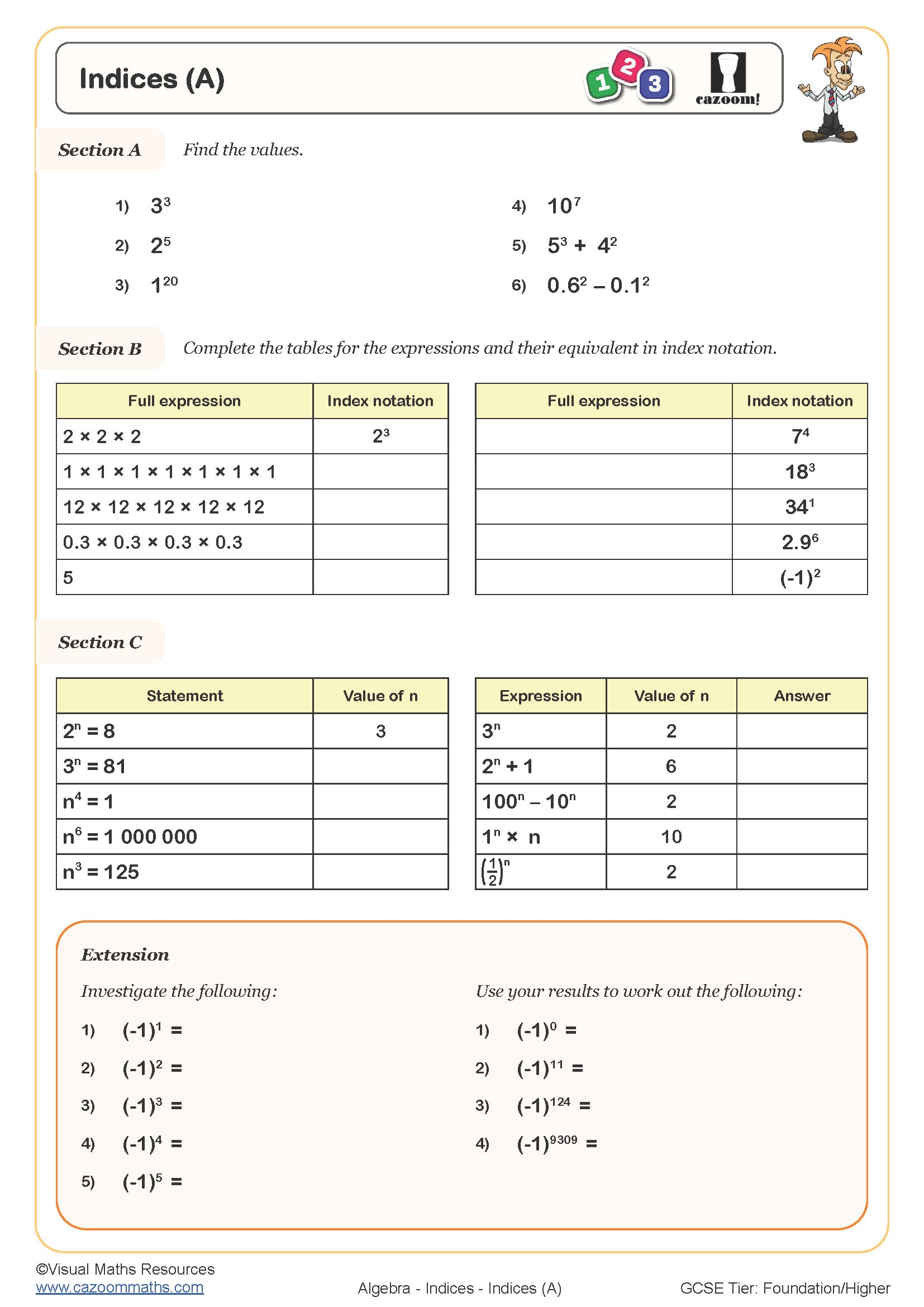
All worksheets are created by the team of experienced teachers at Cazoom Maths.
What Are Indices and Why Do Students Find Them Challenging?
Indices (also called powers or exponents) are a shorthand way of writing repeated multiplication. For example, 2 × 2 × 2 × 2 can be written as 2⁴, where 4 is the index or power. Students often struggle with indices because they represent abstract notation that moves away from concrete arithmetic, requiring them to understand both the base number and the power simultaneously.
The transition from writing out full calculations to using index notation demands careful attention to detail. Common misconceptions include confusing 2⁴ with 2 × 4, or struggling to evaluate expressions like 5³ correctly. Our worksheets address these difficulties through progressive exercises that reinforce the fundamental relationship between repeated multiplication and index form, building secure foundations before moving to more complex index laws.
Which Year Groups Study Introduction to Indices?
Introduction to indices is typically taught during Key Stage 3, with our worksheets specifically designed for Year 8 and Year 9 pupils. Year 8 students encounter indices as part of their algebraic development, learning to write and evaluate simple powers before progressing to basic index laws. Year 9 pupils consolidate this understanding and extend it to more sophisticated applications.
The National Curriculum expects KS3 students to understand and use index notation for positive integer powers, preparing them for GCSE-level work with negative and fractional indices. These worksheets provide age-appropriate practice that bridges arithmetic understanding and algebraic manipulation, ensuring students develop fluency with index notation before tackling more advanced concepts in later years.
How Do Students Calculate Simple Powers?
Calculating simple powers requires students to multiply the base number by itself the number of times indicated by the index. For 3⁴, students multiply 3 × 3 × 3 × 3 = 81. This process reinforces understanding that the index tells you how many times to use the base as a factor, not what to multiply it by.
Our worksheets guide students through systematic practice, starting with small bases and indices before progressing to larger numbers. Exercises include evaluating powers, converting between repeated multiplication and index notation, and comparing the size of different powers. This structured approach prevents the common error of treating indices as simple multiplication whilst building the computational accuracy needed for more advanced index work in algebra.
What's Included with These Introduction to Indices Worksheets?
Each worksheet comes with a complete answer sheet, allowing students to check their work independently or enabling teachers to mark efficiently. The resources are provided as downloadable PDFs, making them straightforward to print for classroom use or share digitally for homework and remote learning.
The worksheets feature clearly laid out questions with sufficient space for working, helping students organise their calculations methodically. Questions progress from basic evaluation of powers to more challenging problems requiring deeper understanding of index notation. This format supports differentiation in mixed-ability settings whilst maintaining focus on the core skills needed to master indices at KS3 level, providing a solid foundation for future work with index laws and algebraic manipulation.