Inverse Functions Worksheets
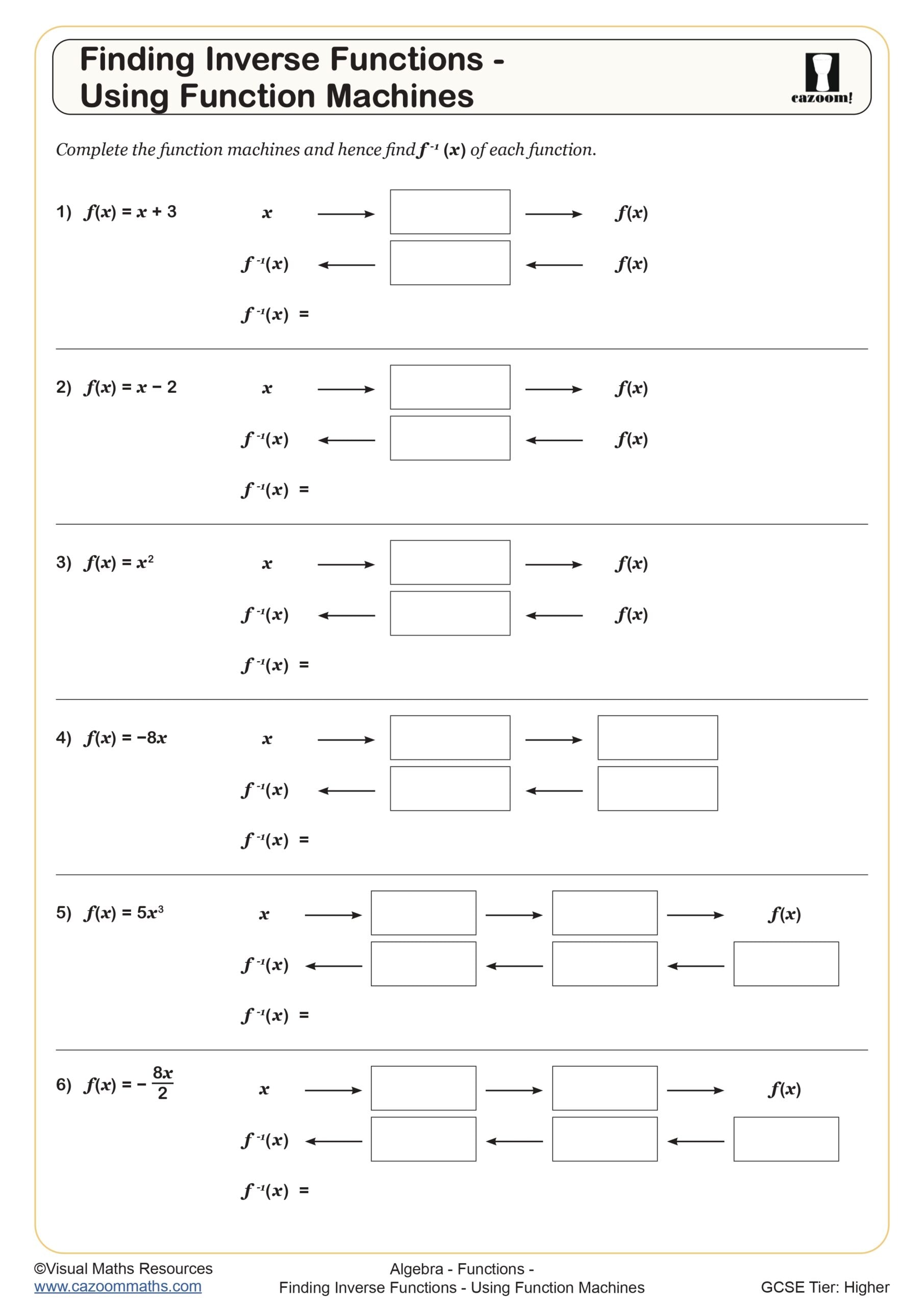
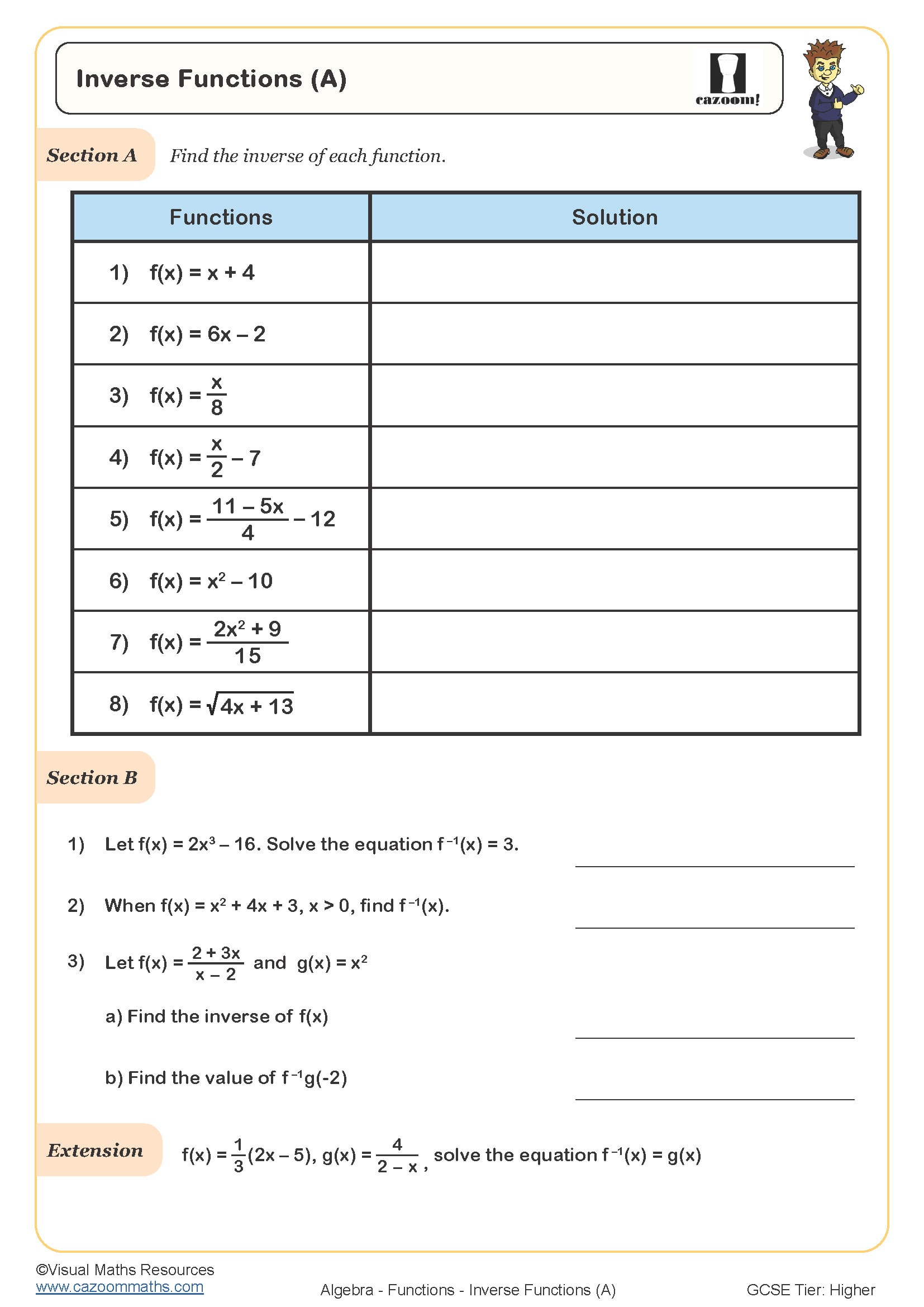
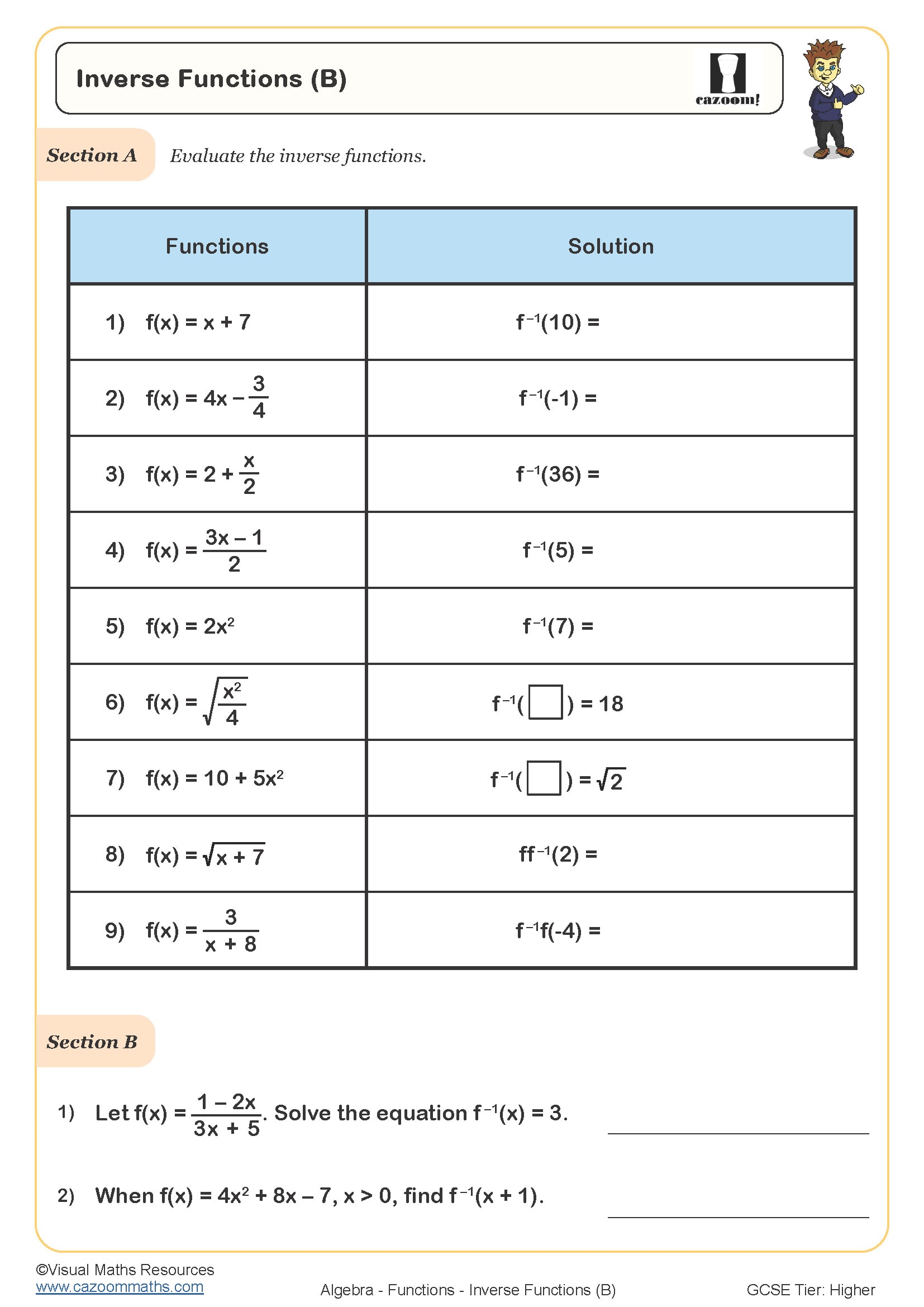
All worksheets are created by the team of experienced teachers at Cazoom Maths.
What Are Inverse Functions in GCSE Maths?
An inverse function reverses the effect of the original function, returning you to the starting value. If function f maps x to y, then the inverse function f⁻¹ maps y back to x. At GCSE, students work with algebraic functions like f(x) = 3x + 5, finding the inverse by swapping x and y, then rearranging to make y the subject again. This appears primarily on Higher tier papers and links directly to solving equations.
Students commonly confuse the notation f⁻¹(x) with the reciprocal 1/f(x), losing marks in exams when they misinterpret the question. Another frequent error occurs when students forget to reverse every operation in the correct order. For instance, with f(x) = (x - 2)/3, students must multiply by 3 first, then add 2, not the other way around. Exam mark schemes specifically look for this systematic reversal of operations.
Which Year Groups Study Inverse Functions?
Inverse functions appear in the Key Stage 4 curriculum for Year 10 and Year 11 students following the Higher tier GCSE pathway. This topic builds on earlier work with function notation and solving equations, typically introduced after students are confident with composite functions and function machines. The National Curriculum expects students to understand that only one-to-one functions have inverses and to verify that two functions are inverses by composition.
Across Year 10 and Year 11, the difficulty increases from finding inverses of linear functions like f(x) = 2x - 7 to more complex expressions involving fractions, such as f(x) = (3x + 1)/(x - 2). Students also progress from straightforward inverse calculations to exam questions requiring them to find f⁻¹(x), then evaluate f⁻¹(a) for specific values, or prove that ff⁻¹(x) = x. This layered approach ensures students understand both the mechanical process and the conceptual meaning of inverse functions.
How Do You Use Function Notation When Finding Inverses?
Using function notation correctly is fundamental when working with inverses. Students replace f(x) with y, swap the positions of x and y, then rearrange to make y the subject. The result is written as f⁻¹(x) = [the rearranged expression]. This systematic method prevents errors and makes checking possible by substituting values. Teachers observe that students who skip the 'swap x and y' step often produce incorrect inverses that don't satisfy the condition ff⁻¹(x) = x.
Inverse functions have direct applications in real-world contexts, particularly in physics and engineering. Temperature conversion provides a clear example: if f(C) = 1.8C + 32 converts Celsius to Fahrenheit, then f⁻¹(F) converts Fahrenheit back to Celsius. In computer science, encryption algorithms rely on inverse functions to decode messages, whilst in economics, inverse demand functions help calculate price from quantity. Understanding inverses helps students see functions as reversible processes rather than abstract symbols, strengthening their algebraic reasoning for A-level mathematics and STEM subjects.
How Can These Worksheets Support Learning About Inverse Functions?
The worksheets provide structured practice that builds from basic inverse function problems through to GCSE-style questions requiring multiple steps. Each sheet includes clear function notation and space for working, encouraging students to show the swap-and-rearrange method explicitly. Worked examples or scaffolded questions help students see the systematic approach needed, whilst answer sheets allow immediate checking of algebraic manipulation, which is where most errors occur in this topic.
These resources work well for targeted intervention with Higher tier groups who find function notation challenging, or as revision material before mock exams. Teachers often use them for homework after introducing the topic, as the answer sheets enable students to identify their own mistakes and correct misunderstandings independently. They're also effective for paired work where students can discuss their methods for rearranging, helping them articulate the reverse operation process. For students preparing for GCSE, timed practice with these worksheets helps build the fluency needed to tackle inverse function questions confidently under exam conditions.