Laws of Indices - Brackets Worksheets
All worksheets are created by the team of experienced teachers at Cazoom Maths.
What are the laws of indices for brackets?
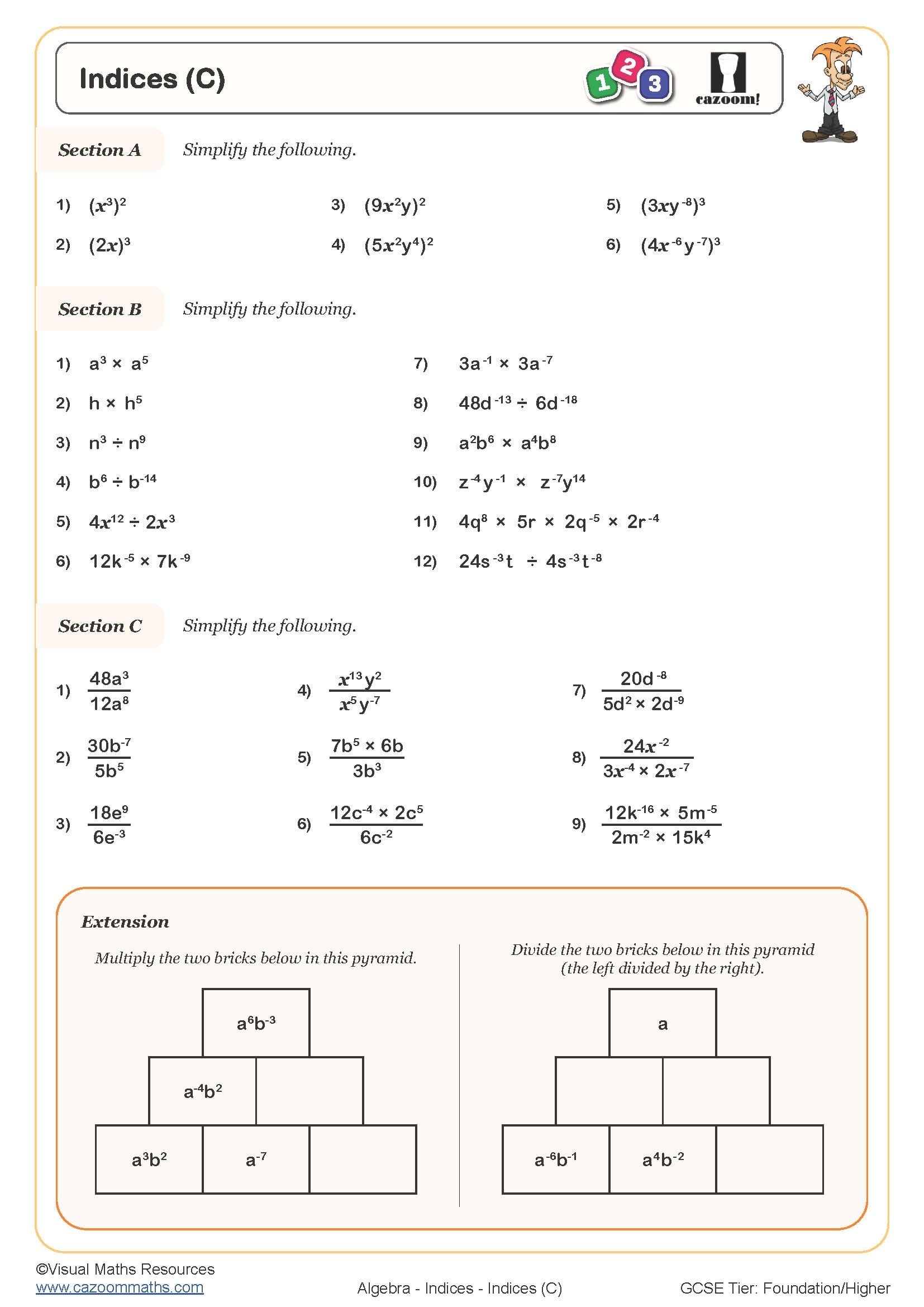
The bracket law of indices states that when a power is raised to another power, you multiply the indices together: (aᵐ)ⁿ = aᵐⁿ. For example, (x³)⁴ = x¹² because 3 × 4 = 12. This law becomes more sophisticated when combined with other index laws, such as when brackets contain products like (2x²y³)⁴, which requires distributing the outer power to each term inside.
Students often encounter this alongside multiplication and division laws, particularly in algebraic simplification. Common mistakes include adding instead of multiplying the powers, or forgetting to apply the outer power to numerical coefficients. Our worksheets provide systematic practice with these scenarios, ensuring students develop fluency with brackets before tackling more complex algebraic expressions.
Which year groups study laws of indices with brackets?
Laws of indices involving brackets appear in the National Curriculum from Year 9 onwards, spanning both KS3 and KS4. Year 9 students typically meet the basic power law (aᵐ)ⁿ = aᵐⁿ as part of their introduction to algebraic manipulation. The concept builds in complexity through Year 10, where it combines with other index laws in examination-style questions.
By Year 11, students must confidently apply bracket laws alongside multiplication, division, and negative indices in preparation for GCSE examinations. Our worksheets cater to all these year groups, with questions pitched appropriately for each stage of development. This progressive approach ensures students build solid foundations before moving to more demanding applications of index laws.
How do you simplify expressions with multiple brackets and indices?
Simplifying expressions with multiple brackets requires applying the power law systematically to each bracketed term before dealing with any multiplication or division between terms. For instance, in (x³)² × (x²)⁴, you first calculate x⁶ × x⁸, then add the indices to get x¹⁴. The key is working through brackets first, then applying other index laws in sequence.
When brackets contain coefficients and multiple variables, such as (3a²b³)², students must raise every factor inside the bracket to the outer power: 3² × a⁴ × b⁶ = 9a⁴b⁶. Our worksheets provide extensive practice with these multi-step problems, helping students develop a methodical approach. Regular practice prevents common errors like forgetting to raise coefficients or incorrectly combining unlike terms.
Do the worksheets include worked solutions?
Every worksheet in our collection includes complete answer sheets showing final solutions for all questions. These answer sheets allow teachers to mark work efficiently and enable students to check their understanding independently. For topics involving laws of indices with brackets, having accurate answers is essential, as algebraic errors can easily compound through multi-step problems.
The answer sheets support self-assessment and help students identify specific misconceptions, such as adding instead of multiplying powers or mishandling coefficients. All worksheets are provided as downloadable PDFs, making them straightforward to print for classroom use or to share digitally for homework. This flexibility ensures resources suit different teaching environments while maintaining the high-quality practice students need to master index laws.