Laws of Indices - Multiplying and Dividing Worksheets
All worksheets are created by the team of experienced teachers at Cazoom Maths.
What are the laws of indices for multiplying and dividing?
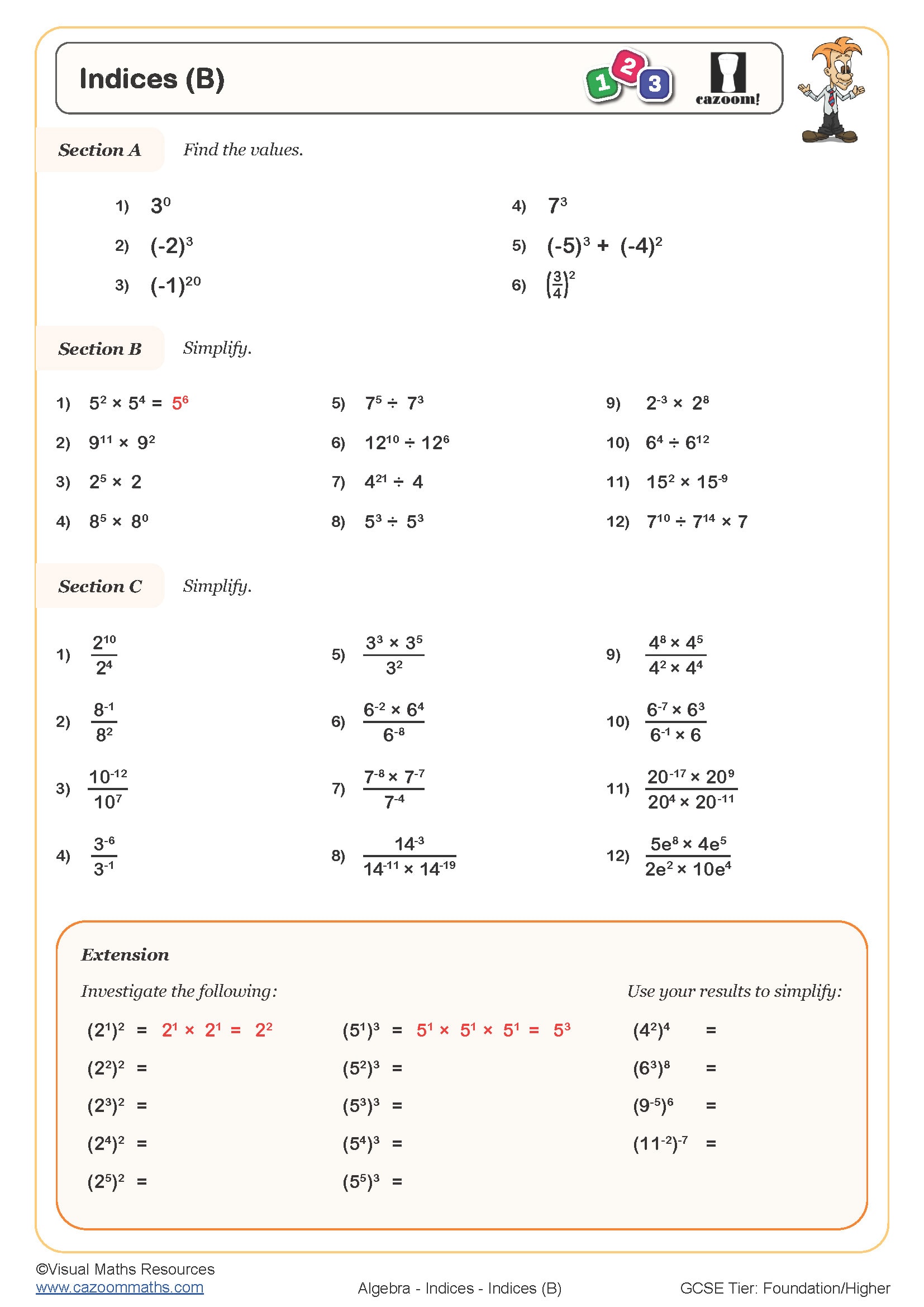
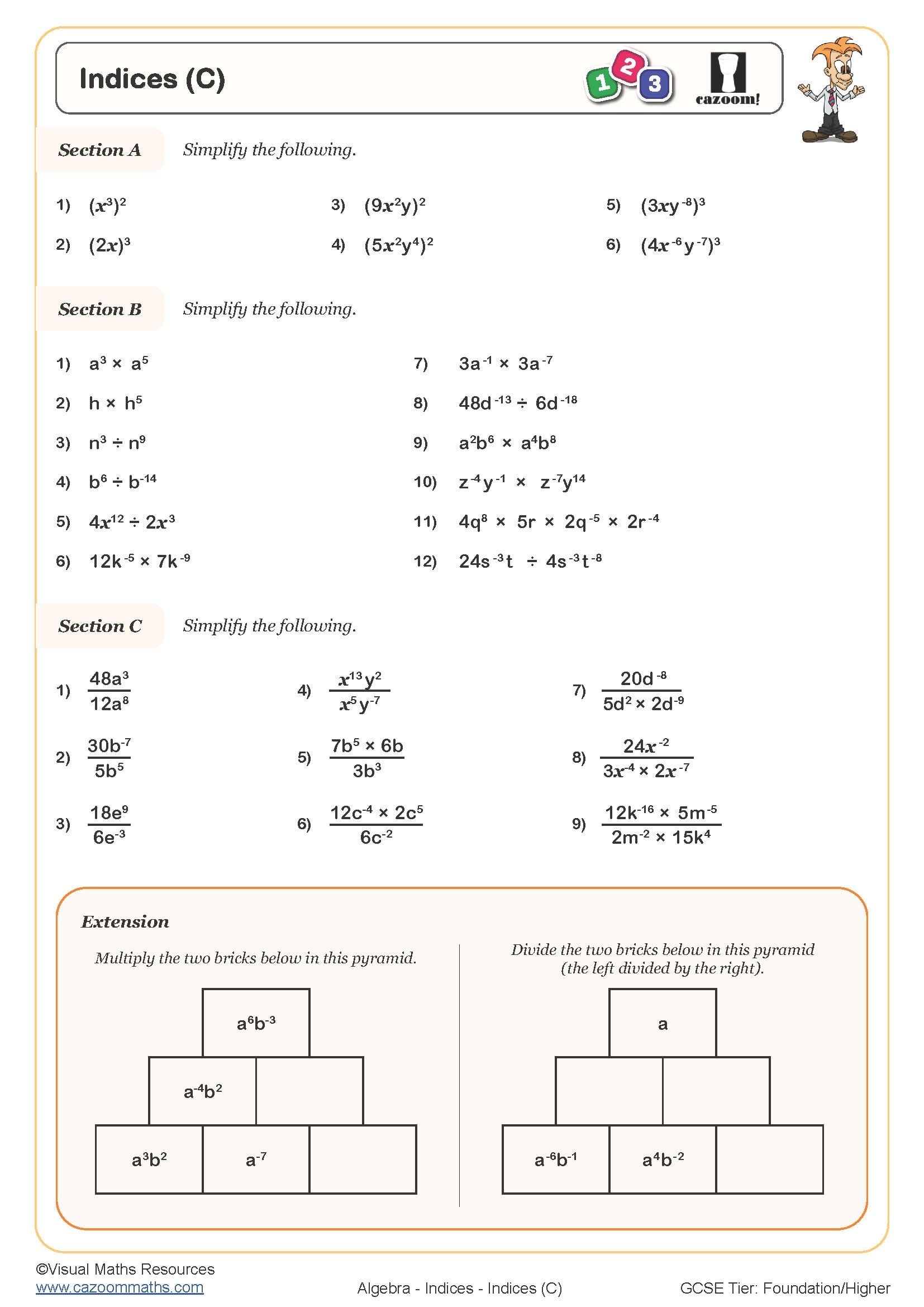
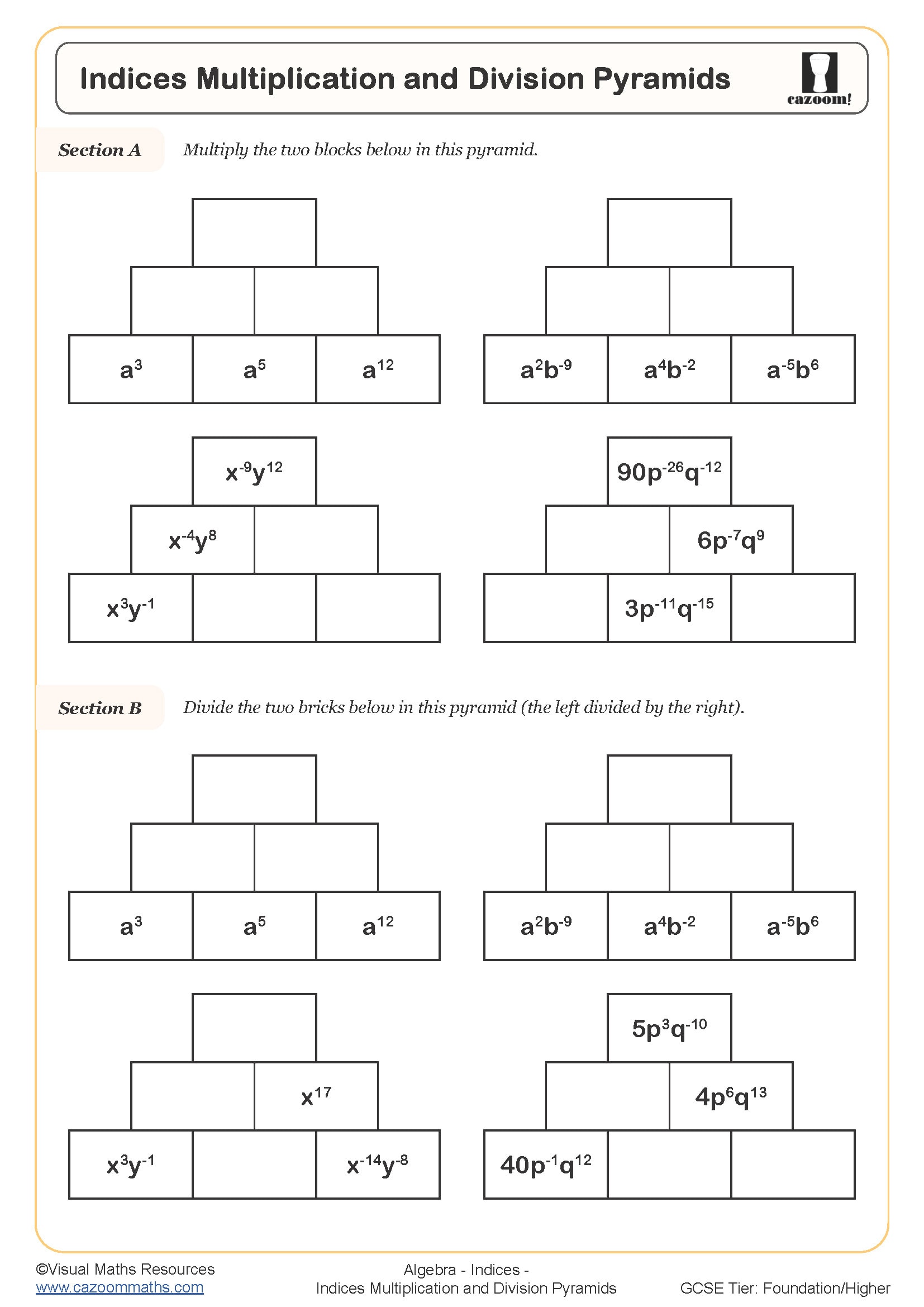
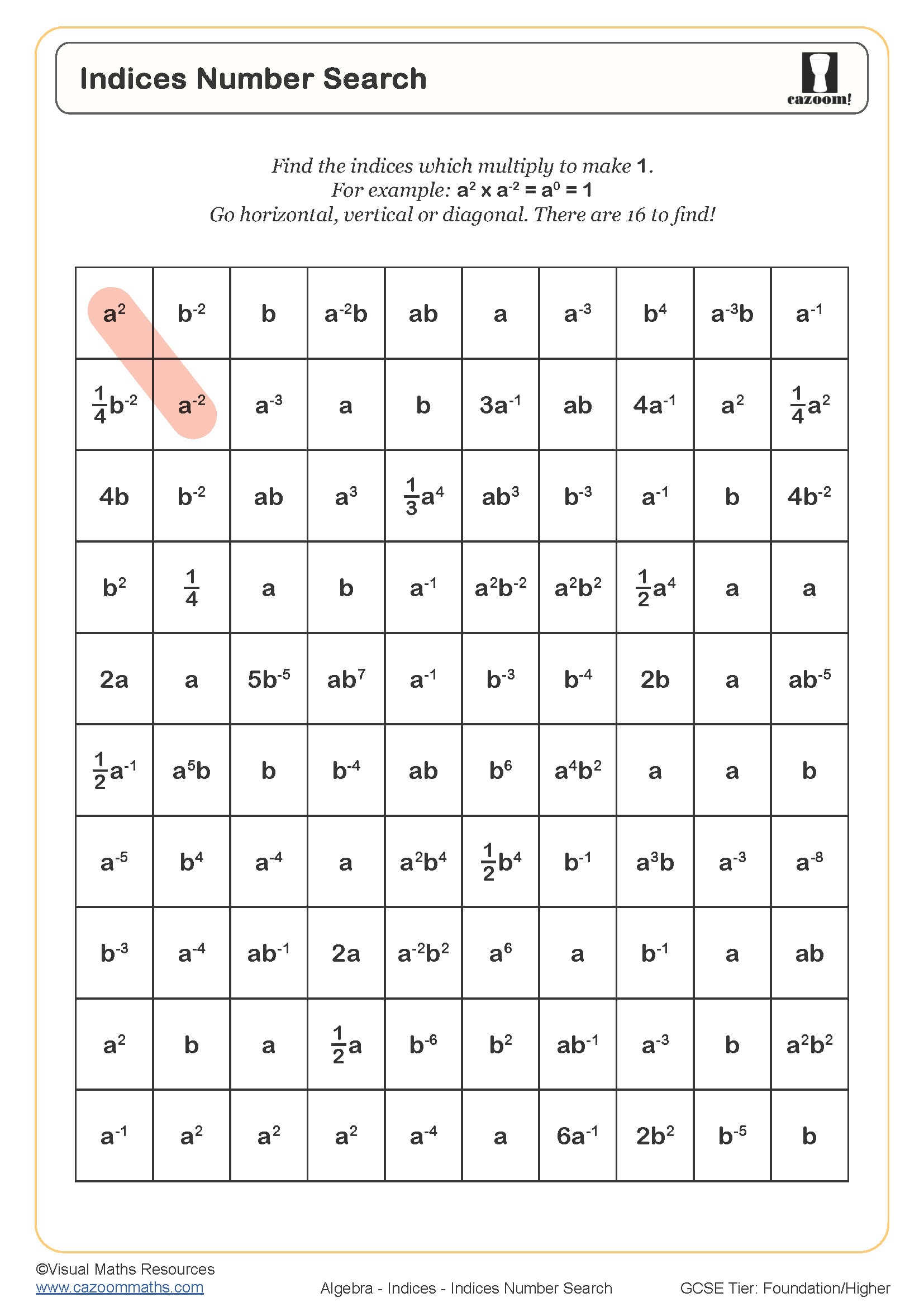
When multiplying terms with the same base, you add the powers together: a^m × a^n = a^(m+n). For example, x^3 × x^5 = x^8. This rule works because you're essentially counting the total number of times the base is multiplied by itself. Students often confuse this with multiplying the powers, so clear practice distinguishing between the base and the exponent is essential.
When dividing terms with the same base, you subtract the powers: a^m ÷ a^n = a^(m-n). For instance, y^7 ÷ y^2 = y^5. This follows logically from cancellation—when you divide, matching factors in the numerator and denominator cancel out. Worksheets reinforce these rules through varied examples, including numerical bases that students can verify by expanding.
Which year groups study multiplying and dividing with indices?
Laws of indices for multiplying and dividing are introduced in Year 8 as part of the KS3 algebra curriculum. Students initially work with simple numerical examples before progressing to algebraic expressions. Year 9 builds on this foundation with more complex problems involving larger powers and mixed operations, ensuring fluency before GCSE courses begin.
At KS4, Year 10 and Year 11 students revisit these laws as essential tools for algebraic manipulation. GCSE questions frequently combine index laws with other algebraic techniques, including expanding brackets, factorising, and solving equations. Higher-tier papers may include questions with negative or fractional indices alongside the multiplication and division rules, requiring secure understanding of the foundational concepts.
How do you multiply indices with different bases?
You cannot directly combine indices when the bases are different—this is a common misconception. For example, 2^3 × 3^2 cannot be simplified using index laws; you must calculate each term separately (8 × 9 = 72). The multiplication rule only applies when bases are identical. However, expressions can sometimes be rewritten to reveal common bases, such as recognising that 4 = 2^2.
Worksheets include questions that test whether students understand this limitation. Mixed exercises featuring both like and unlike bases help develop discrimination skills. Students learn to identify when index laws apply and when they need alternative approaches, building mathematical reasoning alongside procedural fluency. This understanding prevents errors in more complex algebraic work.
Do these worksheets include worked solutions?
Every worksheet comes with comprehensive answer sheets showing the final answers. These allow students to check their work independently and identify any errors in their calculations. For teachers, answer sheets streamline marking and make it straightforward to provide targeted feedback on specific areas where students struggle with applying the index laws correctly.
The worksheets progress systematically through difficulty levels, starting with straightforward numerical bases before introducing algebraic terms and more complex expressions. This structured approach supports differentiation in mixed-ability classrooms. Students can work at their own pace, and teachers can assign specific worksheets targeting individual learning needs. The PDF format means resources are ready to print or share digitally for homework or remote learning.