Parallel and Perpendicular Lines Worksheets
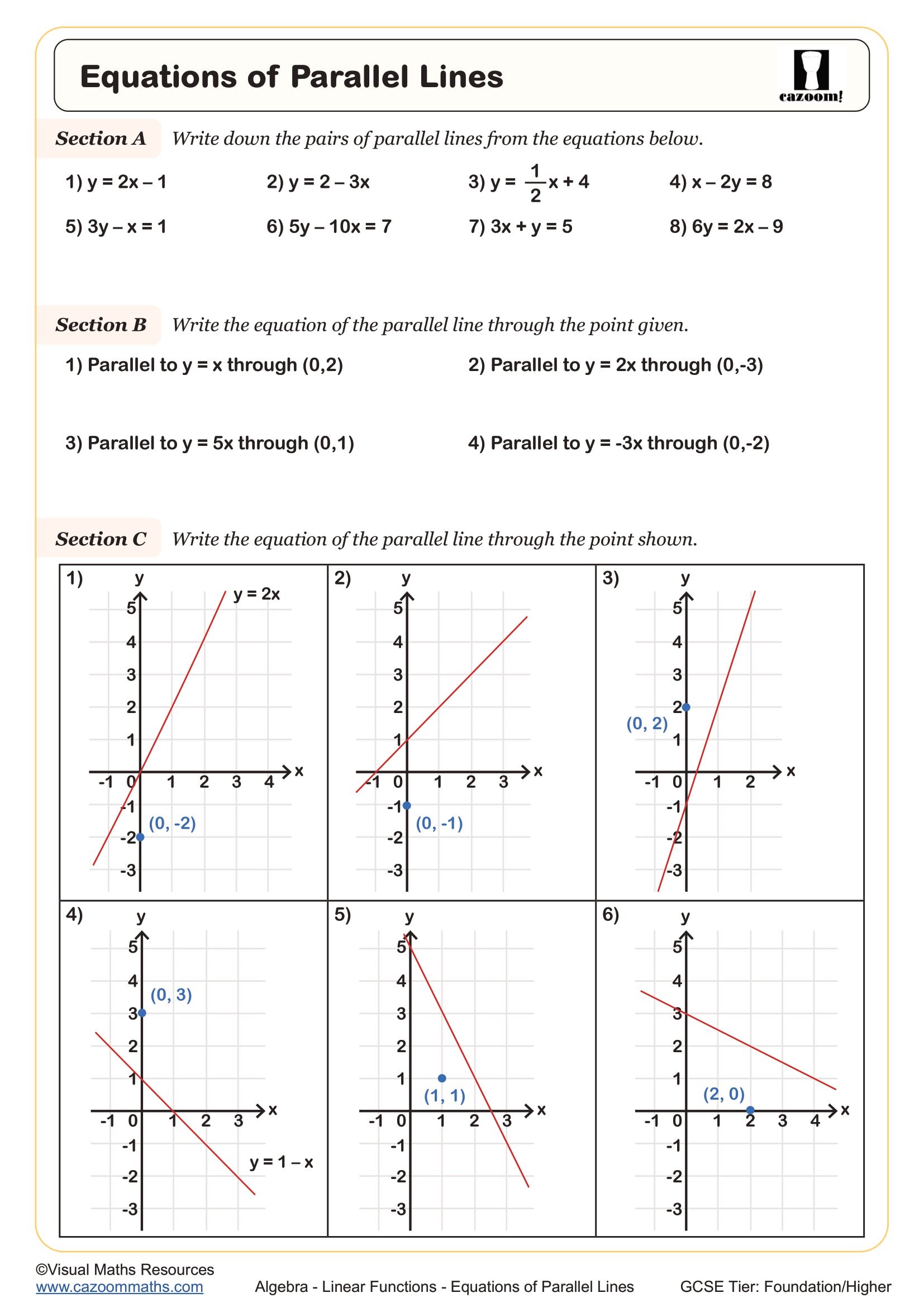
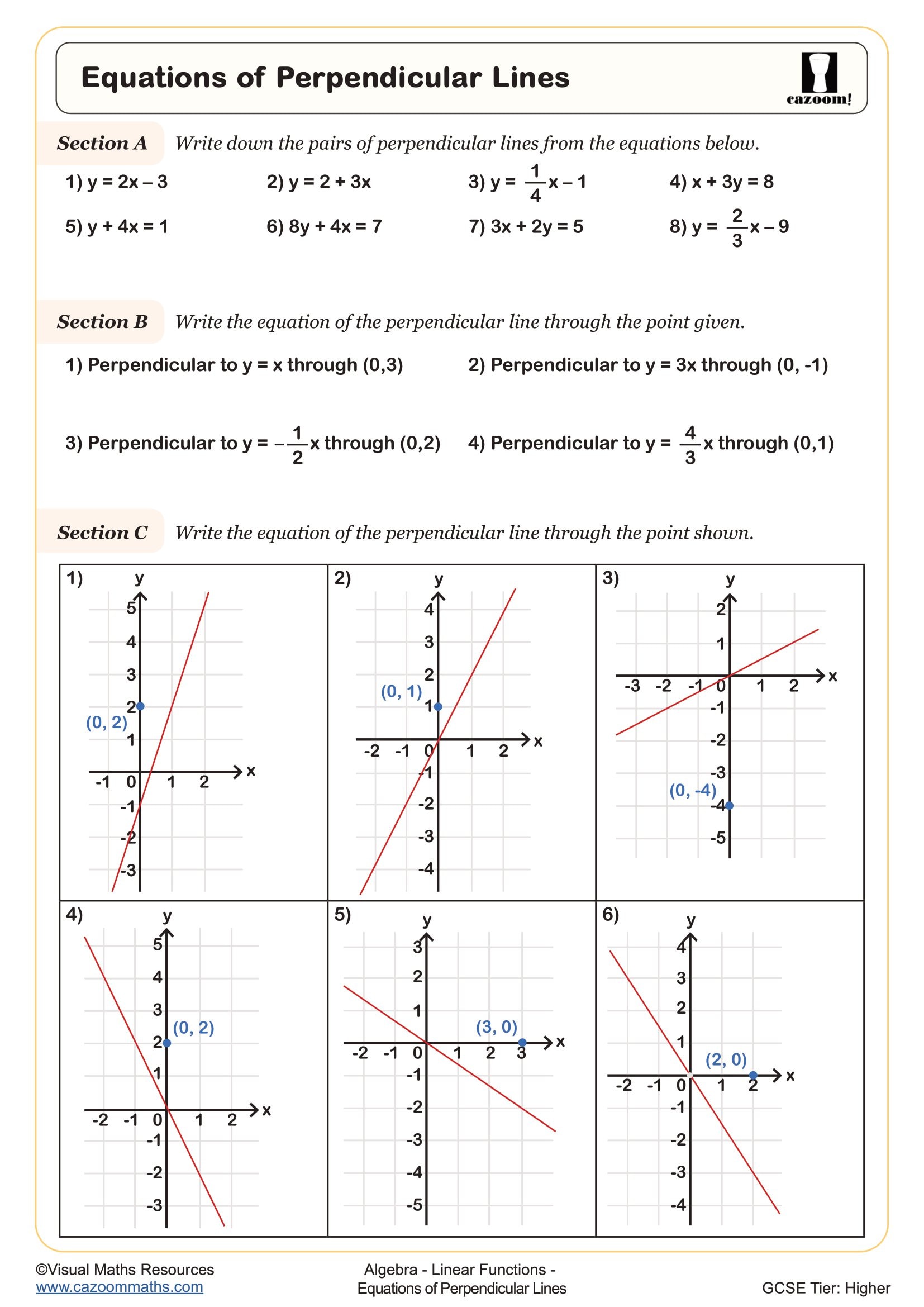
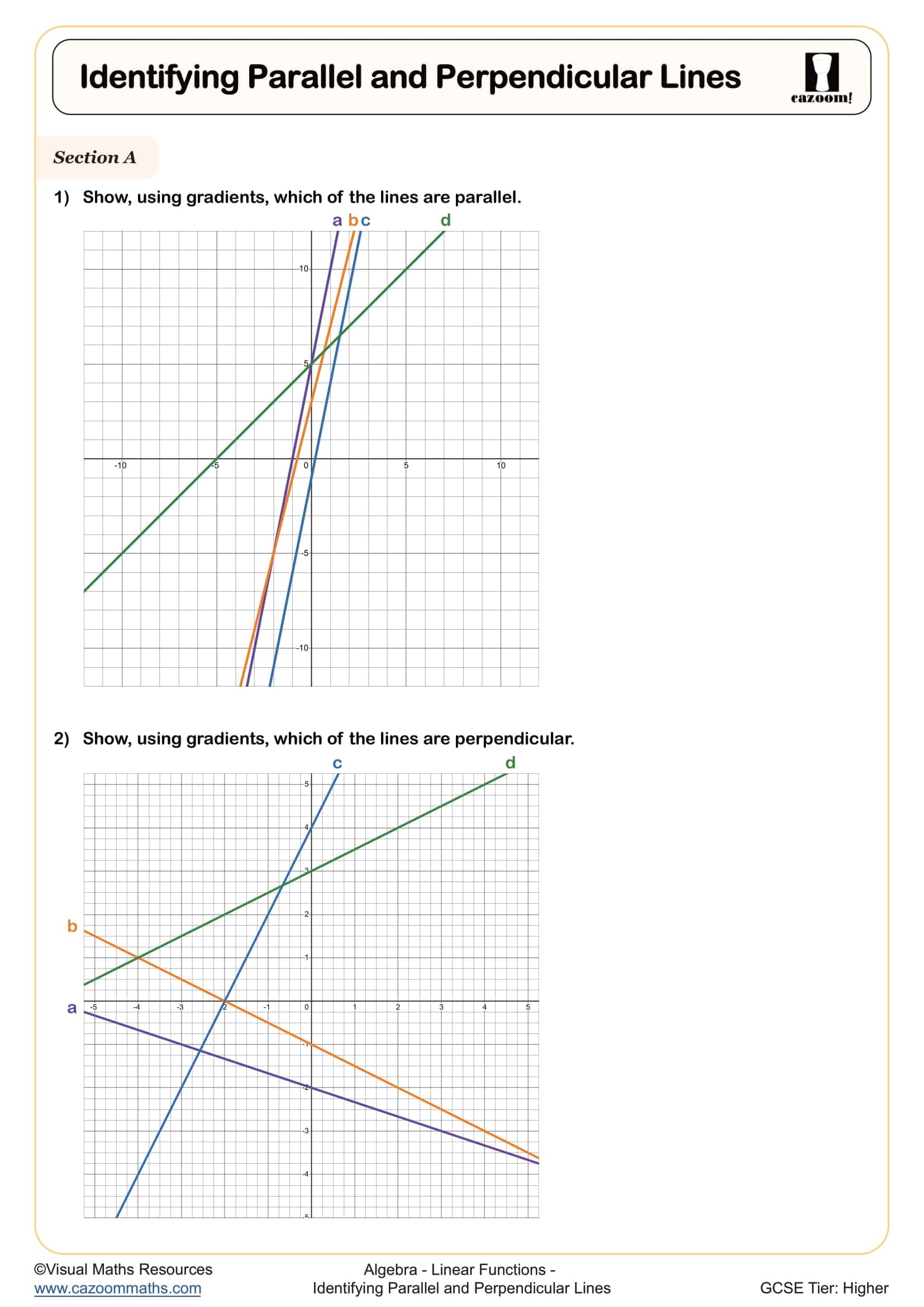
All worksheets are created by the team of experienced teachers at Cazoom Maths.
What makes two lines perpendicular?
Two lines are perpendicular when they meet at right angles (90 degrees), and their gradients multiply together to equal -1. If one line has gradient m, then a perpendicular line has gradient -1/m. This relationship forms a key part of the GCSE algebra curriculum and connects geometric concepts with algebraic skills.
Teachers frequently observe students mixing up the perpendicular gradient rule with parallel lines, where gradients are simply equal. A common error occurs when students calculate perpendicular gradients by making them negative rather than taking the negative reciprocal. For example, if a line has gradient 2, students might incorrectly state the perpendicular gradient as -2 instead of -1/2.
Which year groups study parallel and perpendicular lines?
Parallel and perpendicular lines form part of the Year 10 and Year 11 curriculum, typically introduced after students have mastered basic gradient calculations and linear equations. The topic builds on coordinate geometry foundations established in earlier key stages and prepares students for more advanced geometric reasoning required at A-level.
The progression usually begins with identifying parallel and perpendicular line relationships visually, then moves to using gradients to verify these relationships algebraically. Students then advance to finding equations of lines parallel or perpendicular to given lines, which requires combining gradient rules with point-slope form equations. This scaffolded approach helps prevent misconceptions about gradient relationships.
How do you find the equation of a perpendicular line?
To find the equation of a perpendicular line, students first identify the gradient of the original line, then calculate the negative reciprocal to find the perpendicular gradient. They then use this new gradient with a given point to construct the equation using y - y₁ = m(x - x₁) or rearrange to y = mx + c form.
Many teachers notice students struggle most when the original gradient is a fraction, as finding the negative reciprocal involves multiple steps. For instance, if the original gradient is 3/4, students must recognise that the perpendicular gradient becomes -4/3. Regular practice with fraction manipulation alongside coordinate geometry helps students develop fluency with these multi-step problems that frequently appear in GCSE examinations.
How can teachers use these parallel and perpendicular lines worksheets effectively?
Teachers find these worksheets work best when introduced after students have consolidated basic gradient calculations and can confidently rearrange linear equations. Starting with visual identification exercises helps students develop intuition before moving to algebraic verification. The answer sheets allow for immediate feedback, particularly useful for self-assessment during independent practice.
Many teachers use these resources for differentiated homework, selecting specific question types based on individual student needs. The worksheets also work well for revision sessions before assessments, as they cover the range of parallel and perpendicular line questions typically found in GCSE papers. Teachers often pair these exercises with graphing activities to reinforce the visual connection between algebraic relationships and geometric properties.