Proof Worksheets
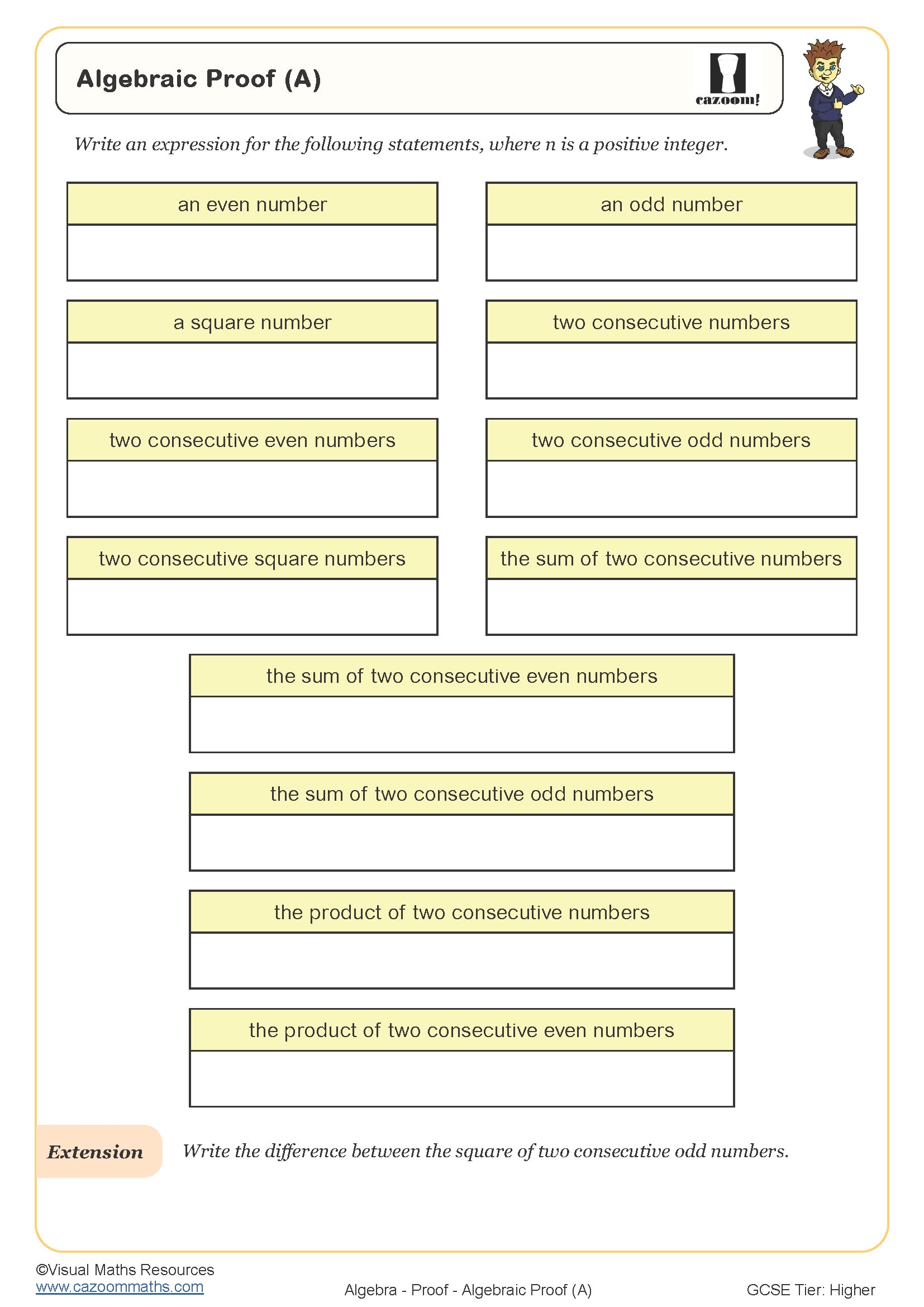
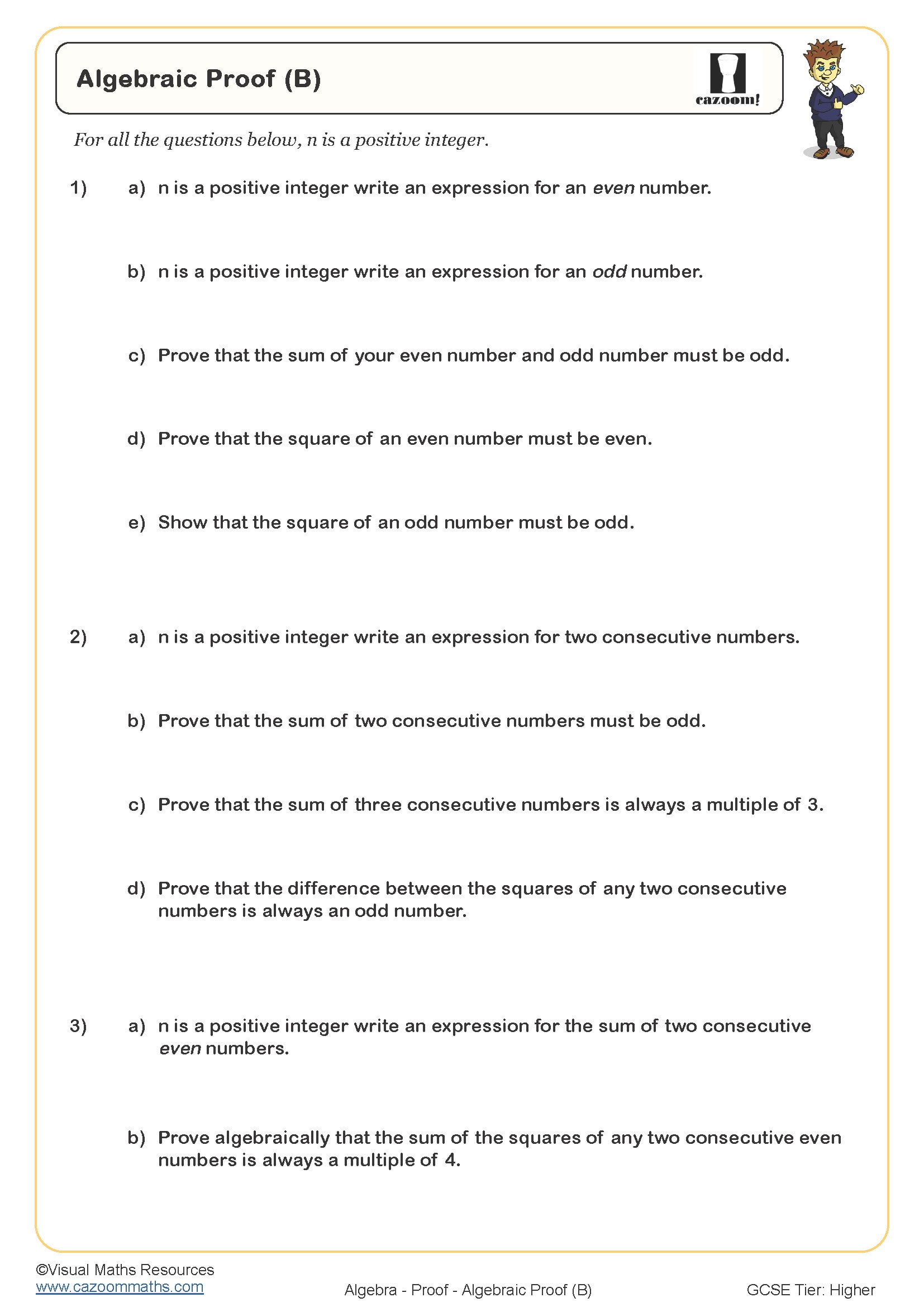
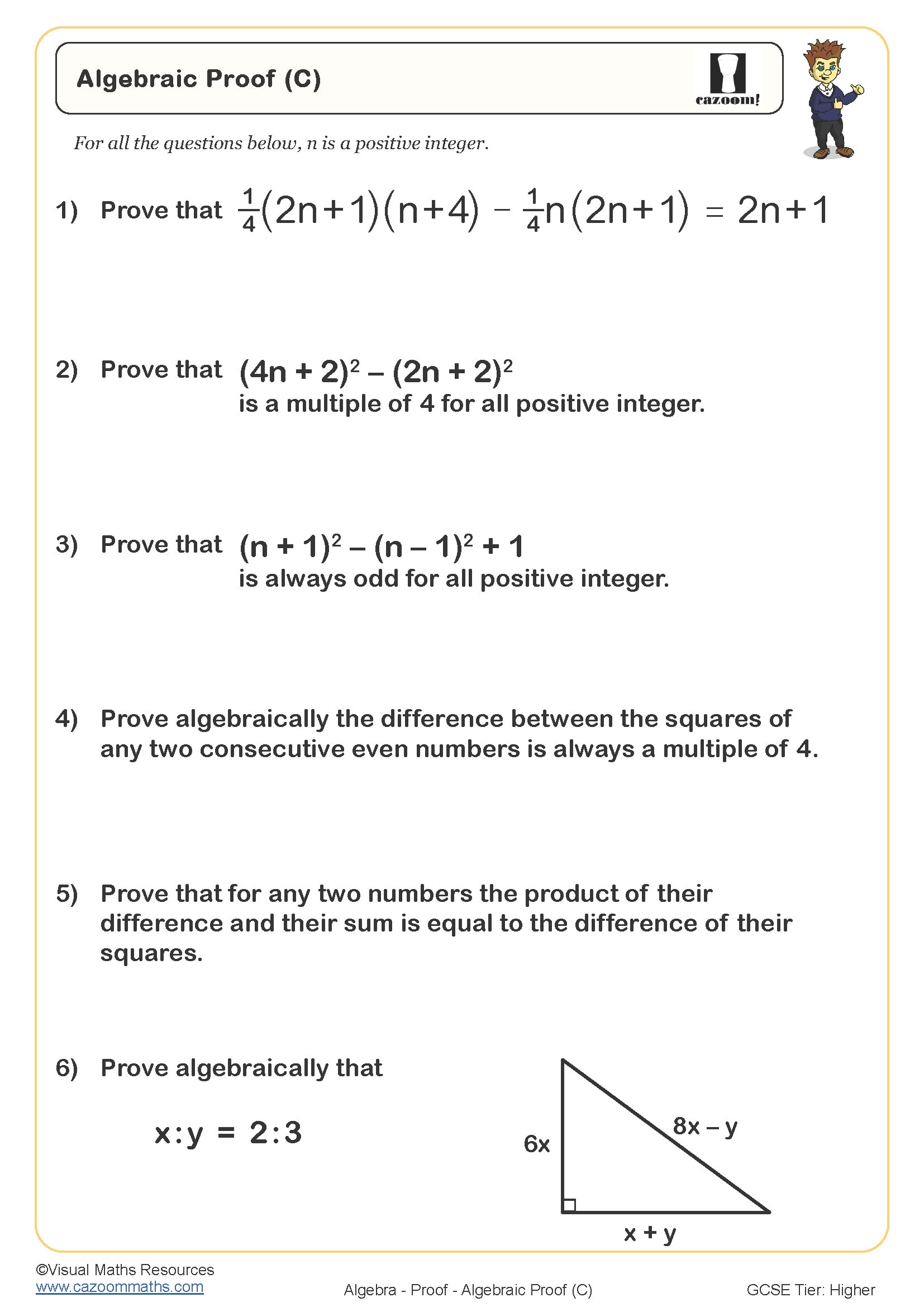
All worksheets are created by the team of experienced teachers at Cazoom Maths.
What types of algebraic proof GCSE questions and answers are included?
The worksheets cover the full range of algebraic proof types expected at GCSE level, including proving statements about odd and even numbers, consecutive integers, and general algebraic expressions. Students encounter questions requiring them to prove that expressions always produce specific results, such as showing that the sum of three consecutive numbers is always divisible by three, alongside more complex proofs involving algebraic manipulation.
Teachers report that students frequently attempt to prove statements by substituting specific numbers rather than using general algebraic methods. The answer sheets demonstrate proper proof structure, showing how to use algebraic variables and logical reasoning to establish statements for all possible values, not just particular examples.
Which year groups should use these algebraic proof resources?
These algebraic proofs worksheets are designed primarily for Year 10 and Year 11 students following the GCSE mathematics curriculum, particularly those working towards higher-tier papers where proof questions regularly appear. The content aligns with National Curriculum requirements for KS4 students to develop reasoning and problem-solving skills through mathematical proof and logical argument.
While proof is formally introduced in Year 10, teachers often find that some Year 9 students benefit from early exposure to basic proof concepts, especially when studying number patterns and algebraic manipulation. The graduated difficulty across worksheets allows teachers to differentiate effectively, supporting students who need additional scaffolding alongside those ready for more challenging algebraic proof questions.
How do students develop skills in writing algebraic proofs effectively?
Writing algebraic proofs requires students to structure their mathematical reasoning clearly, beginning with defining variables, stating what needs to be proved, and working through logical steps to reach a conclusion. The worksheets guide students through this process systematically, helping them understand that proofs must work for all possible values within the given constraints, not just specific examples.
Classroom experience shows that students benefit from seeing multiple proof methods demonstrated side by side. Teachers notice that providing sentence starters and proof frameworks initially helps students develop the formal mathematical language required for GCSE examinations, where clear communication of reasoning earns crucial marks in proof questions.
How can teachers use these algebraic proof worksheets most effectively in lessons?
Teachers find that introducing algebraic proof through collaborative work helps students verbalise their reasoning before writing formal proofs independently. Beginning lessons with worked examples from the answer sheets, then moving to guided practice where students complete partially-structured proofs, builds confidence before tackling complete algebraic proof questions independently.
Many teachers use these resources for retrieval practice, returning to previously covered proof techniques throughout the year to maintain familiarity with the logical reasoning required. The answer sheets support peer assessment activities, where students can check each other's working and identify where proof structures break down, reinforcing understanding of what constitutes valid mathematical reasoning.