Quadratic Functions Worksheets
Completing the Square - Using Algebra Tiles
Year groups: 10, 11
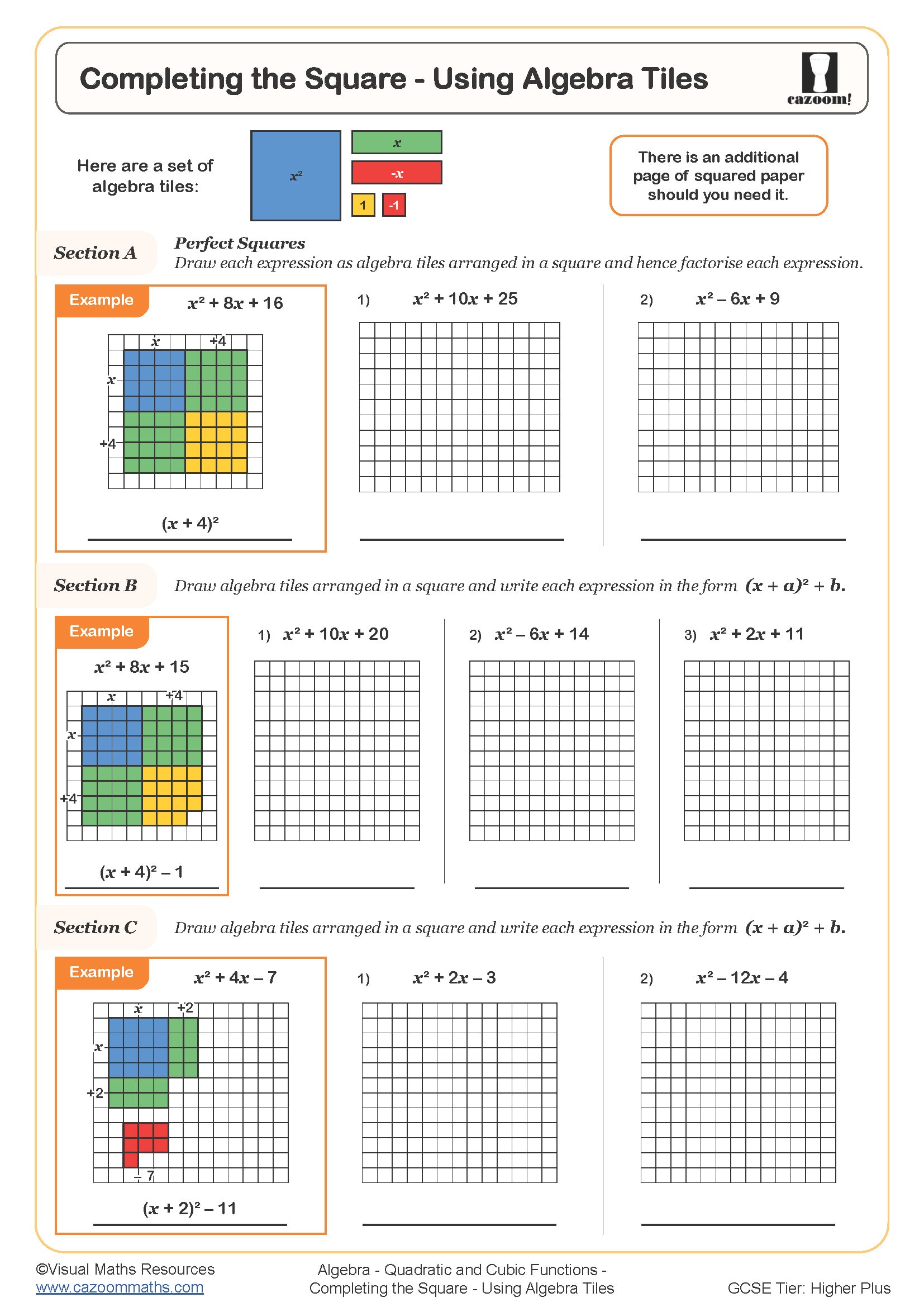
Completing the Square (A)
Year groups: 10, 11
-Worksheet.jpg?w=3840)
Completing the Square (B)
Year groups: 10, 11
-Worksheet.jpg?w=3840)
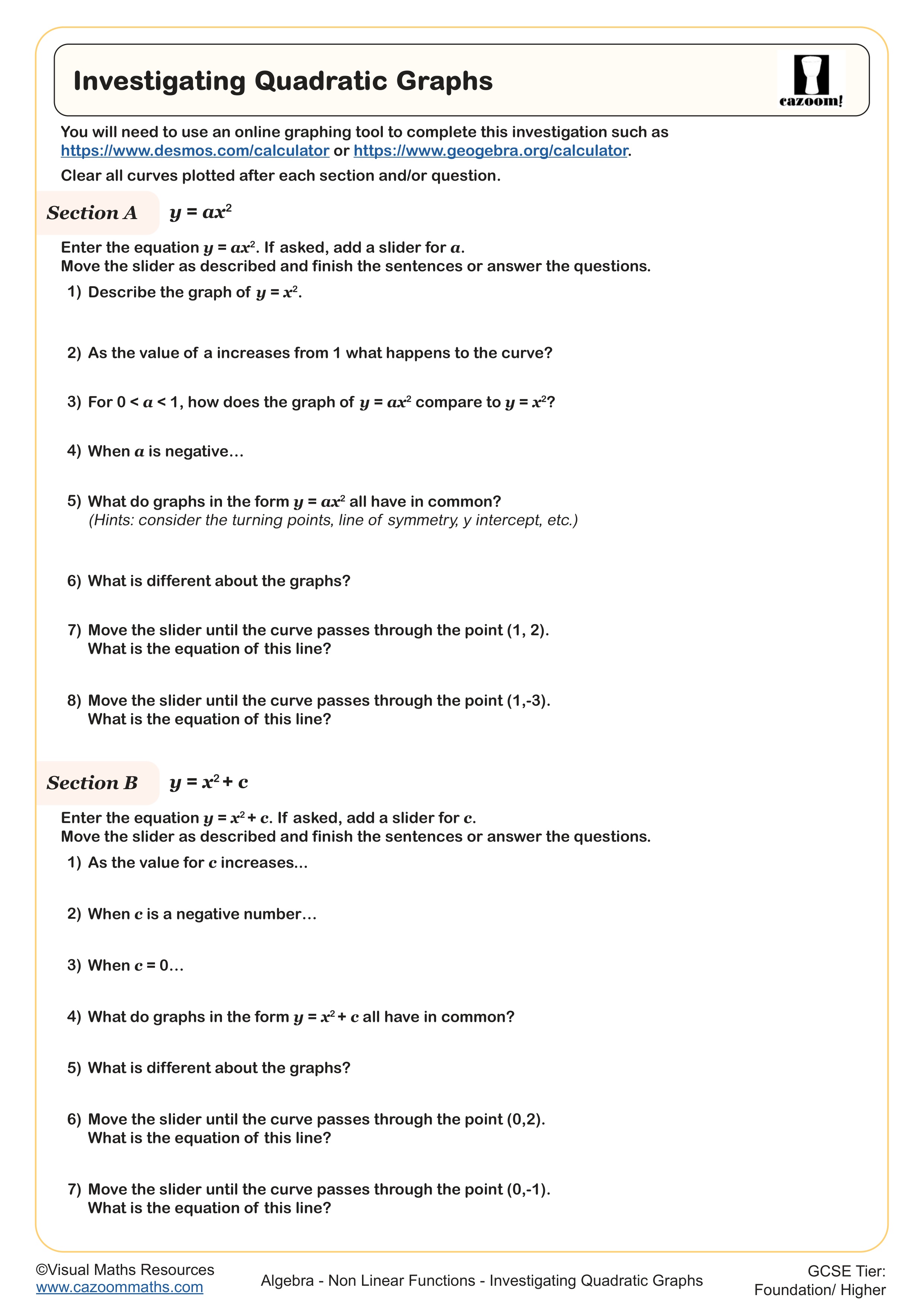
Investigating Quadratic Graphs
Year groups: 10, 11
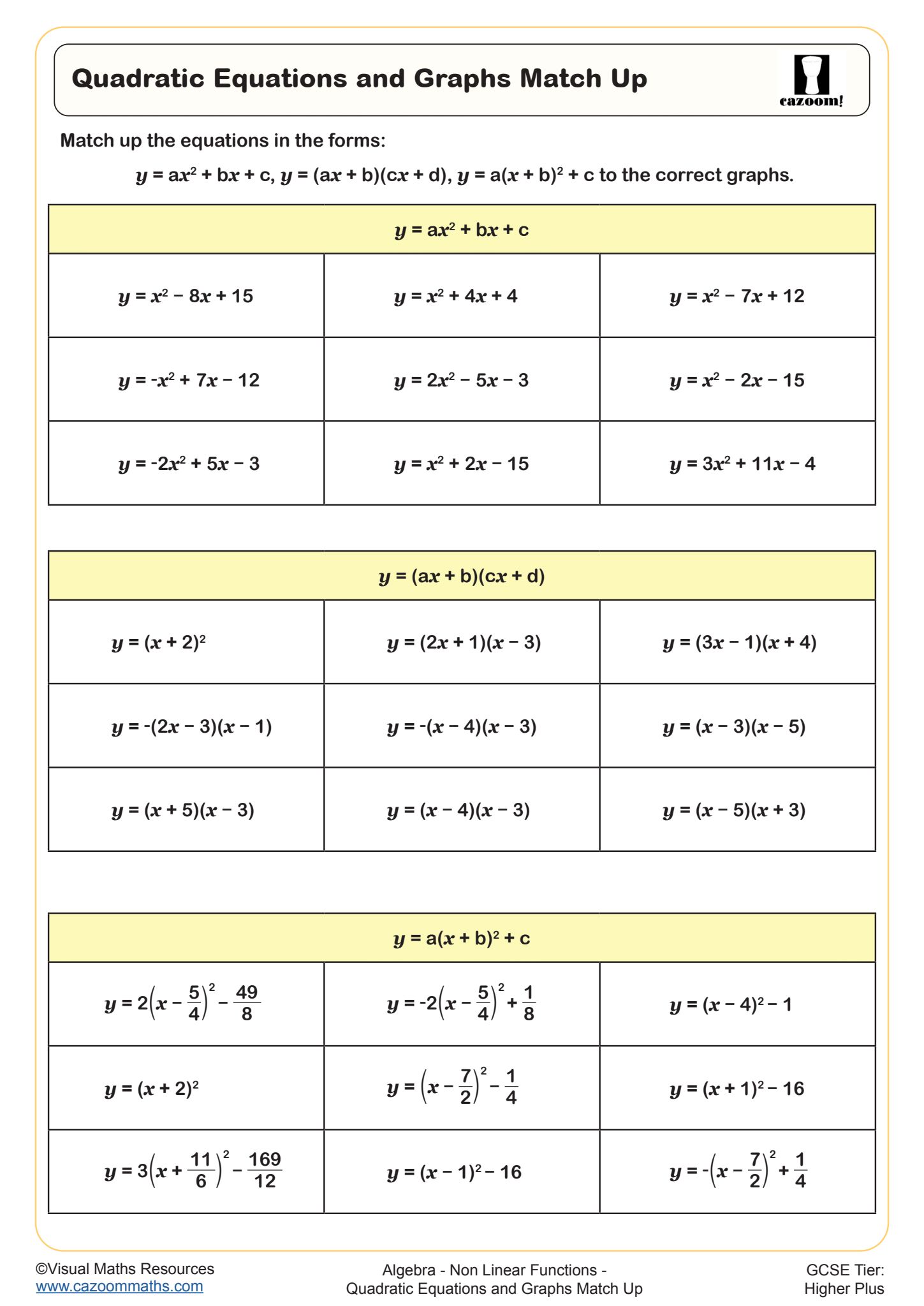
Quadratic Equations and Graphs Match Up
Year groups: 10, 11
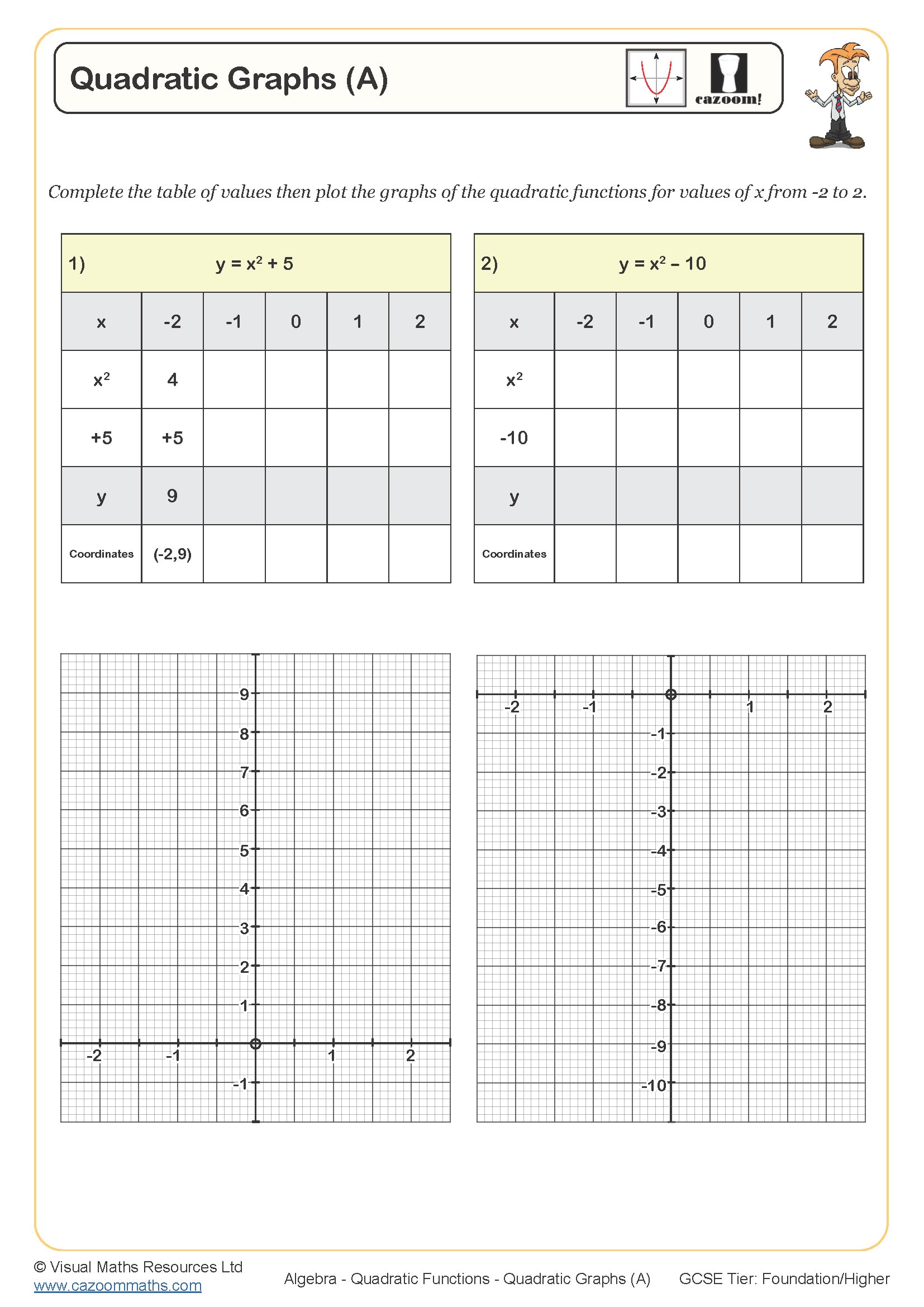
Quadratic Graphs (A)
Year groups: 10, 11
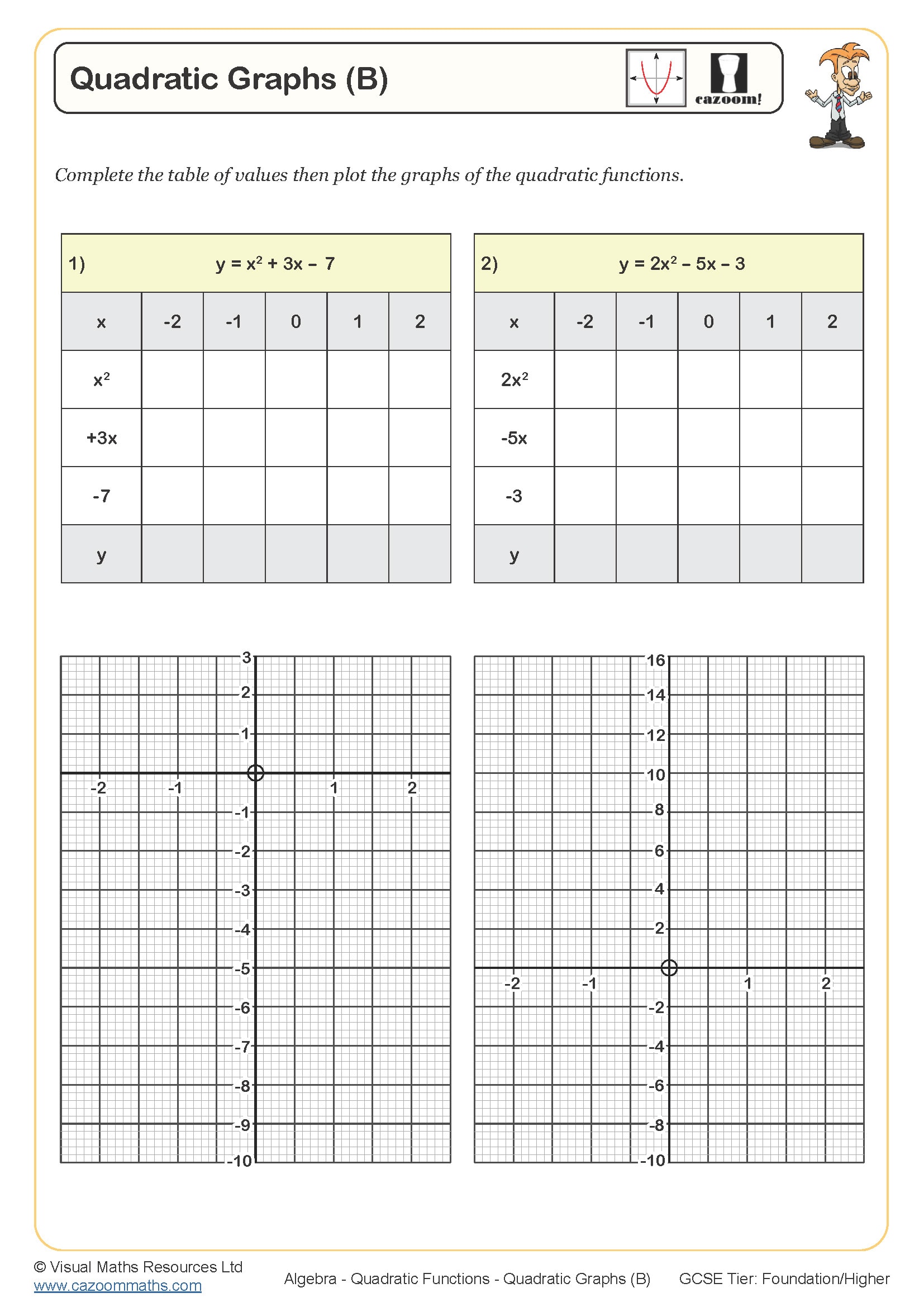
Quadratic Graphs (B)
Year groups: 10, 11
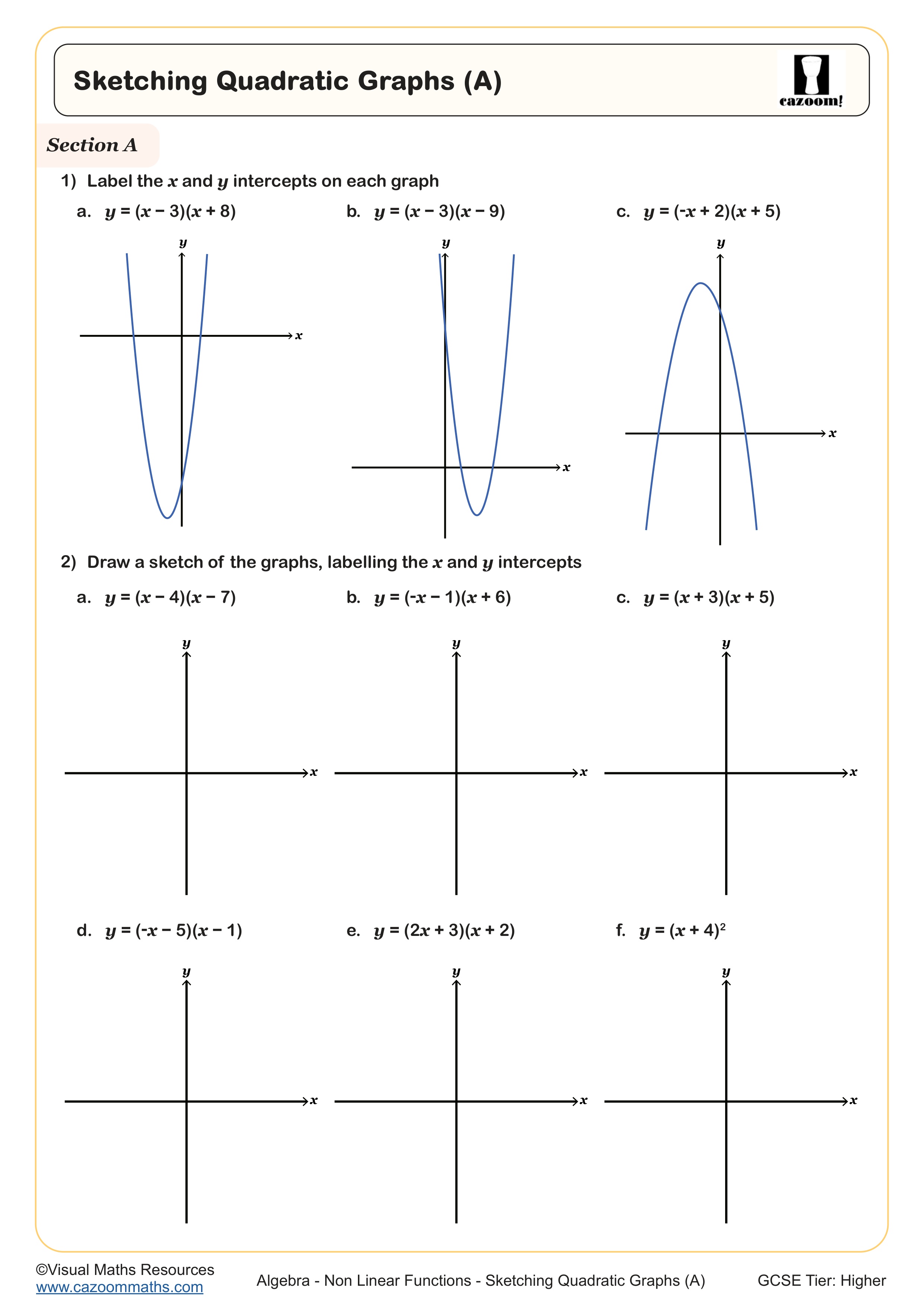
Sketching Quadratic Graphs (A)
Year groups: 10, 11
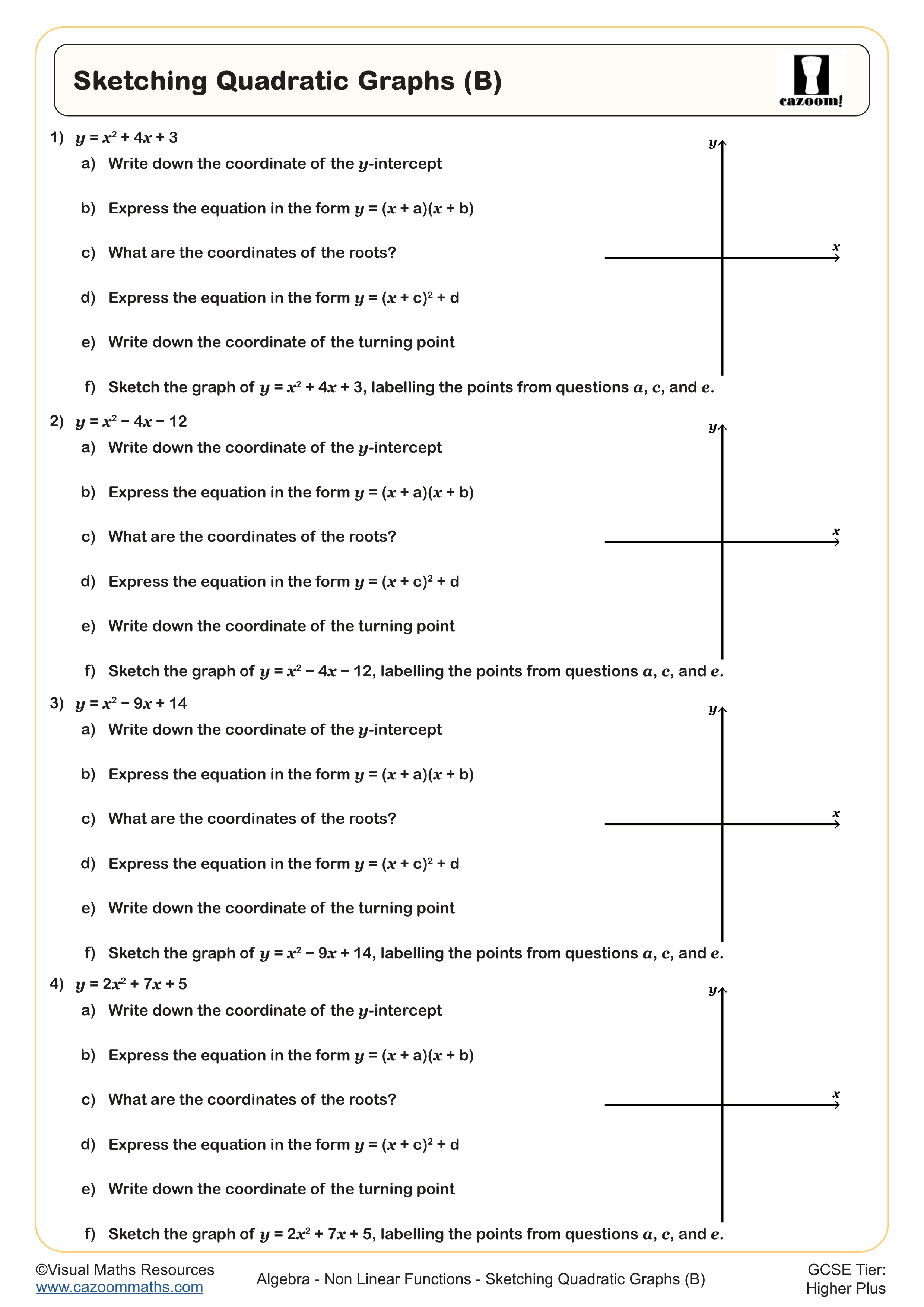
Sketching Quadratic Graphs (B)
Year groups: 10, 11
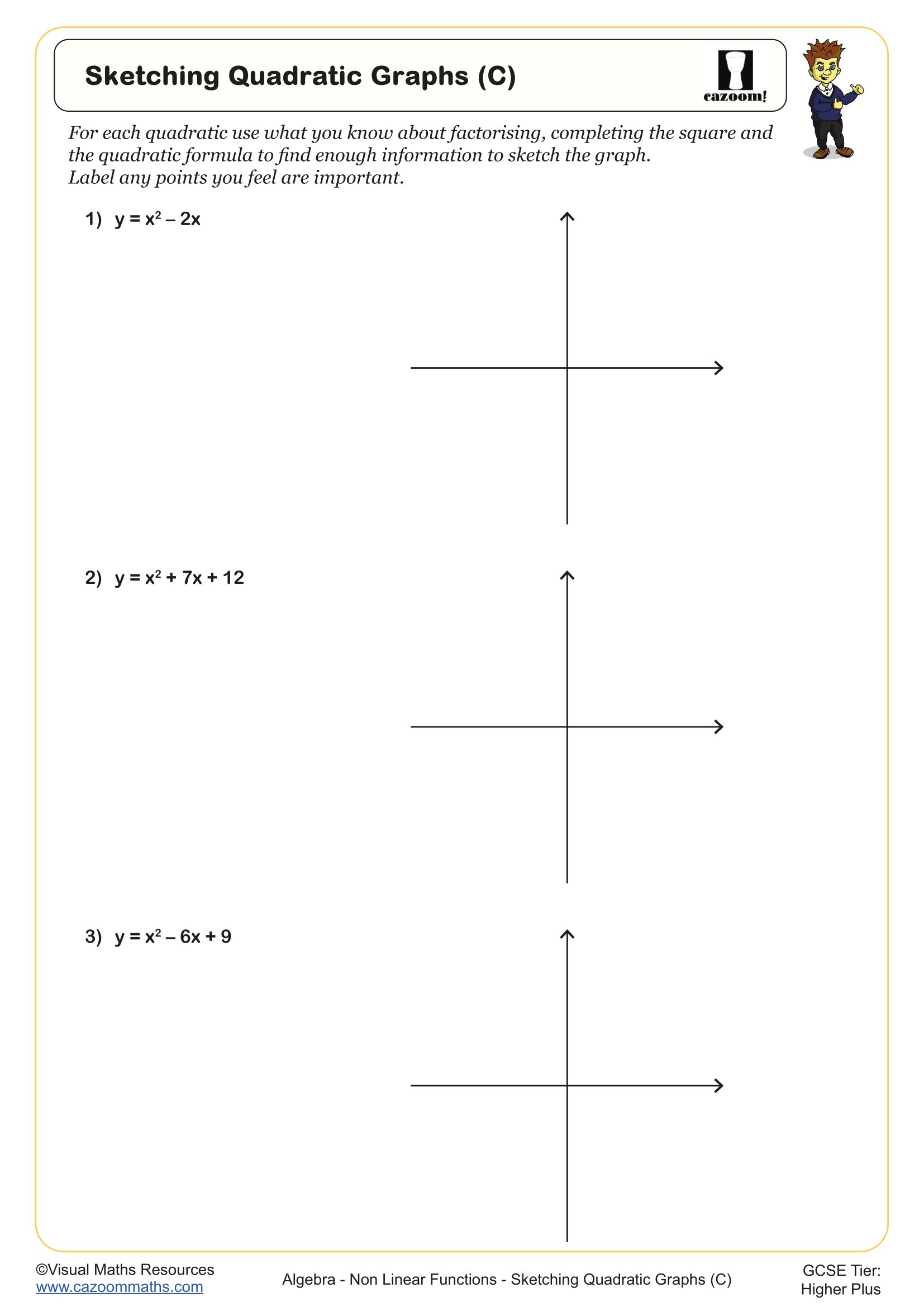
Sketching Quadratic Graphs (C)
Year groups: 10, 11
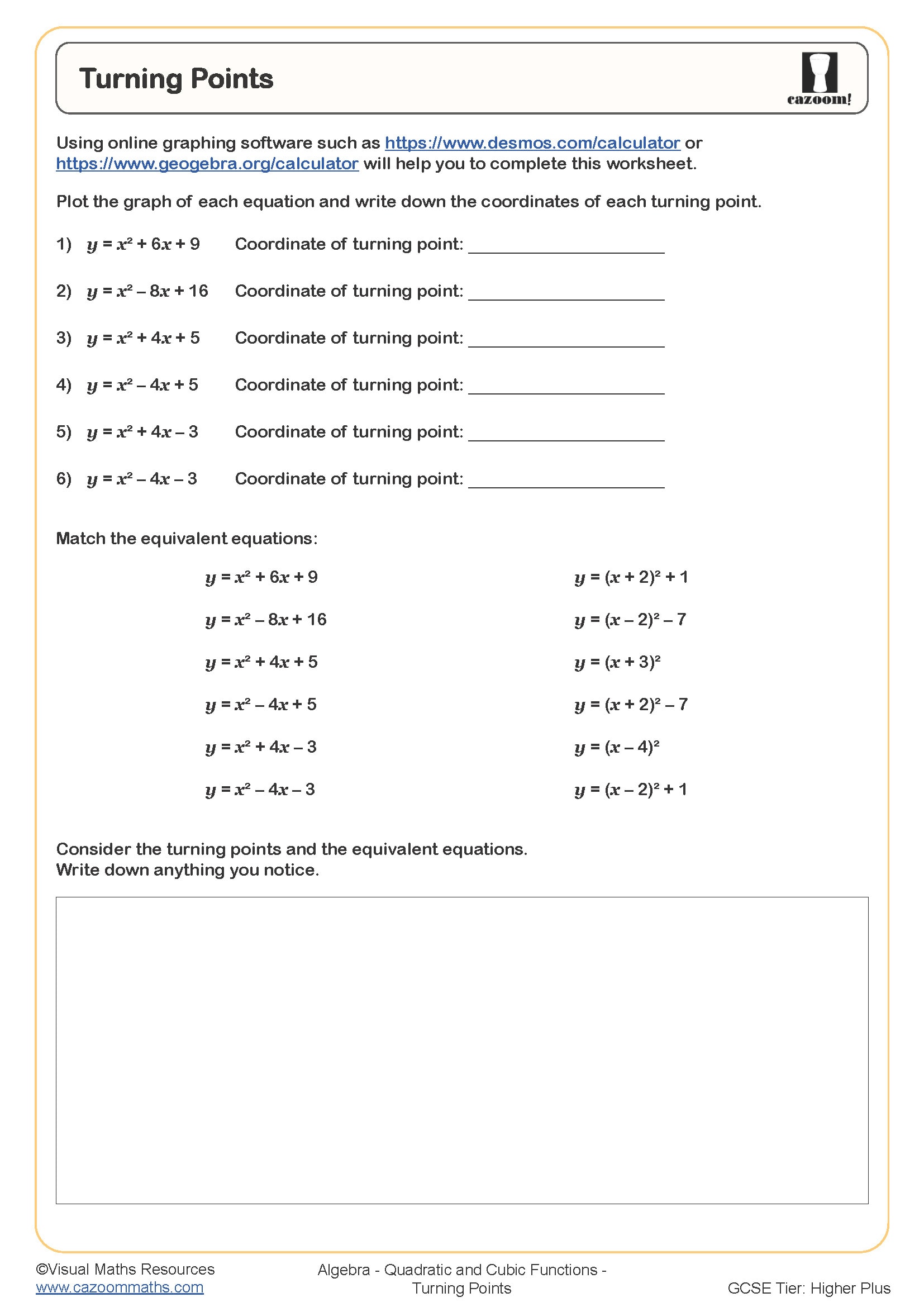
Turning Points
Year groups: 10, 11
All worksheets are created by the team of experienced teachers at Cazoom Maths.
What are quadratic functions and why are they important in GCSE Maths?
A quadratic function is any function that can be written in the form f(x) = ax² + bx + c, where a, b, and c are constants and a ≠ 0. These functions produce U-shaped curves called parabolas when graphed, and they're fundamental to GCSE mathematics. Students need to recognise quadratic functions, sketch their graphs accurately, and identify key features including the vertex (turning point), axis of symmetry, and intercepts.
Quadratic functions appear throughout the GCSE specification and connect multiple mathematical concepts—solving equations, factorising, completing the square, and using the quadratic formula. Understanding how the algebraic form relates to graphical features is essential for success in examinations. These functions also model real-world situations involving area, projectile motion, and optimisation problems, making them practically relevant beyond pure mathematics.
Which year groups study quadratic functions?
Quadratic functions are a Key Stage 4 topic, typically introduced in Year 10 and developed further throughout Year 11. Students first encounter basic quadratic graphs and solving simple quadratic equations earlier in their secondary education, but the detailed study of quadratic functions as a comprehensive topic belongs firmly within the GCSE curriculum.
By Year 11, students should be confident sketching parabolas from different forms, identifying transformations, finding turning points by completing the square, and solving problems involving quadratic functions. The topic builds on earlier algebra work and requires solid foundational skills in expanding brackets, factorising, and manipulating algebraic expressions. Our worksheets support progression across both year groups with appropriately differentiated content.
How do you find the turning point of a quadratic function?
The turning point (or vertex) of a quadratic function can be found using several methods. The most systematic approach is completing the square to write the function in the form f(x) = a(x − h)² + k, where the turning point is (h, k). This method works for any quadratic and reveals whether it's a minimum or maximum point based on whether the coefficient a is positive or negative.
Alternatively, students can find the axis of symmetry using x = −b/2a from the standard form ax² + bx + c, then substitute this x-value back into the function to find the corresponding y-coordinate. Our worksheets provide structured practice in both methods, helping students choose the most efficient approach for different problems. Understanding turning points is crucial for sketching accurate graphs and solving optimisation problems.
Do your quadratic functions worksheets include answer sheets?
Yes, every quadratic functions worksheet comes with a complete answer sheet showing all solutions. This makes them practical for both classroom use and independent study, allowing teachers to set homework confidently and students to check their work effectively. The answers include final results for plotting points, coordinates of turning points, and solutions to equations.
All worksheets are available as downloadable PDFs, so you can print them as needed or share them digitally with students. The clear layout separates questions from answers, making it straightforward to distribute materials appropriately. Having worked solutions readily available saves preparation time and ensures students receive immediate feedback on their practice, which is essential for developing fluency with quadratic functions before examinations.