Quadratic Sequences Worksheets
All worksheets are created by the team of experienced teachers at Cazoom Maths.
What Are Quadratic Sequences in GCSE Maths?
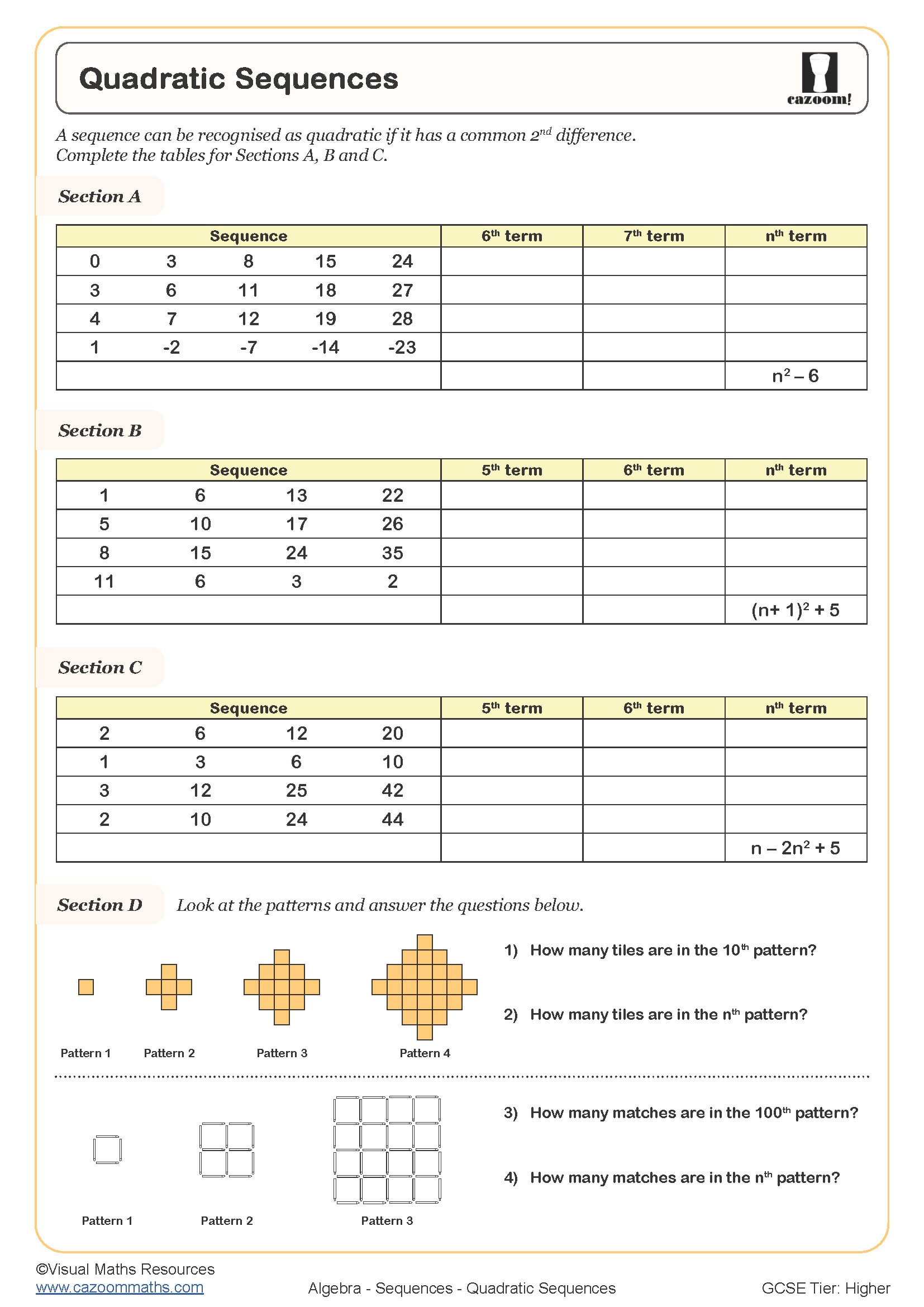
Quadratic sequences are number patterns where the second difference between consecutive terms remains constant. Unlike linear sequences where the first difference is constant, quadratic sequences follow a rule involving n², producing a curved relationship when graphed. Students learn to identify these sequences by finding differences between terms, then differences between those differences.
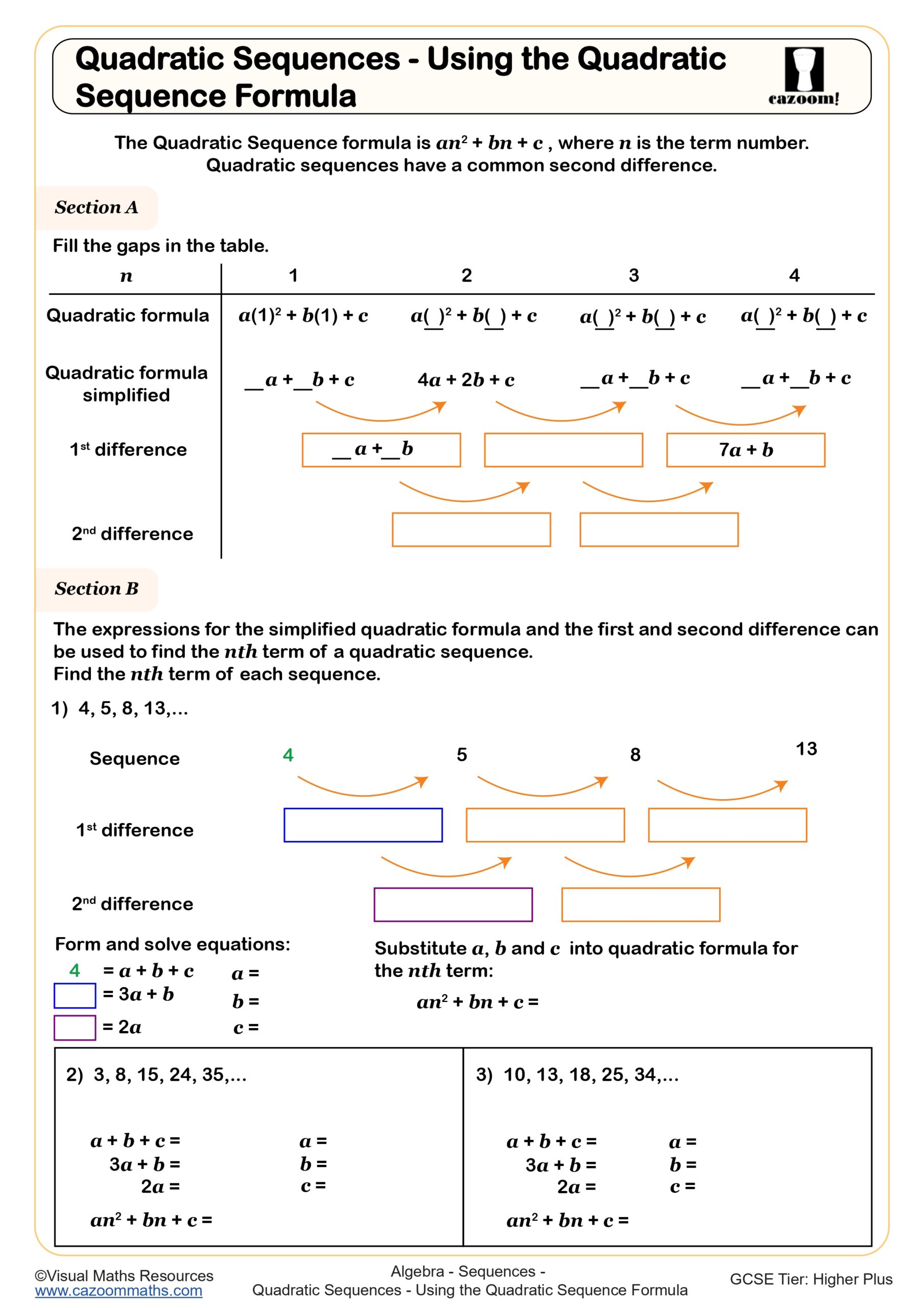
The general form of a quadratic sequence is an² + bn + c, where students must determine the values of a, b, and c. This connects directly to quadratic functions and equations studied elsewhere in GCSE algebra. Mastering quadratic sequences builds essential pattern-recognition skills and prepares students for A-level mathematics topics involving series and sequences.
Which Year Groups Study Quadratic Sequences?
Quadratic sequences appear in the KS4 curriculum, typically taught to Year 10 and Year 11 students preparing for GCSE Mathematics. This topic forms part of the algebra content in the National Curriculum and features predominantly in higher-tier examinations. Students usually encounter quadratic sequences after mastering linear sequences and before moving to more complex algebraic concepts.
The progression through quadratic sequences builds on prior knowledge of number patterns, substitution, and solving equations. Year 10 students often begin with recognising and continuing quadratic patterns, whilst Year 11 work focuses on deriving the nth term formula and solving more complex problems. This timing allows students to consolidate their understanding of quadratic expressions and equations studied concurrently in other algebra units.
How Do You Find the nth Term of a Quadratic Sequence?
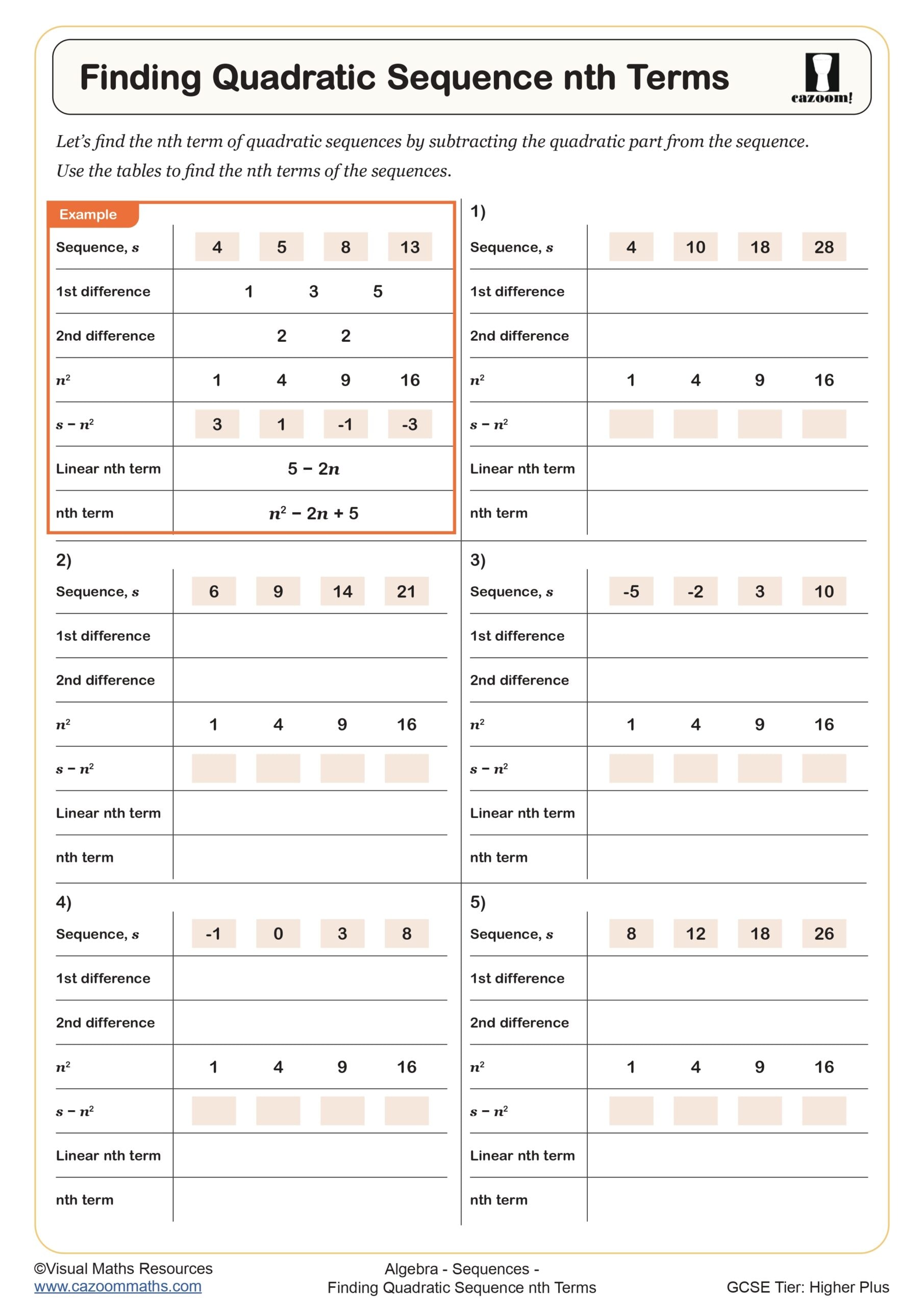
Finding the nth term of a quadratic sequence involves a systematic method using differences. First, students calculate the first differences between consecutive terms, then find the second differences. When these second differences are constant, the sequence is definitely quadratic. The coefficient of n² equals half the second difference, providing the starting point for the formula.
Once the n² term is established, students subtract this component from the original sequence to reveal a linear pattern. They then find the nth term of this linear sequence, combining it with the n² term to form the complete quadratic formula. This multi-step process requires careful organisation and checking, skills our worksheets specifically develop through structured practice questions with varying difficulty levels.
What's Included in These Quadratic Sequences Worksheets?
Each worksheet includes carefully structured questions progressing from identifying quadratic sequences through to finding complete nth term formulae. Problems vary in complexity, offering differentiated practice suitable for both foundation concepts and higher-tier examination requirements. Questions typically include pattern continuation, second difference calculations, and deriving algebraic rules for position-to-term relationships.
Every worksheet comes with comprehensive answer sheets showing complete solutions, not just final answers. This allows students to check their working method at each stage and helps teachers identify precisely where misconceptions arise. The PDF format means worksheets can be printed for classroom use, set as homework, or used digitally. This flexibility makes them suitable for whole-class teaching, intervention groups, or independent revision sessions.