Rearranging Equations Worksheets
Changing the Subject
Year groups: 9, 10, 11
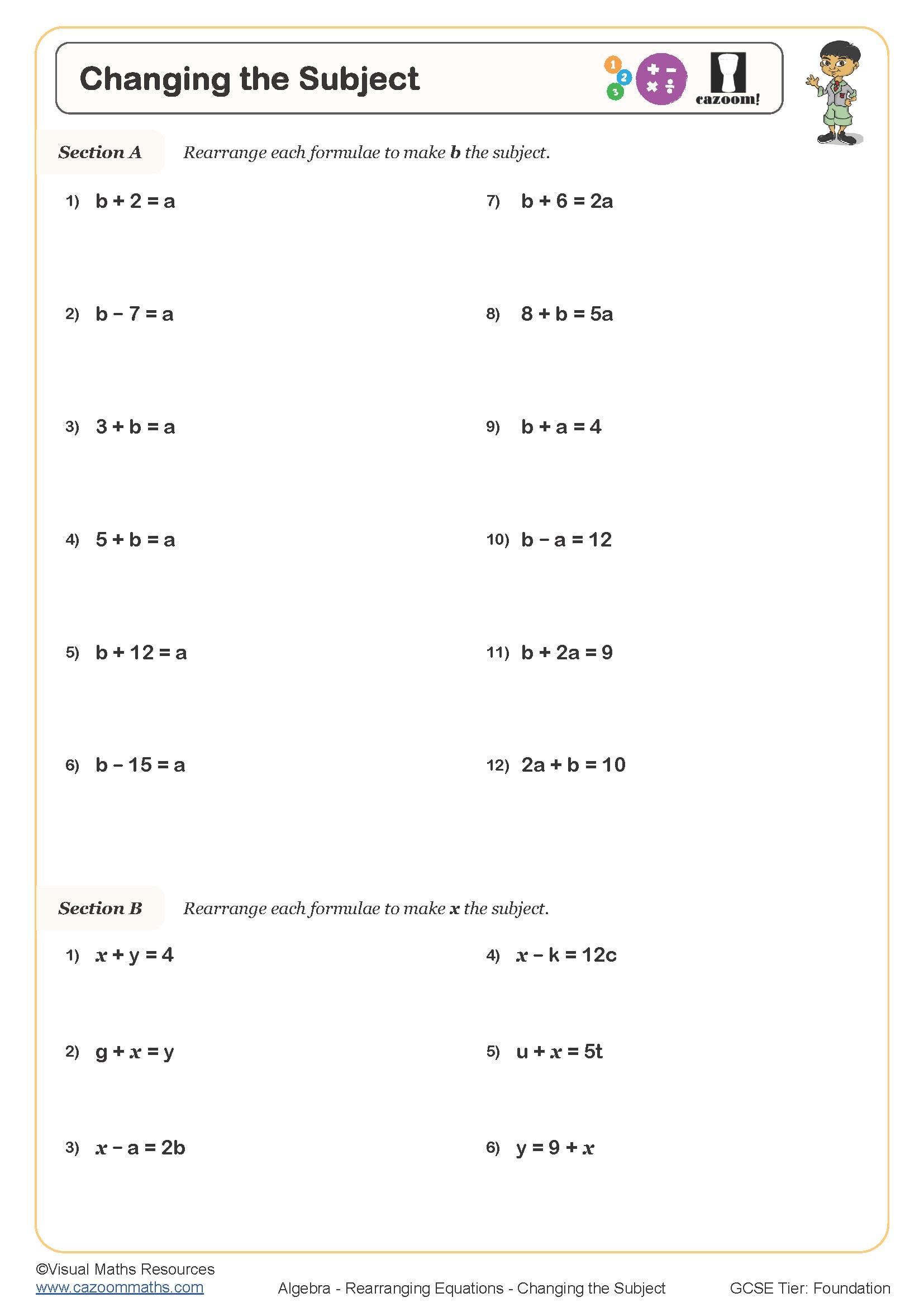
Rearranging Formulae with Function Machines
Year groups: 9, 10
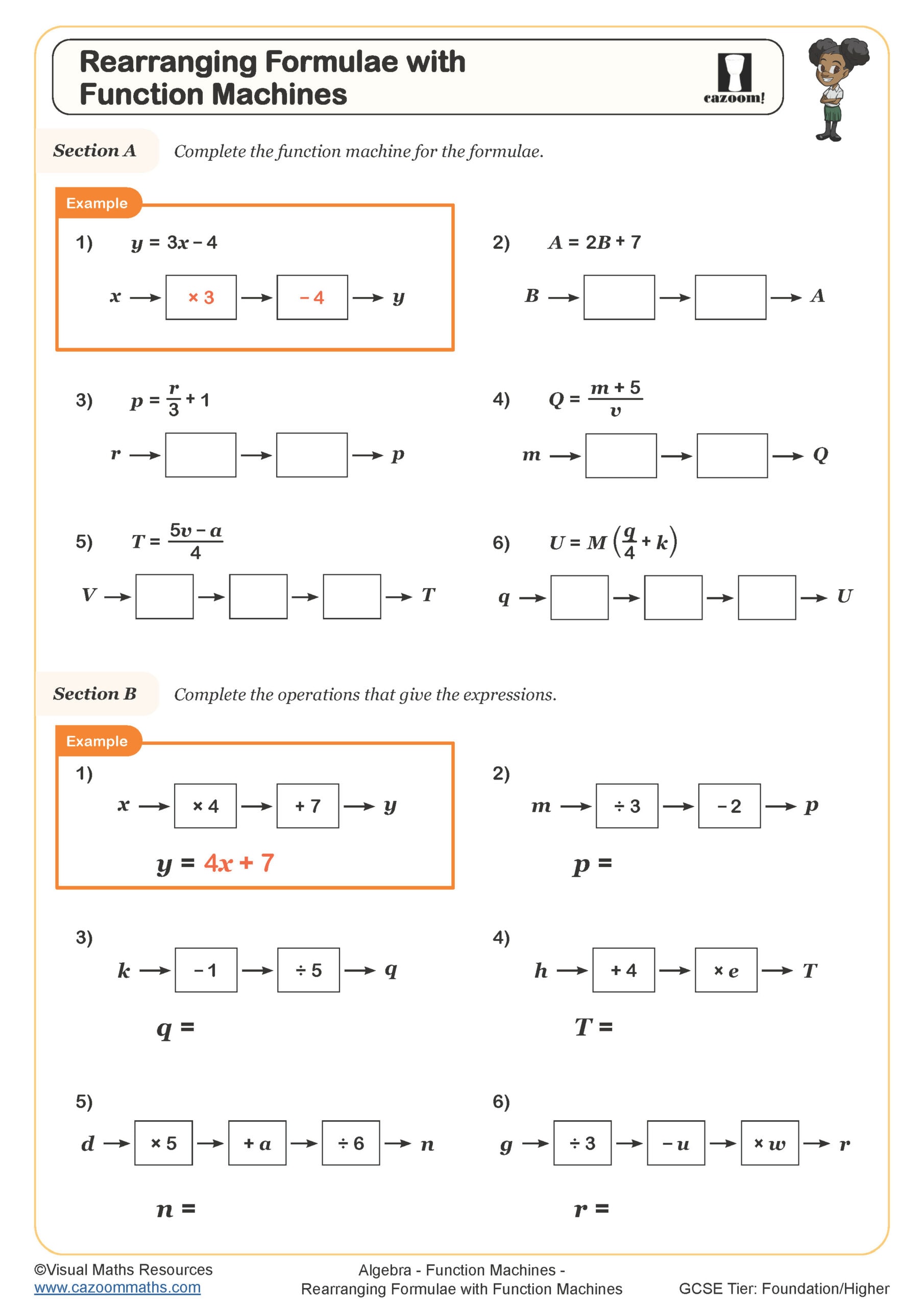
Rearranging into the Form y = mx + c
Year groups: 9, 10, 11
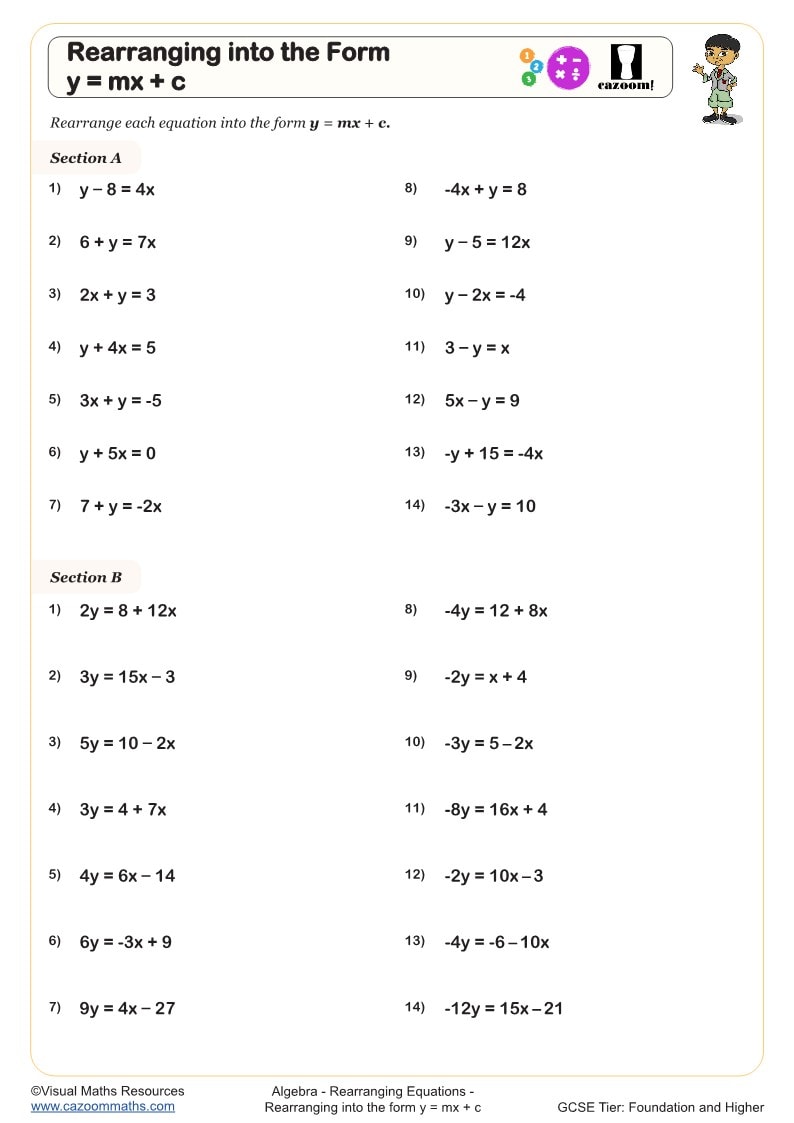
Changing the Subject: Requires Factorisation
Year groups: 10, 11
Iteration
Year groups: 10, 11
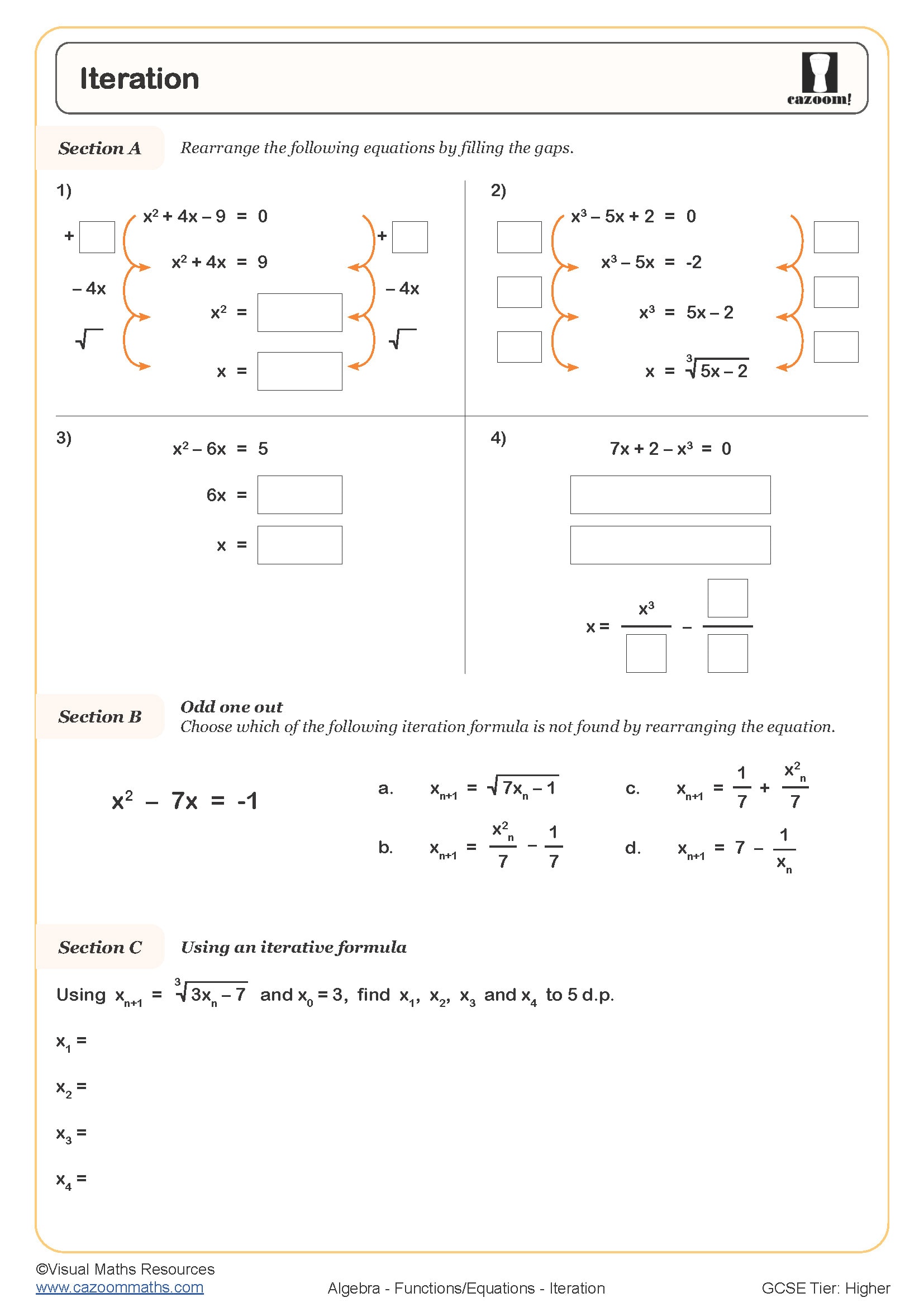
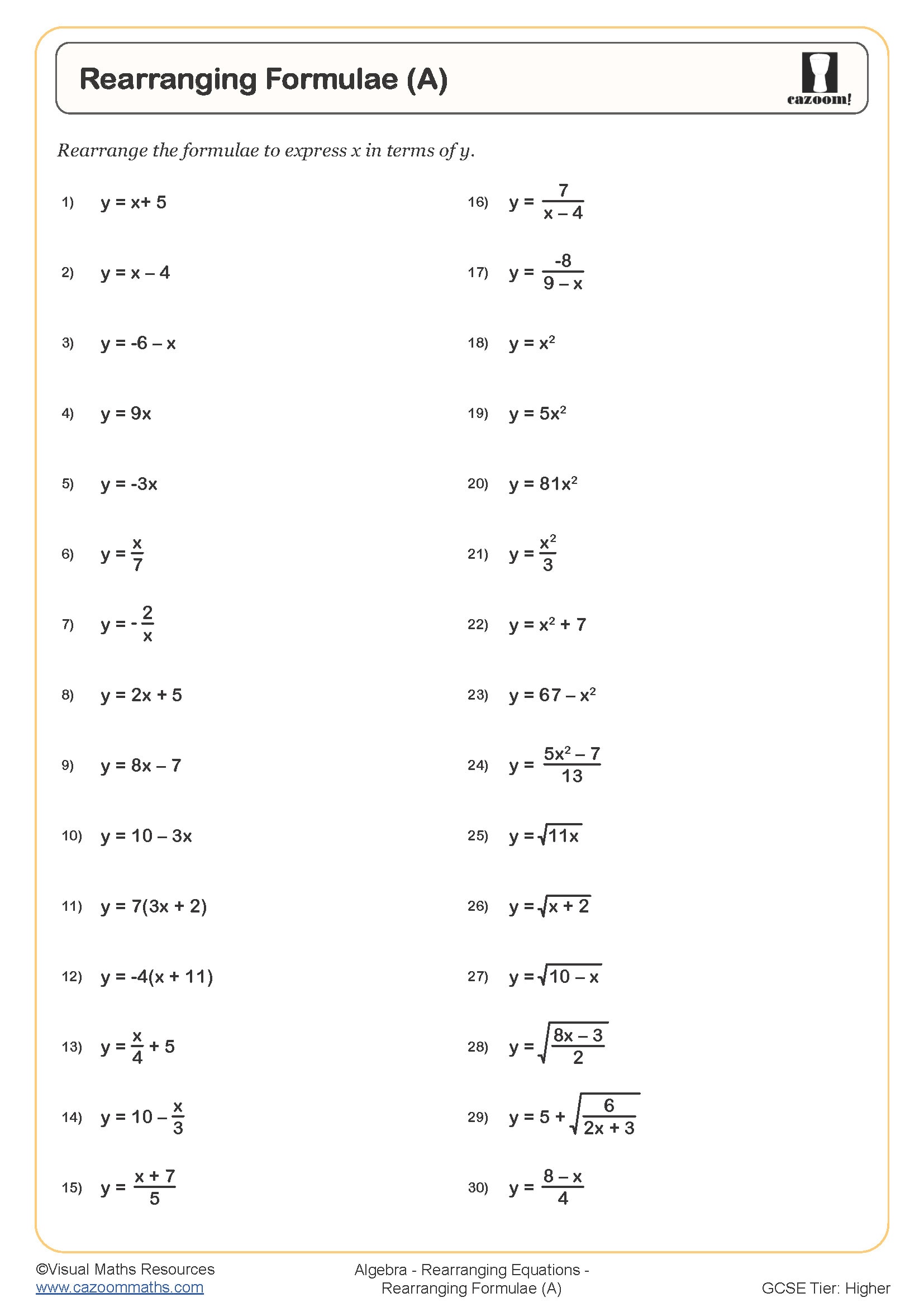
Rearranging Formulae (A)
Year groups: 10, 11
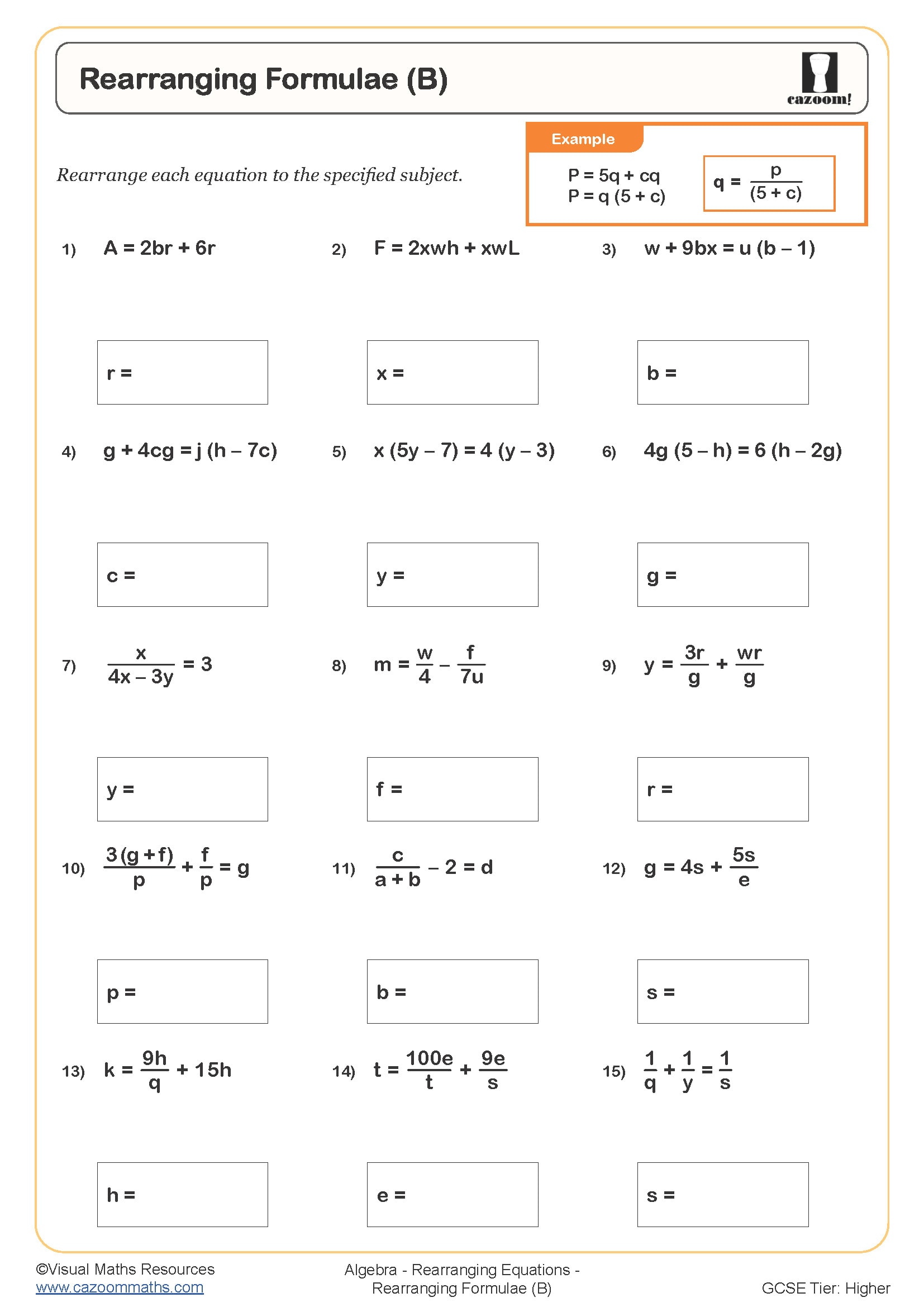
Rearranging Formulae (B)
Year groups: 10, 11
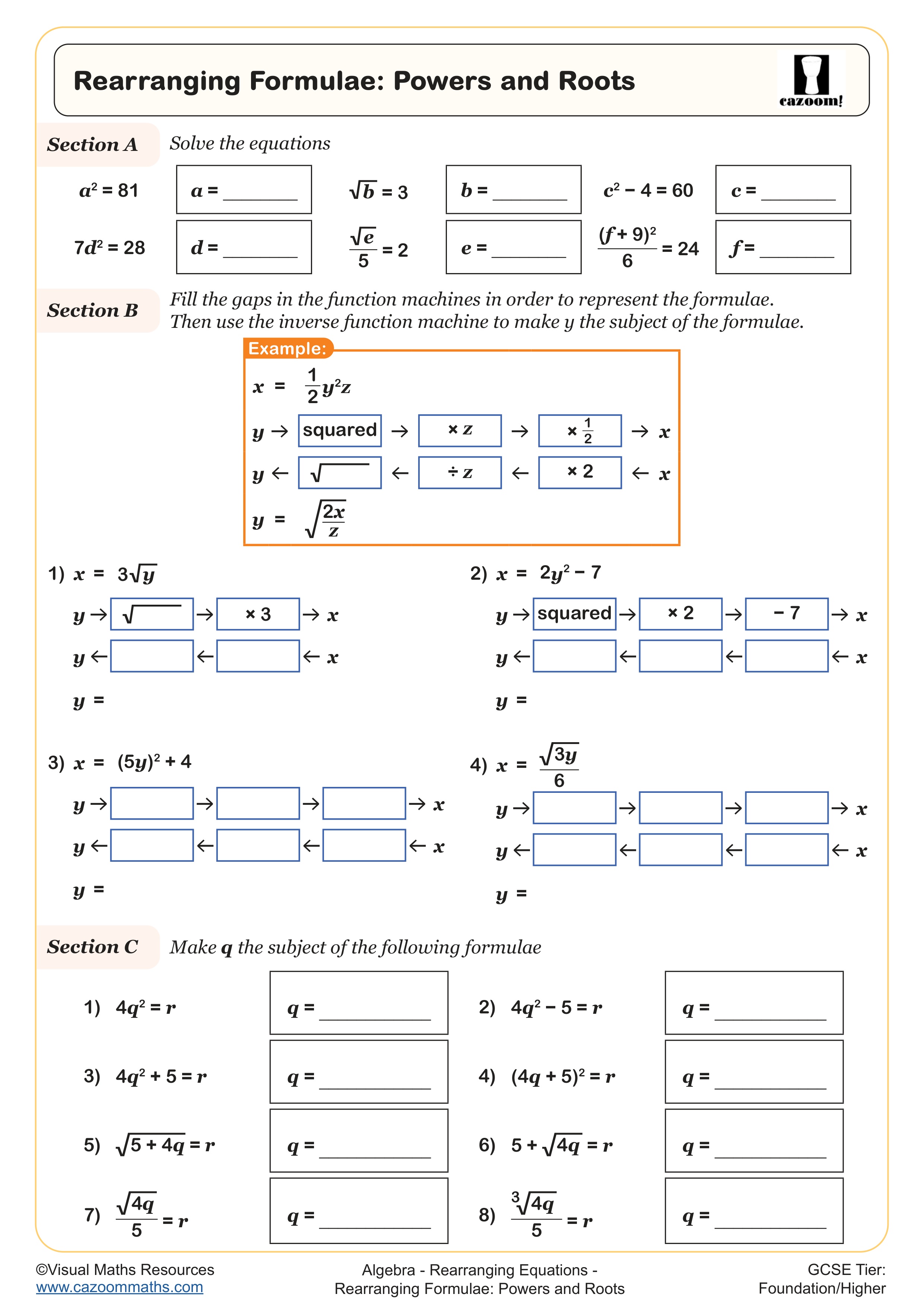
Rearranging Formulae: Powers and Roots
Year groups: 10, 11
All worksheets are created by the team of experienced teachers at Cazoom Maths.
What makes effective rearranging formulae questions for classroom practice?
Effective rearranging formulae questions build systematically from single-operation problems to complex multi-step scenarios. Students need structured progression starting with simple linear rearrangements like making x the subject of y = mx + c, then advancing to formulae involving fractions, powers, and nested operations that appear frequently in GCSE examinations.
Teachers find that students often make errors when the variable appears multiple times in the formula, such as in s = ut + ½at². The most productive questions include real-world contexts from physics and engineering, helping students understand why changing the subject of the formula worksheet activities connect to practical problem-solving across STEM subjects.
Which year groups should use rearranging equations worksheets?
Rearranging equations typically begins in Year 7 with simple one-step problems before developing into the full changing the subject of a formula worksheet approach by Year 9. KS3 students start with linear rearrangements, whilst KS4 students tackle more complex scenarios involving quadratic expressions, logarithms, and trigonometric functions required for GCSE success.
The progression allows students to build algebraic confidence gradually. Year 7 might rearrange y = 3x + 2 to find x, whilst Year 11 students work with complex formulae like the quadratic formula or compound interest calculations that require multiple algebraic manipulation steps.
How do students approach rearranging linear equations successfully?
A rearranging linear equations worksheet focuses on the fundamental principle of performing inverse operations in reverse order. Students learn to identify the operations applied to the desired variable, then systematically undo them using opposite operations whilst maintaining equation balance through identical operations on both sides.
The most common error teachers observe occurs when students attempt to isolate variables trapped within brackets or fractions. Students often forget to apply operations to entire expressions rather than individual terms. Successful approaches emphasise clear step-by-step working, with students writing each manipulation as a separate line to avoid computational mistakes that compound through longer problems.
How can teachers use these worksheets most effectively in lessons?
Teachers report best results when using rearranging formulas worksheet with answers for immediate feedback during guided practice. Starting lessons with collaborative work on simpler problems allows teachers to address misconceptions before students attempt independent practice on more challenging rearrangements that build towards examination requirements.
The answer sheets enable efficient peer marking activities, encouraging mathematical discussion about different solution methods. Teachers often use these resources for homework consolidation after introducing new rearrangement techniques, with the detailed solutions helping students identify exactly where errors occurred in their algebraic manipulation processes.
Why Would You Want to Rearrange Equations?
You are likely wondering why anyone would want to rearrange an equation. You should rearrange equations because then you can easily solve for any variable. The following are some of the reasons you should learn rearranging formulas in your math practice:
• When you can manipulate an equation, it cuts down drastically on the amount of memorization you need to do. If you can rearrange formulas, you will only have to remember one equation with all the variable questions.
• If you know anything about equations, you know they are easier to solve before you start inserting numbers. Being able to isolate a variable on one side, makes the equation much easier to solve.
• Keeping track of the units on a number is an essential part of solving equations. By manipulating the equation, you can easily insert numbers and cancel the units, allowing you to end up with the right units for all variables.
Steps to rearranging a formula:
Look at what you have, but do not put any numbers in just yet.
Decide which variable you want as your answer.
Rearrange the equation so you place the intended variable on one side by itself.
Put in the numbers.
Find the value of the unknown variable.
Important Rules for Rearranging Equations
As with all algebra problems, there are some rules you will need to remember when working with a rearranged equation. Keeping these in mind will help you to avoid making mistakes that cause you to input the wrong answer.
Rules for rearranging equations:
Anything you do to one side must be done to the other. You can always perform any action, such as addition, subtraction, or division, but what is done to one side must be done to the other. Think of the equal sign as a fulcrum. You must keep both sides balanced so the meaning of the equation remains the same.
If you plan to cancel or move any variable or quantity, always make sure to do the opposite on the other side. If you add on one side, you must subtract on the other side. Doing the opposite move will balance the equation and allow it to remain true.
How Do You Rearrange Density Equations?
The formula for the density of an object is D=m/v.
To isolate m, you will multiply both sides by v.
This will allow you to find the value of m.
How Do You Evaluate Algebraic Expressions?
To evaluate algebraic expressions, you first need to know the definition of a variable. A variable is a letter represented by x, y, or z. The letter represents a number that has not been given.
For example: 7+x= 12
To evaluate the expression, you simply need to input a number in place of the x and perform the mathematics operations in the problem. In the example above, x=5 because 7+5=12. Once you know the value of your variable (letter), you will be able to evaluate the expression and see if the number is correct.
Learn More by Using Cazoom Maths Practice Worksheets
We have a ton of practice worksheets that can help you about rearranging equations. The more you practice, the better equipped you will be to solve these formulae with ease