Rearranging with Factorisation Worksheets
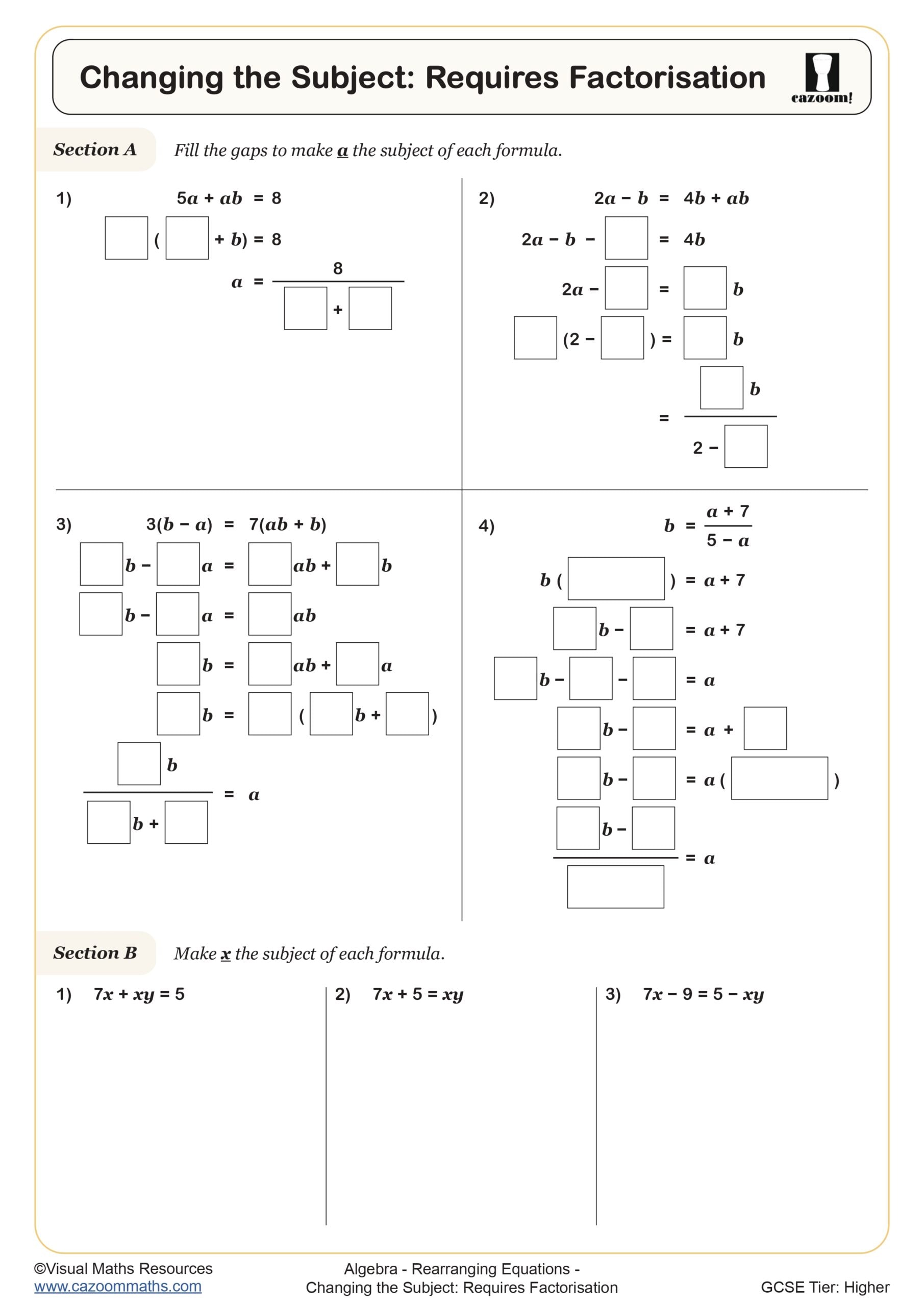
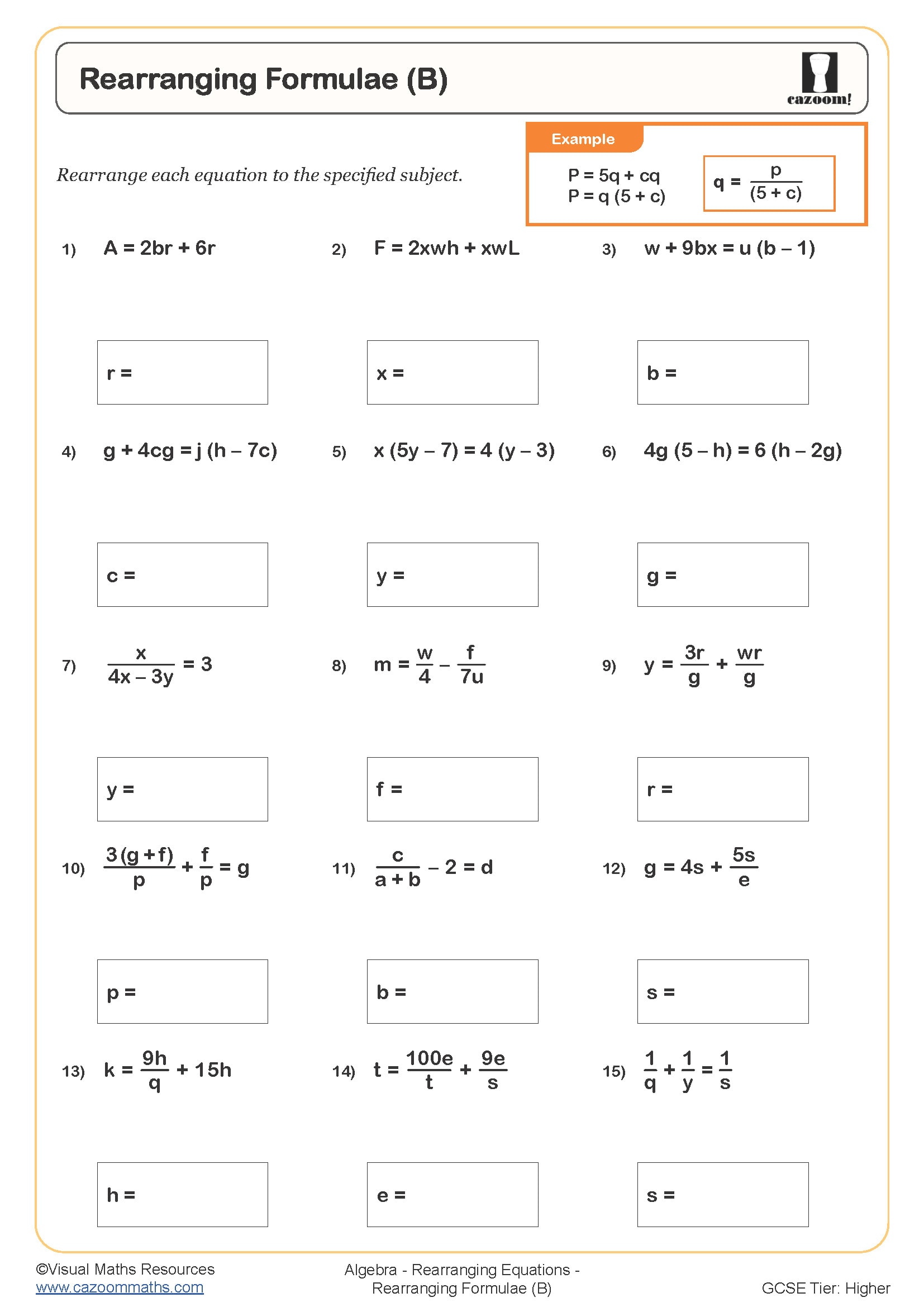
All worksheets are created by the team of experienced teachers at Cazoom Maths.
What is rearranging with factorisation in algebra?
Rearranging with factorisation is an algebraic technique used when a variable appears more than once in a formula or equation, and you need to make that variable the subject. Instead of trying to isolate each occurrence separately, you factorise the variable out as a common factor, then divide to isolate it. For example, to make x the subject of ax + bx = c, you'd factorise to get x(a + b) = c, then divide both sides by (a + b).
This method is essential for GCSE higher tier algebra and appears regularly in examinations. Students encounter it when rearranging physics formulae, solving literal equations, and manipulating complex algebraic expressions. Mastering this technique requires solid understanding of both factorisation skills and the principles of maintaining equation balance when rearranging.
Which year groups study rearranging with factorisation?
Rearranging with factorisation is taught at Key Stage 4, specifically to Year 10 and Year 11 students following the GCSE mathematics curriculum. This topic typically appears on the higher tier pathway, as it requires confident handling of algebraic manipulation and factorisation techniques. Students usually encounter it after they've mastered basic formula rearrangement and factorisation separately.
The skill forms part of the algebra strand in the National Curriculum and builds towards GCSE examination questions worth significant marks. Year 10 students are introduced to the fundamental technique, whilst Year 11 students revisit and extend their understanding through more complex problems involving multiple variables, fractions, and nested brackets during their revision and examination preparation.
How do you know when to use factorisation to rearrange?
The key indicator that factorisation is needed when rearranging is when the variable you're trying to make the subject appears in two or more separate terms of the equation. If you spot the same letter on different sides of the equation, or in multiple terms on the same side, factorisation is usually the most efficient approach. Without factorisation, you'd struggle to isolate the variable completely.
Common examples include formulae like v = u + at where you need to make 'a' the subject when it appears elsewhere, or expressions such as px + qx = r. Students should look for the repeated variable, collect all terms containing it on one side, then factorise it out as a common factor before dividing. This systematic approach prevents errors and makes complex rearrangements manageable.
What do the rearranging with factorisation worksheets include?
Each worksheet focuses on problems where students must factorise before successfully rearranging formulae. The exercises progress systematically, starting with straightforward examples where the target variable appears twice, then advancing to more challenging problems involving fractions, brackets, or multiple variables. Students practise identifying when factorisation is necessary, executing the factorisation correctly, and completing the rearrangement accurately.
All worksheets are provided as downloadable PDFs with complete answer sheets included. The answer sheets show full worked solutions, not just final answers, helping students understand the step-by-step process and identify where they've gone wrong. This makes them suitable for independent study, homework tasks, or classroom teaching, giving teachers flexible resources that support different learning needs across GCSE preparation.