Rearranging without Factorisation Worksheets
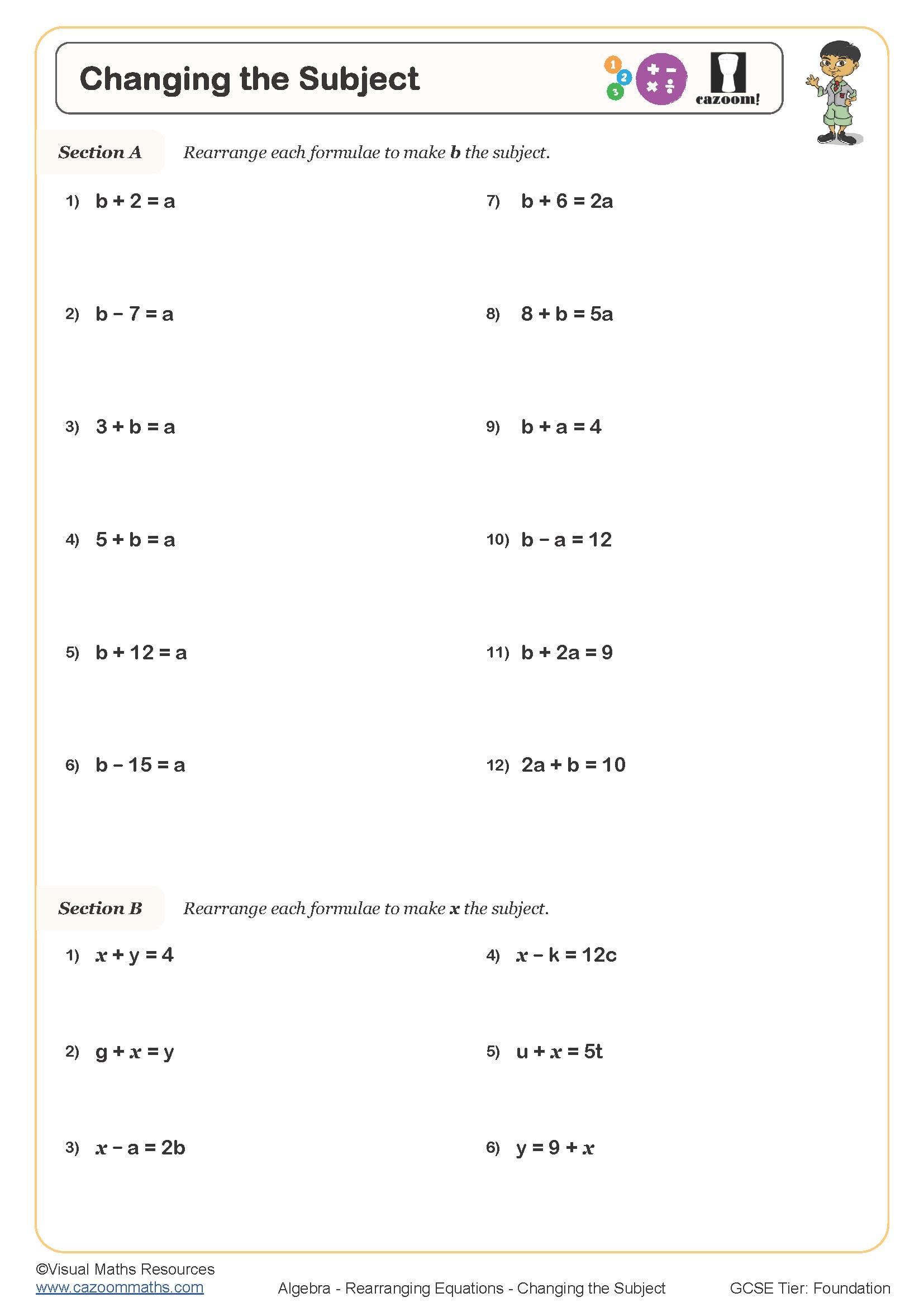
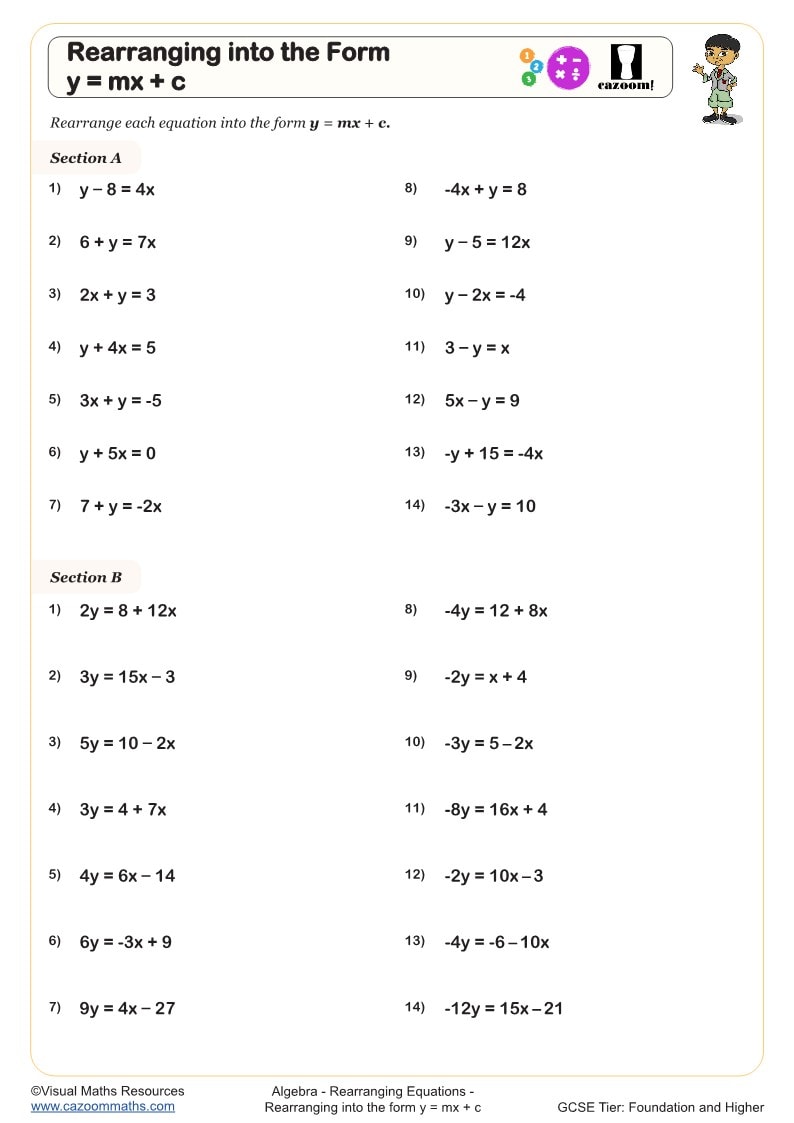
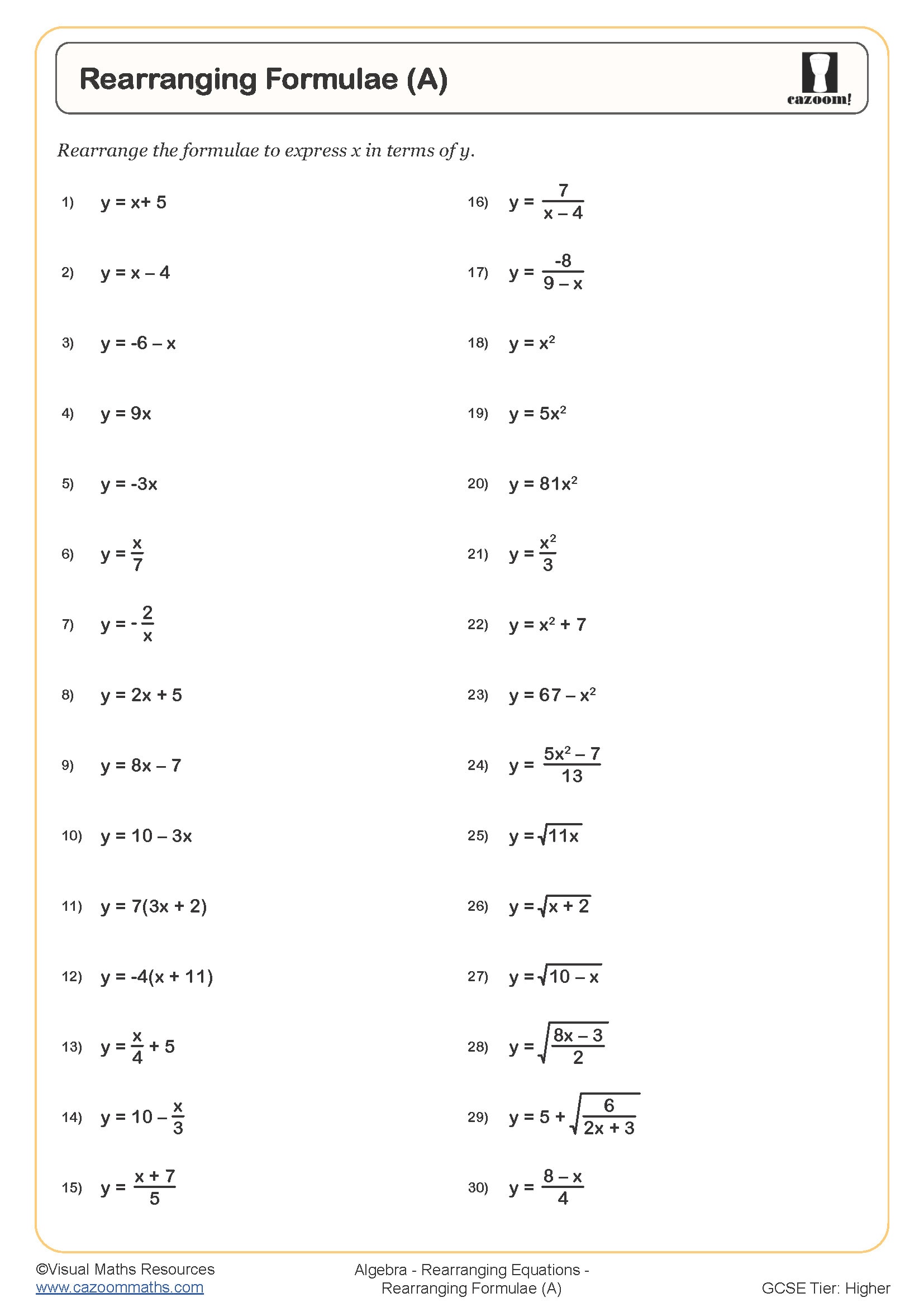
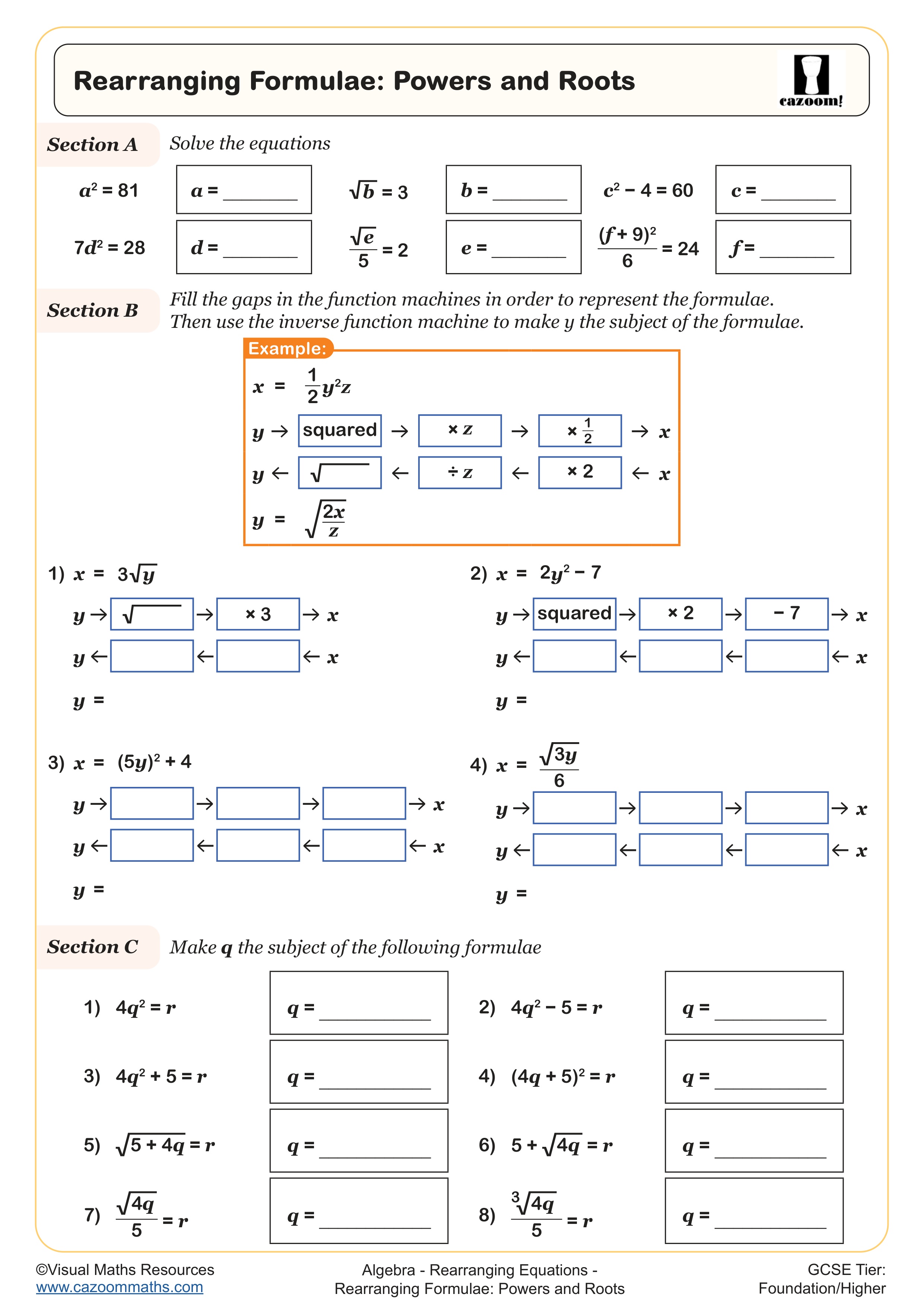
All worksheets are created by the team of experienced teachers at Cazoom Maths.
What is rearranging without factorisation?
Rearranging without factorisation involves changing the subject of a formula or equation when the variable you're solving for appears only once. This means you can isolate the variable using inverse operations—addition, subtraction, multiplication, and division—rather than needing to factorise. For example, to make h the subject in A = bh, you simply divide both sides by b to get h = A/b.
This technique is fundamental to algebra and appears throughout GCSE maths. Students apply these skills when rearranging formulae in physics and chemistry, converting between units, and solving real-world problems. Mastering this skill before tackling more complex rearrangement involving factorisation gives students a solid foundation for algebraic manipulation.
Which year groups study rearranging without factorisation?
Rearranging without factorisation is introduced in Year 9 as part of the KS3 algebra curriculum, where students first encounter changing the subject of simple formulae. The skill is then developed further in Year 10 and Year 11 at KS4, where students work with increasingly complex formulae involving fractions, brackets, and multiple operations.
At GCSE level, this topic appears across both Foundation and Higher tiers. Foundation students focus on simpler rearrangements, whilst Higher tier students tackle more challenging formulae. These worksheets provide appropriate practise for all three year groups, helping students build confidence with algebraic manipulation before progressing to rearrangement requiring factorisation.
How do you rearrange formulae with fractions?
When rearranging formulae with fractions, start by eliminating the fraction through multiplication. If the variable you're solving for is in the numerator, multiply both sides by the denominator. For example, with v = u/t, multiply both sides by t to get vt = u, then divide by v to make t the subject: t = u/v.
If the variable appears in the denominator, multiply both sides by that denominator first, then rearrange as normal. With practice, students develop efficient strategies for dealing with fractions, recognising patterns and choosing the most direct route to isolate the required variable. Our worksheets provide structured practise moving from straightforward examples to more complex formulae involving multiple fractions.
Do the worksheets include worked solutions?
Yes, every worksheet includes a complete answer sheet showing the final solutions. These answer sheets allow students to check their work independently and identify any errors in their rearrangement. For teachers, they make marking homework or classwork straightforward, whilst parents can support home learning without needing to work through each problem themselves.
The worksheets are designed with clear layouts and progressive difficulty, helping students build confidence systematically. You can use them for initial teaching, consolidation practise, or revision before assessments. Each resource downloads as a PDF, making printing and distribution simple whether you're preparing for a full class or supporting individual students who need additional practise with algebraic manipulation.