Simultaneous Equations Worksheets
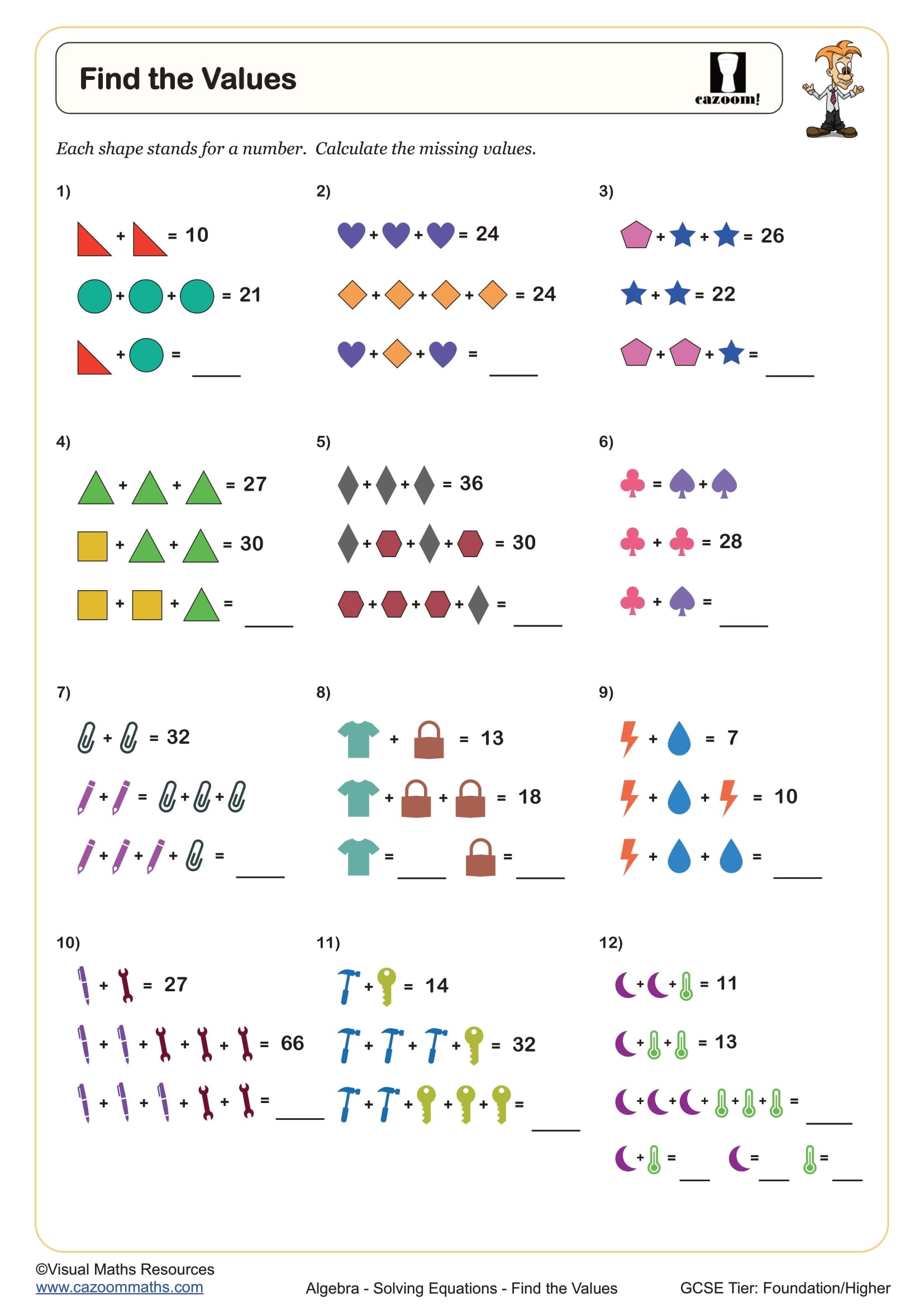
Find the Values
Year groups: 8, 9
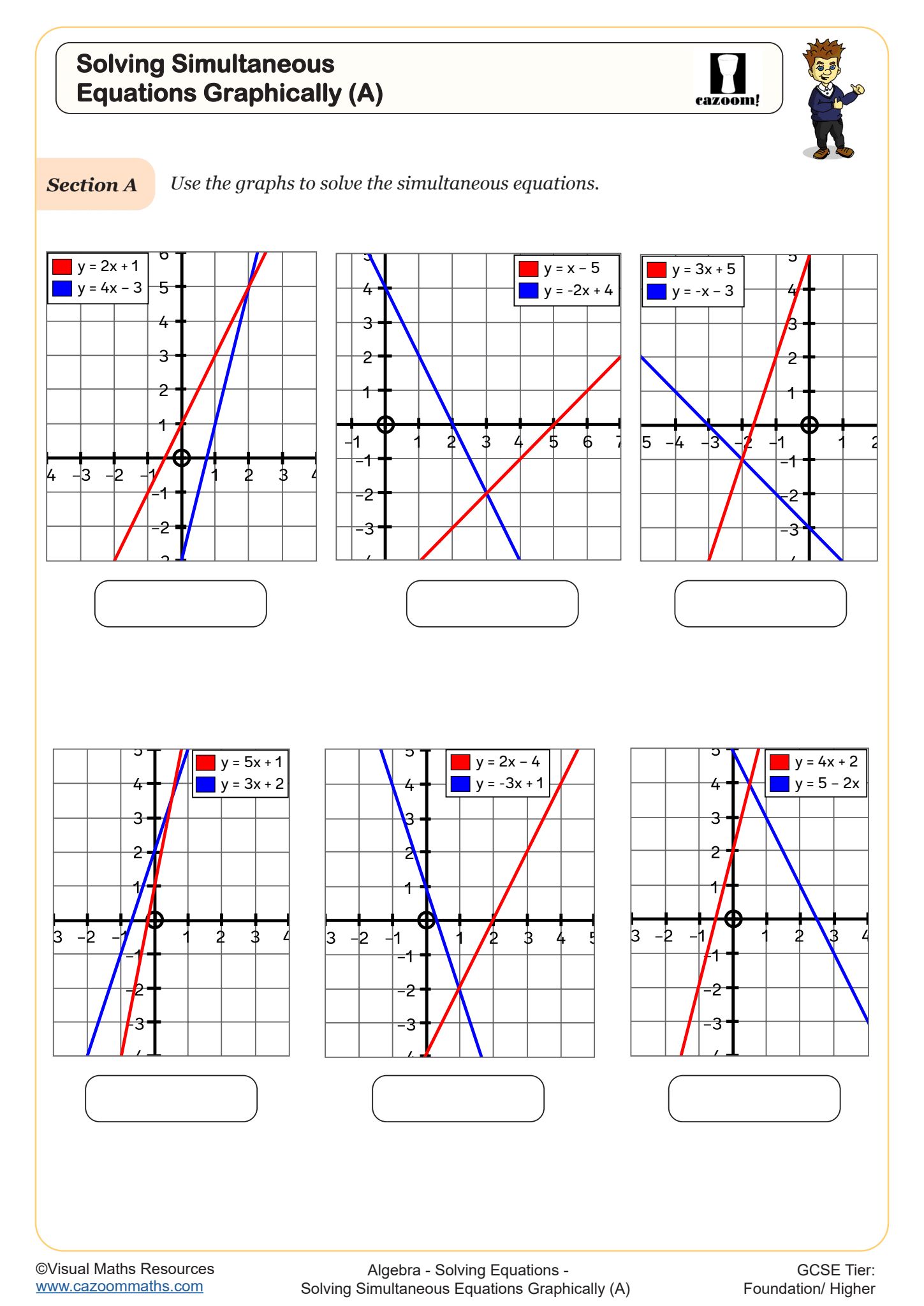
Solving Simultaneous Equations Graphically (A)
Year groups: 9, 10
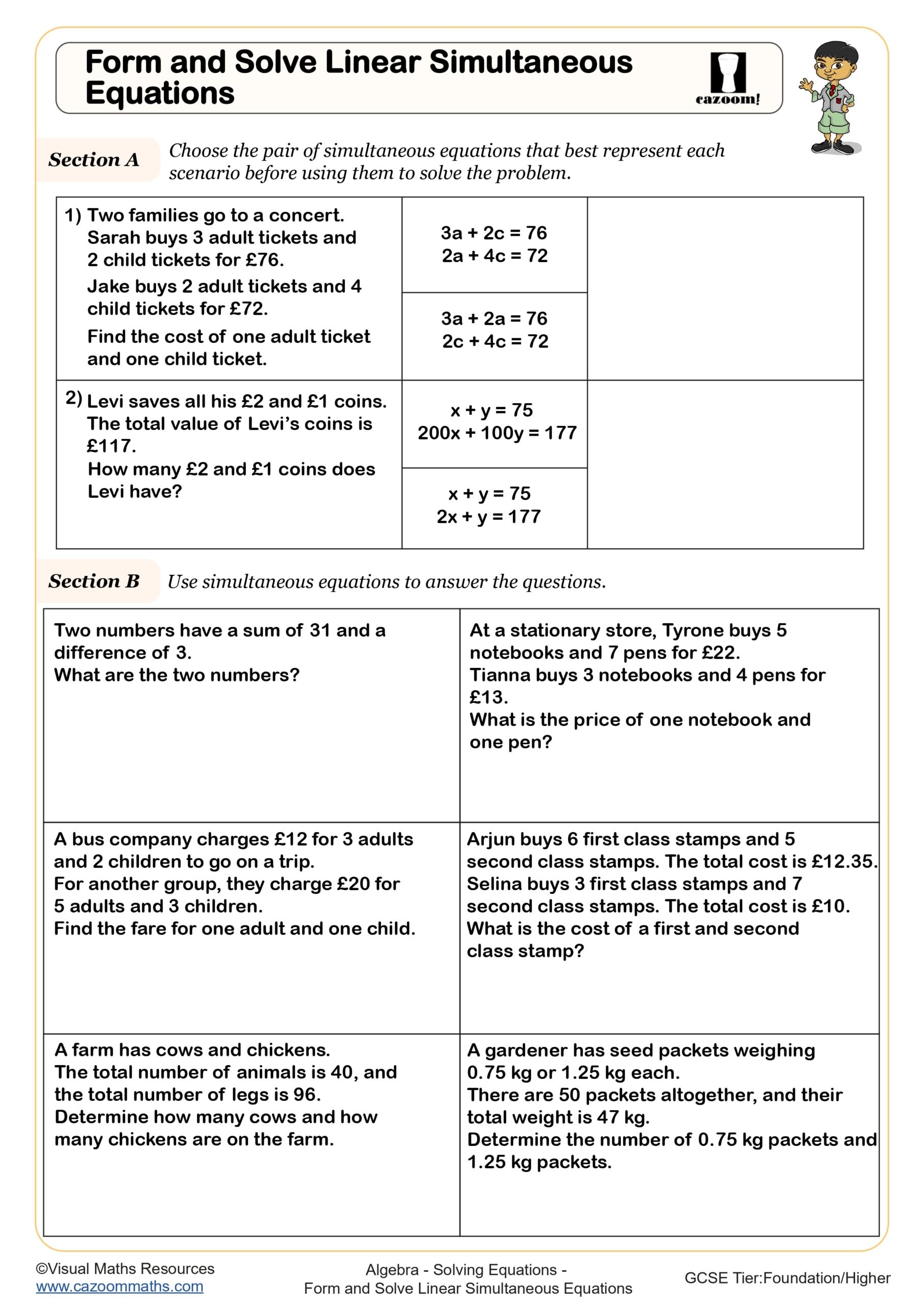
Form and Solve Linear Simultaneous Equations
Year groups: 10, 11
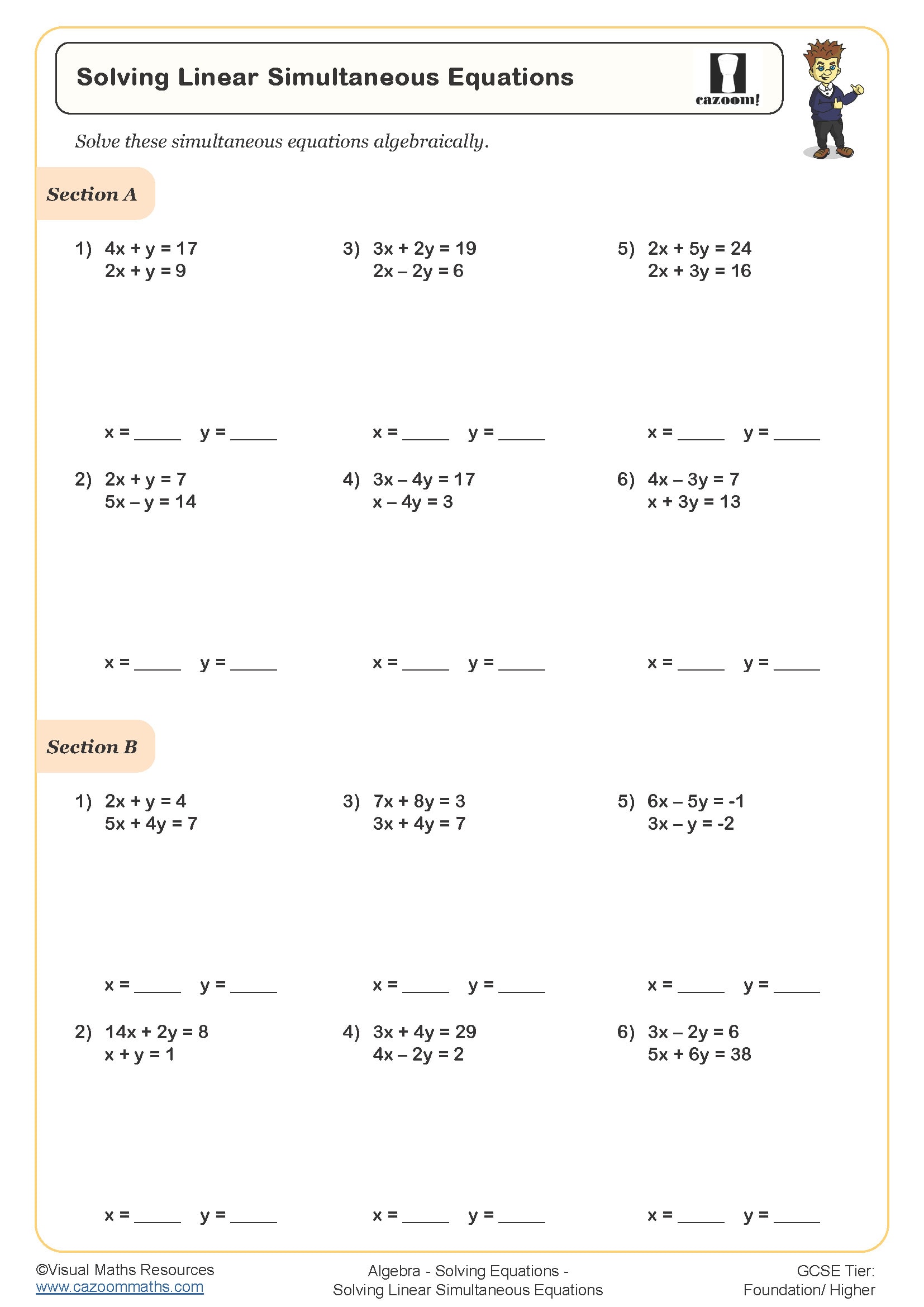
Solving Linear Simultaneous Equations
Year groups: 10, 11
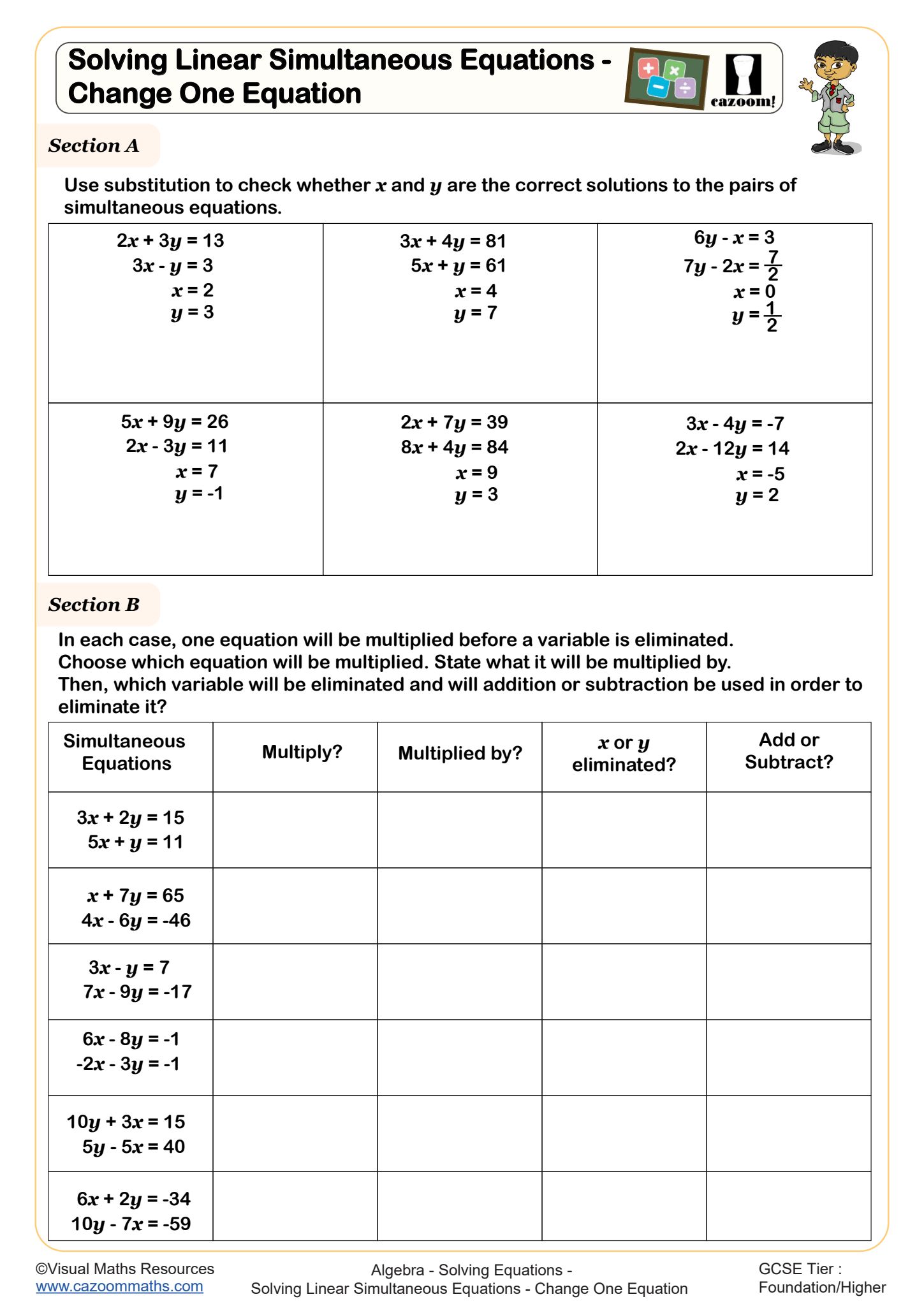
Solving Linear Simultaneous Equations - Change One Equation
Year groups: 10, 11
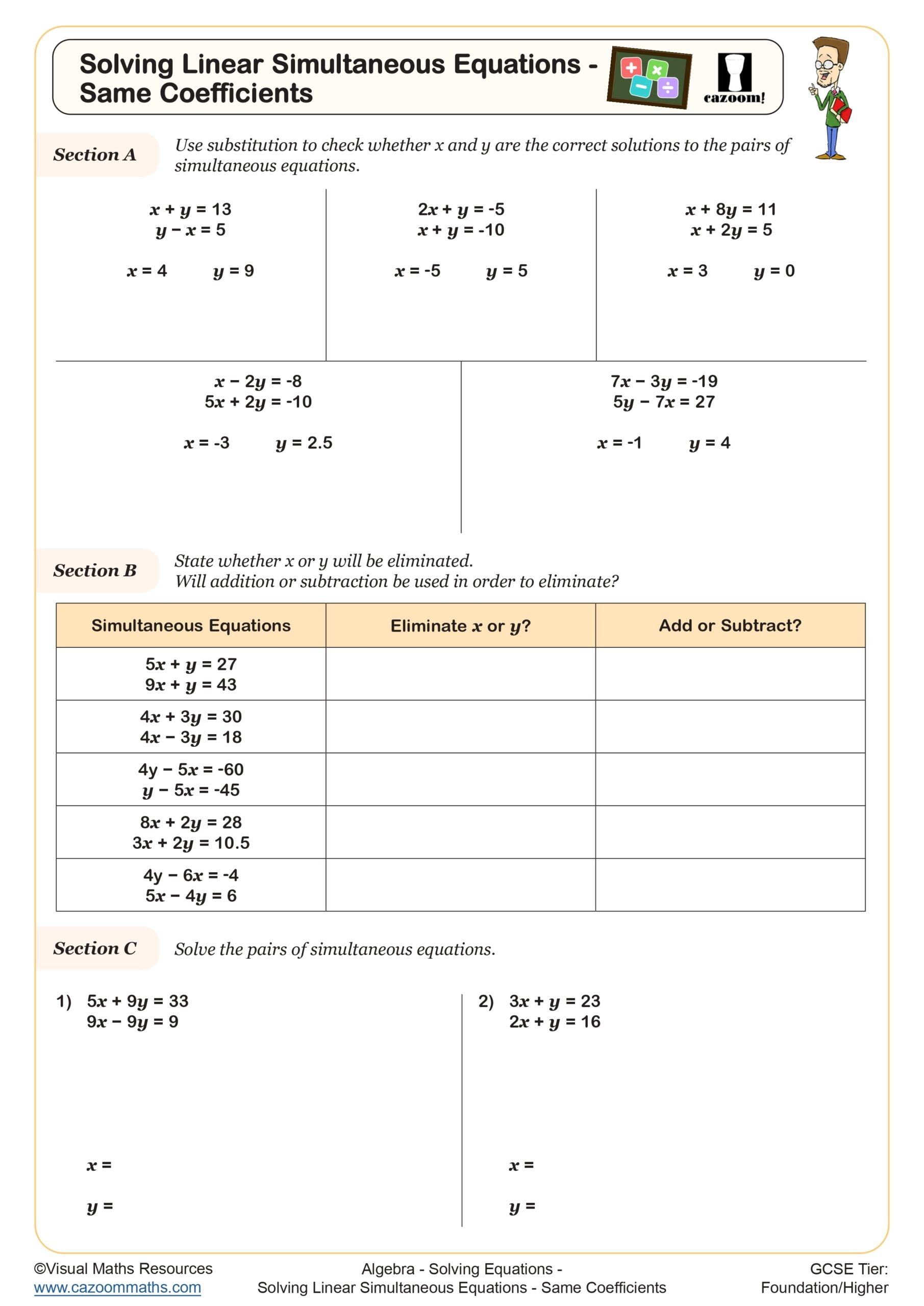
Solving Linear Simultaneous Equations - Same Coefficients
Year groups: 10, 11
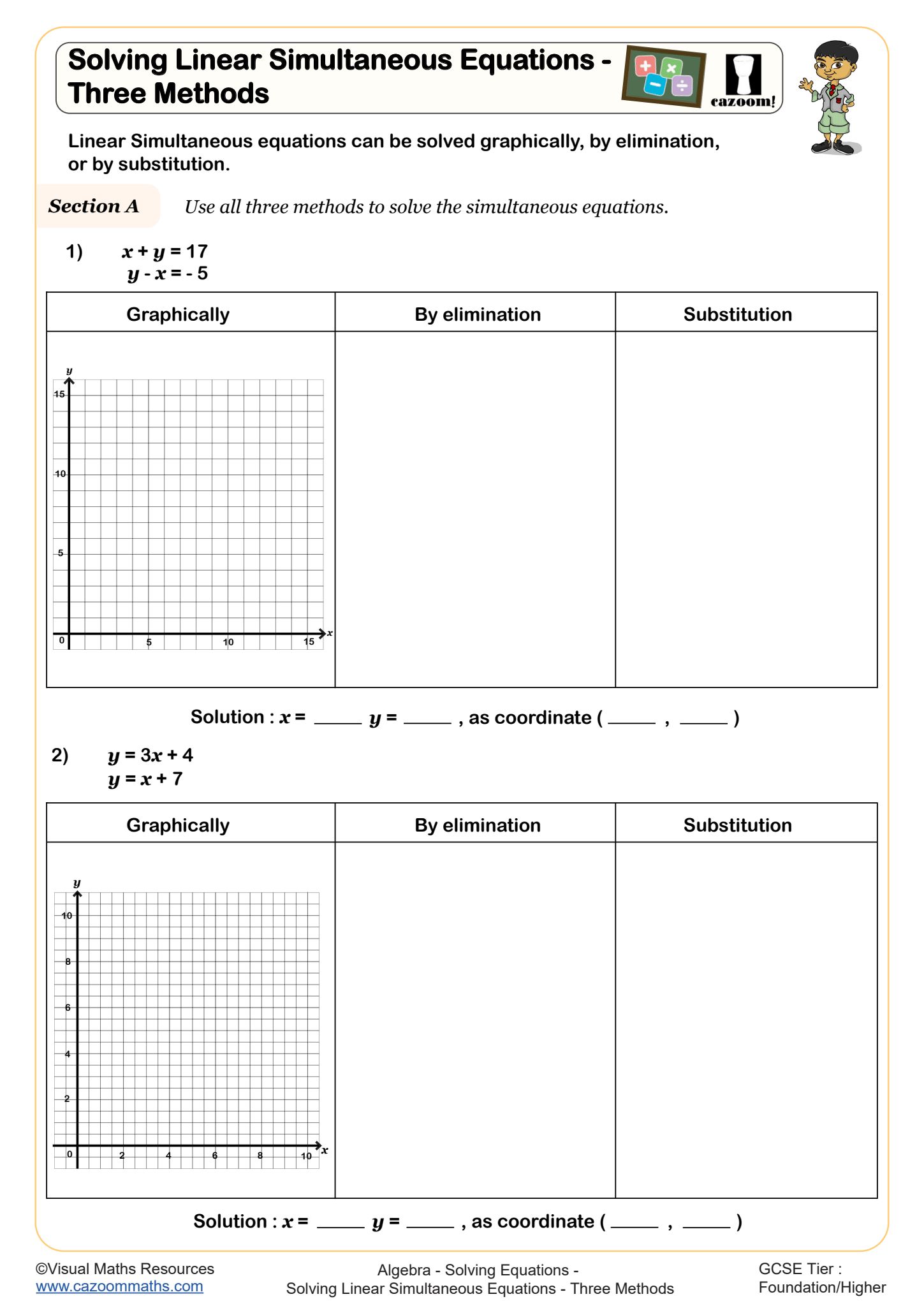
Solving Linear Simultaneous Equations - Three Methods
Year groups: 10, 11
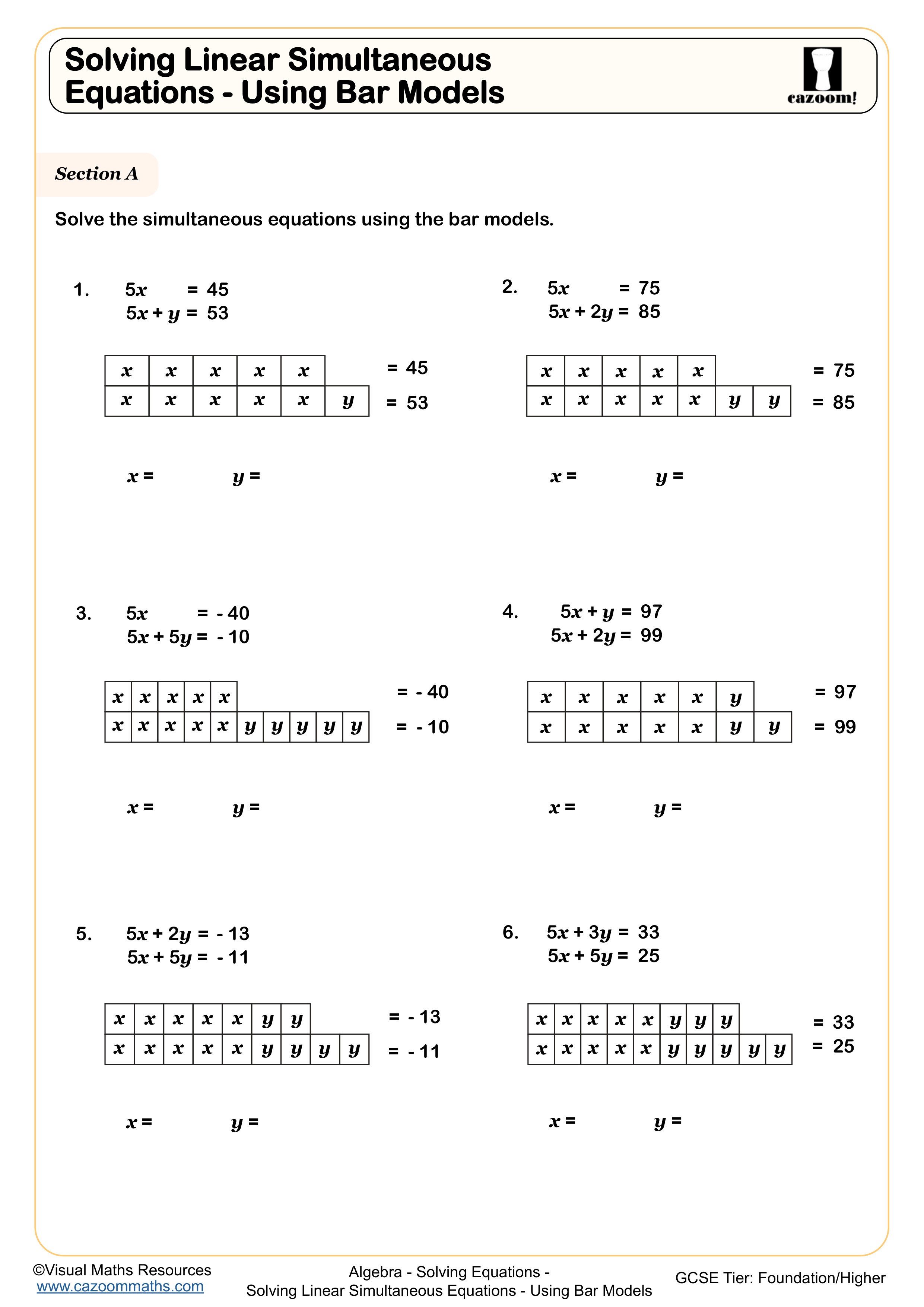
Solving Linear Simultaneous Equations - Using Bar Models
Year groups: 10, 11
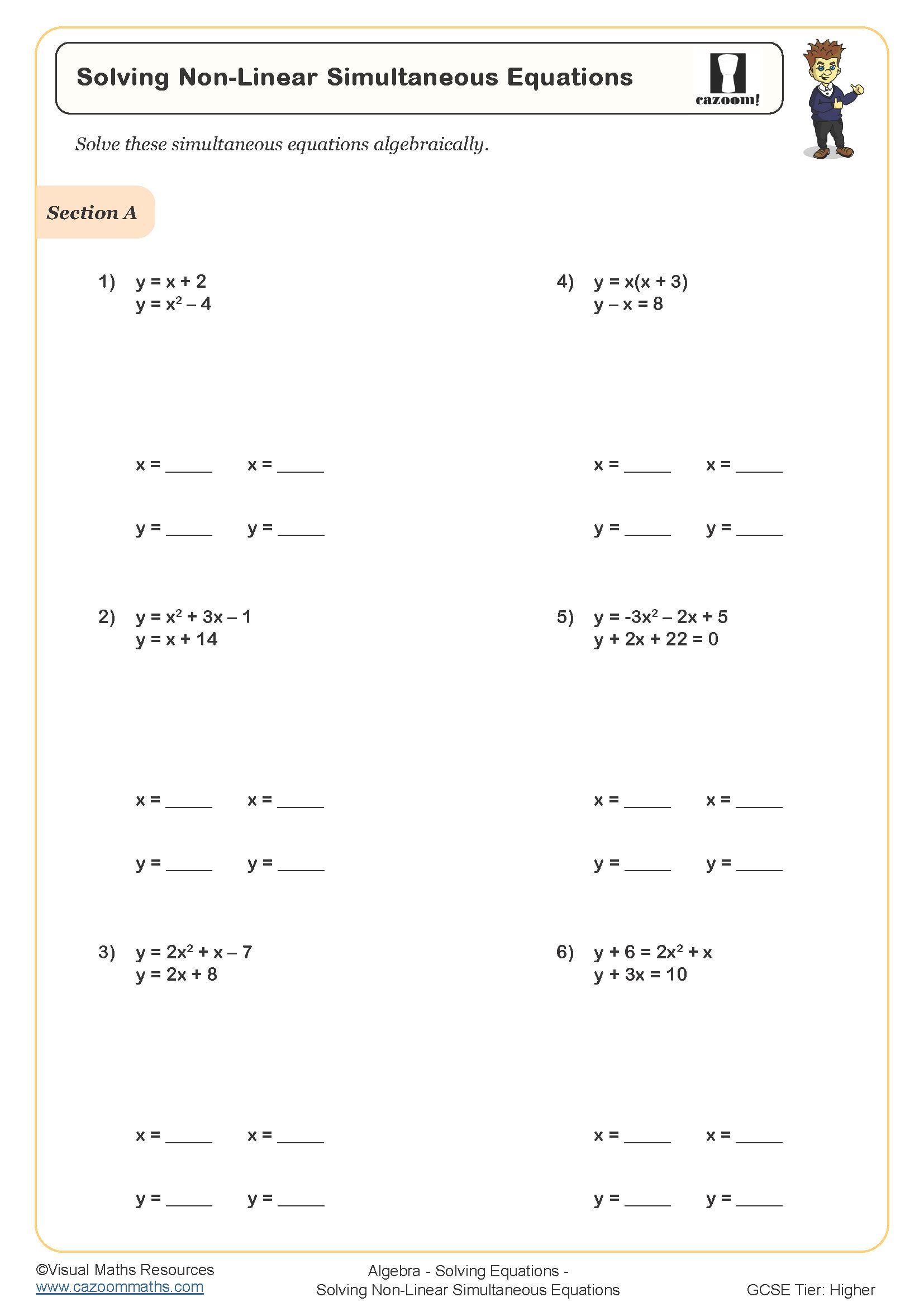
Solving Non-linear Simultaneous Equations
Year groups: 10, 11
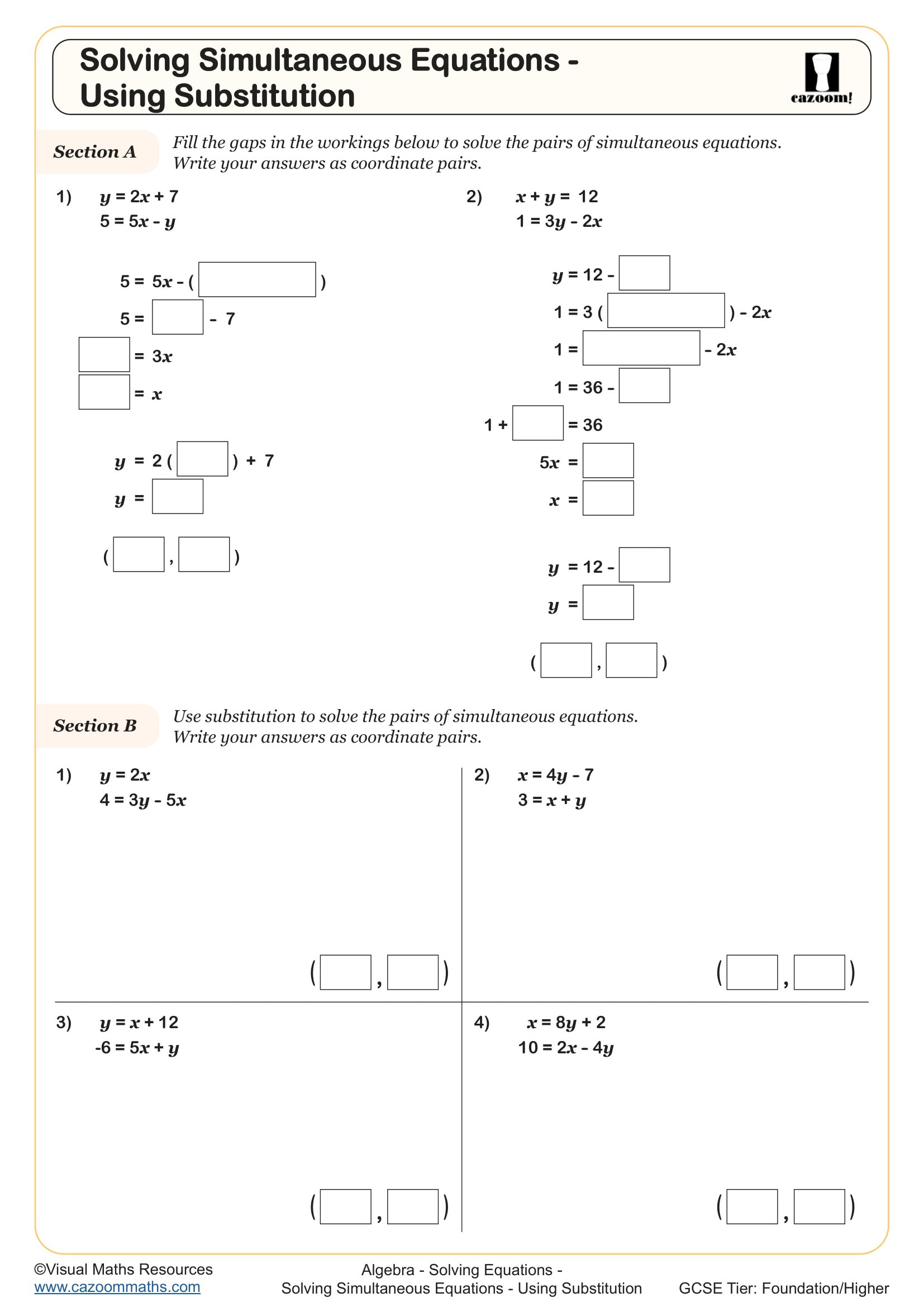
Solving Simultaneous Equations - Using Substitution
Year groups: 10, 11
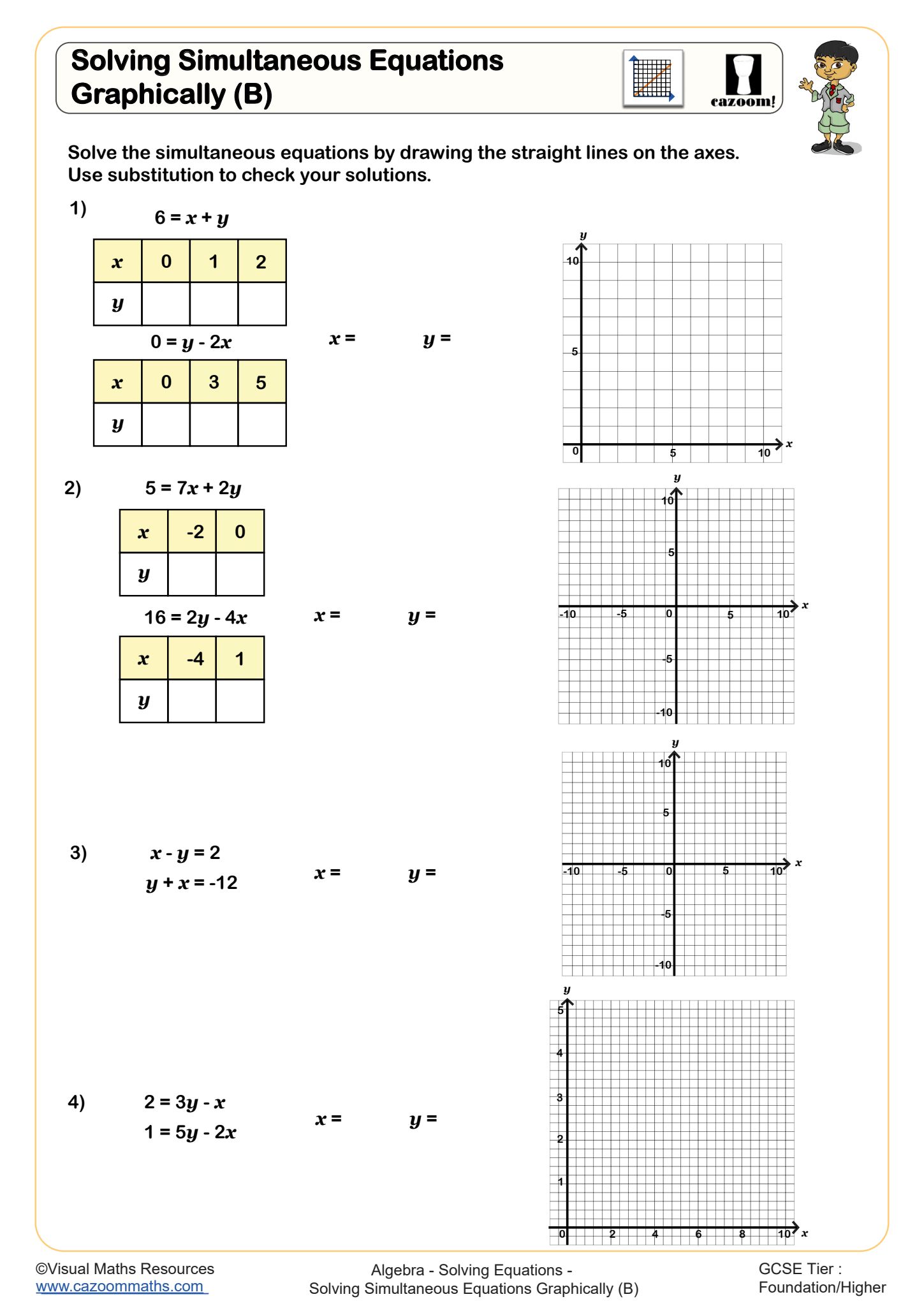
Solving Simultaneous Equations Graphically (B)
Year groups: 10, 11
All worksheets are created by the team of experienced teachers at Cazoom Maths.
What are the three methods for solving simultaneous equations?
The three main methods taught in UK secondary schools are elimination, substitution, and graphical representation. Elimination involves adding or subtracting equations to cancel one variable, substitution means rearranging one equation to replace a variable in the other, whilst the graphical method plots both lines to find their intersection point. At GCSE, students must be fluent in all three approaches as exam questions often specify which method to use.
Students commonly make errors when using elimination by forgetting to apply operations to both sides of the equation. When coefficients need adjusting, many multiply only one term rather than the entire equation, leading to incorrect solutions. Mark schemes particularly penalise work where students change coefficients but fail to show this step clearly, so encouraging systematic recording of each stage proves valuable.
Which year groups study simultaneous equations?
Simultaneous equations appear in the National Curriculum from Year 8 onwards, continuing through Key Stage 3 and forming essential GCSE content at Key Stage 4. Year 8 students typically begin with equations where coefficients are already the same, making elimination straightforward. Year 9 introduces cases requiring one equation to be multiplied, whilst Year 10 and Year 11 work covers all three methods including substitution and more complex algebraic manipulation.
The progression builds systematically: students start with integer solutions and simple coefficients before encountering fractional or negative solutions. By Year 11, higher-tier GCSE students tackle simultaneous equations involving one linear and one quadratic equation, though these linear-linear systems remain the foundation. Teachers observe that students who haven't mastered basic elimination in Year 8 struggle significantly with GCSE problem-solving questions where forming simultaneous equations from worded contexts is required.
When do you use the substitution method for simultaneous equations?
Substitution works particularly well when one equation is already rearranged to make a variable the subject, such as y = 3x + 2, or when coefficients make elimination awkward. Students rearrange one equation for a single variable, then substitute this expression into the other equation. This creates a single-variable equation to solve, after which they substitute back to find the second value. The method proves especially useful when one equation has a coefficient of 1.
This technique connects directly to real-world applications in STEM fields where constraint equations must be satisfied simultaneously. Engineers use substitution when designing systems with multiple specifications—for example, calculating wire lengths and angles in structural frameworks where both strength requirements and material costs must balance. Understanding that one constraint can be expressed in terms of another, then applied to find feasible solutions, underpins optimisation problems students encounter in further mathematics and science courses.
How can teachers use simultaneous equations worksheets effectively?
The worksheets provide scaffolded practice starting with equations featuring same coefficients before progressing to cases requiring manipulation. This structure allows teachers to differentiate by selecting appropriate difficulty levels whilst maintaining the same core skill development. Questions typically increase in complexity within each sheet, helping students build confidence through initial success before tackling more challenging problems that prepare them for GCSE-style questions.
Many teachers use these resources for targeted intervention with students who grasp the concept but make procedural errors, as the answer sheets enable immediate self-correction. They work well for homework following initial teaching, allowing students to consolidate methods independently. In revision sessions, selecting mixed questions from different sheets helps students recognise which method suits particular equation structures, a skill that exam mark schemes reward. Paired work proves effective too, with students comparing methods and checking each other's elimination or substitution steps against the provided answers.