Solving Linear Equations with Unknowns on Both Sides Worksheets
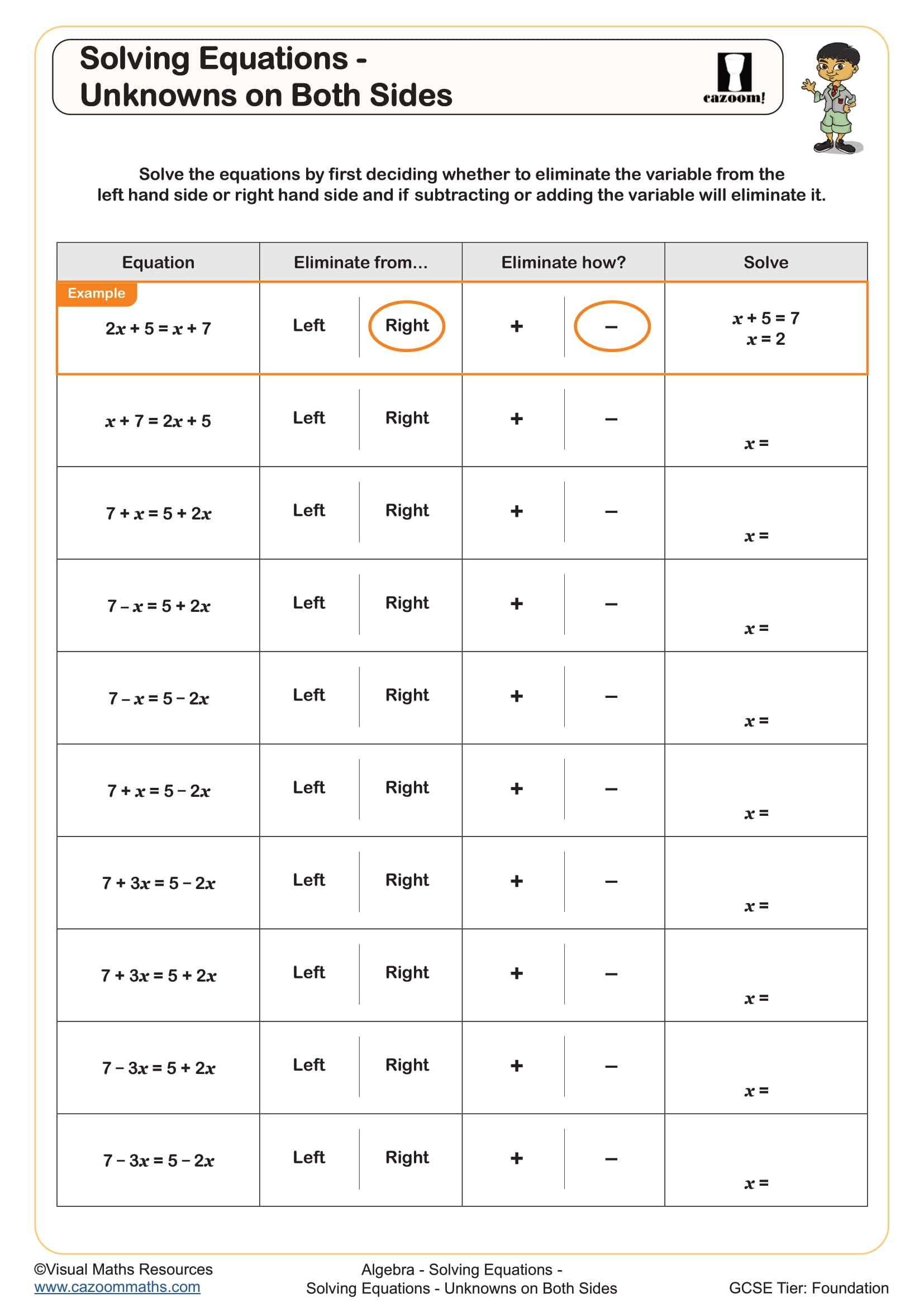
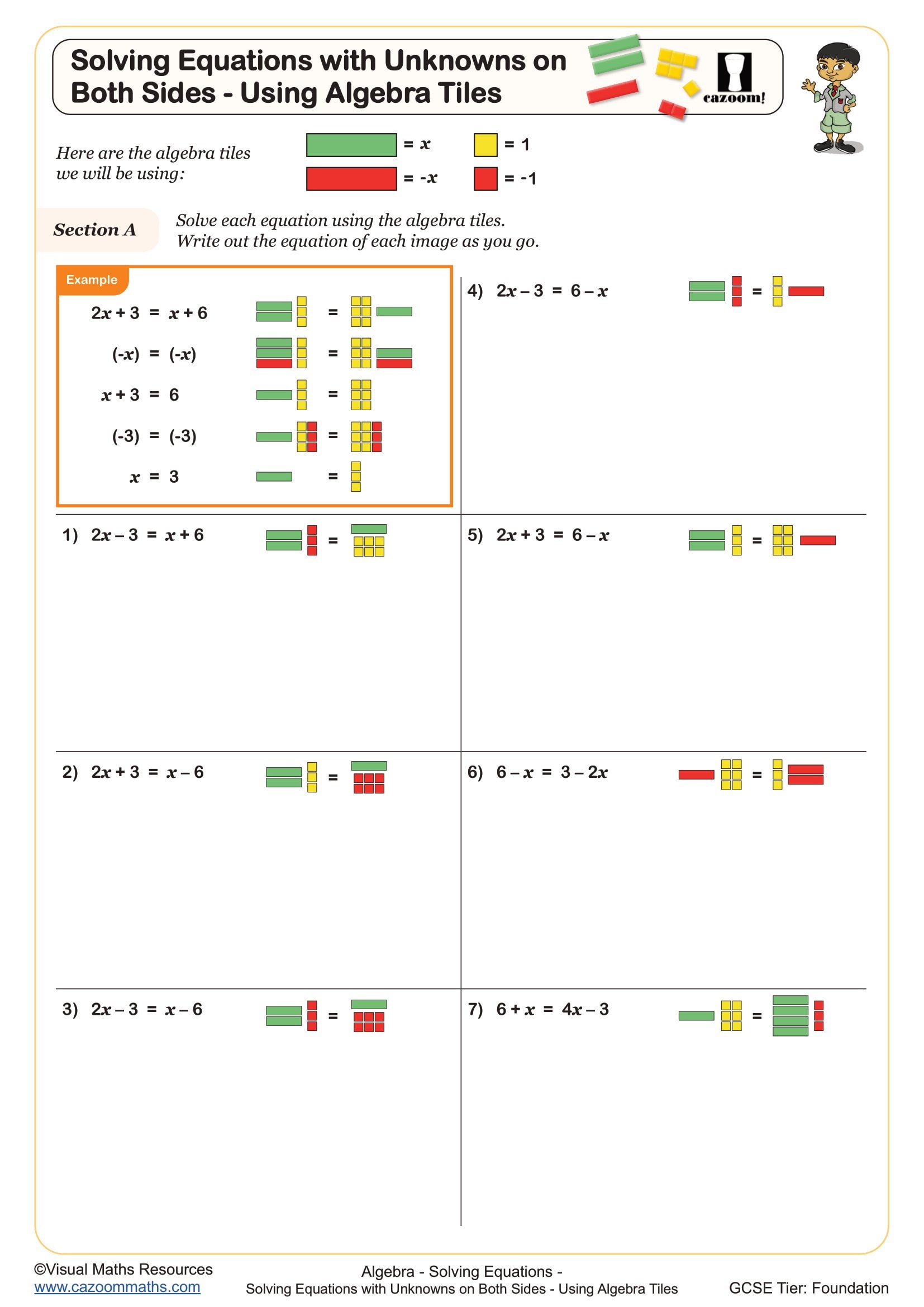
All worksheets are created by the team of experienced teachers at Cazoom Maths.
How do you solve equations with unknowns on both sides?
The standard method involves collecting all terms containing the variable on one side of the equation and all constant terms on the other, then isolating the variable through inverse operations. Students typically move the smaller variable term first to avoid negative coefficients, though either approach works mathematically. For example, with 5x + 3 = 2x + 12, subtracting 2x from both sides gives 3x + 3 = 12, then subtracting 3 yields 3x = 9, so x = 3.
Exam mark schemes frequently penalise students who skip the intermediate step of showing their collection of terms. Many students lose marks by attempting mental arithmetic too early and making sign errors, particularly when dealing with negative coefficients. Teachers notice that students who write out every step methodically, even when the equation seems simple, make fewer errors and can trace back mistakes more effectively when checking their solutions.
Which year groups study solving linear equations with unknowns on both sides?
This topic appears in the Key Stage 3 curriculum for Year 8 students and continues through Years 9 and 10 as part of GCSE preparation. The National Curriculum expects students to solve linear equations with integer coefficients where the unknown appears on both sides, forming the foundation for ratio problems, proportion, and simultaneous equations. At Key Stage 4, this skill becomes non-negotiable for accessing higher-tier GCSE questions.
The progression across these year groups typically involves increasing algebraic complexity rather than conceptual changes. Year 8 worksheets focus on equations with positive coefficients and simple constants, Year 9 introduces negative terms and fractional solutions, whilst Year 10 materials incorporate brackets requiring expansion and equations arising from geometric contexts. Students who struggle with this progression often have underlying gaps in understanding inverse operations or integer arithmetic, particularly with negatives.
Why do we need equations with unknowns on both sides?
Equations with variables on both sides model situations where two expressions need balancing or comparing, reflecting how relationships work in applied mathematics and science. This algebraic structure appears when comparing mobile phone tariffs (fixed charge plus per-minute rates), calculating break-even points in business contexts, or analysing motion problems where two objects travel at different speeds. The ability to manipulate these equations underpins much of GCSE and A-level problem-solving.
In engineering and technology, balanced equations represent conservation laws and equilibrium states. When electronics students calculate current distribution in circuits using Kirchhoff's laws, or when physics students analyse systems in equilibrium, they're solving equations with terms on both sides. The systematic manipulation skills developed here transfer directly to rearranging formulae in STEM subjects, making this topic genuinely foundational rather than purely abstract practice. Teachers can strengthen understanding by regularly connecting classroom equations to these tangible contexts.
How should teachers use these worksheets in lessons?
These worksheets work most effectively when students have already grasped solving basic linear equations with the unknown on one side, as they extend rather than introduce algebraic manipulation. The structured progression within each worksheet allows teachers to identify precisely where understanding falters, whether at the collection of terms stage, dealing with negative coefficients, or maintaining accuracy through multi-step procedures. The answer sheets enable quick diagnostic marking during lessons, letting teachers intervene before misconceptions become embedded.
Many teachers use these worksheets for targeted intervention with small groups who need additional practice before assessments, or as homework to consolidate lesson content. They work particularly well for paired work where students solve alternate questions then check each other's methods, as articulating the steps reveals gaps in understanding. During revision periods before end-of-year exams or GCSE mocks, these worksheets help students rebuild fluency with procedural skills that may have become rusty, whilst the answer sheets allow independent study outside lessons.