Solving Quadratic Equations Worksheets
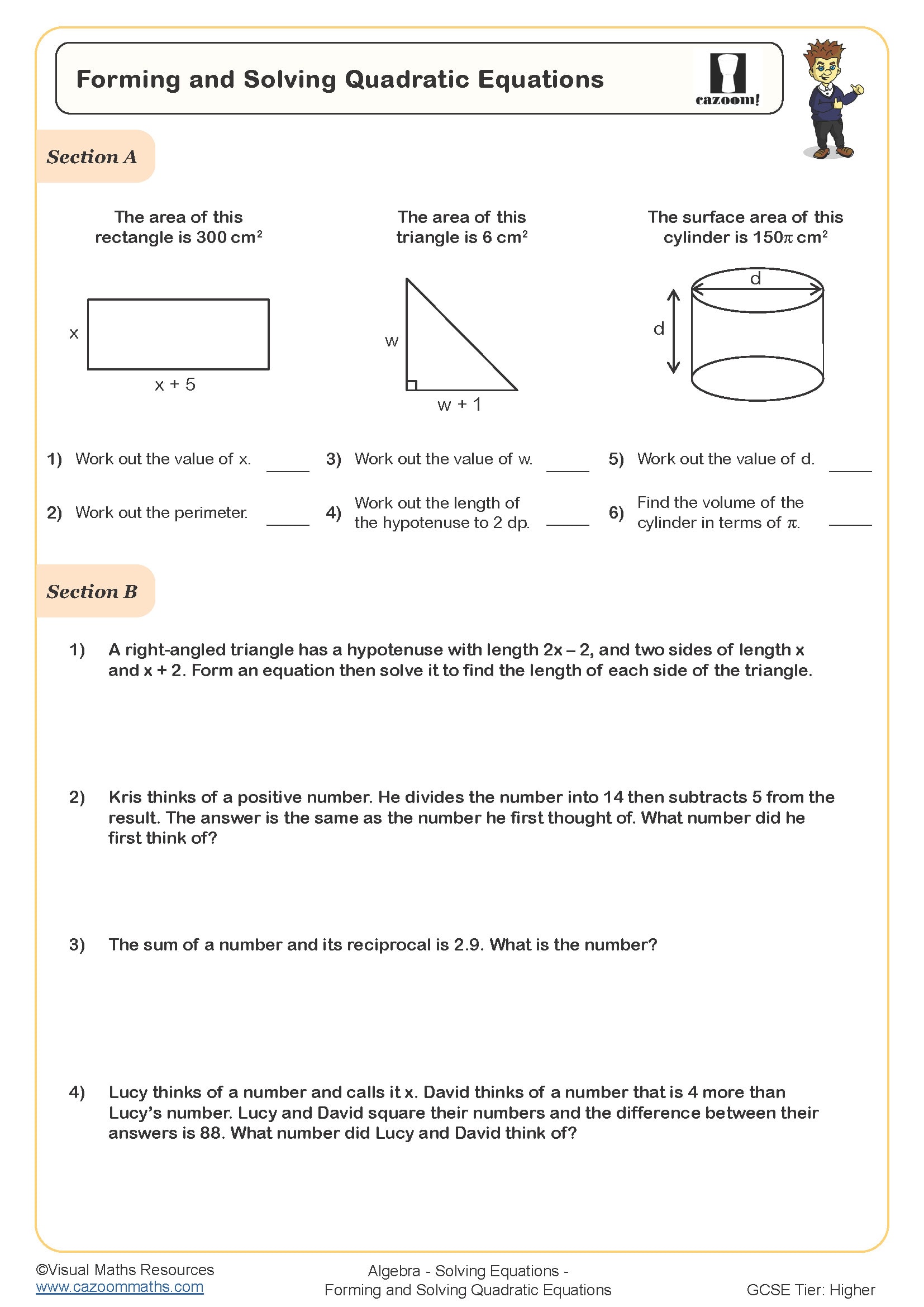
Forming and Solving Quadratic Equations
Year groups: 10, 11
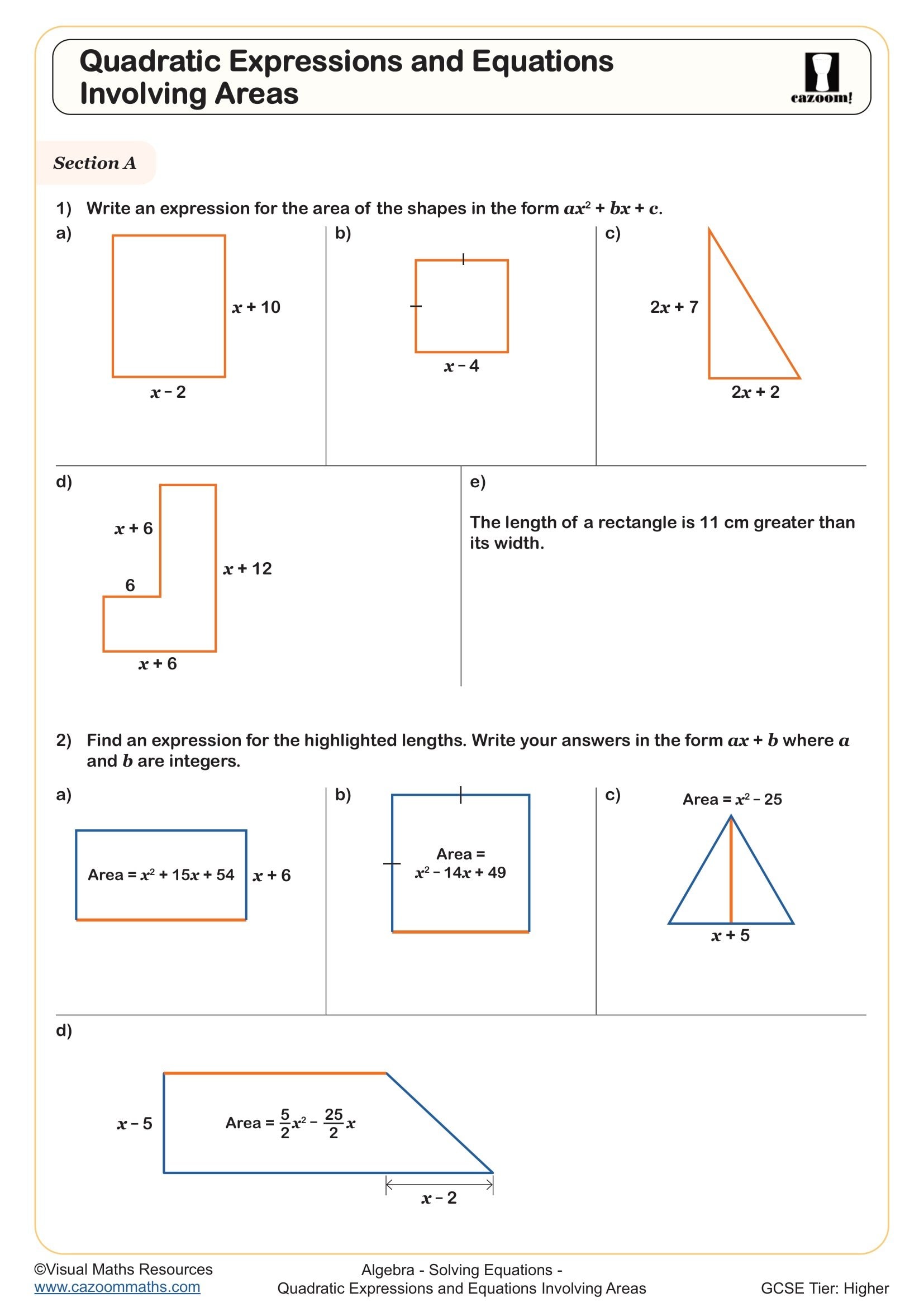
Quadratic Expressions and Equations Involving Areas
Year groups: 10, 11
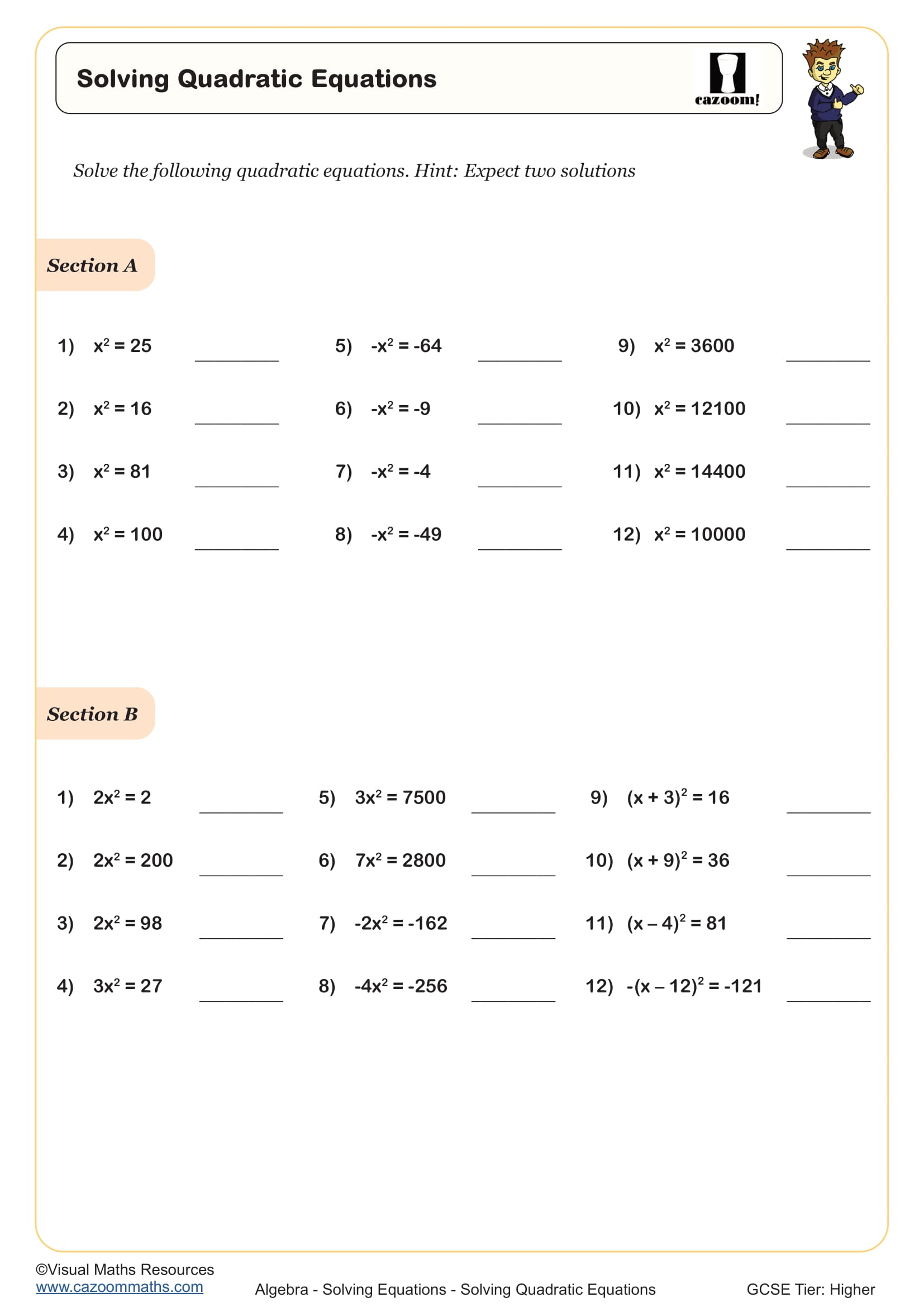
Solving Quadratic Equations
Year groups: 10, 11
Solving Quadratic Equations by Completing the Square
Year groups: 10, 11
.jpg?w=3840)
Solving Quadratic Equations by Factorising
Year groups: 10, 11
.jpg?w=3840)
Solving Quadratic Equations by Formula
Year groups: 10, 11
.jpg?w=3840)
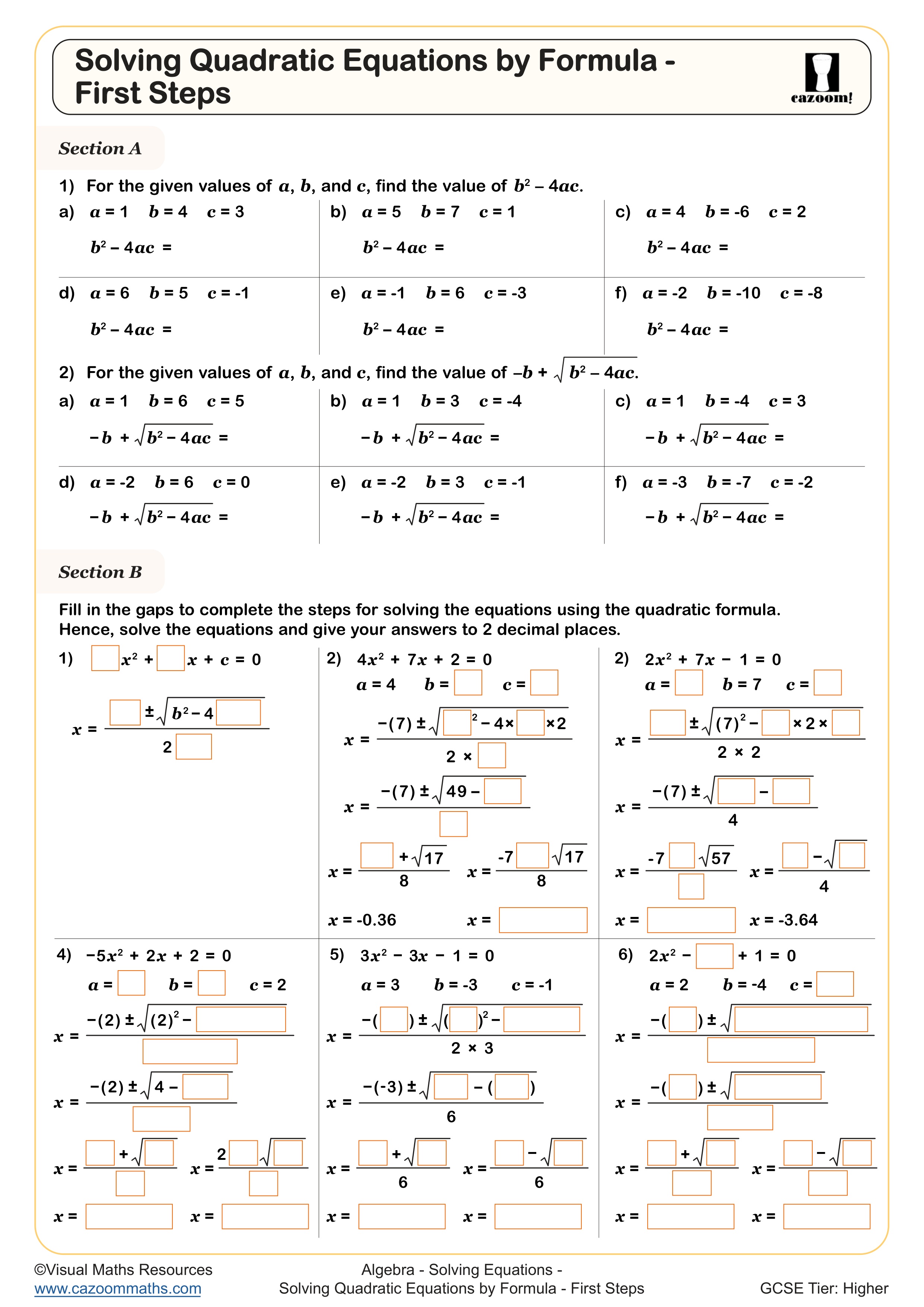
Solving Quadratic Equations by Formula - First Steps
Year groups: 10, 11
Solving Quadratic Equations by Formula (Non-Calculator)
Year groups: 10, 11
-Worksheet.jpg?w=3840)
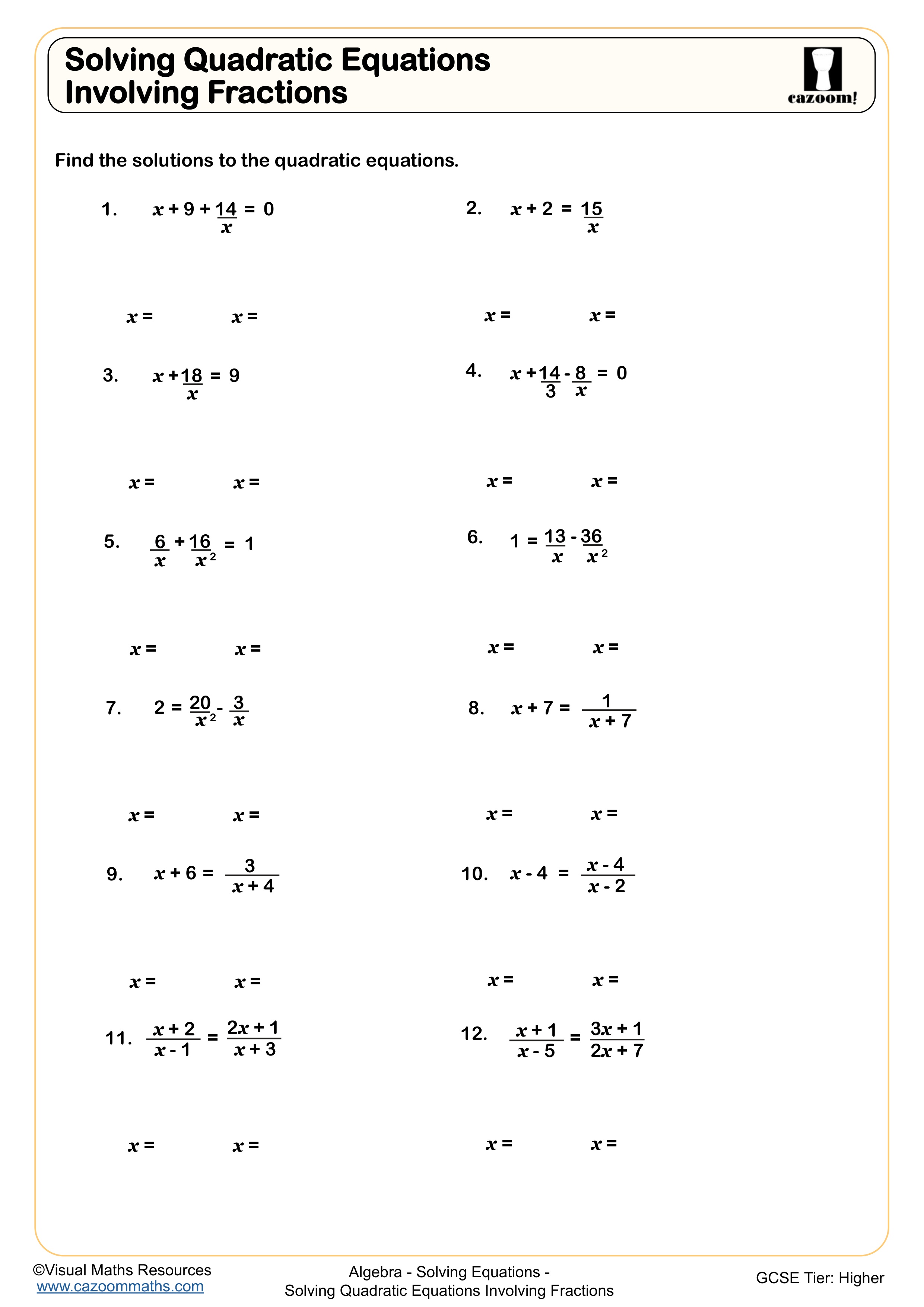
Solving Quadratic Equations Involving Fractions
Year groups: 10, 11
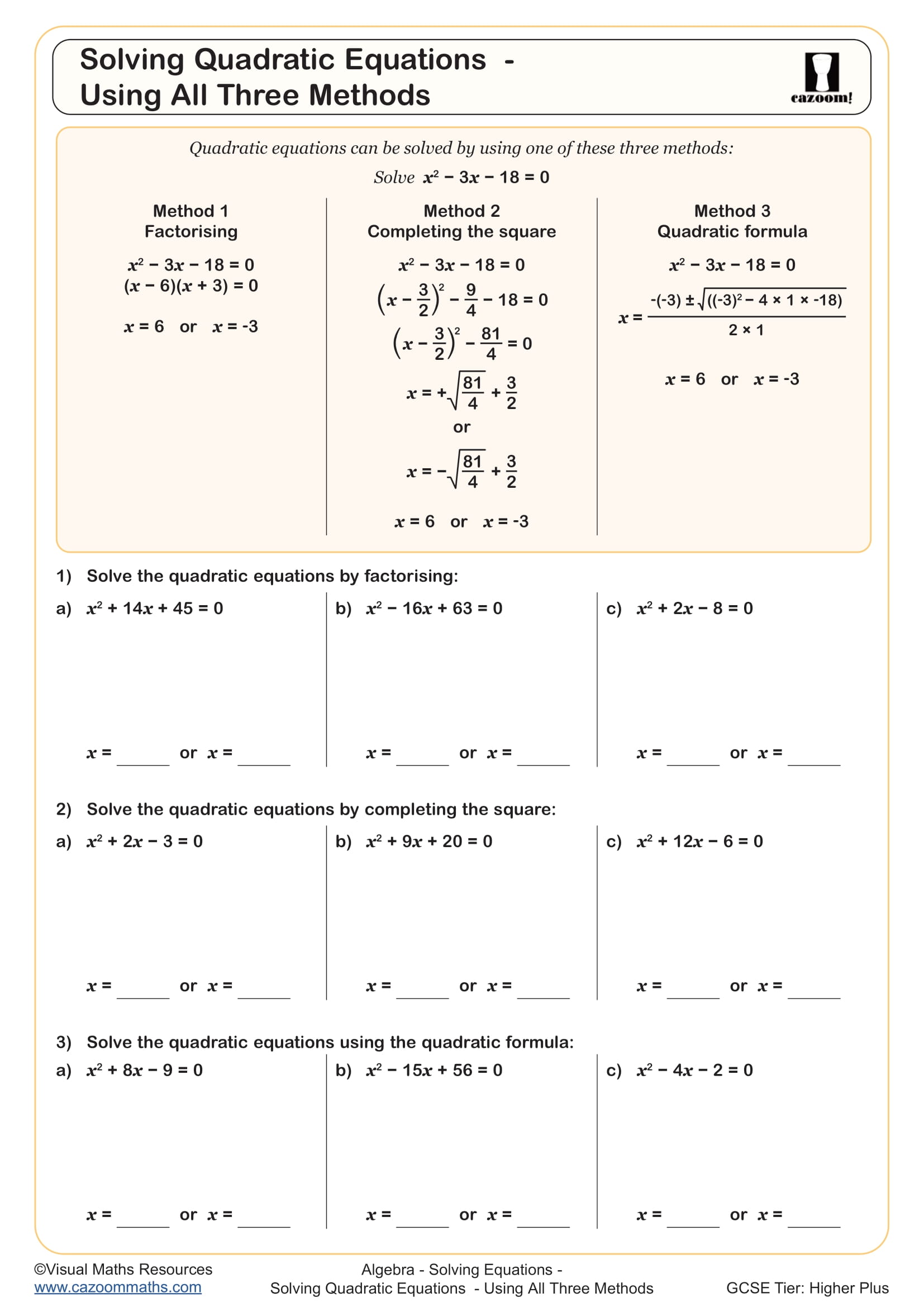
Solving Quadratic Equations Using All Three Methods
Year groups: 10, 11
All worksheets are created by the team of experienced teachers at Cazoom Maths.
What are the main methods for solving quadratic equations?
Students at KS4 need to master three core methods: factorising and using the null factor law, completing the square, and applying the quadratic formula. The National Curriculum expects students to recognise which method suits each equation, with factorising being most efficient for simple integer solutions and the quadratic formula providing a reliable approach for non-factorisable cases. Completing the square appears less frequently in exams but underpins work on turning points and sketching parabolas.
A common error occurs when students attempt to factorise equations like x² + 3x + 1 = 0, wasting time searching for factors that don't exist. Exam mark schemes penalise incomplete working, so teachers emphasise checking the discriminant (b² - 4ac) early to determine whether factorising is viable. Students also struggle with negative coefficients when factorising, frequently writing (x - 2)(x - 3) when they mean (x + 2)(x + 3) after misapplying signs.
Which year groups study solving quadratic equations?
Solving quadratic equations sits firmly within the Key Stage 4 curriculum, typically introduced in Year 10 and developed throughout Year 11. Students encounter quadratics on the Higher tier GCSE paper, where questions range from straightforward factorising worth 2-3 marks through to problem-solving contexts requiring equation formation and solution. Foundation tier students may meet simple factorising but won't face the full range of solution methods.
Progression across Year 10 and 11 involves moving from equations that factorise neatly (with integer solutions) to those requiring the quadratic formula and yielding surd or decimal answers. By Year 11, students should confidently handle equations with fractional or negative coefficients, rearrange before solving, and apply quadratics to real-world problems involving areas, projectile motion or optimisation. The demand increases as equations become embedded within multi-step problems rather than presented in isolated ax² + bx + c = 0 form.
How does completing the square help solve quadratic equations?
Completing the square rewrites a quadratic in the form (x + p)² + q = 0, allowing students to rearrange and take square roots to find solutions. This method works for all quadratics, including those that don't factorise, and explicitly shows why some equations have no real solutions (when taking the square root of a negative number is required). Students often find this method more algebraically demanding than factorising, particularly when the coefficient of x² isn't 1, but it builds deeper understanding of quadratic structure.
This technique has direct applications in physics and engineering when analysing motion under gravity. Projectile problems frequently require finding when an object reaches a specific height, leading to equations like -5t² + 20t + 3 = 10. Completing the square reveals the maximum height directly from the turning point form, whilst also solving for specific time values. Civil engineers use the same approach when designing parabolic arches or cables, where the quadratic relationship between height and distance must be optimised for structural constraints.
How can these worksheets support different learners?
The worksheets scaffold learning by separating first steps from more demanding problems, allowing teachers to match difficulty to student confidence. Early questions focus on identifying equation type and selecting appropriate methods, whilst later problems integrate multiple skills such as rearranging before solving or handling fractional coefficients. Worked examples demonstrate the layout and reasoning exam markers expect, helping students structure their solutions to maximise marks even when final answers are incorrect.
These resources work effectively for targeted intervention with students who've been absent or struggle with algebraic manipulation, as the answer sheets enable paired self-checking without teacher supervision. Many teachers use them for homework to build automaticity with factorising patterns, or as timed practice under exam conditions during Year 11 revision. The structured progression also suits setting starter activities that recap prior learning before introducing completing the square or the quadratic formula, ensuring students' foundational factorising skills remain sharp throughout their GCSE preparation.