Substituting into Expressions Worksheets
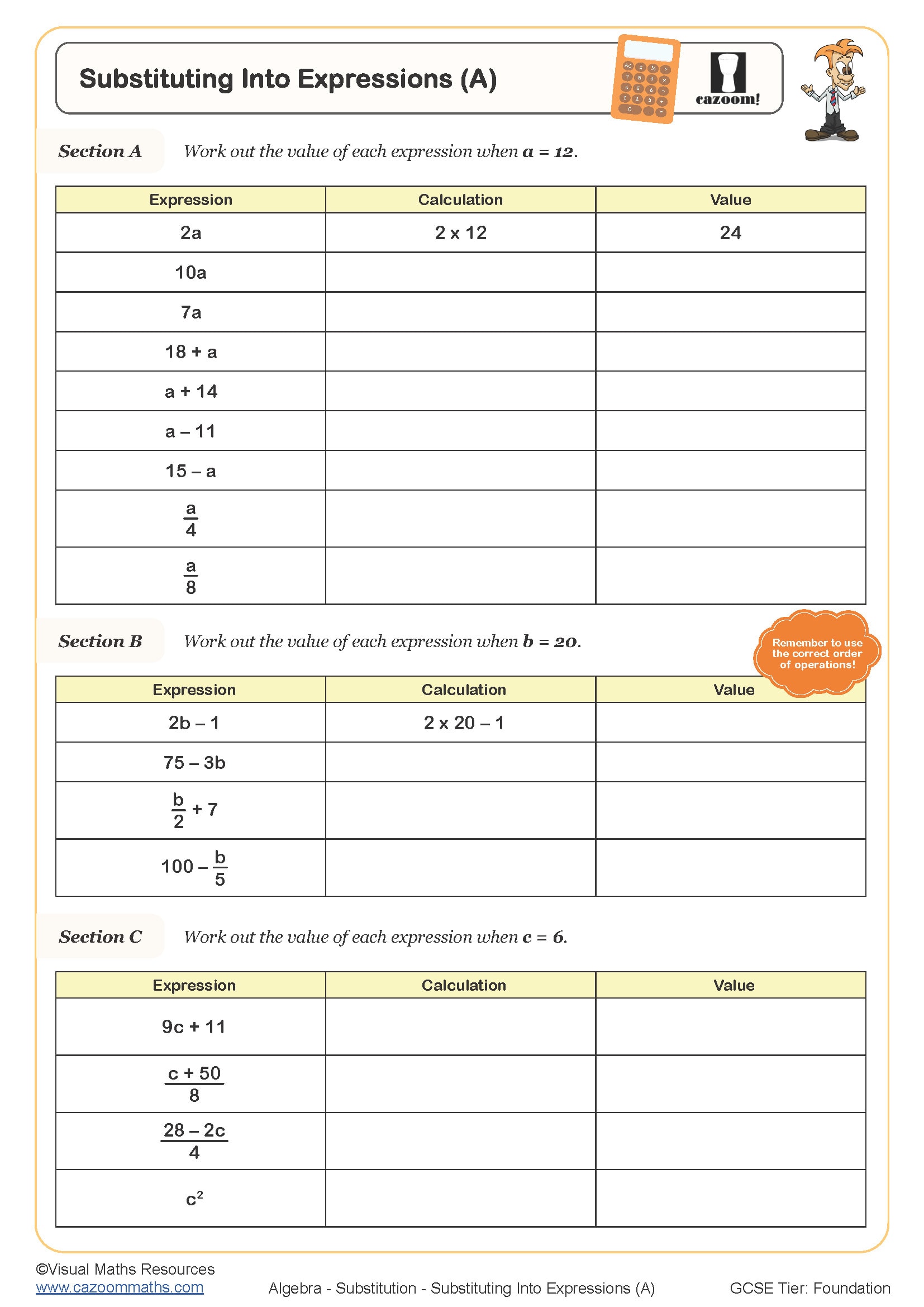
Substituting into Expressions (A)
Year groups: 7, 8, 9
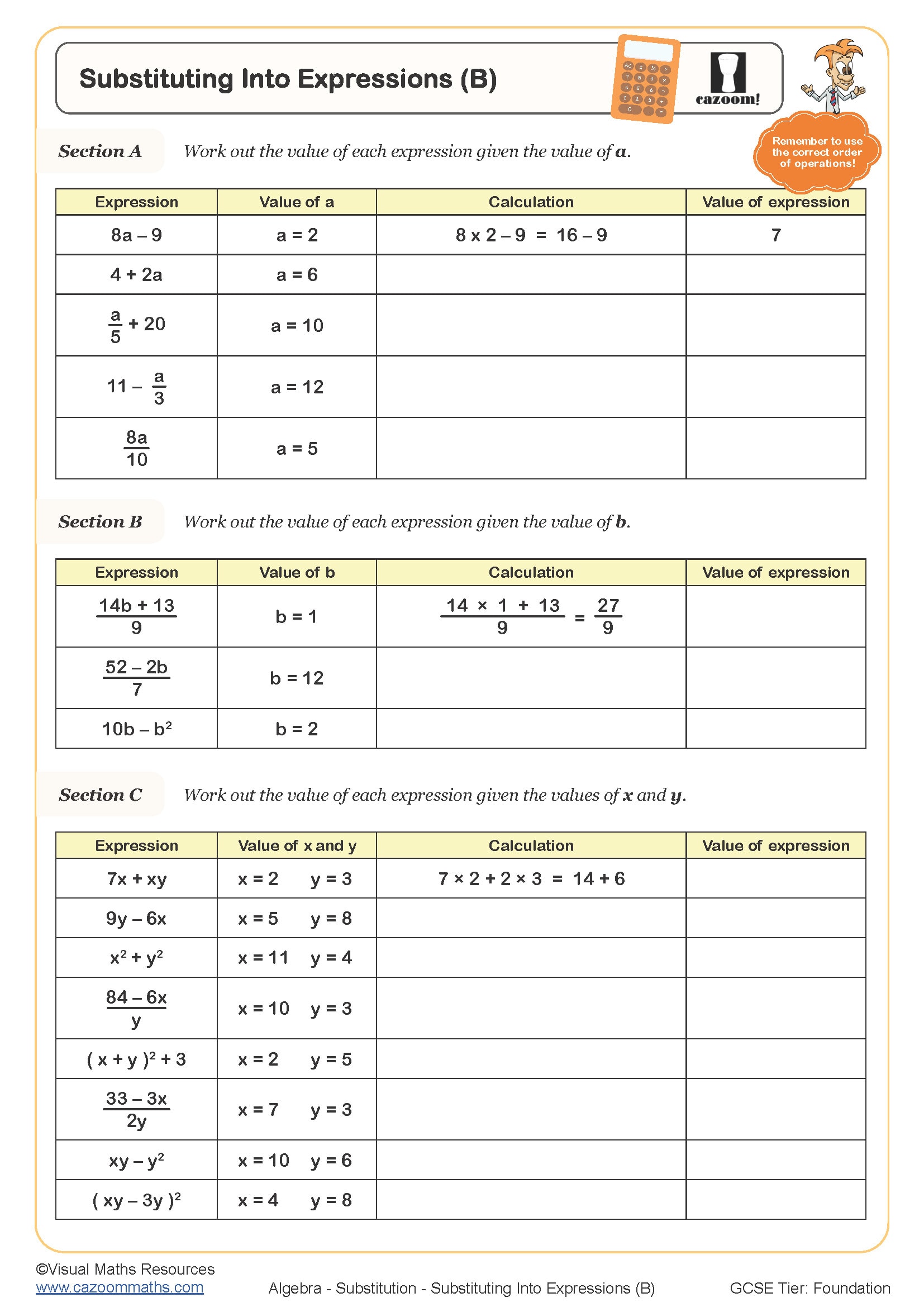
Substituting into Expressions (B)
Year groups: 7, 8, 9
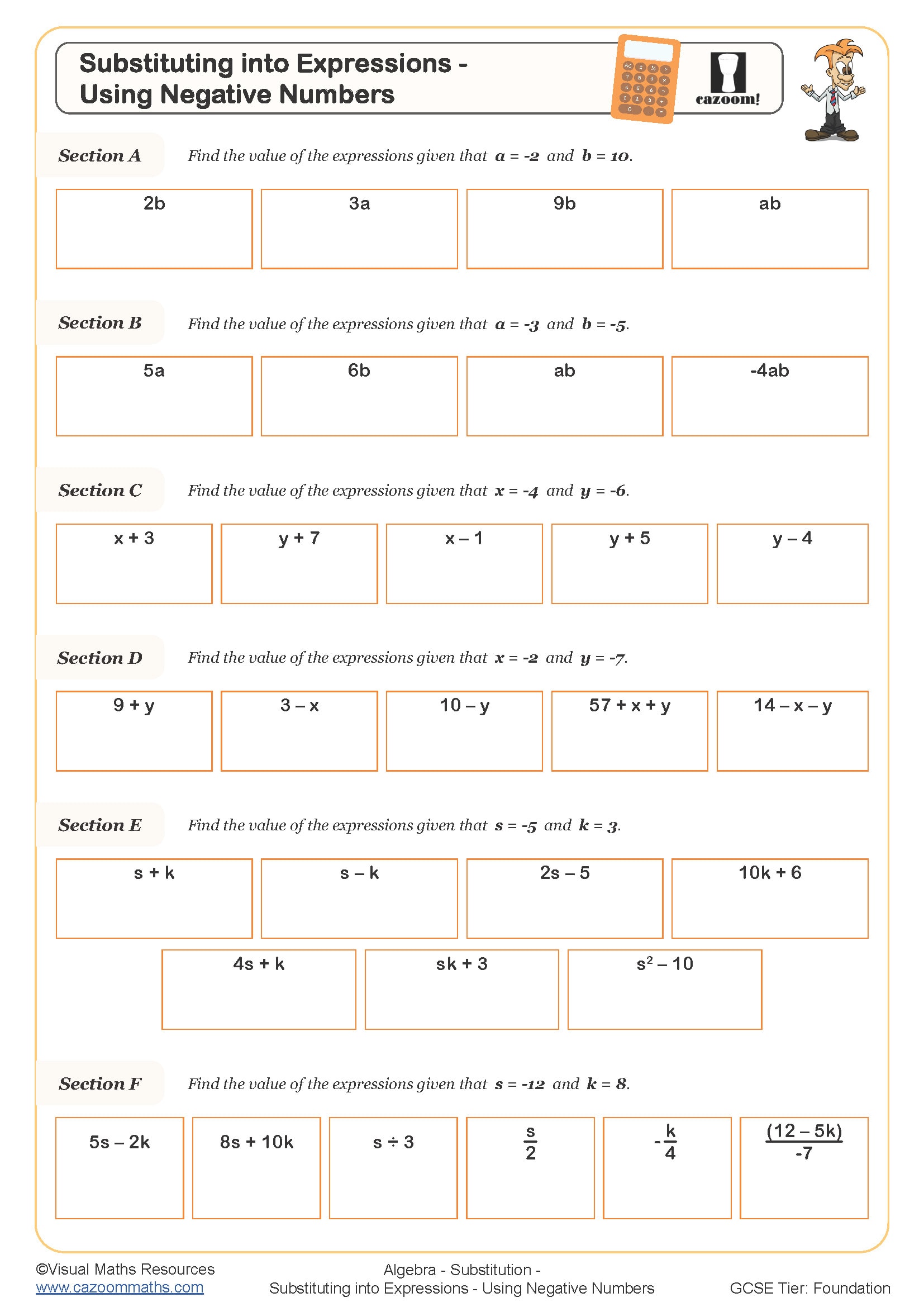
Substituting into Expressions using Negative Numbers
Year groups: 7, 8, 9
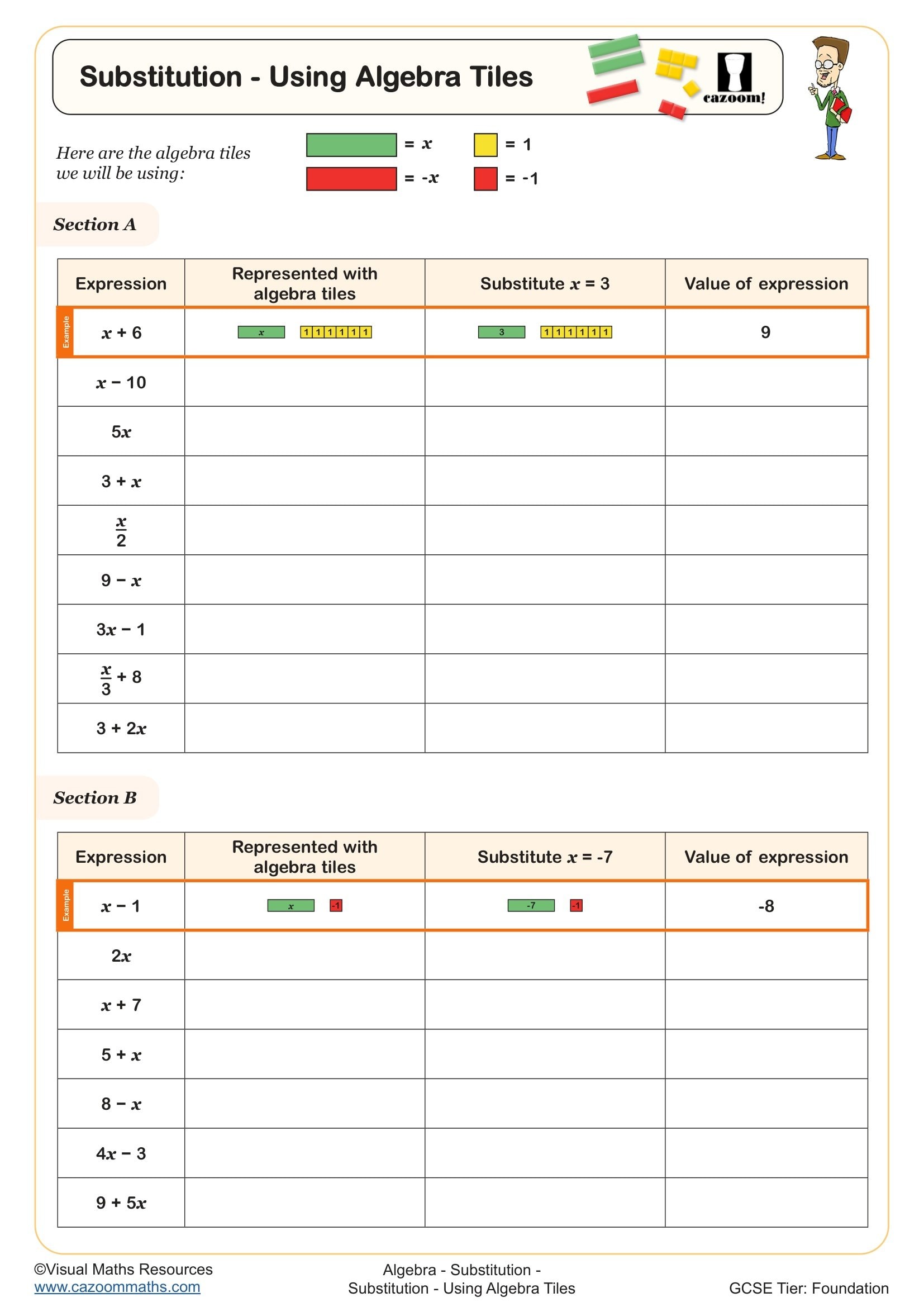
Substitution - Using Algebra Tiles
Year groups: 7, 8
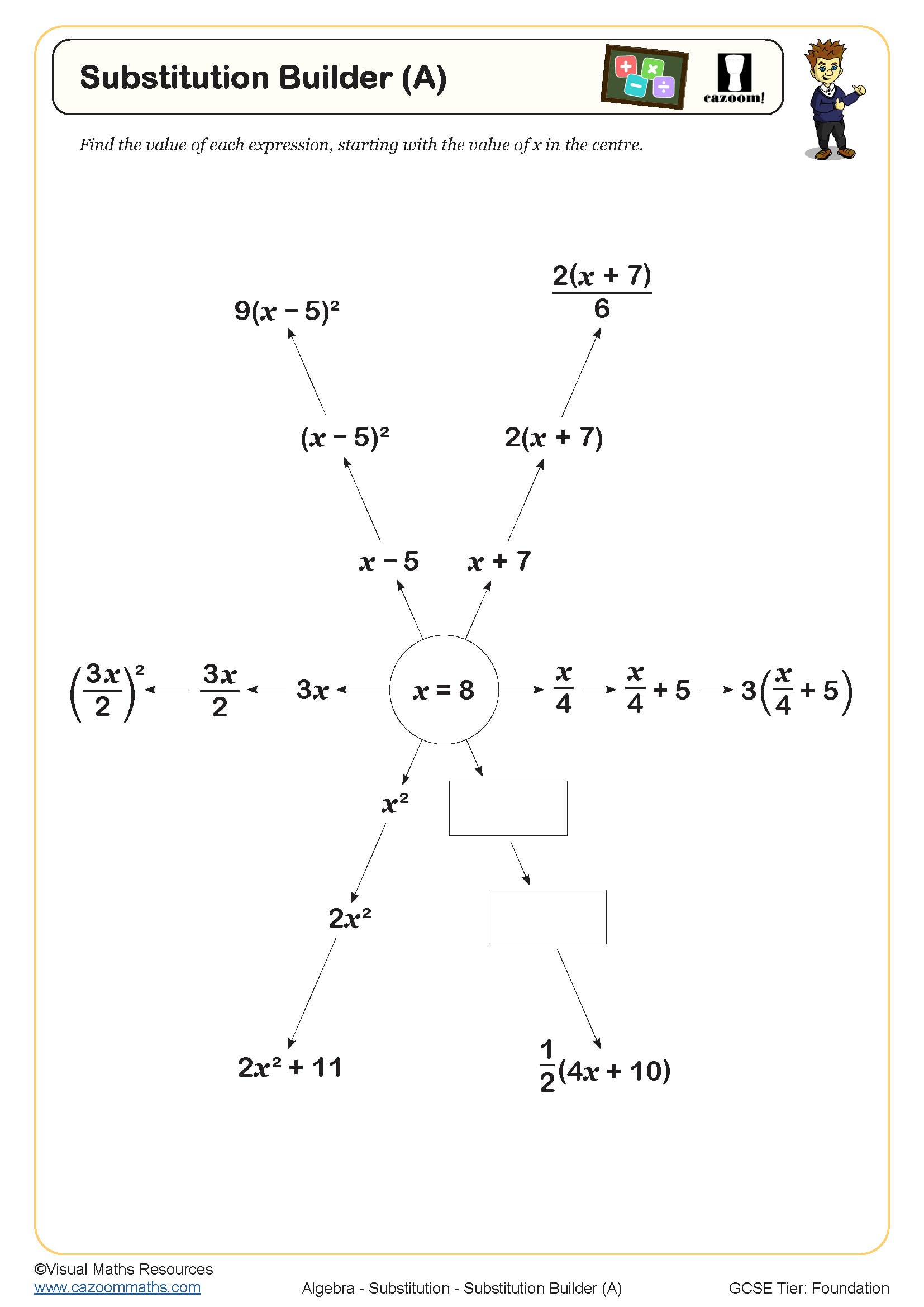
Substitution Builder (A)
Year groups: 7, 8, 9
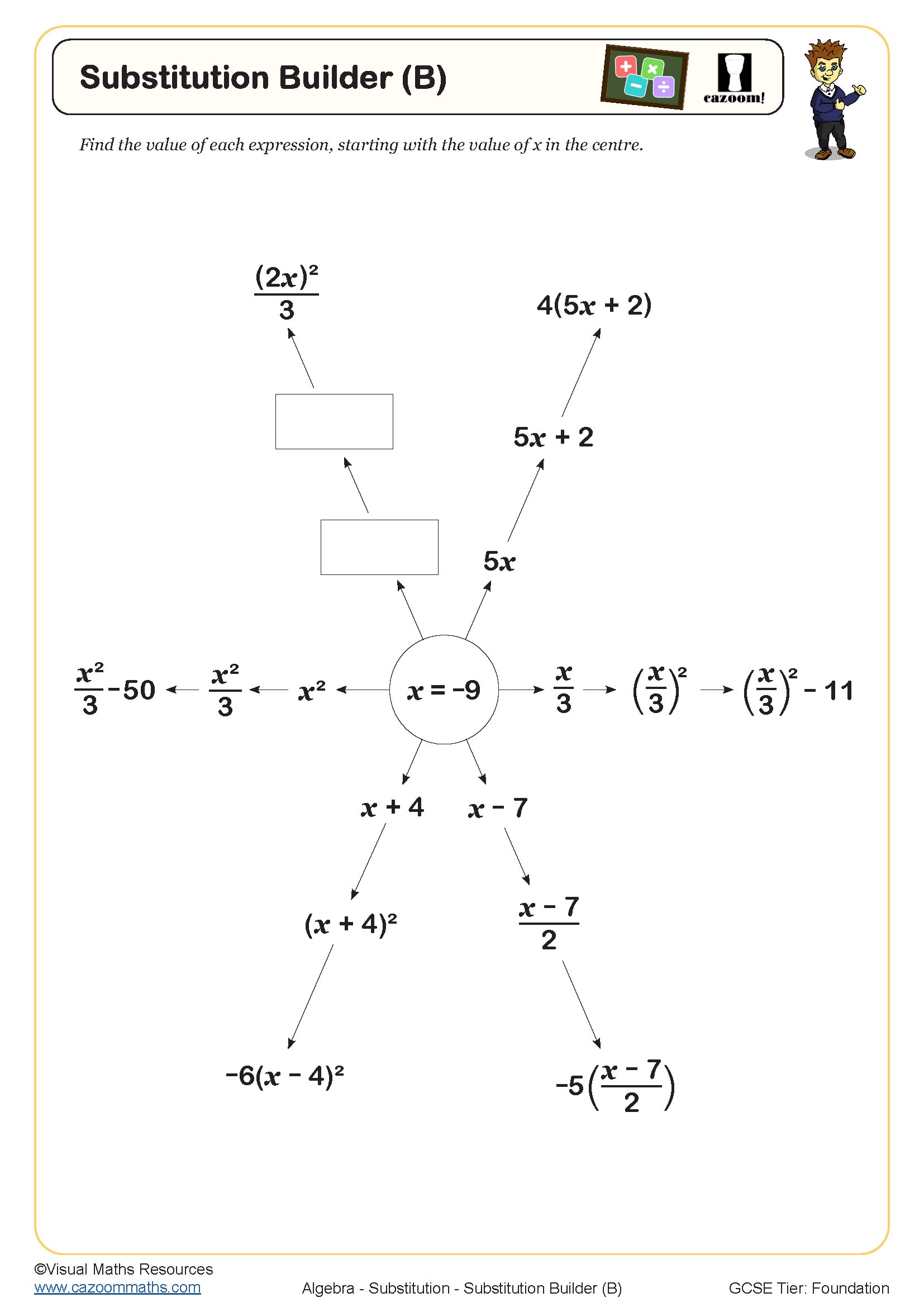
Substitution Builder (B)
Year groups: 7, 8, 9
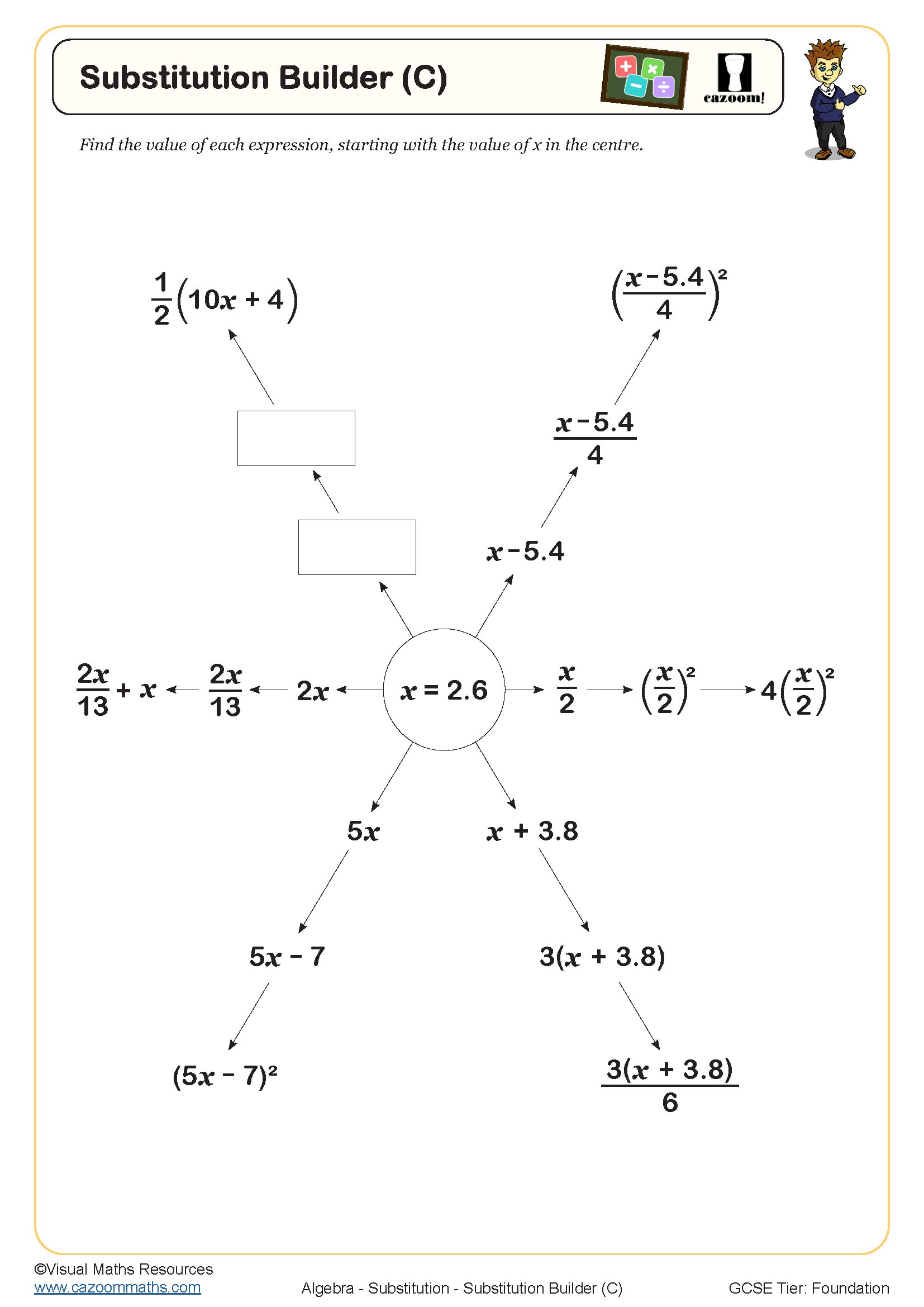
Substitution Builder (C)
Year groups: 7, 8, 9
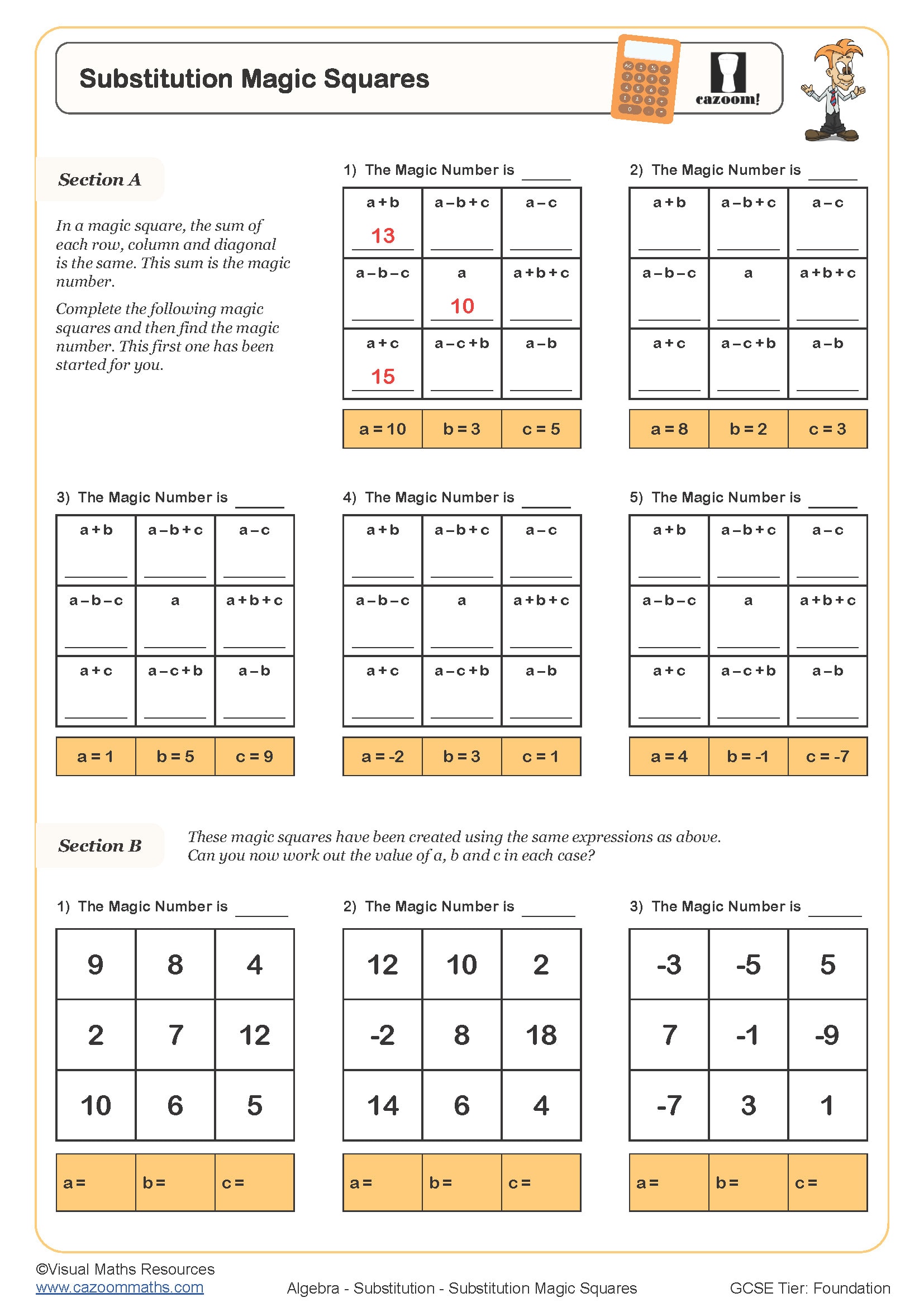
Substitution Magic Squares
Year groups: 7, 8, 9
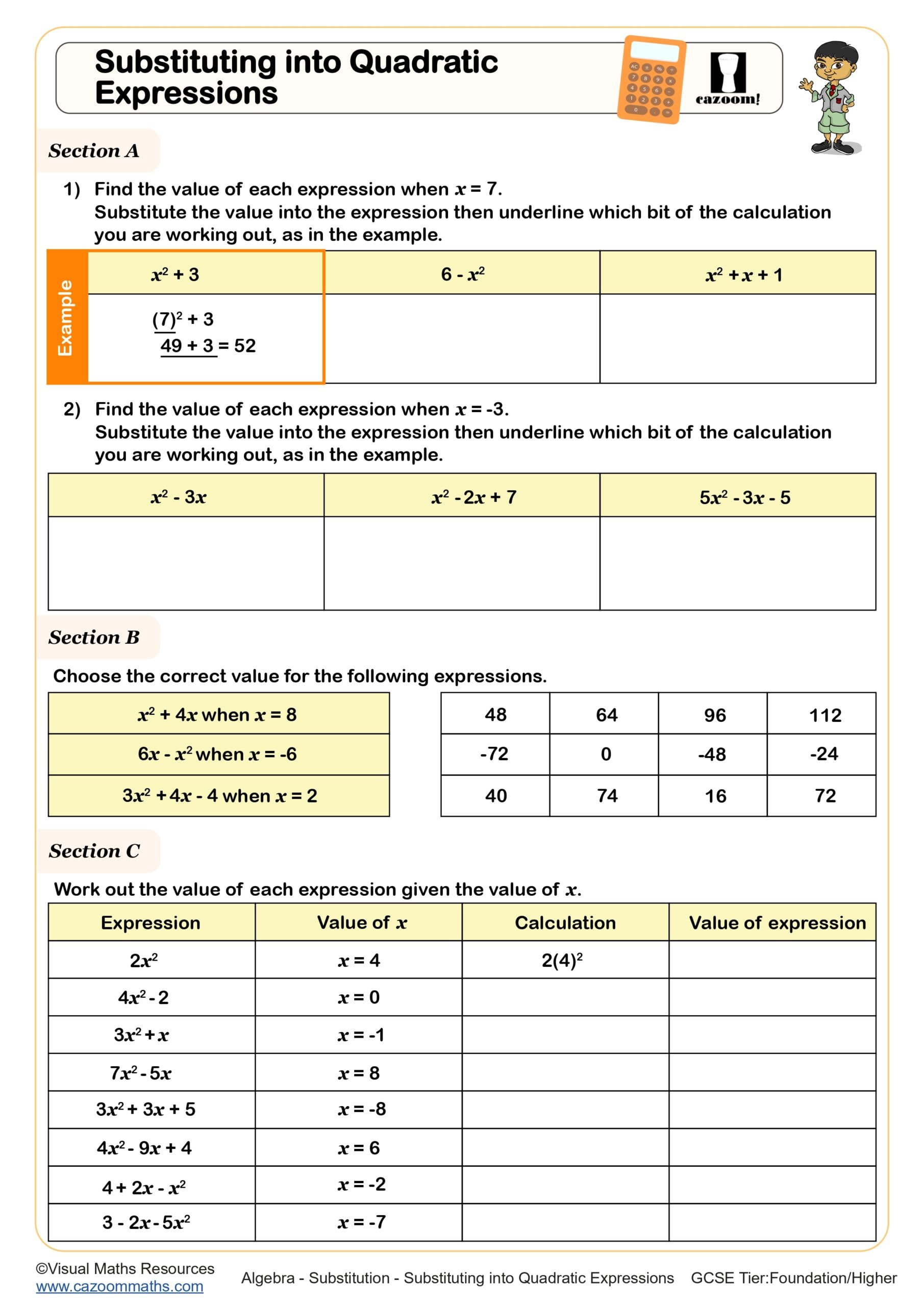
Substituting into Quadratic Expressions
Year groups: 8, 9
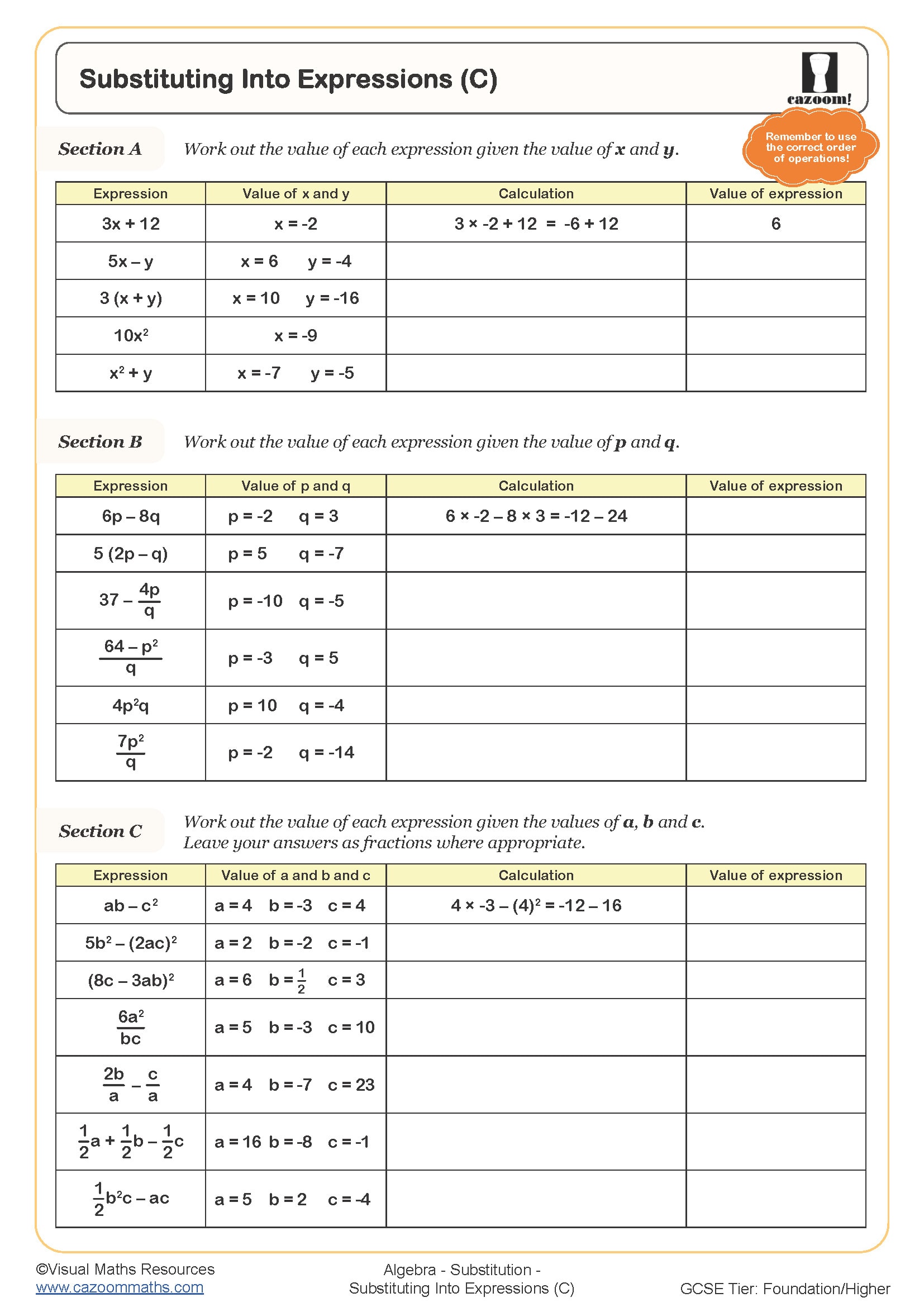
Substituting into Expressions (C)
Year groups: 9, 10, 11
All worksheets are created by the team of experienced teachers at Cazoom Maths.
What are the common mistakes when substituting into expressions?
The most frequent error occurs when substituting negative numbers without using brackets, leading students to calculate 3 × -2 as -32 = -9 instead of 3 × (-2) = -6. Students often overlook that the minus sign must stay with the number throughout the calculation. Order of operations causes similar difficulties, particularly in expressions like 2a² where students substitute a = 5 and calculate (2 × 5)² = 100 rather than 2 × 5² = 50.
Another persistent issue appears with implied multiplication, where expressions like 3ab confuse students who write 3ab = 35 instead of recognising this means 3 × a × b. Exam mark schemes routinely penalise work that lacks brackets around substituted negatives, even when the final answer is correct, so teachers emphasise writing out the substitution step explicitly before calculating.
Which year groups study substituting into expressions?
Substitution appears across Year 7, Year 8, Year 9, Year 10, and Year 11, forming a thread throughout the algebra curriculum from Key Stage 3 into GCSE preparation. The National Curriculum introduces basic substitution in Year 7 alongside early algebraic notation, where students work with single variables and whole number values in simple linear expressions.
The complexity increases significantly across year groups. Year 7 focuses on positive integers in expressions like 3n + 5, whilst Year 9 introduces fractional and negative substitutions. By Year 10 and Year 11, students encounter quadratic expressions, compound formulas from geometry and physics, and substitution into rearranged formulas. GCSE Foundation papers typically feature straightforward substitution worth 2-3 marks, whilst Higher tier questions embed substitution within multi-step problem-solving contexts.
How does substitution connect to real-world problem solving?
Substitution into expressions mirrors how formulas work across science, engineering, and finance. When calculating kinetic energy using E = ½mv², engineers substitute specific mass and velocity values exactly as students practise in algebra lessons. Understanding that each letter represents a measurable quantity and that the expression structure dictates the calculation sequence proves essential for applying mathematical models to real situations.
This skill becomes particularly relevant in STEM subjects where students encounter electrical resistance formulas, compound interest calculations, and conversion between units. Climate scientists substitute temperature and pressure values into atmospheric models, whilst pharmacists use substitution to calculate medication dosages based on patient mass. The precision required in these professional contexts reflects why exam mark schemes penalise careless substitution errors so heavily, emphasising that algebraic fluency has genuine practical consequences beyond the classroom.
How can these worksheets support classroom teaching?
The worksheets build confidence through carefully graduated difficulty, starting with expressions requiring minimal calculation before progressing to multi-step problems involving indices and negative values. This scaffolded approach allows teachers to identify precisely where individual students lose accuracy, whether through arithmetic errors, misunderstanding notation, or incorrect operation order. Worked examples on earlier questions help students internalise the bracket-writing habit that prevents sign errors.
Many teachers use these resources for retrieval practice at lesson starts, particularly in Year 10 and Year 11 where substitution underpins formula questions across topics. The complete answer sheets enable peer marking, which helps students spot common errors in each other's work before they become ingrained habits. For intervention sessions, selecting specific worksheets targeting one aspect, such as substituting into expressions with indices, allows focused practice without overwhelming students who struggle with algebraic manipulation more broadly.