Substituting into Formulae Worksheets
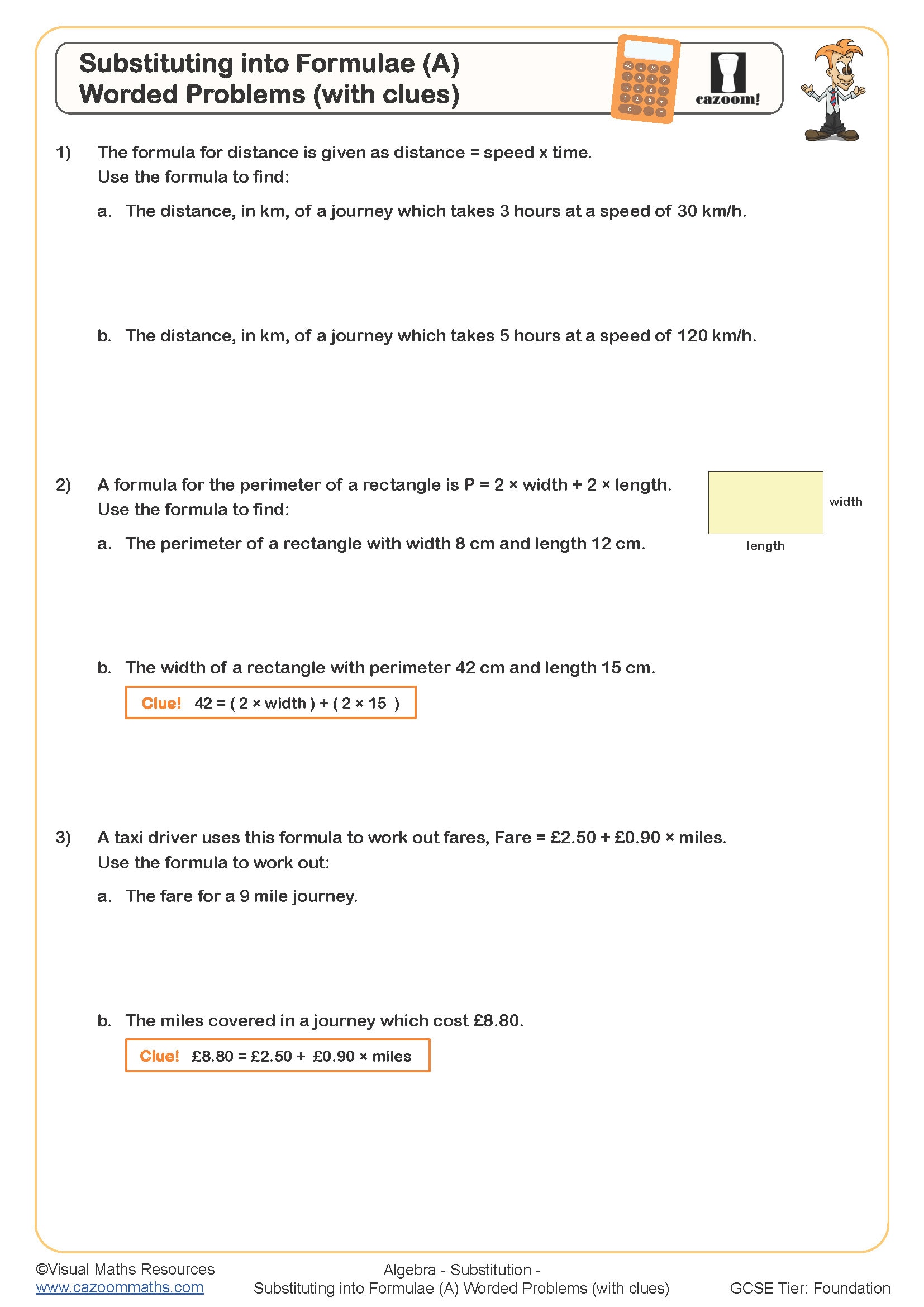
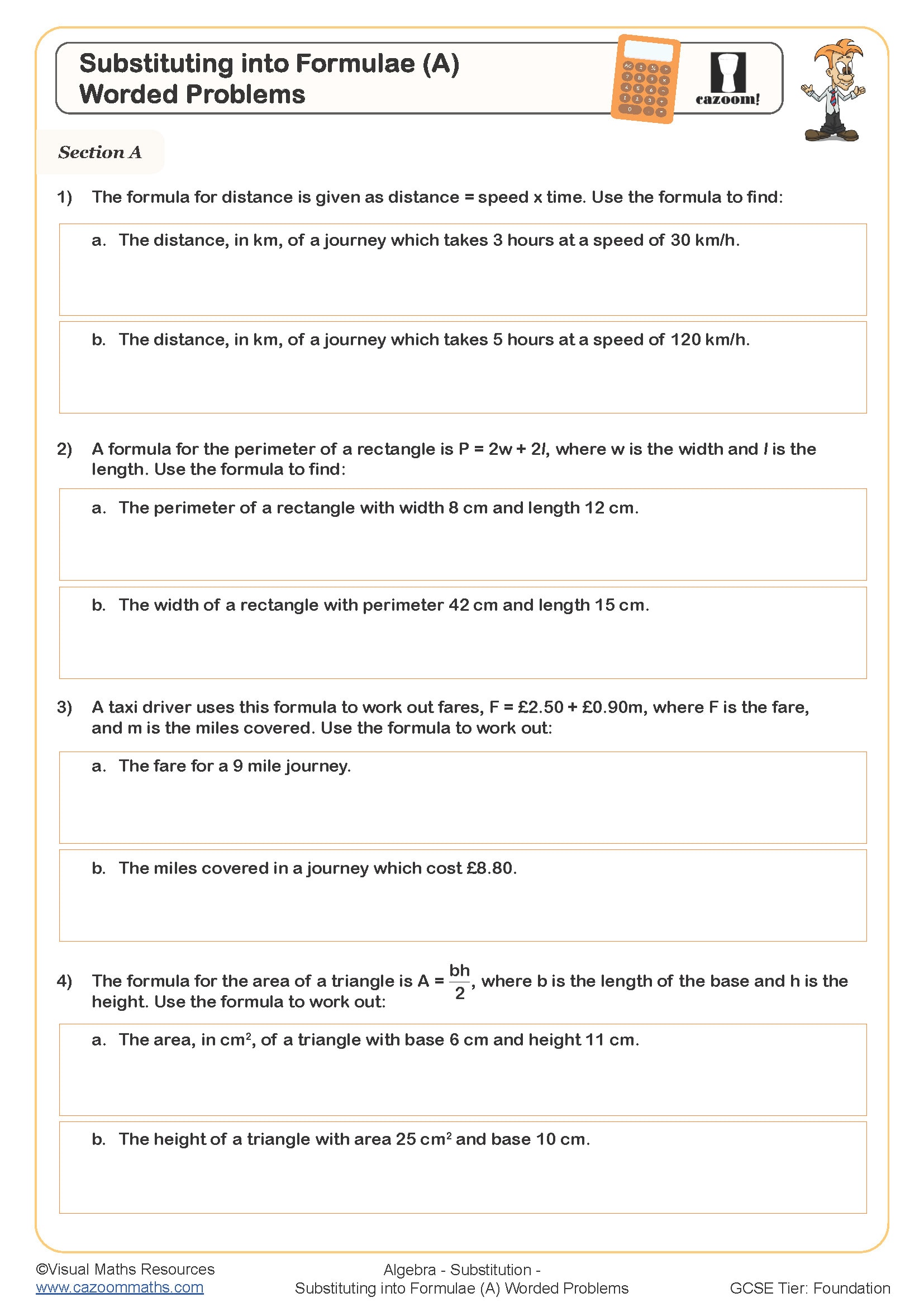
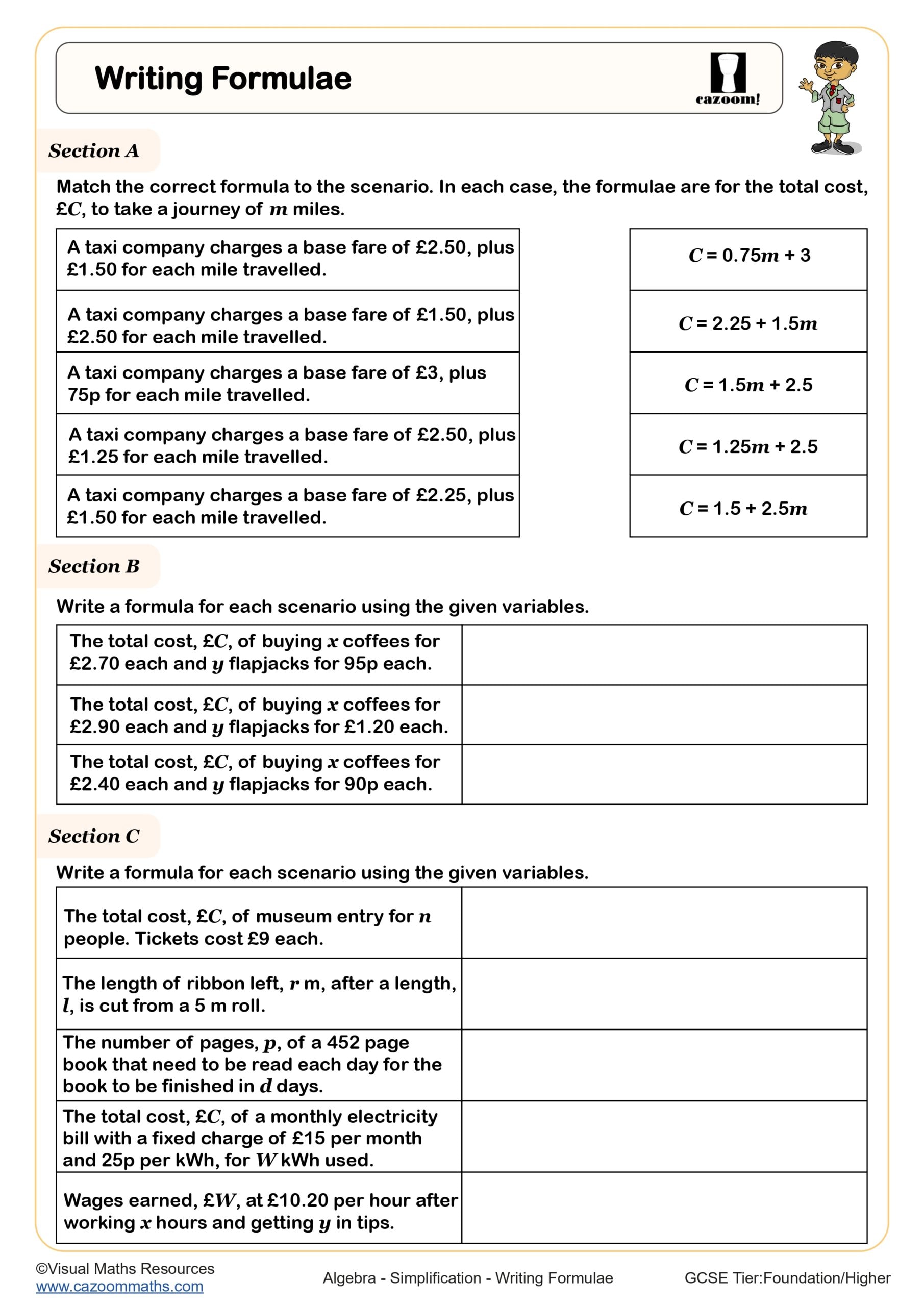
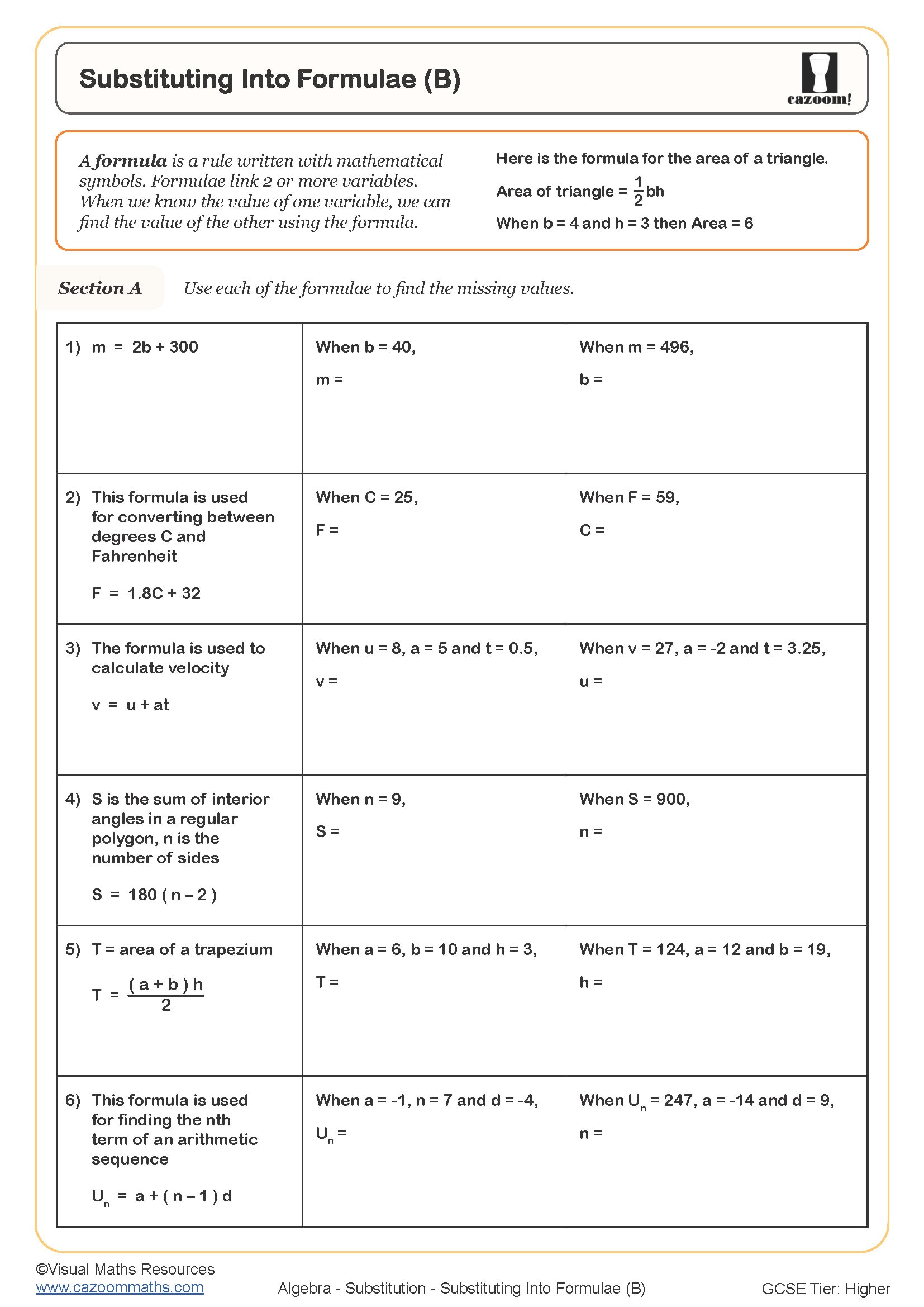
All worksheets are created by the team of experienced teachers at Cazoom Maths.
What does substituting into formulae mean in maths?
Substituting into formulae means replacing letters (variables) in an algebraic expression or equation with given numerical values, then calculating the result. This skill appears throughout Key Stage 3 and Key Stage 4, connecting algebra to practical applications in science, design technology and geography where formulae express relationships between quantities.
Students typically lose marks when they fail to use brackets correctly after substitution. For example, when substituting x = -3 into x², many write -3² = -9 instead of (-3)² = 9. Teachers notice this error appears repeatedly in exam questions involving temperature formulae or kinetic energy calculations, where negative values are common and the order of operations becomes critical for accuracy.
Which year groups learn substituting into formulae?
These worksheets cover Year 7, Year 8, Year 9, Year 10 and Year 11, spanning both Key Stage 3 and Key Stage 4. The National Curriculum introduces substitution in Year 7 as part of developing algebraic fluency, building on earlier work with expressions and making it accessible before moving to solving equations.
Progression across year groups increases in complexity. Year 7 and Year 8 typically work with single-operation formulae and positive integers, whilst Year 9 introduces negative values and decimals. By Year 10 and Year 11, students substitute into quadratic expressions, compound formulae requiring multiple steps, and exam-style questions linking to trigonometry, scientific notation and geometry. GCSE questions often embed substitution within problem-solving contexts rather than presenting it as isolated practice.
How do you substitute negative numbers into formulae?
When substituting negative numbers, students must write brackets around the negative value before applying any operations. For instance, in the formula y = 3x² - 5x, substituting x = -2 requires writing y = 3(-2)² - 5(-2), which gives y = 3(4) + 10 = 22. Teachers observe that students frequently omit brackets and incorrectly calculate -2² as -4, or mishandle the double negative in subtraction.
This skill connects directly to physics formulae where negative values represent direction or temperature below zero. When calculating displacement using s = ut + ½at², negative acceleration (deceleration) requires careful substitution. Engineers and scientists rely on accurate substitution when working with formulae involving losses, debts, or measurements below reference points, making this mathematical precision essential beyond the classroom.
How can teachers use these substituting into formulae worksheets?
The worksheets provide structured practice with questions that increase in difficulty, allowing students to build confidence before tackling complex substitutions. Answer sheets enable immediate checking, helping students identify whether errors stem from substitution mistakes or subsequent calculation problems. This self-checking approach supports students in developing accuracy and recognising patterns in their own errors.
Many teachers use these worksheets during revision sessions before assessments, as substitution appears across GCSE papers in various contexts. They work well for homework when introducing new formula work in science, allowing students to practise the mathematical technique before applying it to scientific concepts. The worksheets also suit intervention sessions for students who struggle with negative numbers, providing focused practice that teachers can monitor closely to address specific misconceptions as they arise.