Transformations of Graphs Worksheets
All worksheets are created by the team of experienced teachers at Cazoom Maths.
What are the four types of graph transformations?
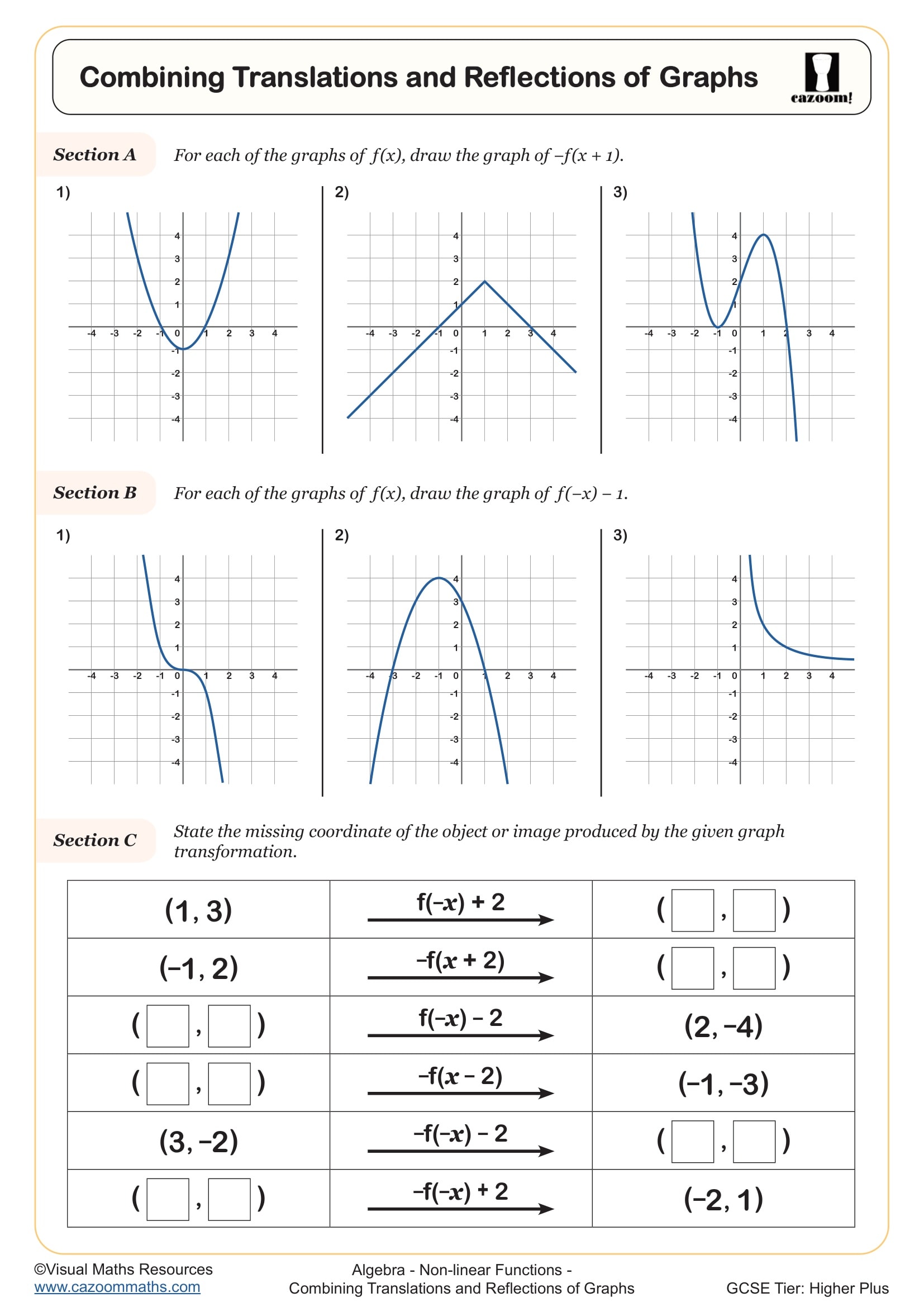
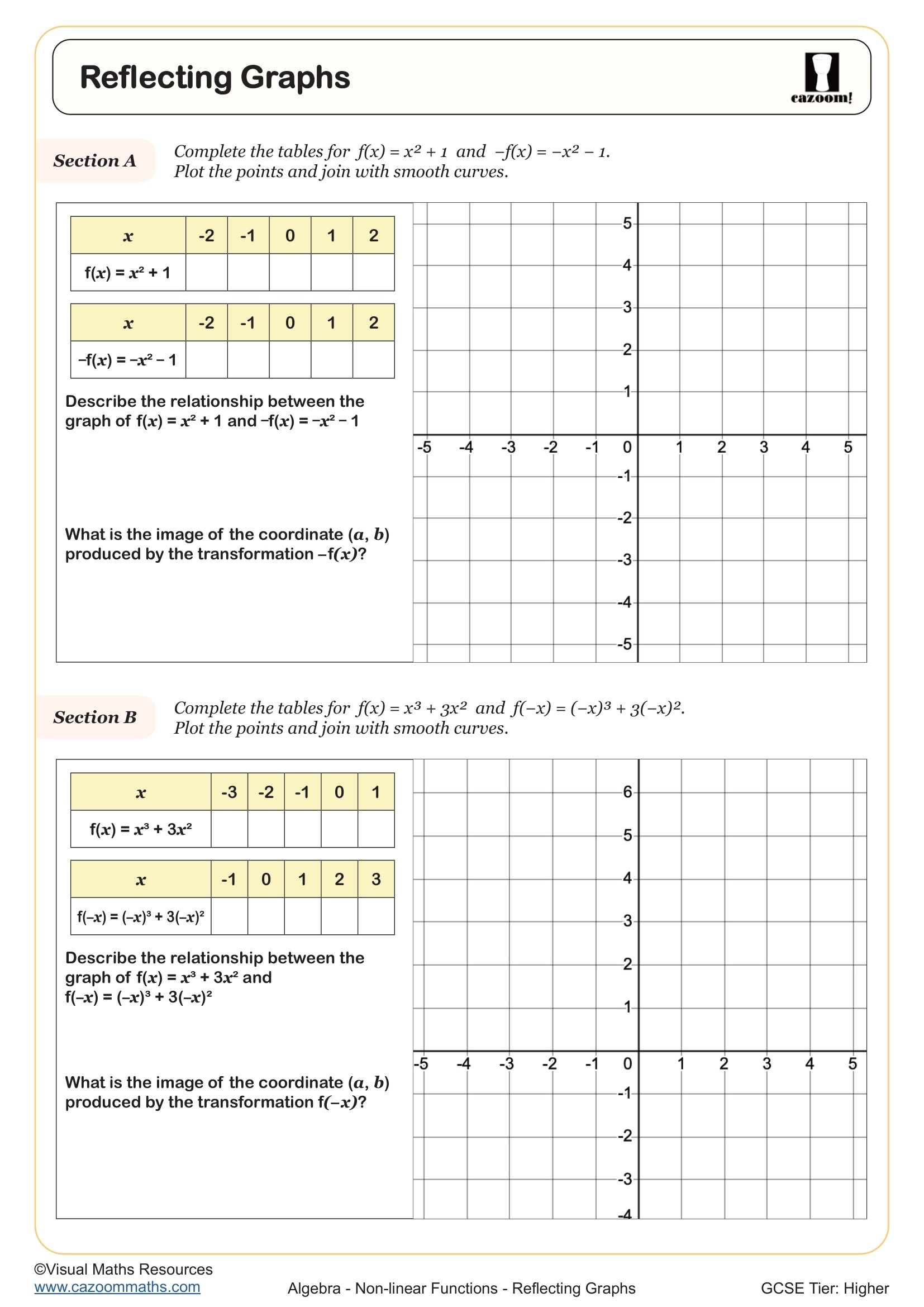
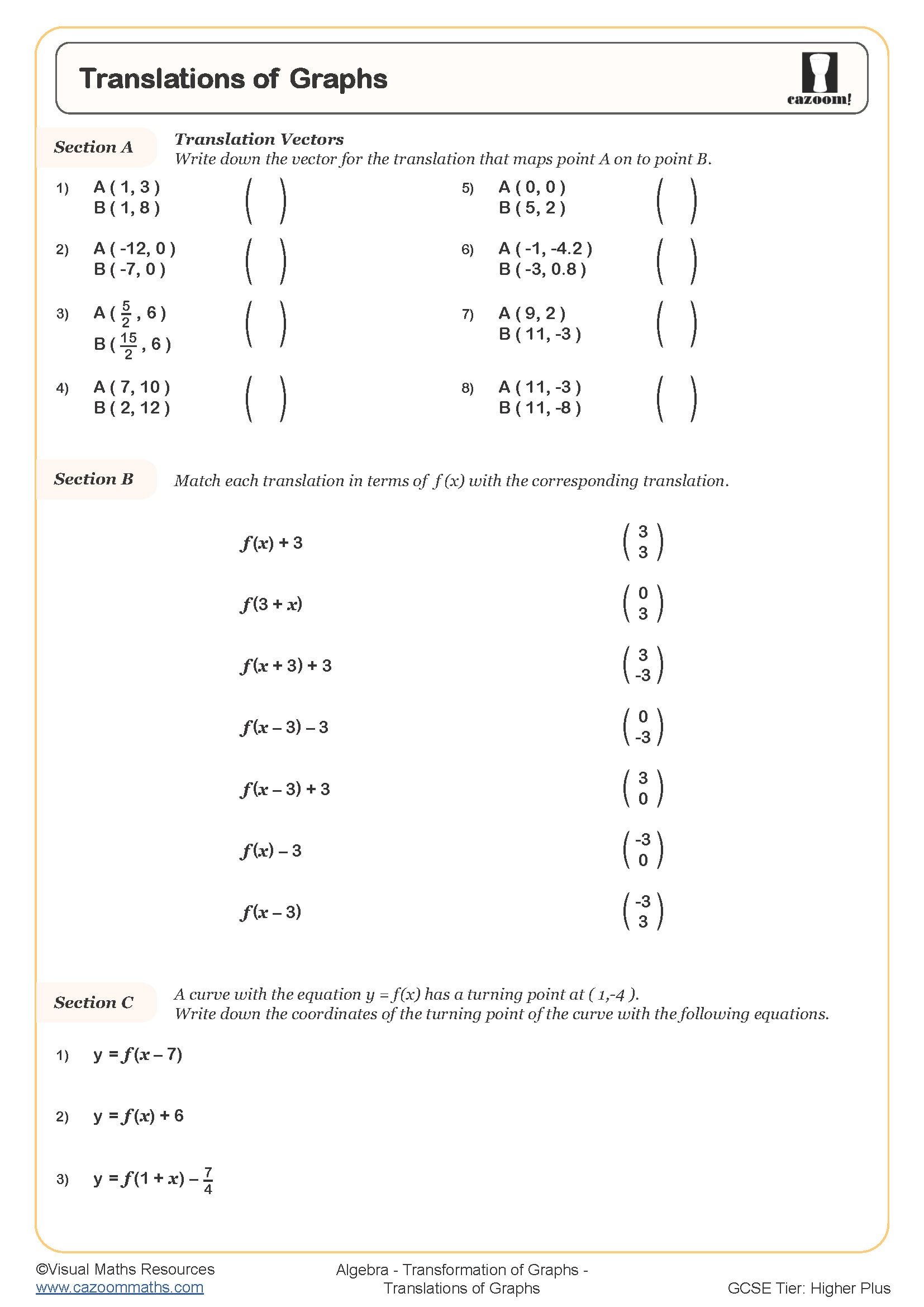
The four main transformations are translations (shifts up, down, left, or right), reflections (flips across axes), vertical stretches or compressions, and horizontal stretches or compressions. At GCSE level, students work with these systematically, learning that y = f(x) + a translates vertically, y = f(x + a) translates horizontally, y = -f(x) reflects in the x-axis, and y = f(-x) reflects in the y-axis.
Students frequently lose marks by confusing the notation for horizontal transformations, expecting y = f(x - 3) to move the graph left rather than right. Exam mark schemes expect candidates to state the direction and magnitude clearly, and to sketch transformed graphs accurately using key coordinates from the original function. Practising with multiple function types helps students recognise these patterns consistently.
Which year groups study transformations of graphs?
Transformations of graphs appears in the Year 10 and Year 11 curriculum as part of the GCSE Higher tier content. Students encounter basic function notation and simple transformations at the end of Key Stage 3, but the systematic study of combined transformations and their notation belongs firmly in KS4. This topic builds on earlier work with coordinates, straight-line graphs, and quadratic functions.
The difficulty increases as students progress from single transformations of simple functions to combined transformations applied to more complex curves. Year 11 students tackle exam questions that require them to describe transformations from one graph to another, work backwards from transformed equations, or apply multiple transformations in sequence, particularly with trigonometric and exponential functions where the effects become less intuitive.
How do vertical and horizontal stretches differ?
A vertical stretch multiplies the function itself, written as y = af(x), where the y-coordinates are multiplied by the scale factor a whilst x-coordinates remain unchanged. A horizontal stretch affects the input variable, written as y = f(x/a), where the x-coordinates are multiplied by a whilst y-coordinates stay the same. Teachers frequently observe that students struggle with horizontal stretches because the reciprocal relationship feels counterintuitive.
Graph transformations appear extensively in engineering and physics when modelling wave behaviour. Audio engineers manipulate sound waves using these principles, where vertical stretches represent amplitude changes (volume) and horizontal stretches represent frequency changes (pitch). Understanding how y = 2sin(x) differs from y = sin(2x) becomes essential when designing signal processing systems or analysing periodic phenomena in real-world data.
How can these worksheets support exam preparation?
The worksheets build understanding through carefully sequenced questions that progress from identifying single transformations to describing and applying combined transformations. Each worksheet includes visual representations alongside algebraic work, helping students develop the dual reasoning skills that exam questions demand. The answer sheets show complete working, which supports students in understanding the logical steps rather than just checking final answers.
Many teachers use these resources during revision sessions where students work through one transformation type at a time before attempting mixed questions. The worksheets work well for targeted intervention with students who struggle to visualise algebraic changes, and they're equally valuable as homework following classroom teaching. Paired work often helps, with one student sketching whilst the other verifies using the transformation rules, building both fluency and mathematical communication skills.