Understanding Gradients Worksheets
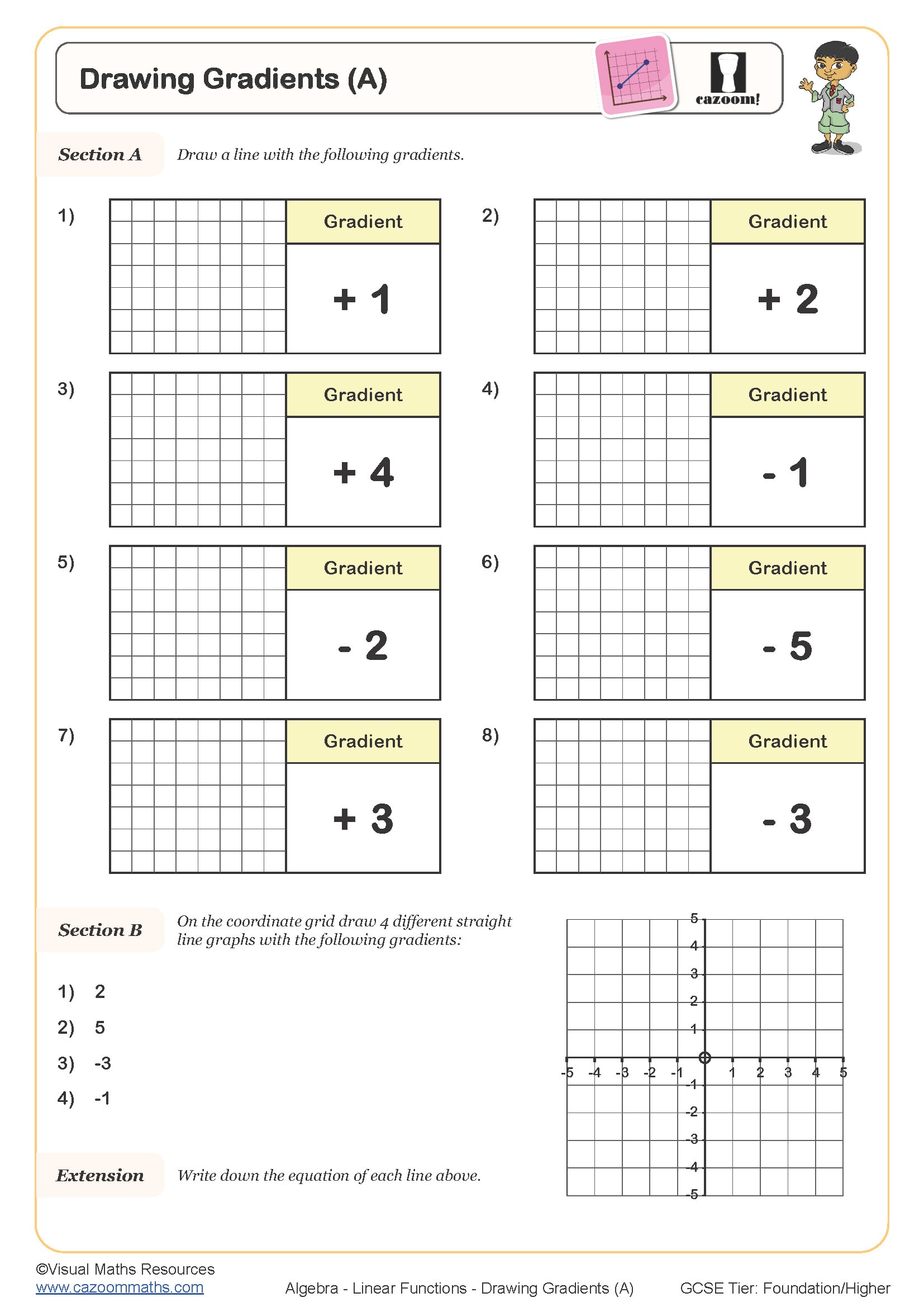
Drawing Gradients (A)
Year groups: 8, 9, 10
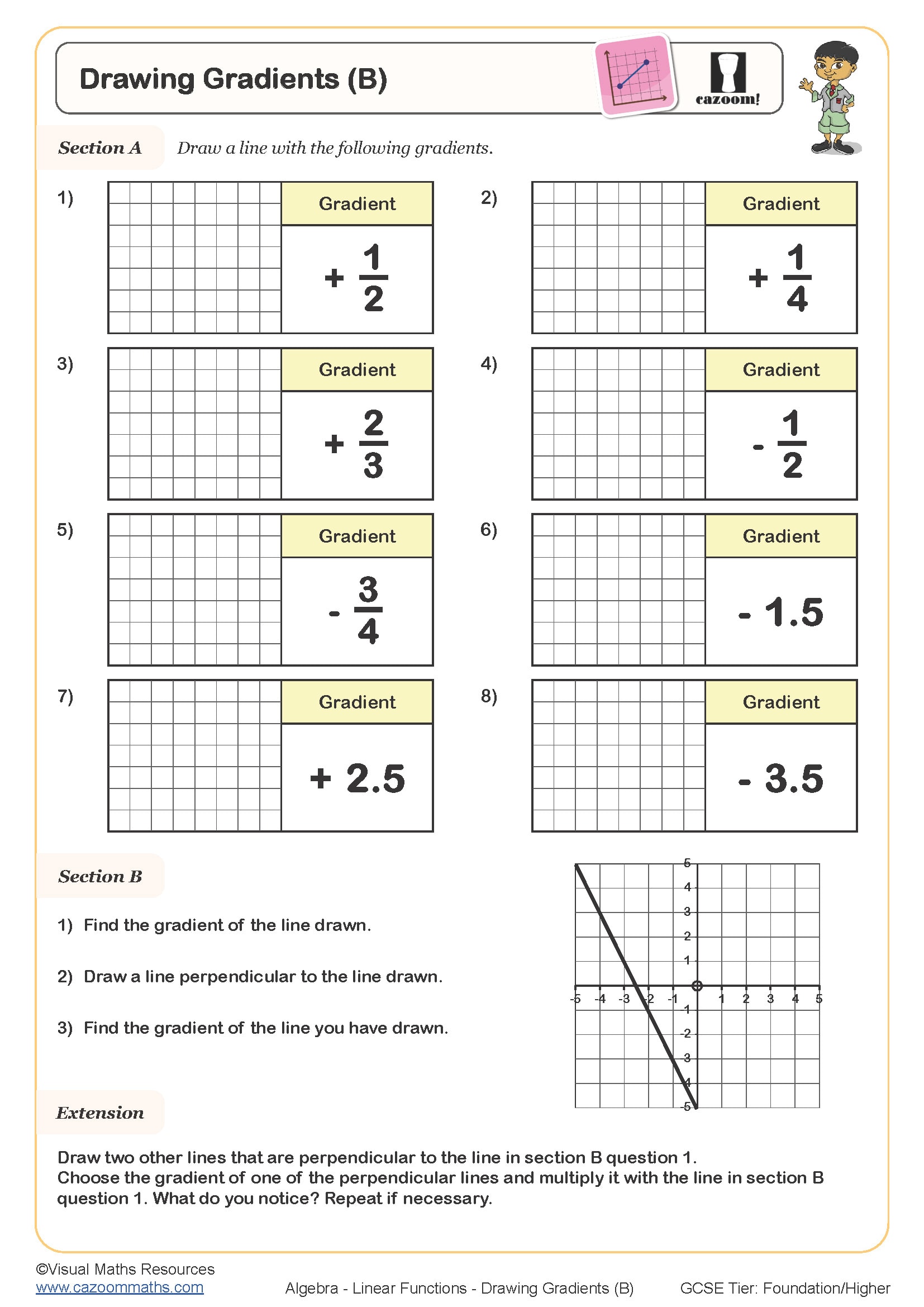
Drawing Gradients (B)
Year groups: 8, 9, 10
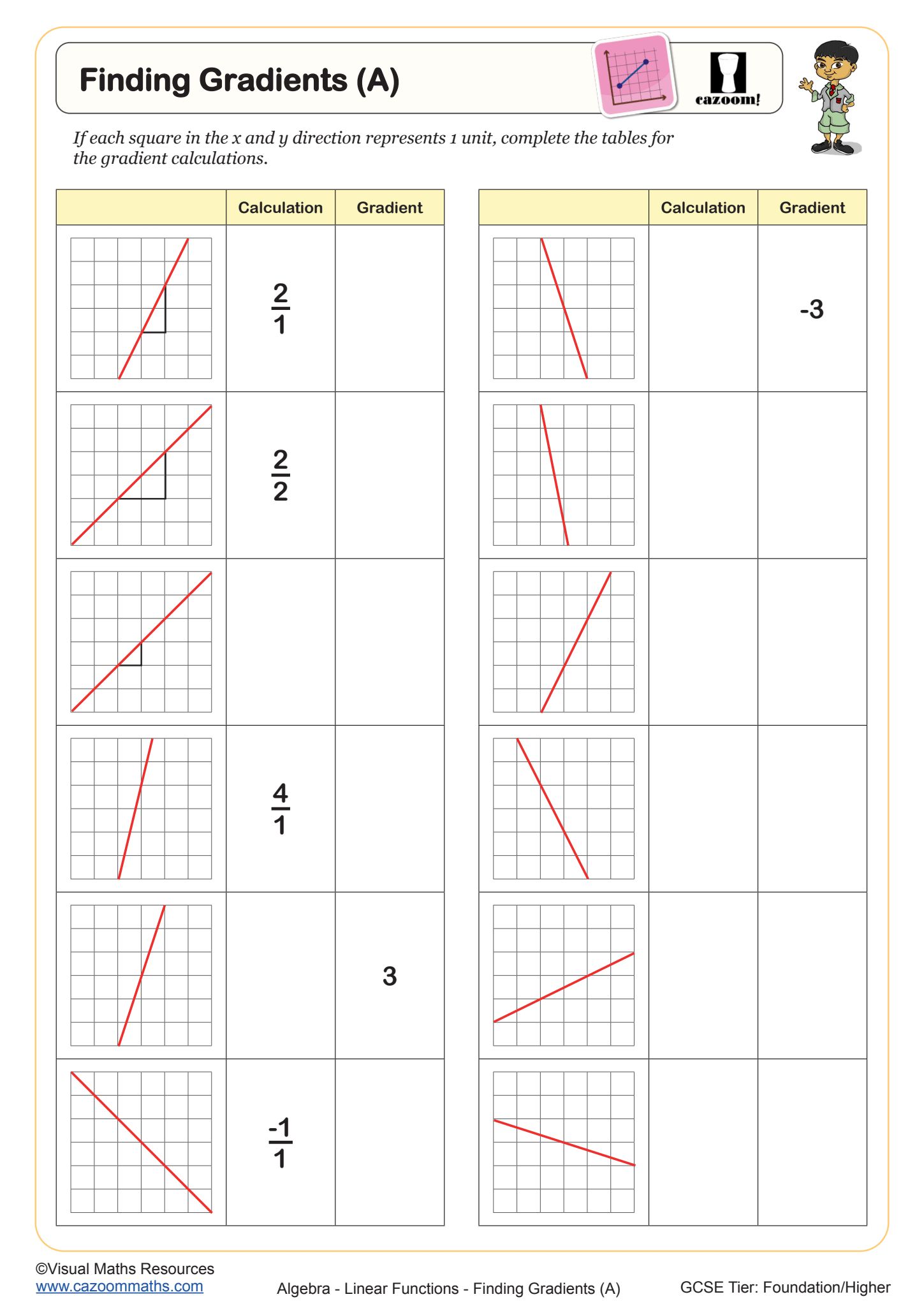
Finding Gradients (A)
Year groups: 8, 9, 10
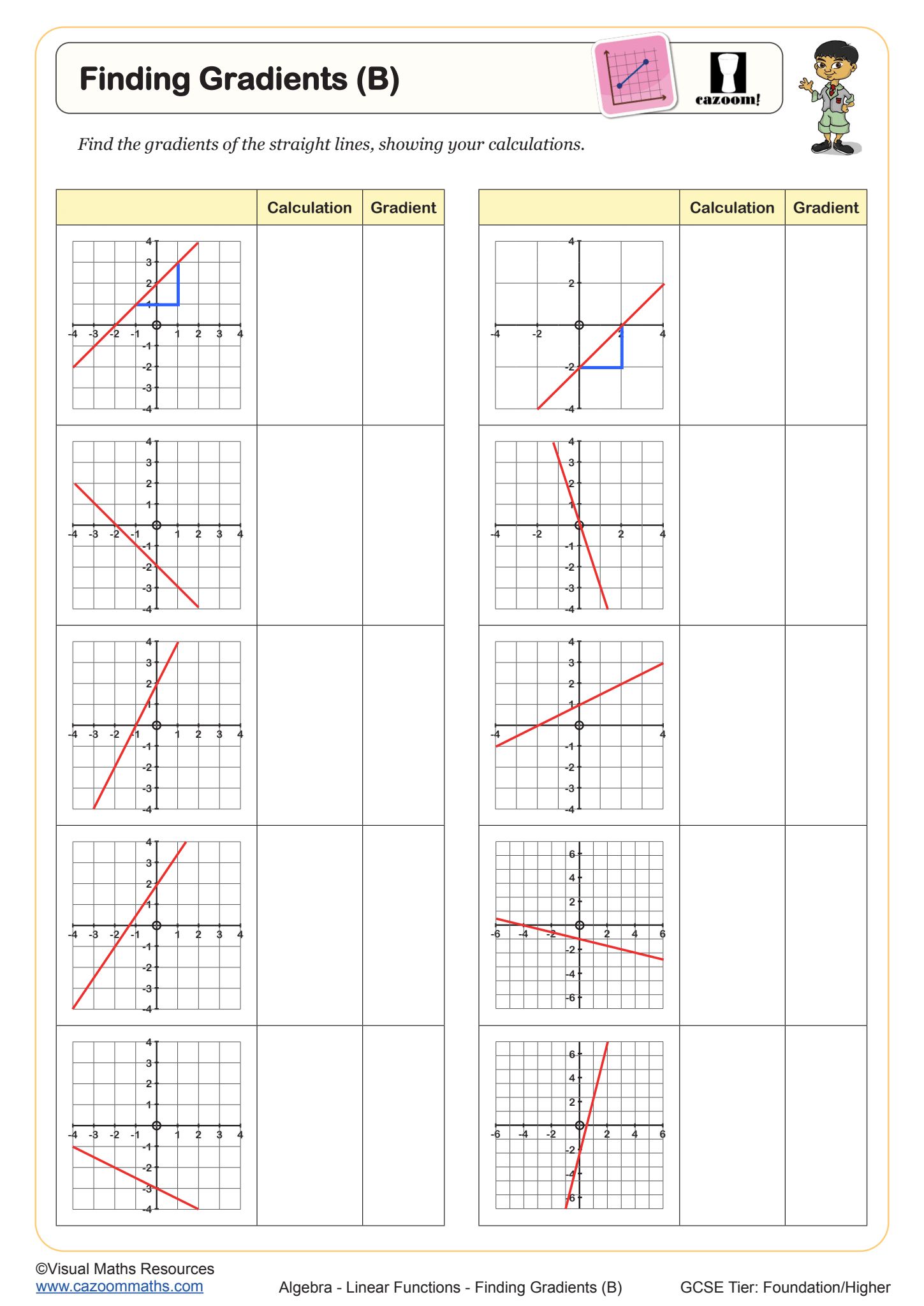
Finding Gradients (B)
Year groups: 8, 9, 10
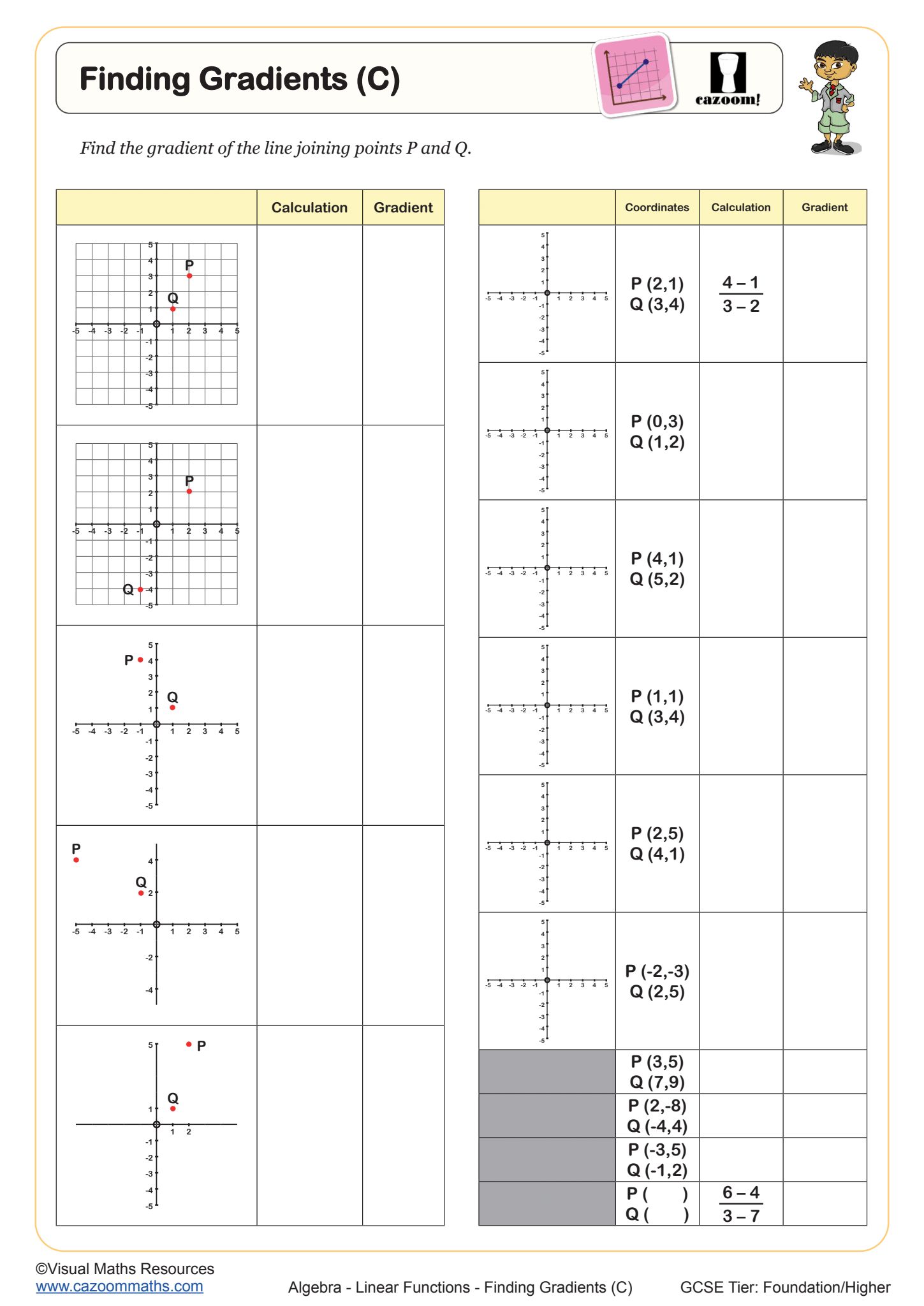
Finding Gradients (C)
Year groups: 8, 9, 10
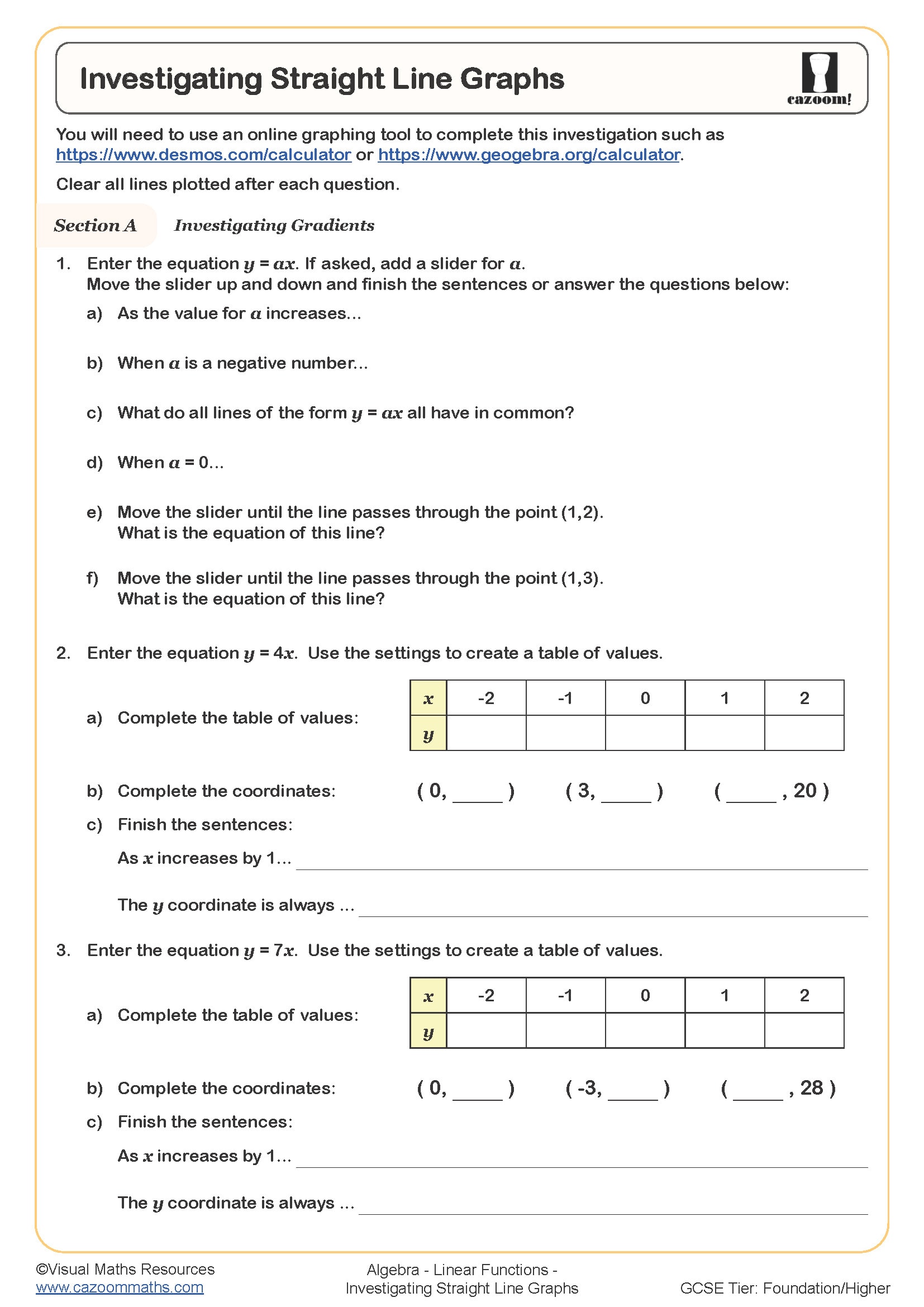
Investigating Straight Line Graphs
Year groups: 8, 9
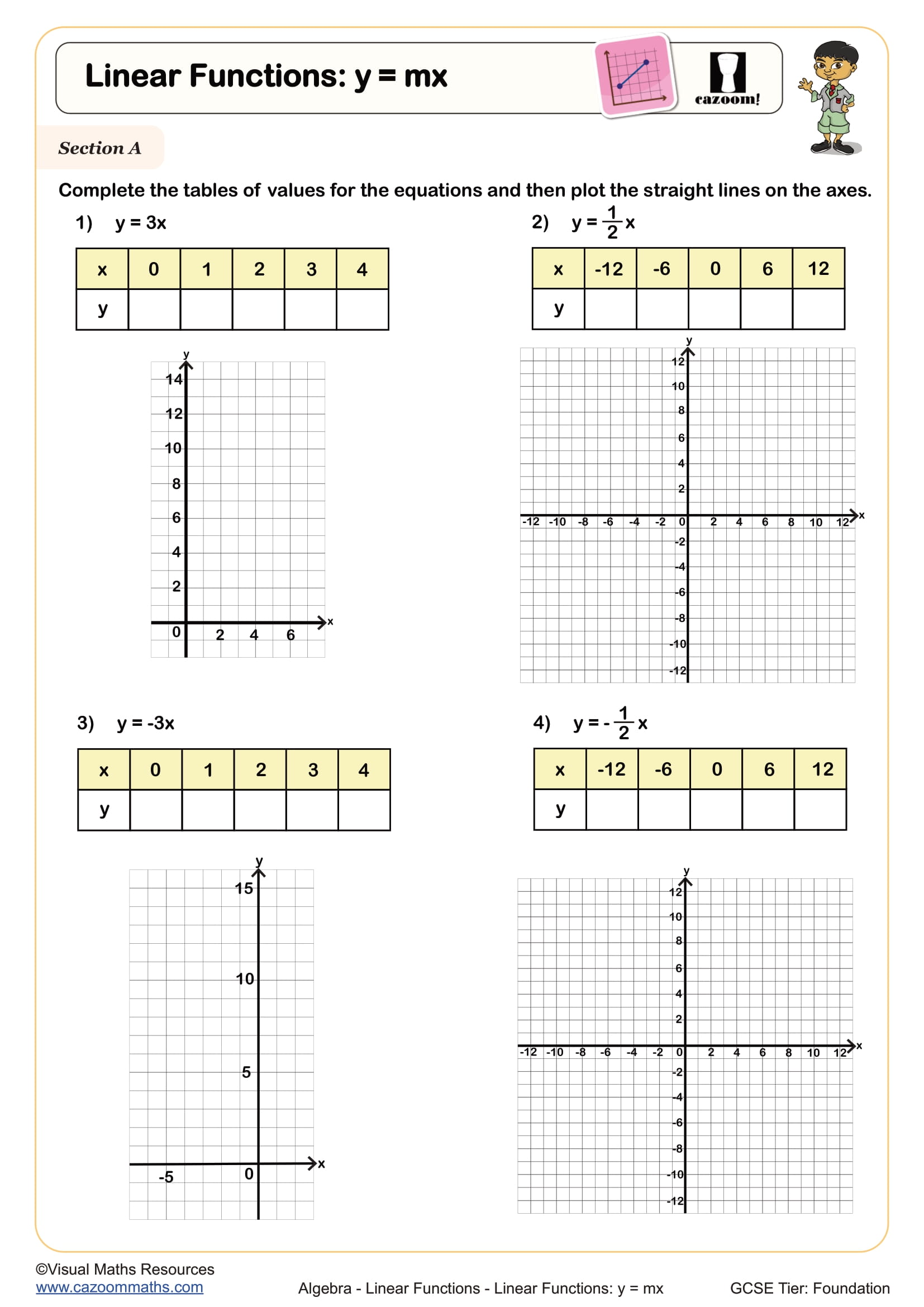
Linear Functions: y = mx
Year groups: 8, 9
All worksheets are created by the team of experienced teachers at Cazoom Maths.
What does understanding gradients mean in maths?
Understanding gradients means recognising that gradient measures the steepness and direction of a straight line, calculated as the change in y-coordinates divided by the change in x-coordinates between two points. In the National Curriculum, this concept bridges numerical work with visual representation, helping students see how algebra describes geometric properties. The formula m = (y₂ - y₁) ÷ (x₂ - x₁) appears throughout GCSE papers, particularly in questions about parallel and perpendicular lines.
Students often struggle when coordinates produce negative gradients, forgetting that a line sloping downwards from left to right yields a negative value. Teachers notice this confusion particularly when students plot points correctly but then describe the gradient as positive because they've calculated the absolute difference. Worksheets that explicitly practise both positive and negative examples help students develop the visual intuition to predict gradient direction before calculating.
Which year groups study understanding gradients?
These worksheets cover understanding gradients for Year 8, Year 9, and Year 10, spanning Key Stage 3 and Key Stage 4. The topic typically introduces in Year 8 as students begin working with coordinates beyond simple plotting, connecting numerical patterns to visual slopes. At this stage, work focuses on calculating gradients from clearly labelled points and recognising whether gradients are positive, negative, zero, or undefined.
Progression through Year 9 and Year 10 brings more complex coordinates, including decimal and fractional values, and links gradient to the equation of a line in the form y = mx + c. By Year 10, students connect gradients to rates of change in real contexts and use gradient properties to identify parallel lines (equal gradients) and perpendicular lines (gradients that multiply to give -1), skills tested regularly in GCSE Foundation and Higher tier papers.
How do you calculate the gradient between two points?
To calculate the gradient between two points, subtract the y-coordinate of the first point from the y-coordinate of the second point, then divide by the difference in x-coordinates. If points are labelled (x₁, y₁) and (x₂, y₂), the formula becomes m = (y₂ - y₁) ÷ (x₂ - x₁). Students must take care with the order of subtraction, ensuring they subtract coordinates from the same point in both numerator and denominator, though either order works provided they're consistent.
Gradient calculation has direct applications in engineering, architecture, and construction, where gradient determines whether structures like wheelchair ramps meet accessibility standards. A gradient of 1:12 (approximately 0.083) represents the maximum slope for accessible ramps in the UK, whilst road gradients on warning signs express steepness as percentages. Understanding these calculations helps students see why surveyors, civil engineers, and architects rely on precise gradient measurements when designing safe, functional spaces.
How do these worksheets help students master gradients?
The worksheets build gradient understanding through carefully structured questions that begin with integer coordinates on visible grids before progressing to coordinate pairs without visual support. This scaffolding helps students develop the conceptual understanding that gradient describes steepness before relying purely on formula manipulation. Questions include identifying gradients from diagrams, calculating from coordinates, and applying gradient knowledge to determine whether lines are parallel or perpendicular, mirroring the variety seen in exam questions.
Teachers use these resources effectively for initial teaching in mixed-ability classes, where different worksheets allow simultaneous practice at appropriate levels. They work well as homework following lessons on straight-line graphs, as intervention materials for students who struggled with gradient in class, or as revision before assessments. The complete answer sheets enable students to self-mark during independent study or paired work, whilst teachers can quickly identify whether errors stem from arithmetic mistakes or fundamental misunderstandings about what gradient represents.