Understanding the Y intercept Worksheets
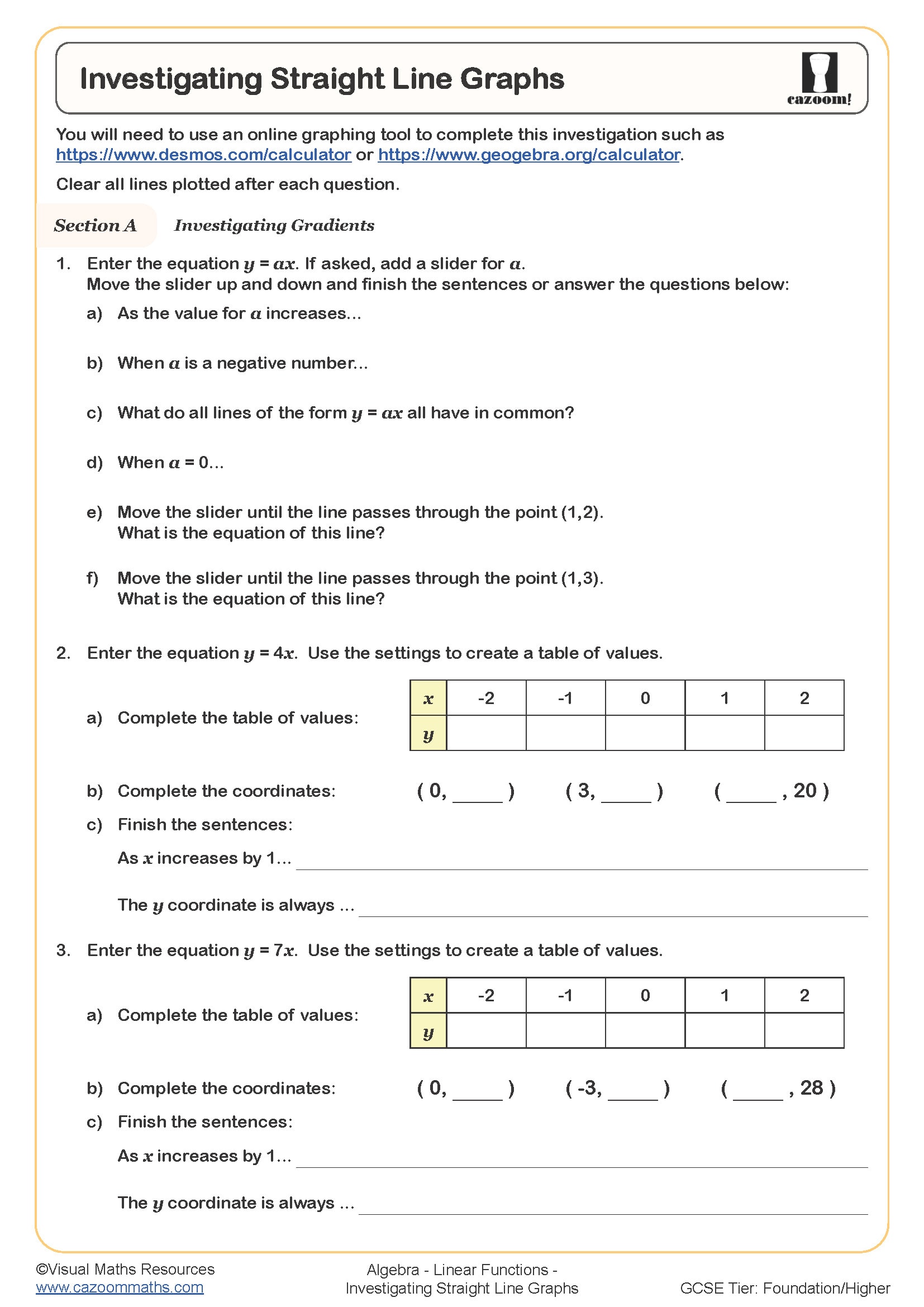
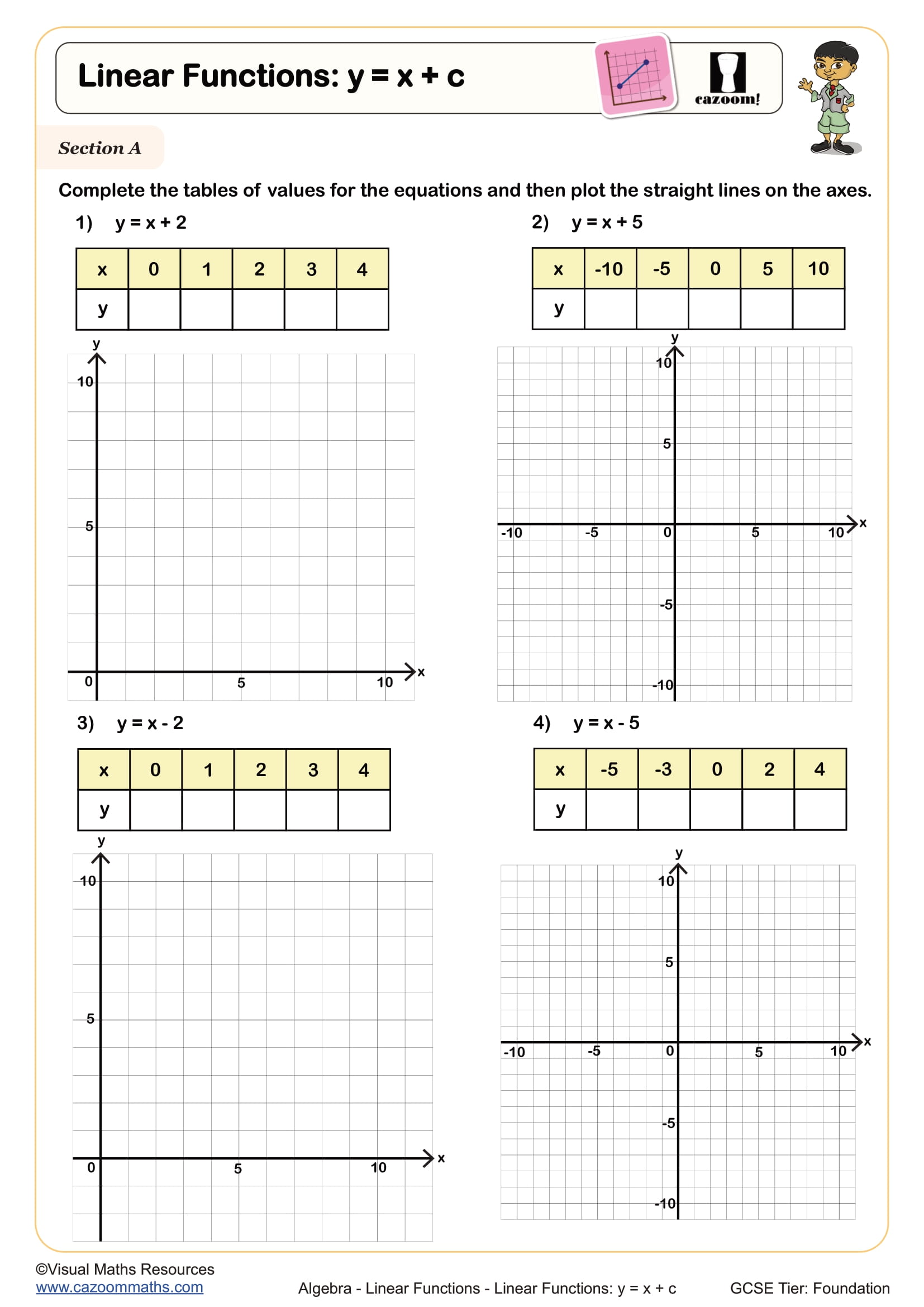
All worksheets are created by the team of experienced teachers at Cazoom Maths.
What is the y intercept and why does it matter in algebra?
The y intercept is the point where a straight line crosses the y-axis, which always occurs when x = 0. In the linear equation y = mx + c, the y intercept is represented by the constant c, whilst m represents the gradient. Understanding y intercepts becomes particularly important when students progress to solving simultaneous equations graphically and interpreting real-world data, as it represents the starting value or initial condition in many practical contexts.
Students often confuse the y intercept with the x intercept or mistakenly believe the y intercept is just the number c rather than the coordinate (0, c). This confusion typically surfaces when plotting graphs from equations, where students might plot the point (c, 0) instead of (0, c). Exam mark schemes consistently penalise this error, particularly in questions asking students to state the y intercept as a coordinate rather than simply giving the value.
Which year groups study understanding the y intercept?
Understanding the y intercept appears in the KS3 National Curriculum for both Year 8 and Year 9, forming part of the algebra strand focused on linear relationships. Year 8 students typically encounter y intercepts when first learning about straight line graphs and the equation y = mx + c, building on their earlier work with coordinates and plotting points. This topic connects directly to their developing understanding of how changing numbers in an equation affects the position and steepness of a line.
By Year 9, the focus shifts towards using y intercepts alongside gradients to sketch graphs quickly without plotting multiple points, and interpreting y intercepts in context-based problems. Students also work with negative y intercepts and equations where the constant term might not be explicitly written, such as y = 3x (where c = 0). The progression emphasises fluency in moving between equations, graphs, and real-world scenarios where the y intercept has practical meaning.
How do you find the y intercept from different forms?
Finding the y intercept depends on the format of the information provided. From an equation in the form y = mx + c, the y intercept is simply the value of c, making it the most straightforward method. From a table of values, students should identify the y value when x = 0. From a graph, they locate where the line crosses the y-axis and read the coordinate. When given two points, students can substitute one point into y = mx + c after calculating the gradient, then solve for c.
The y intercept has significant applications in STEM fields and everyday contexts. In physics, it might represent initial height in projectile motion or the fixed cost in a pricing structure where the gradient represents cost per unit. Scientists use y intercepts when analysing experimental data to determine baseline measurements before an independent variable takes effect. In business studies, break-even graphs use the y intercept to show fixed costs, helping students understand how real companies analyse profit and loss. This connection to authentic contexts helps students appreciate why identifying y intercepts accurately matters beyond abstract algebraic manipulation.
How can teachers use these y intercept worksheets effectively?
The worksheets provide structured practice that builds from identifying y intercepts on given graphs through to finding them from equations and tables. This scaffolded approach allows students to develop procedural fluency before tackling more complex multi-step problems. The included answer sheets support independent learning, enabling students to self-assess and identify specific areas where they need additional support, particularly useful when students confuse y intercepts with x intercepts or make sign errors with negative constants.
Many teachers use these worksheets for targeted intervention with students who've grasped gradients but struggle with the full y = mx + c relationship. They work well as homework to consolidate classroom teaching or as starter activities to check retention from previous lessons. The worksheets also suit paired work, where students can discuss why certain values represent y intercepts and check each other's reasoning before consulting the answers. During revision periods before end-of-topic assessments, teachers often assign specific question types based on common errors identified through formative assessment.