Using Function Machines Worksheets
All worksheets are created by the team of experienced teachers at Cazoom Maths.
What are function machines in maths?
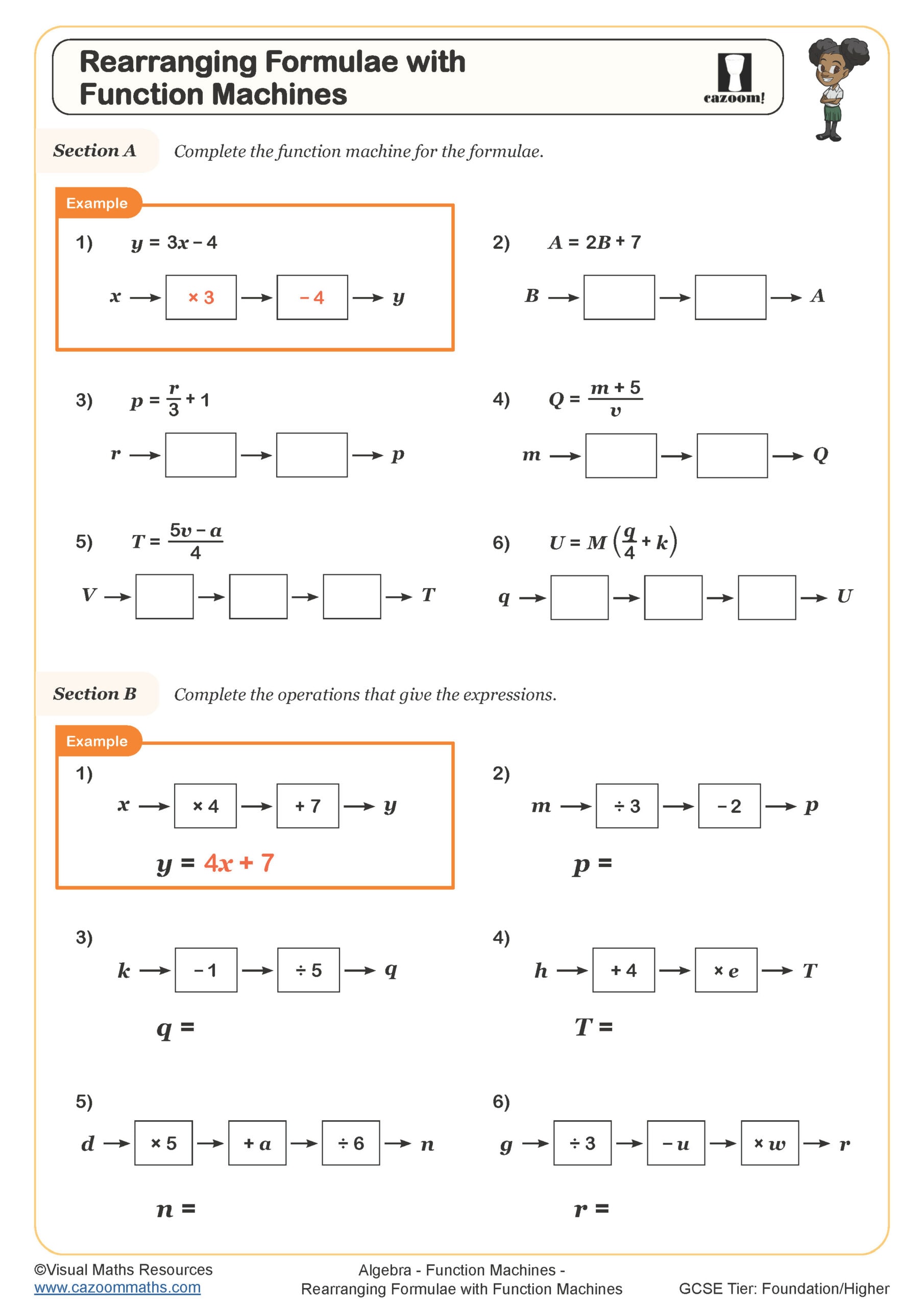
Function machines are visual representations that show how an input value is transformed through one or more operations to produce an output. In KS3 and KS4 maths, they help students understand functions as mappings, using boxes or arrows to show operations like 'multiply by 3' or 'add 7'. This approach makes abstract algebraic thinking more accessible and prepares students for formal function notation.
A common error occurs when students work backwards through a function machine but fail to apply inverse operations in the correct order. For instance, if the forward operations are 'multiply by 4, then add 5', students sometimes subtract 5 first but then divide by 4 incorrectly if brackets aren't considered. Mark schemes at GCSE specifically penalise this reversal error, as it demonstrates misunderstanding of the order of operations in algebraic manipulation.
Which year groups study using function machines?
These worksheets support students in Year 9 and Year 10, spanning Key Stage 3 and Key Stage 4. Function machines typically appear in Year 7 or Year 8 as an introduction to algebraic thinking, but the focus shifts in later years towards more complex operations, composite functions, and connections with solving equations. By Year 9 and Year 10, students work with function machines that include fractions, negatives, and multiple operations.
The progression across these year groups involves moving from single-step functions to multi-step problems and introducing inverse function machines as preparation for solving linear equations. Year 10 students encounter function machines in the context of GCSE revision, where they must confidently work both forwards and backwards through operations, often without the visual scaffolding. This builds the algebraic manipulation skills needed for rearranging formulae and solving more complex equations.
How do inverse function machines work?
Inverse function machines reverse the operations of a standard function machine to work backwards from the output to the input. Each operation must be undone using its inverse: addition becomes subtraction, multiplication becomes division, squaring becomes square rooting. Crucially, the operations must be reversed in order, working from the last operation back to the first, which reinforces understanding of the order of operations.
This skill has direct applications in engineering and computer programming, where reverse calculations are essential. Software developers use inverse functions when creating undo features, while engineers apply inverse operations when calculating required inputs to achieve desired outputs in systems design. Understanding inverse function machines also underpins later work with inverse trigonometric functions and logarithms, making it a foundational concept that extends well beyond basic algebra into STEM careers.
How can teachers use these function machine worksheets effectively?
The worksheets build understanding through structured practice, allowing students to work through examples that gradually increase in complexity. With complete answer sheets provided, students can self-check their work during independent practice, while teachers can quickly identify patterns in errors across the class. The format supports students in recognising the connection between function machines and equation-solving, particularly when operations involve algebraic expressions.
Many teachers find these worksheets valuable for intervention sessions with students who struggle with abstract algebraic notation, as the visual nature of function machines provides a concrete entry point. They work well as homework following initial teaching, or as starter activities to revisit the concept before moving on to formal function notation. Paired work can be particularly effective, with one student creating a function machine and the other finding the inverse, then checking each other's answers using the provided solutions.