Year 10 Factorising Worksheets
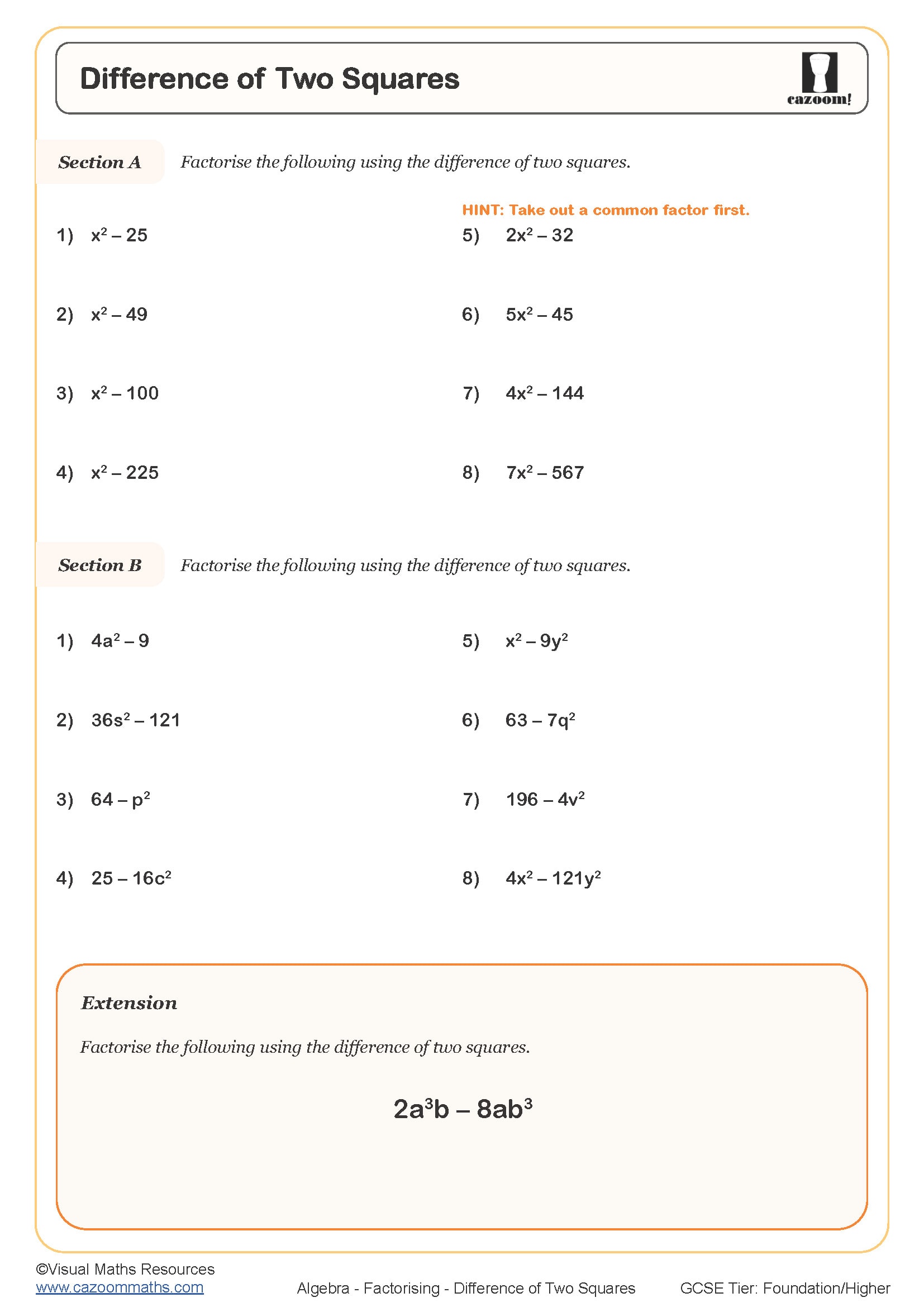
Difference of Two Squares
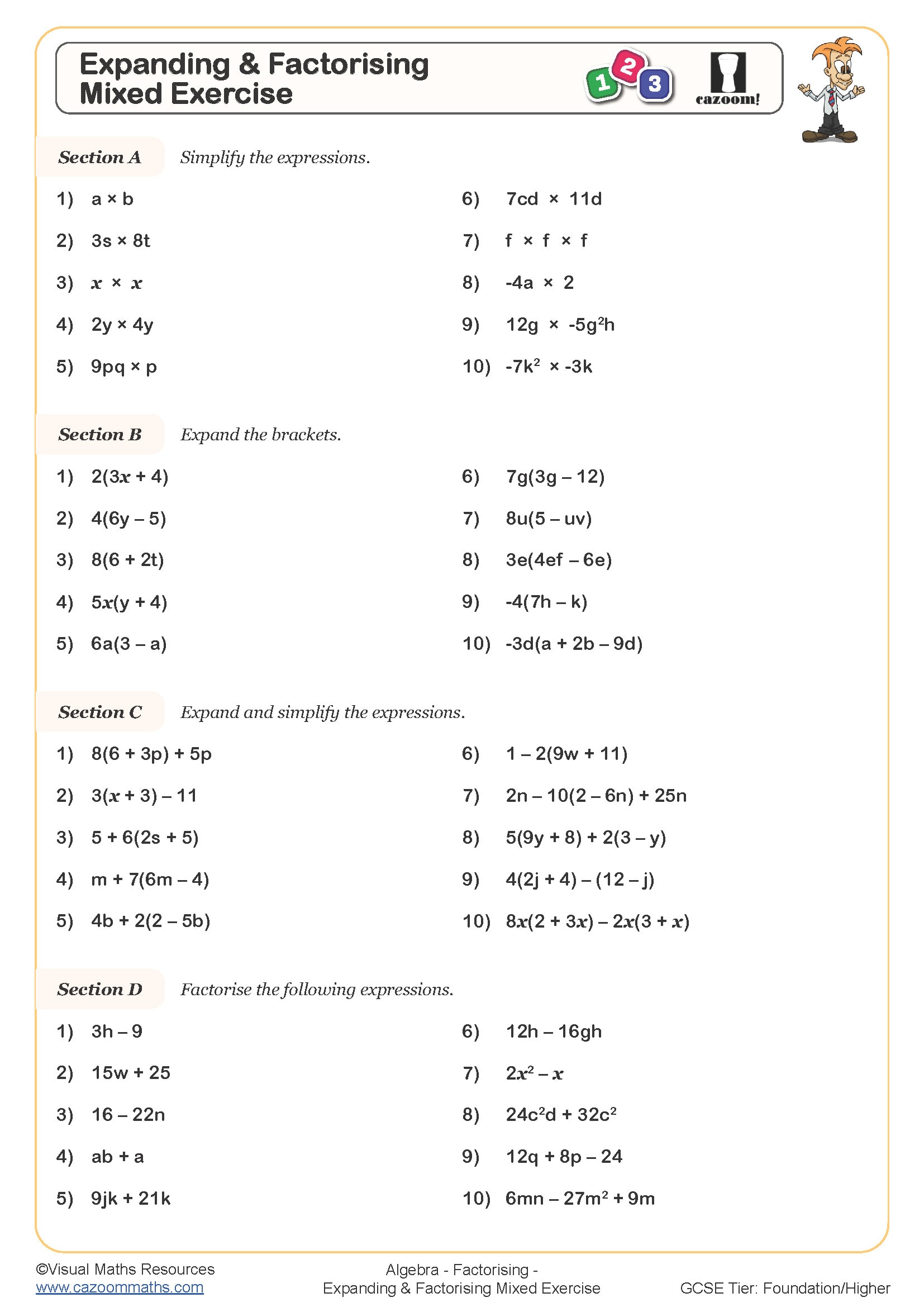
Expanding and Factorising Mixed Exercise
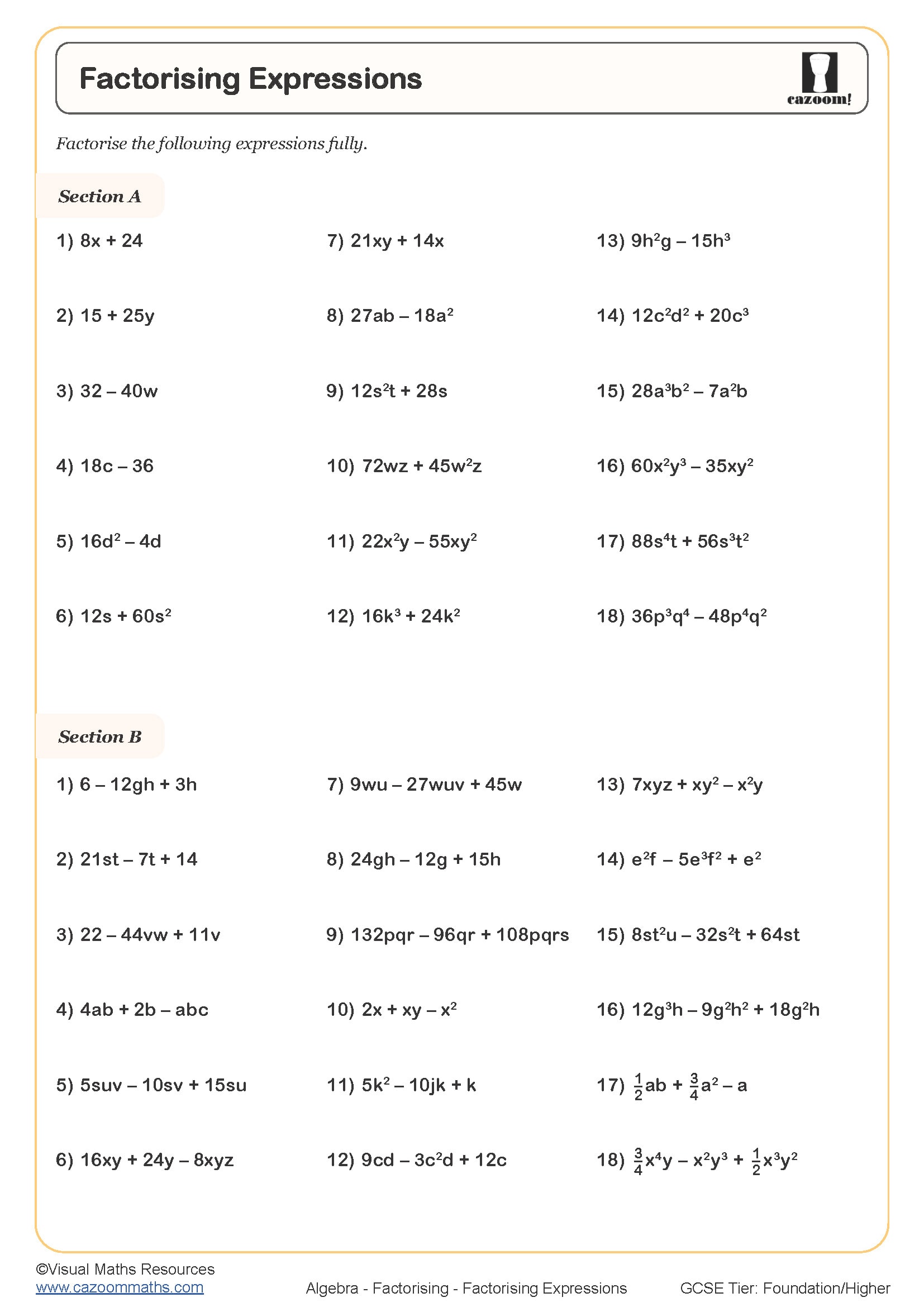
Factorising Expressions
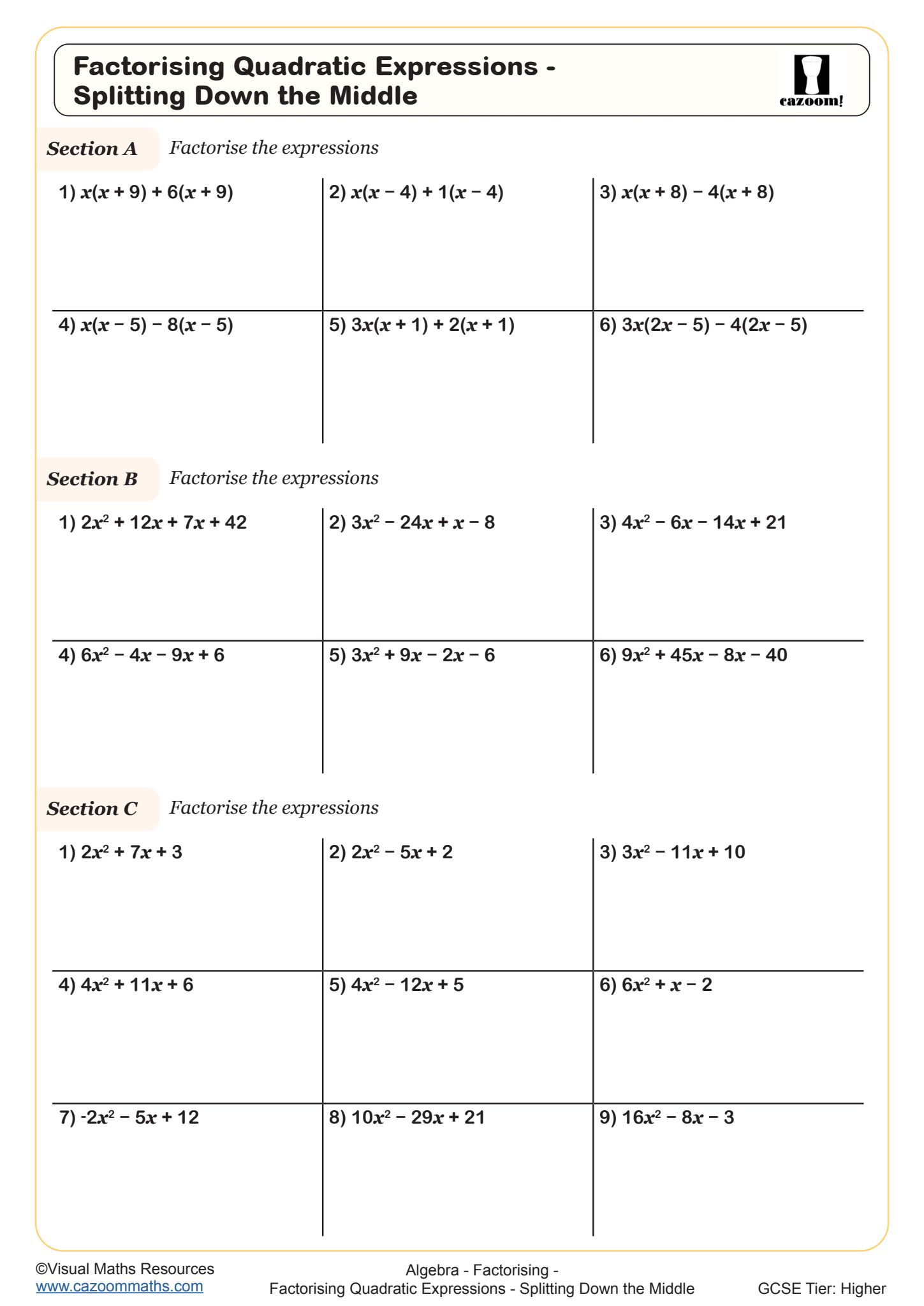
Factorising Quadratic Expressions - Splitting Down the Middle
Factorising Quadratic Expressions - Using the Area Model (A)
-Questions-1.jpg?w=3840)
Factorising Quadratic Expressions - Using the Area Model (B)
-Worksheet.jpg?w=3840)
Factorising Quadratic Expressions (A)
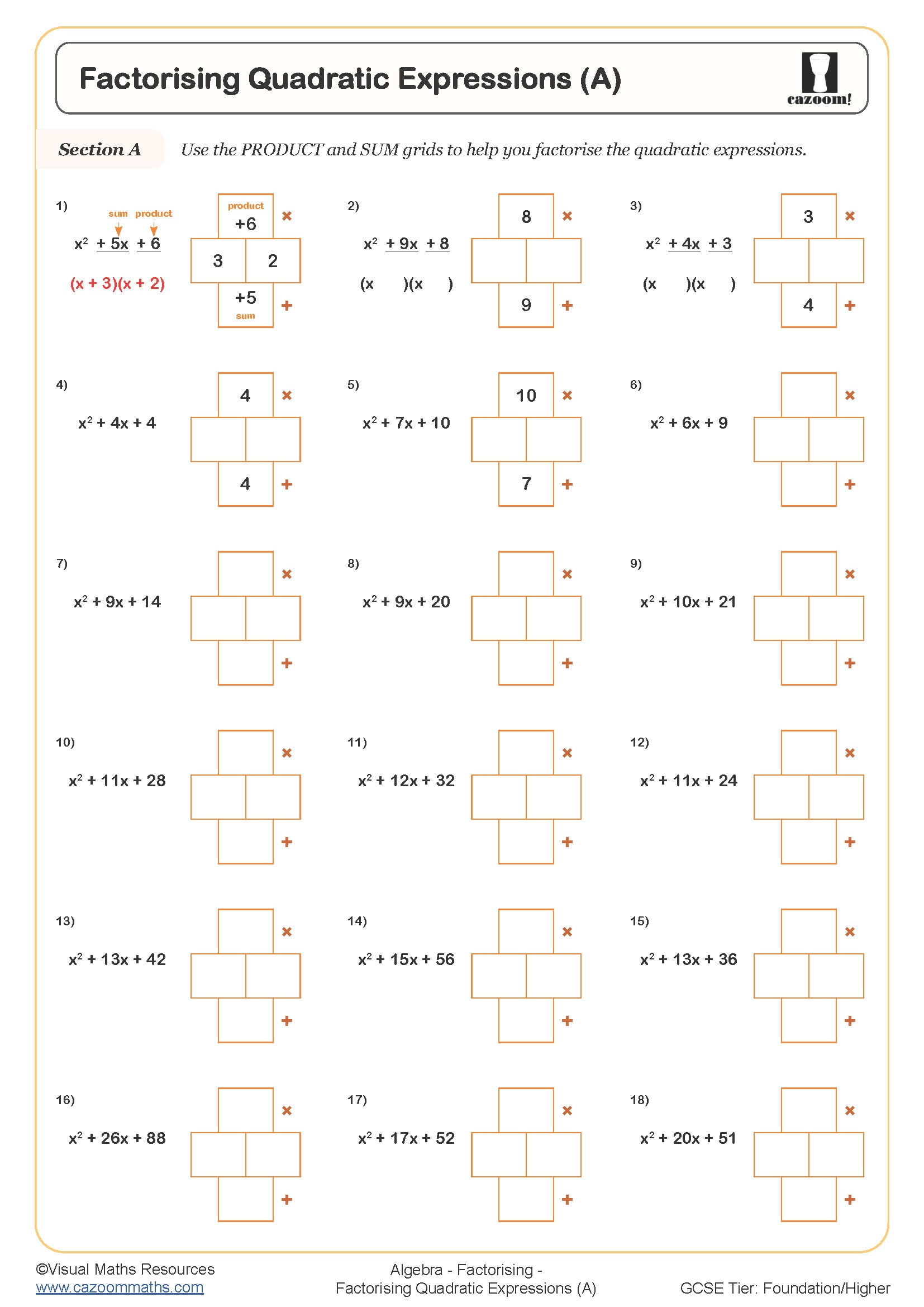
Factorising Quadratic Expressions (B)
.jpg?w=3840)
Factorising Quadratic Expressions (C)
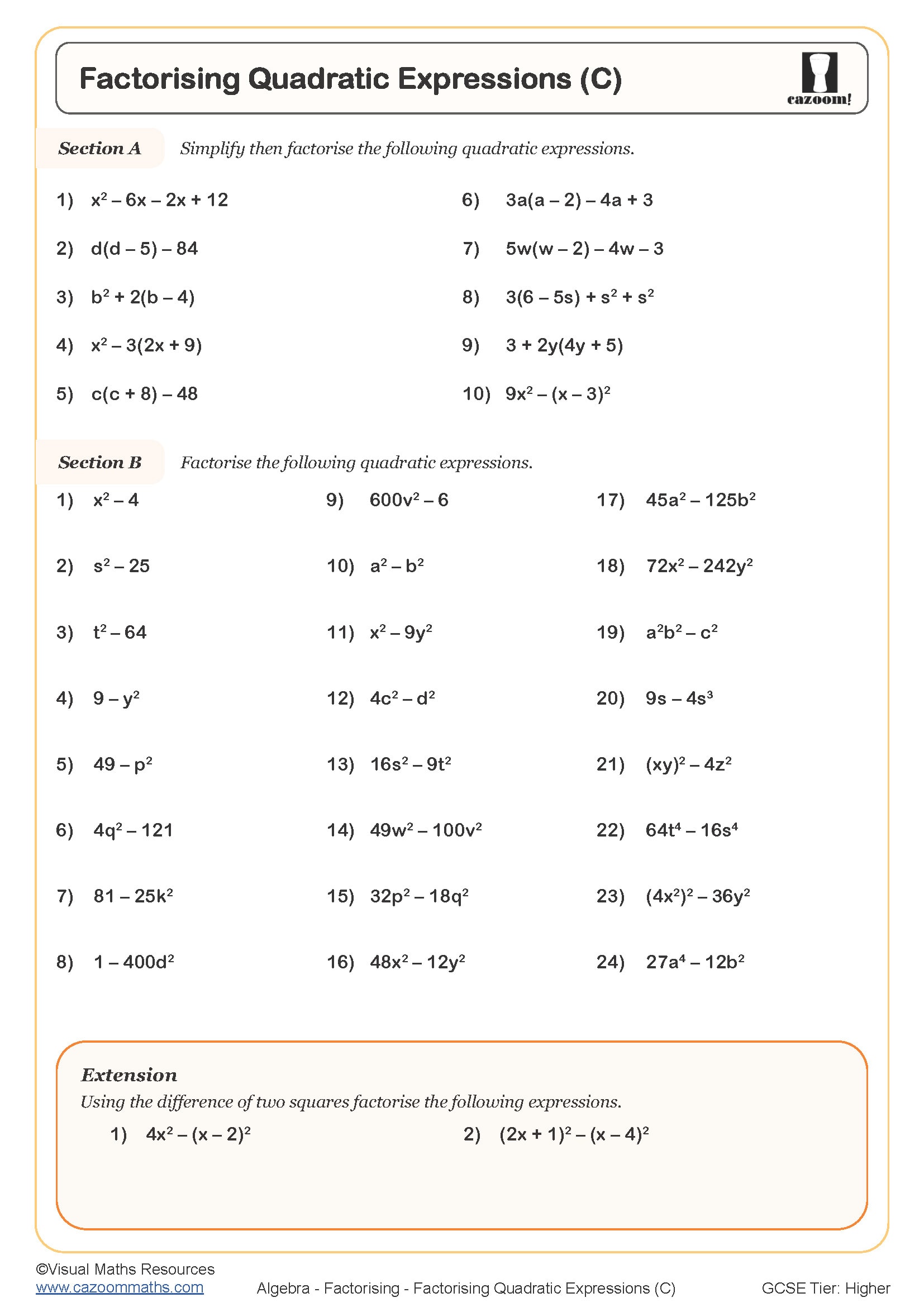
Introducing Factorisation
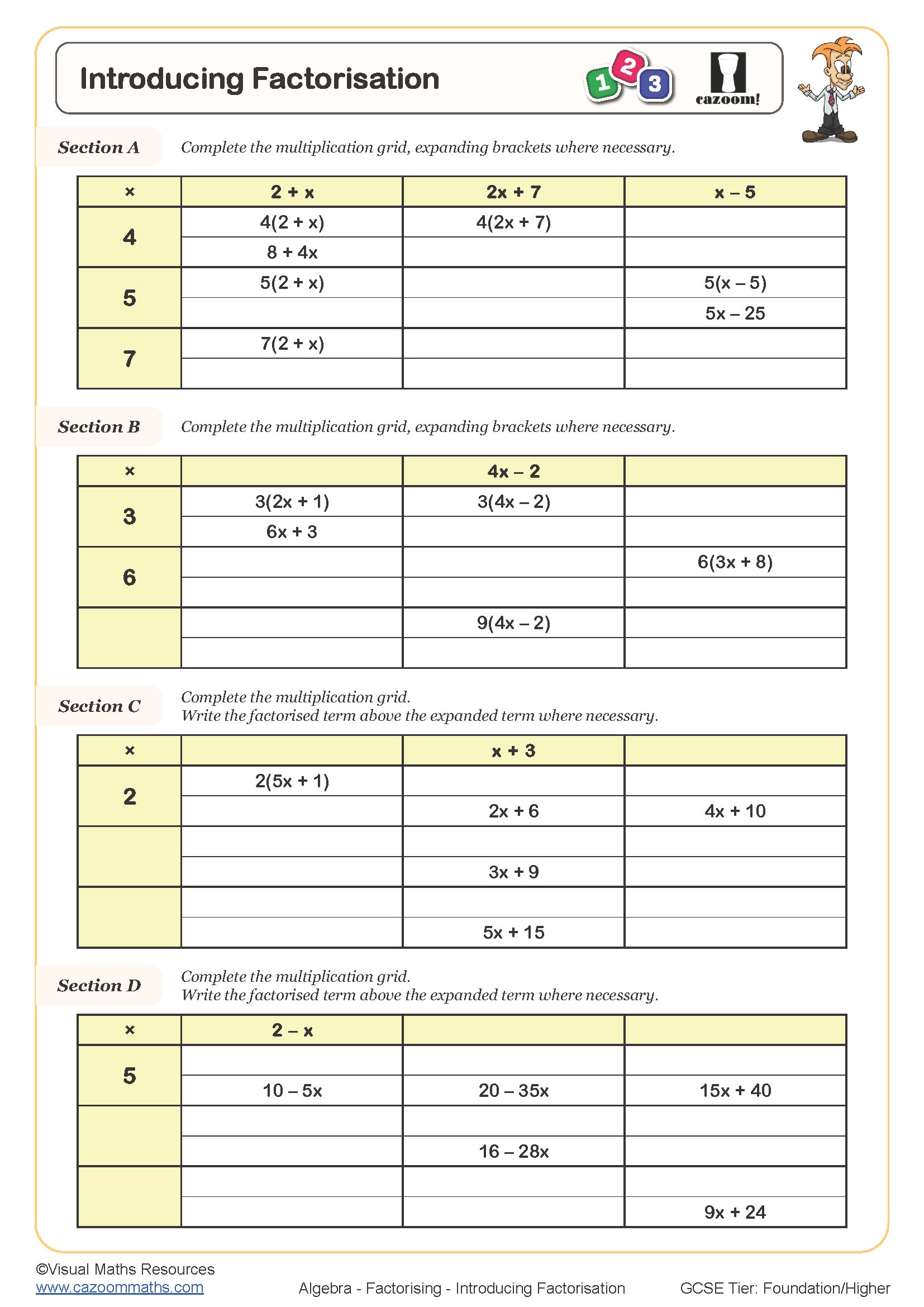
All worksheets are created by the team of experienced teachers at Cazoom Maths.
What types of questions are included in factorisation Year 10 worksheets with answers?
These worksheets cover the full spectrum of factorisation techniques required at Year 10 level, including extracting highest common factors, factorising quadratic expressions, difference of two squares, and factorising by grouping. Each worksheet progresses systematically from basic single-variable expressions through to more complex algebraic forms that students encounter in their GCSE preparation.
Teachers frequently observe that students rush into attempting complex factorisation methods without first checking for common factors, leading to unnecessarily complicated working. The answer sheets provide step-by-step solutions that demonstrate the logical sequence students should follow, helping them develop systematic approaches to recognising which factorisation method to apply in different situations.
Are these factorising worksheets suitable for other year groups besides Year 10?
While designed primarily for Year 10 students, these worksheets serve multiple year groups depending on ability and curriculum timing. Higher-ability Year 9 students often benefit from early exposure to these concepts, whilst some Year 11 students require additional practice before their GCSE examinations. The progressive difficulty levels make them adaptable across different teaching contexts.
Many teachers use selected questions from these resources to support Year 8 students learning basic factorisation of simple algebraic expressions. Conversely, A-level teachers sometimes utilise the more challenging questions as refresher material, ensuring students have solid algebraic foundations before tackling advanced polynomial work. The thorough answer sheets support differentiated learning across these various applications.
How do these worksheets address the difference between expanding and factorising?
The worksheets explicitly contrast expansion and factorisation processes, helping students understand these as inverse operations. Many questions require students to expand given factorisations to verify their answers, reinforcing the mathematical relationship between these processes. This approach helps students develop fluency in both directions, which is crucial for solving equations and manipulating algebraic expressions effectively.
Classroom experience shows that students often confuse when to expand and when to factorise, particularly in problem-solving contexts. The expanding and factorising worksheet pdf with answers includes mixed practice where students must identify which operation is required, developing their mathematical reasoning skills alongside technical proficiency in both processes.
How can teachers use these factorising worksheets most effectively in lessons?
These worksheets work best when used strategically within a structured teaching sequence, beginning with teacher demonstration of key techniques before students attempt independent practice. Teachers often find success using individual questions as starter activities or homework tasks, gradually building student confidence before tackling complete worksheets. The detailed answer sheets enable peer marking activities that promote mathematical discussion.
Effective implementation often involves using the worksheets to identify specific areas where students need additional support, rather than simply as assessment tools. Many teachers extract particular question types that highlight common misconceptions, using these as focused intervention materials. The PDF format allows teachers to easily select and modify questions to match their specific lesson objectives and student needs.