Year 10 Indices Worksheets
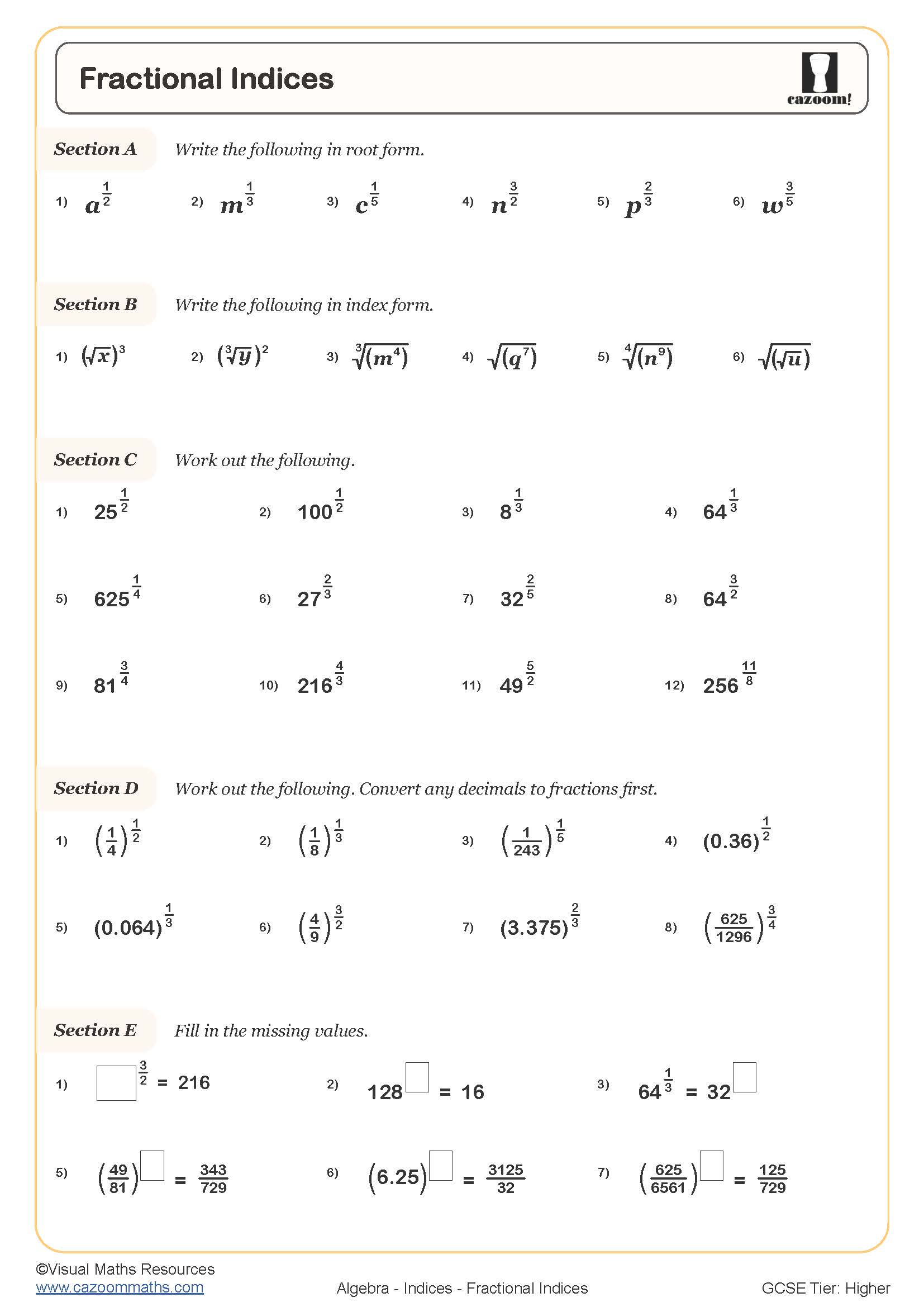
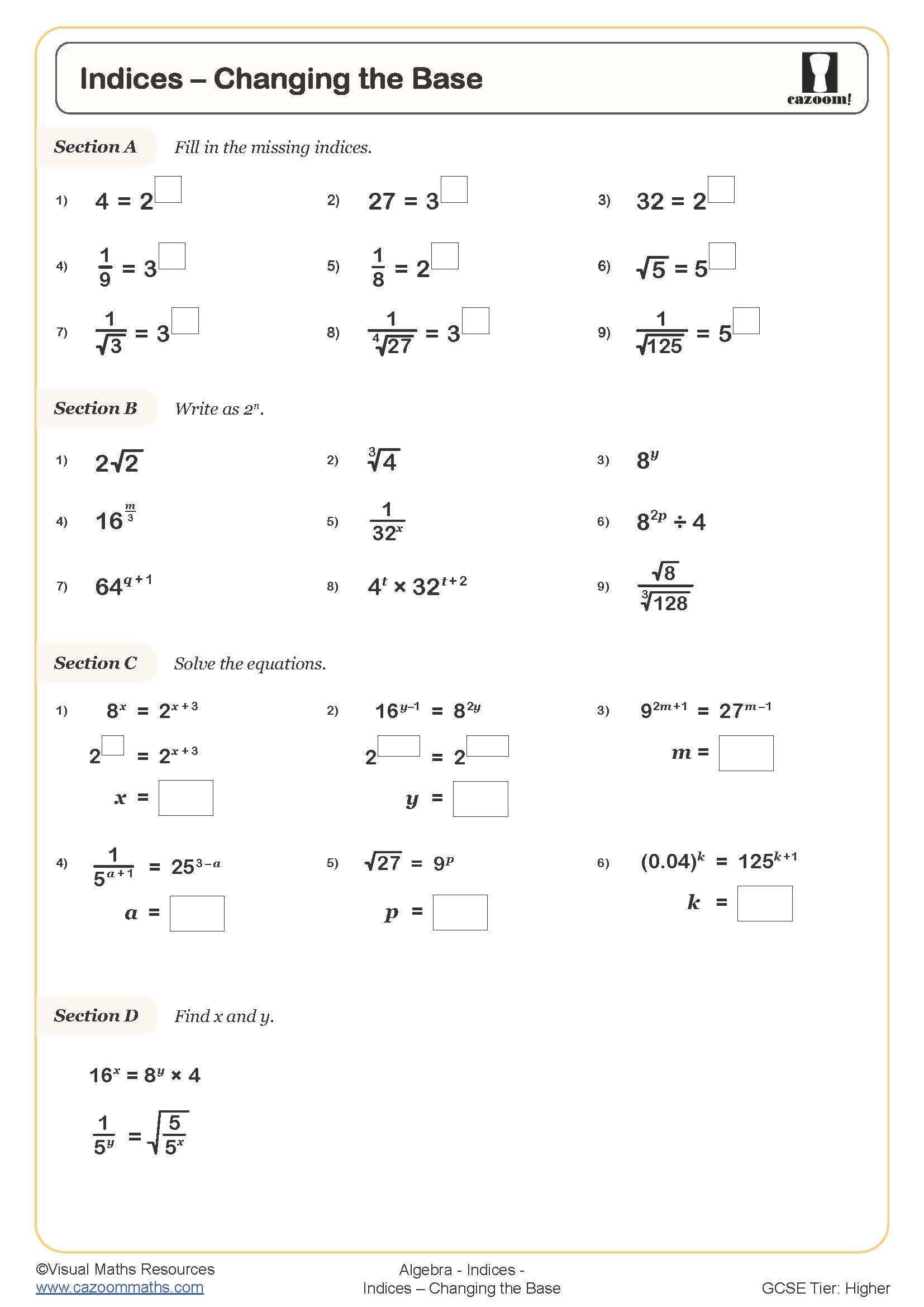
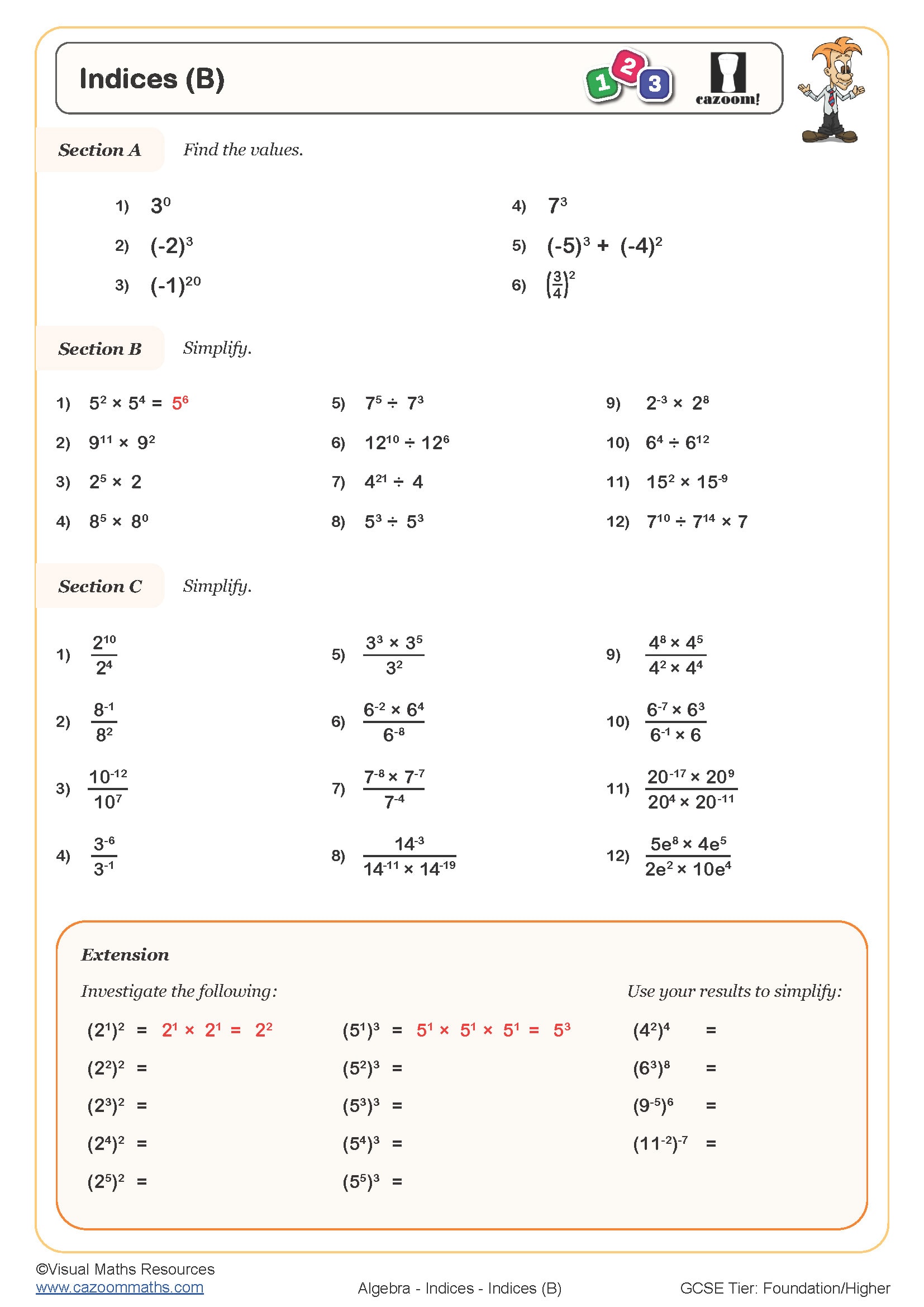
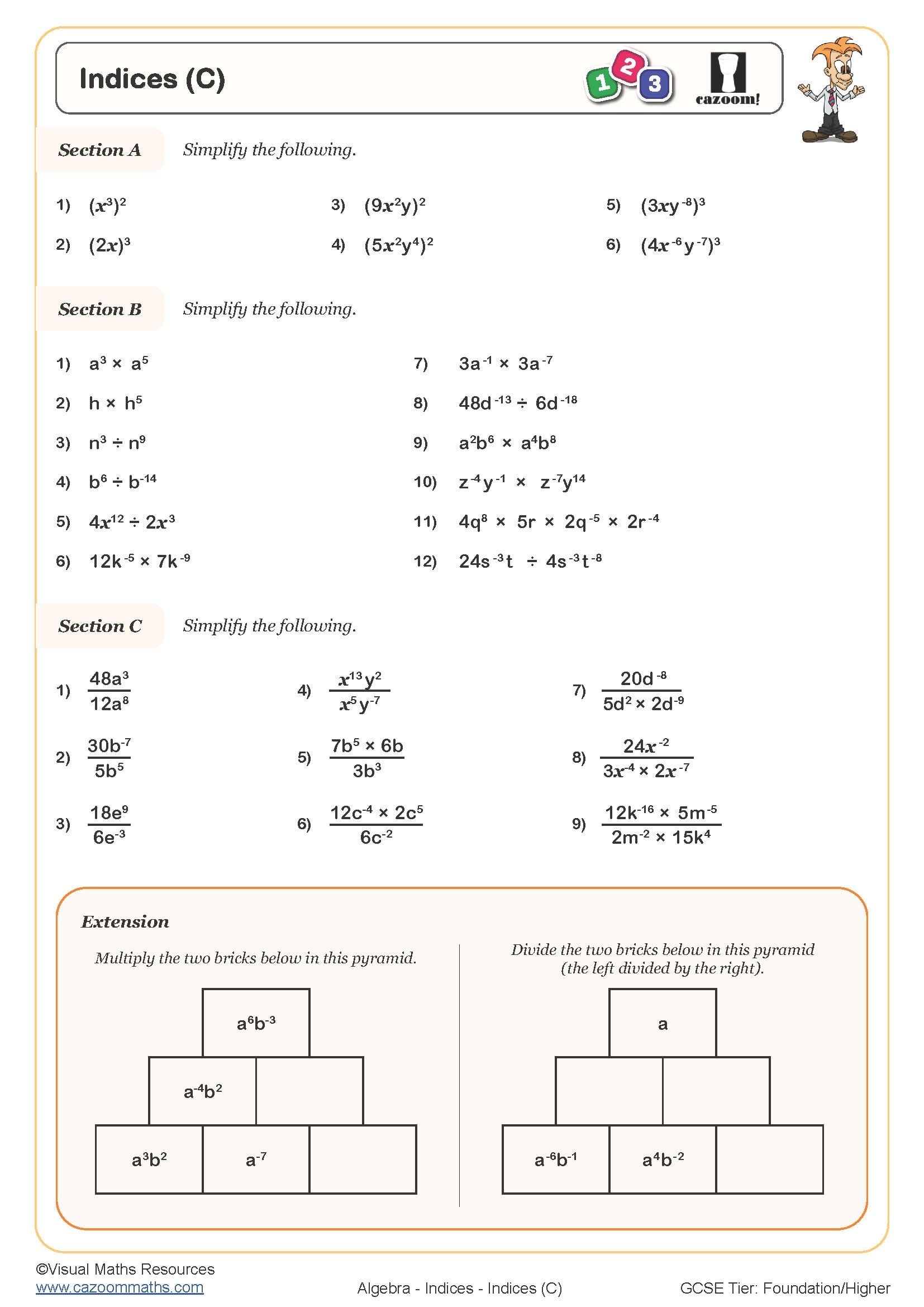
All worksheets are created by the team of experienced teachers at Cazoom Maths.
What types of problems appear on an indices worksheet?
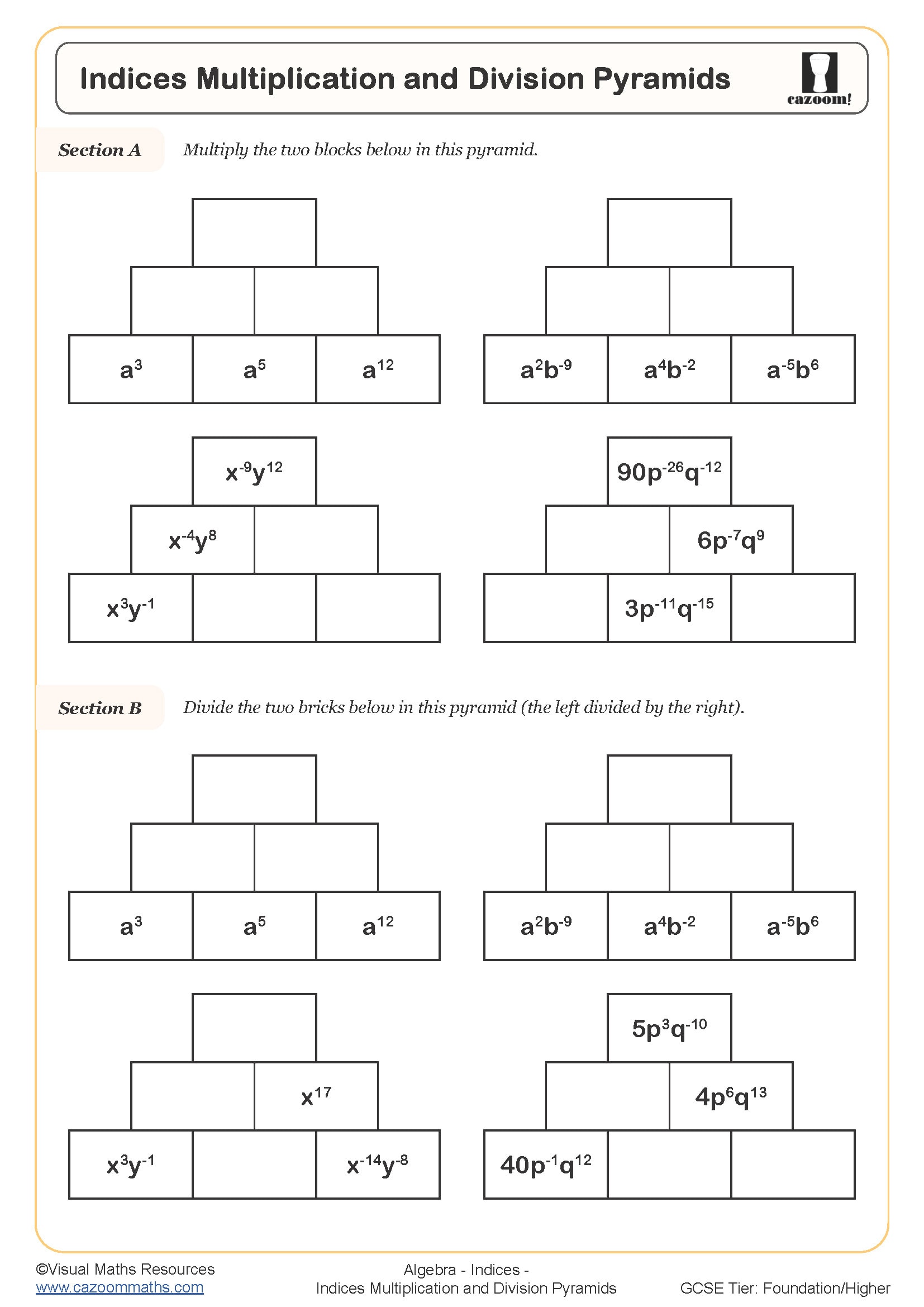
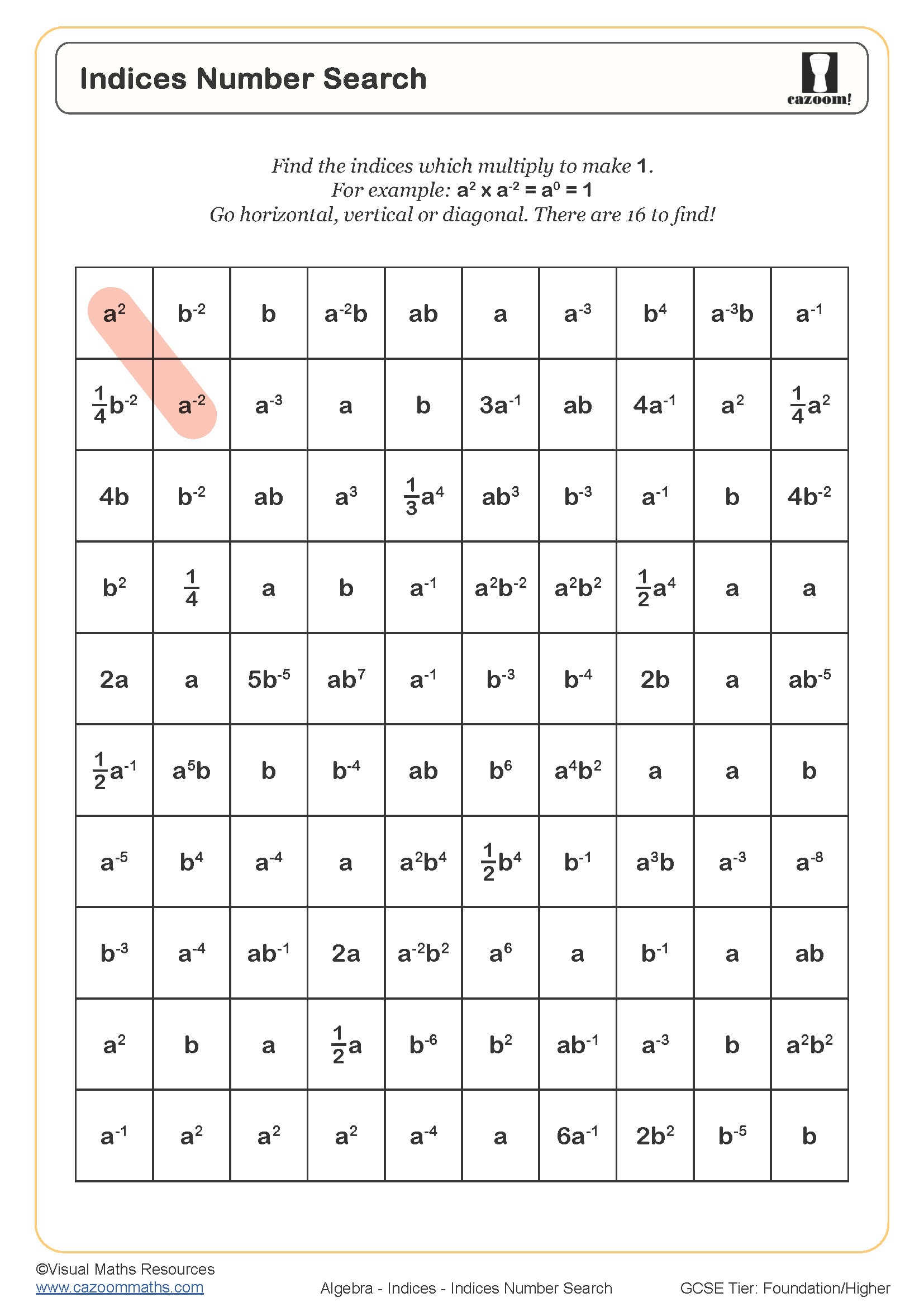
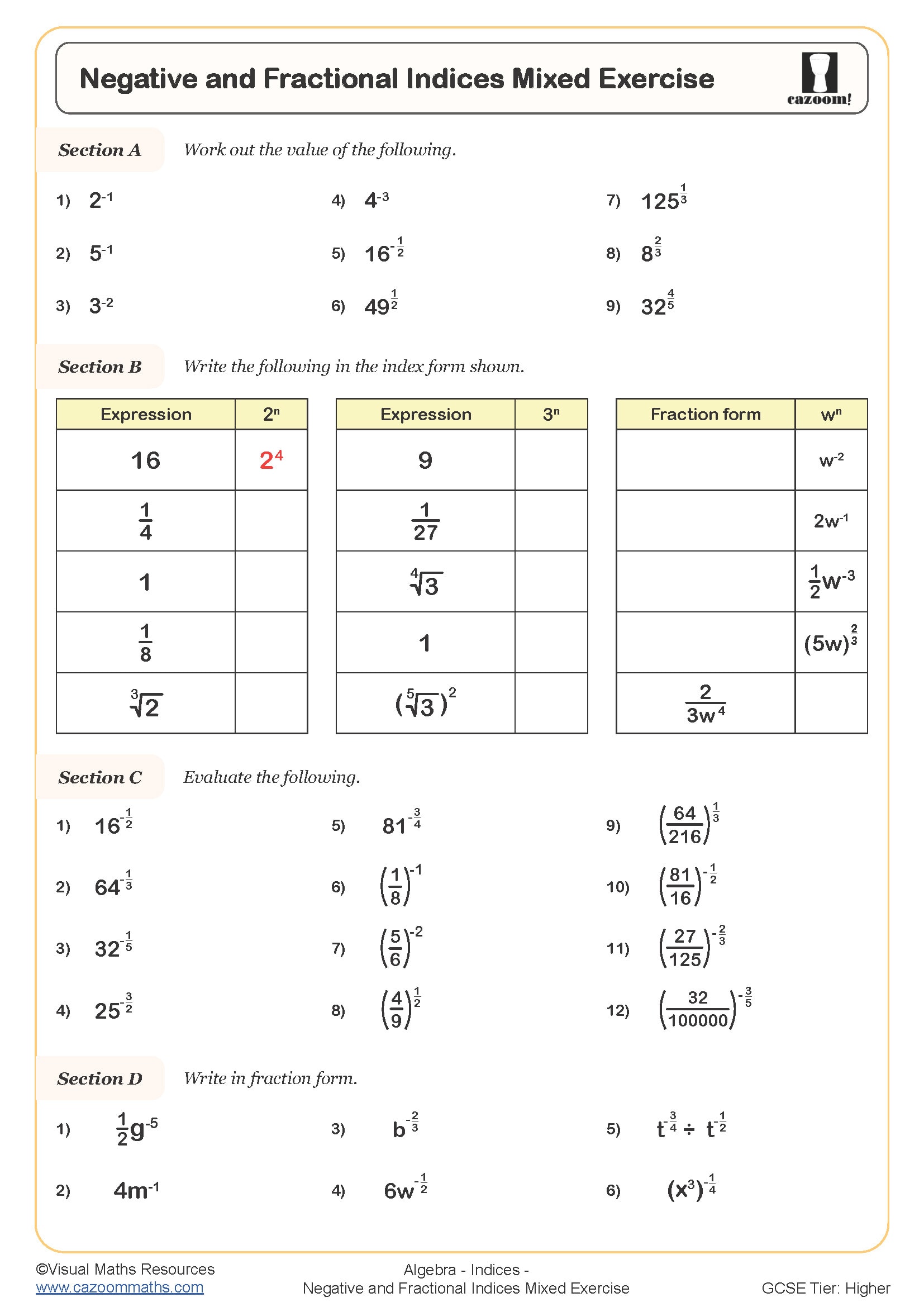
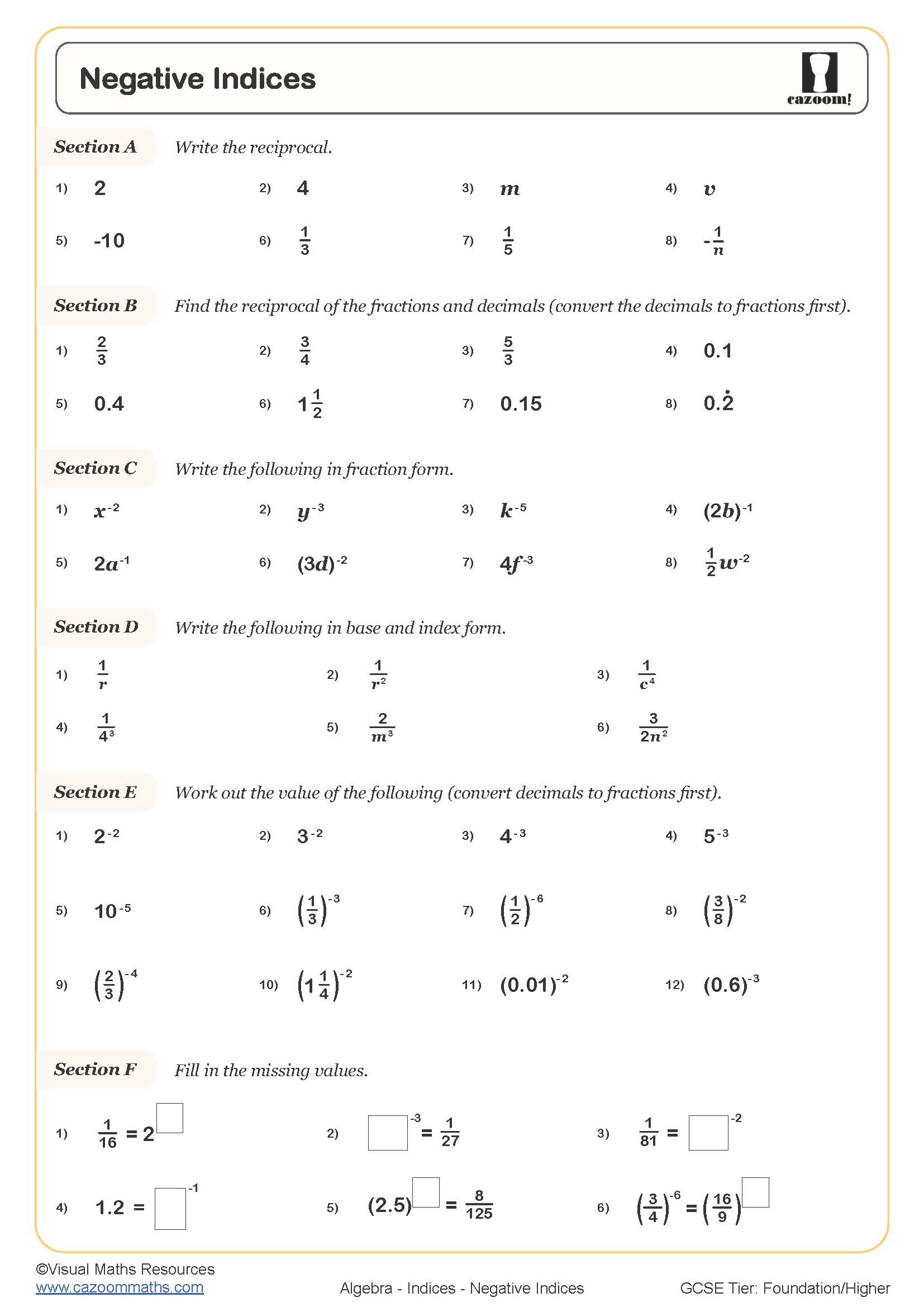
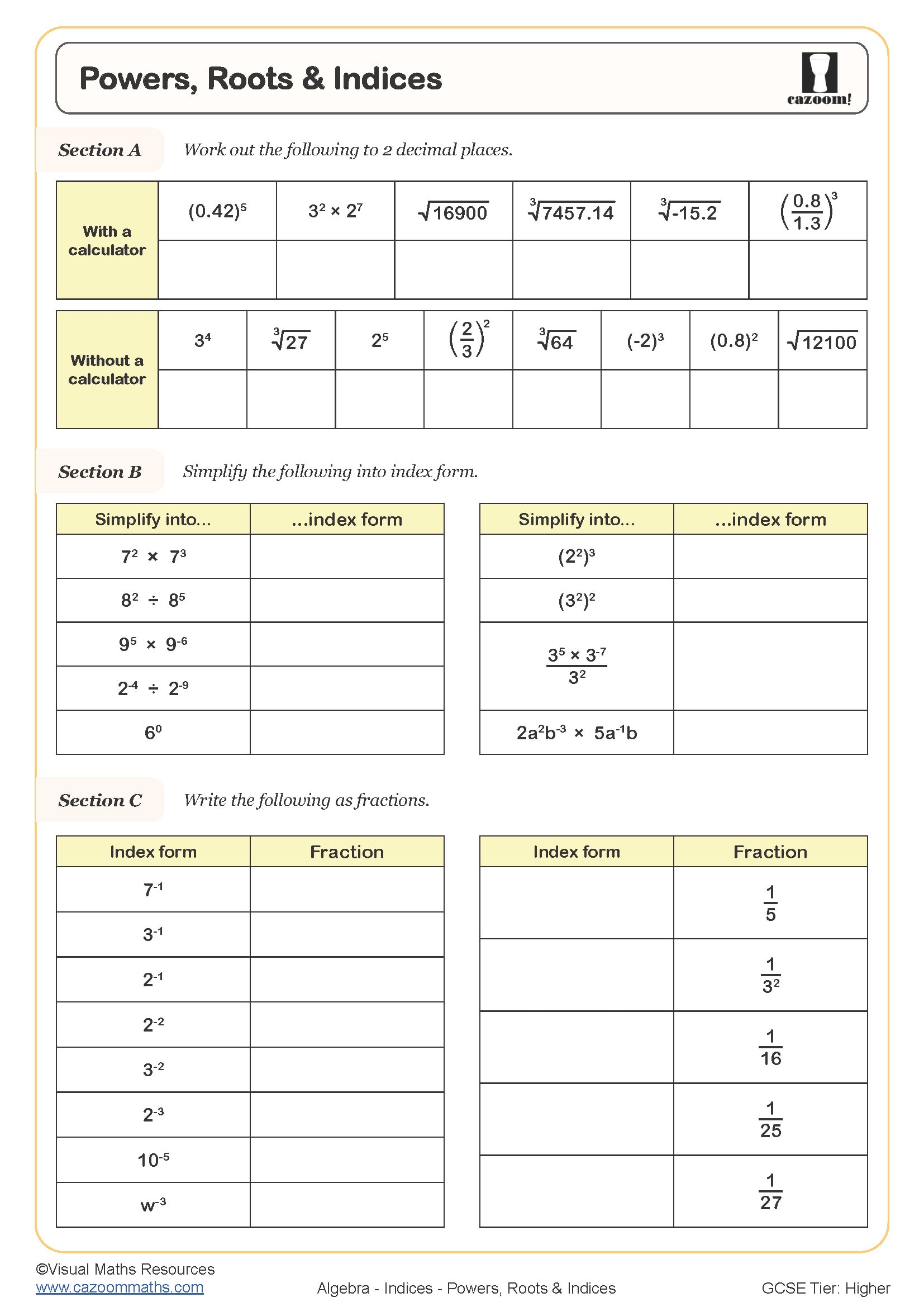
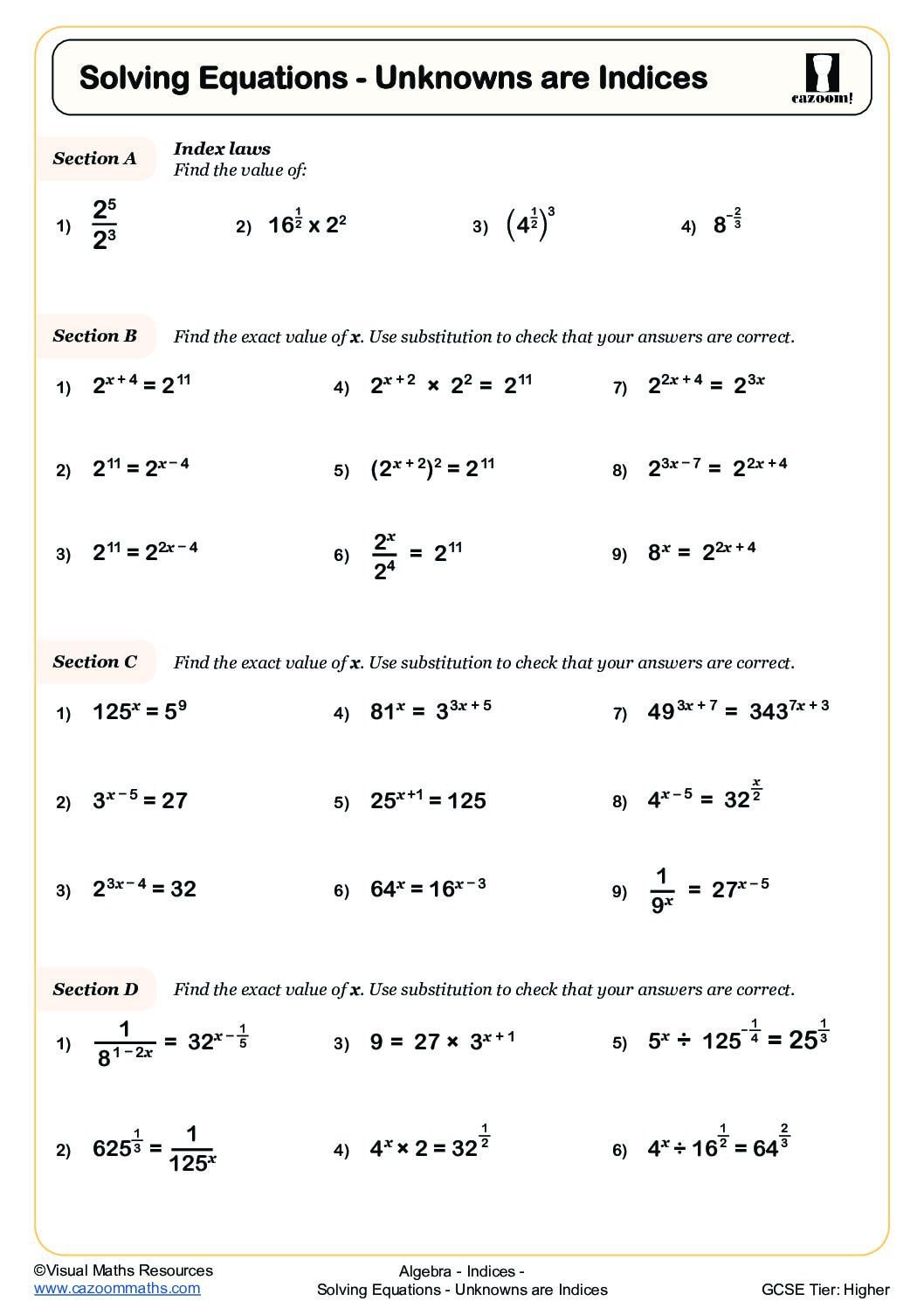
An indices worksheet typically includes problems covering all major index laws: multiplying powers with the same base (a^m × a^n = a^(m+n)), dividing powers (a^m ÷ a^n = a^(m-n)), and raising powers to powers ((a^m)^n = a^(mn)). Students also encounter negative indices (a^(-n) = 1/a^n), fractional indices (a^(1/n) = ⁿ√a), and zero indices (a^0 = 1).
Teachers notice that whilst students grasp basic multiplication of indices quickly, they frequently make sign errors when working with negative indices. The most challenging problems involve simplifying expressions with multiple index operations, where students must apply several laws in sequence whilst maintaining accuracy with algebraic manipulation throughout the solution process.
Which year groups should use indices questions year 10 level worksheets?
Indices questions year 10 worksheets are primarily designed for Key Stage 4 students, typically ages 14-15, who are building towards GCSE mathematics. However, high-achieving Year 9 students often benefit from early exposure to these concepts, particularly when studying surds and powers in advanced algebra topics.
Year 11 students frequently return to these worksheets for revision purposes, especially when preparing for GCSE examinations where index laws appear in both algebraic manipulation and scientific notation contexts. Teachers find that students who master these concepts early develop stronger algebraic fluency, which supports their progress through quadratic equations, exponential functions, and logarithms in later mathematics study.
How do index laws worksheet problems connect to real-world applications?
Index laws worksheet problems directly relate to scientific contexts where students encounter exponential growth, decay models, and scientific notation. In physics, students use index laws when calculating compound interest, population growth, and radioactive decay rates. Engineering applications include electrical circuit calculations and material stress analysis using exponential relationships.
Teachers observe that students engage more readily with abstract index manipulation when they understand these practical connections. For example, understanding that 10^3 × 10^2 = 10^5 helps students work confidently with scientific notation in chemistry calculations, where they might multiply concentrations like 2.3 × 10^(-4) by 1.5 × 10^6 to find reaction rates or molecular quantities.
How can teachers use law of indices worksheet resources most effectively in lessons?
Teachers achieve best results when they introduce law of indices worksheet exercises after demonstrating each rule with concrete numerical examples before progressing to algebraic expressions. Starting with simple bases like 2^3 × 2^4 helps students visualise the underlying multiplication before tackling x^5 × x^3 problems.
Classroom experience shows that mixed practice works better than isolated law practice, as students need to identify which rule applies to each problem. Teachers often use the answer sheets for peer marking activities, encouraging students to explain their working to classmates. This approach reveals misconceptions quickly and reinforces correct index law applications through mathematical discussion and collaborative problem-solving strategies.