Year 11 Expanding Brackets Worksheets
All worksheets are created by the team of experienced teachers at Cazoom Maths.
What topics are covered in an expanding brackets worksheet?
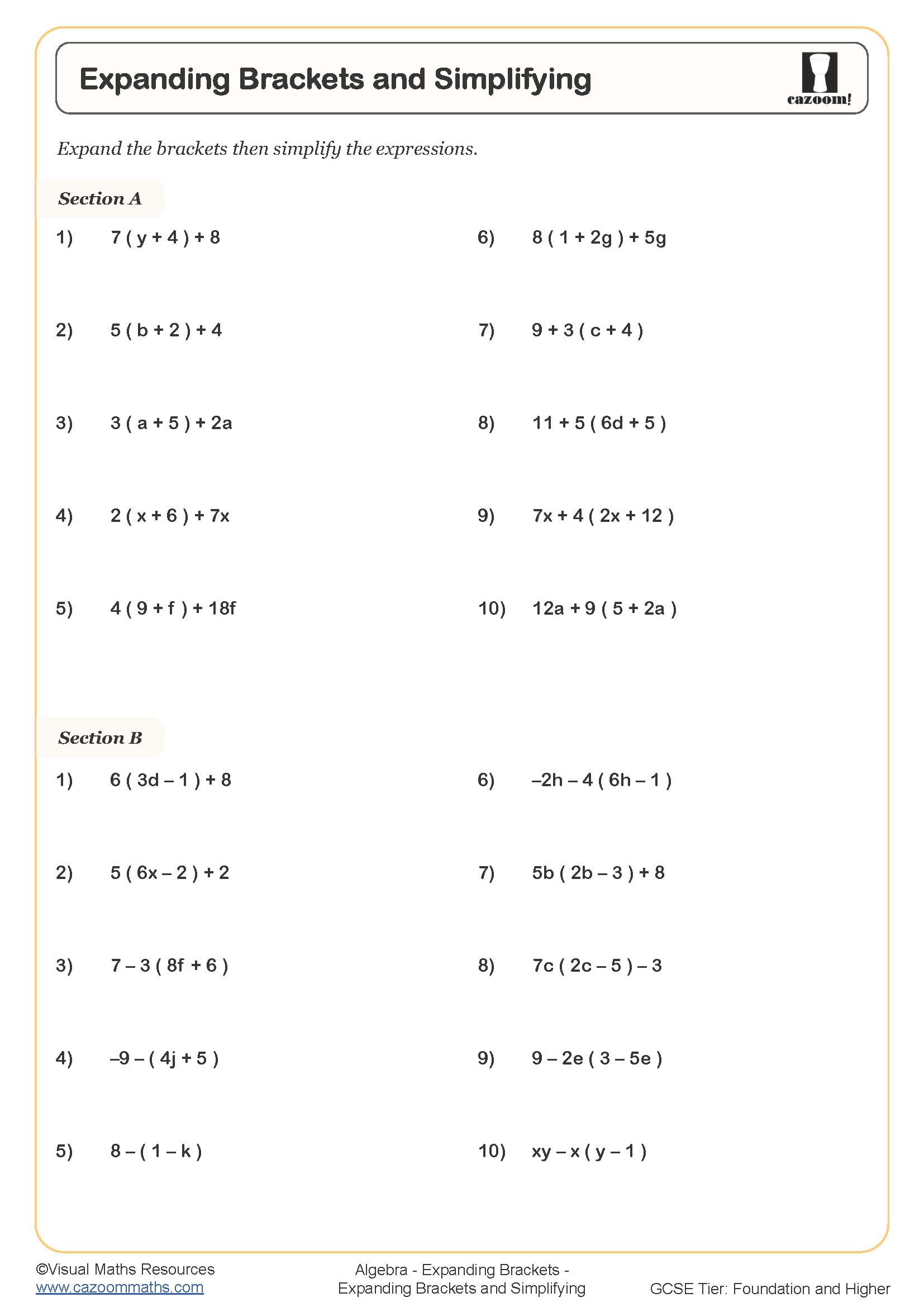
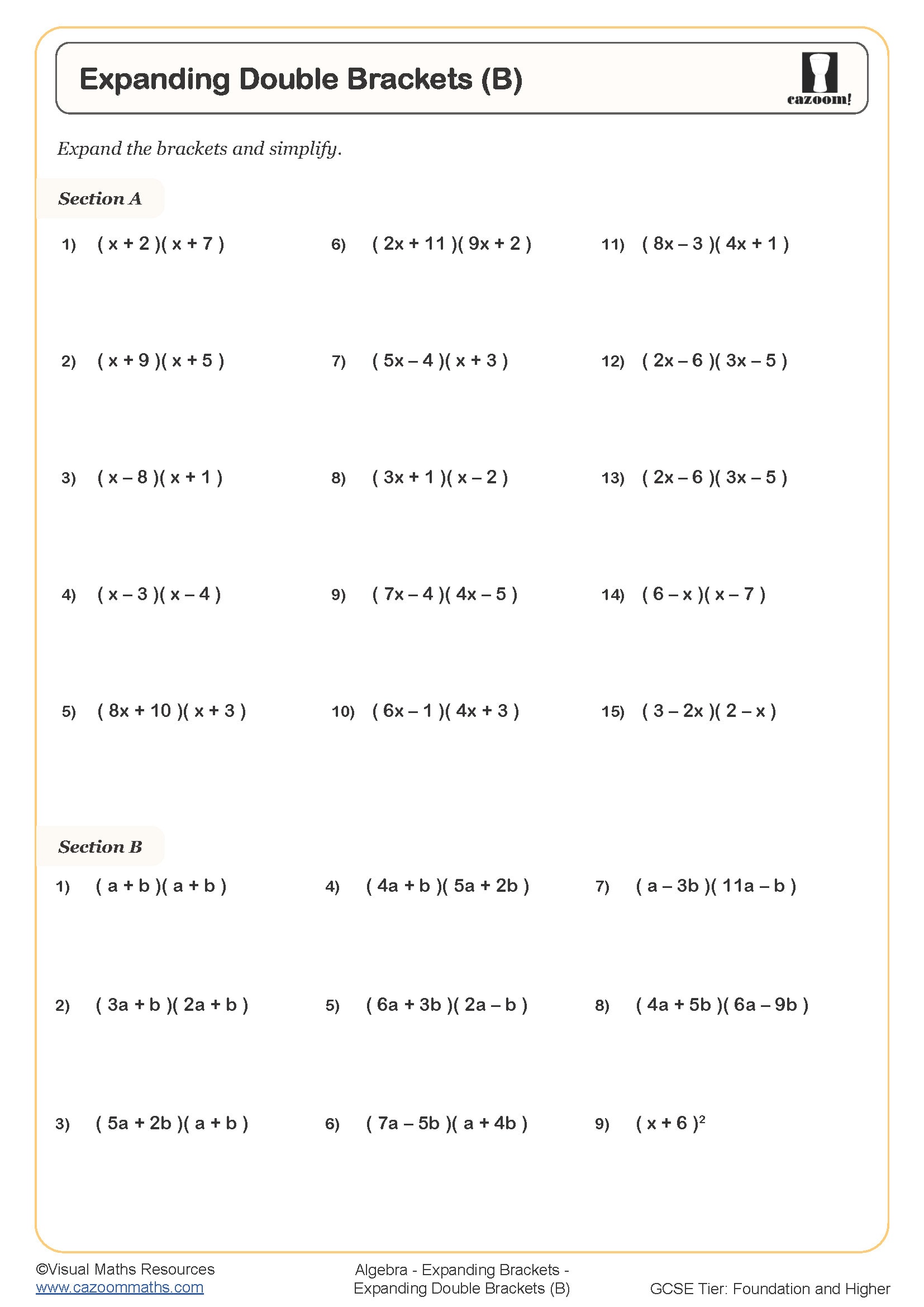
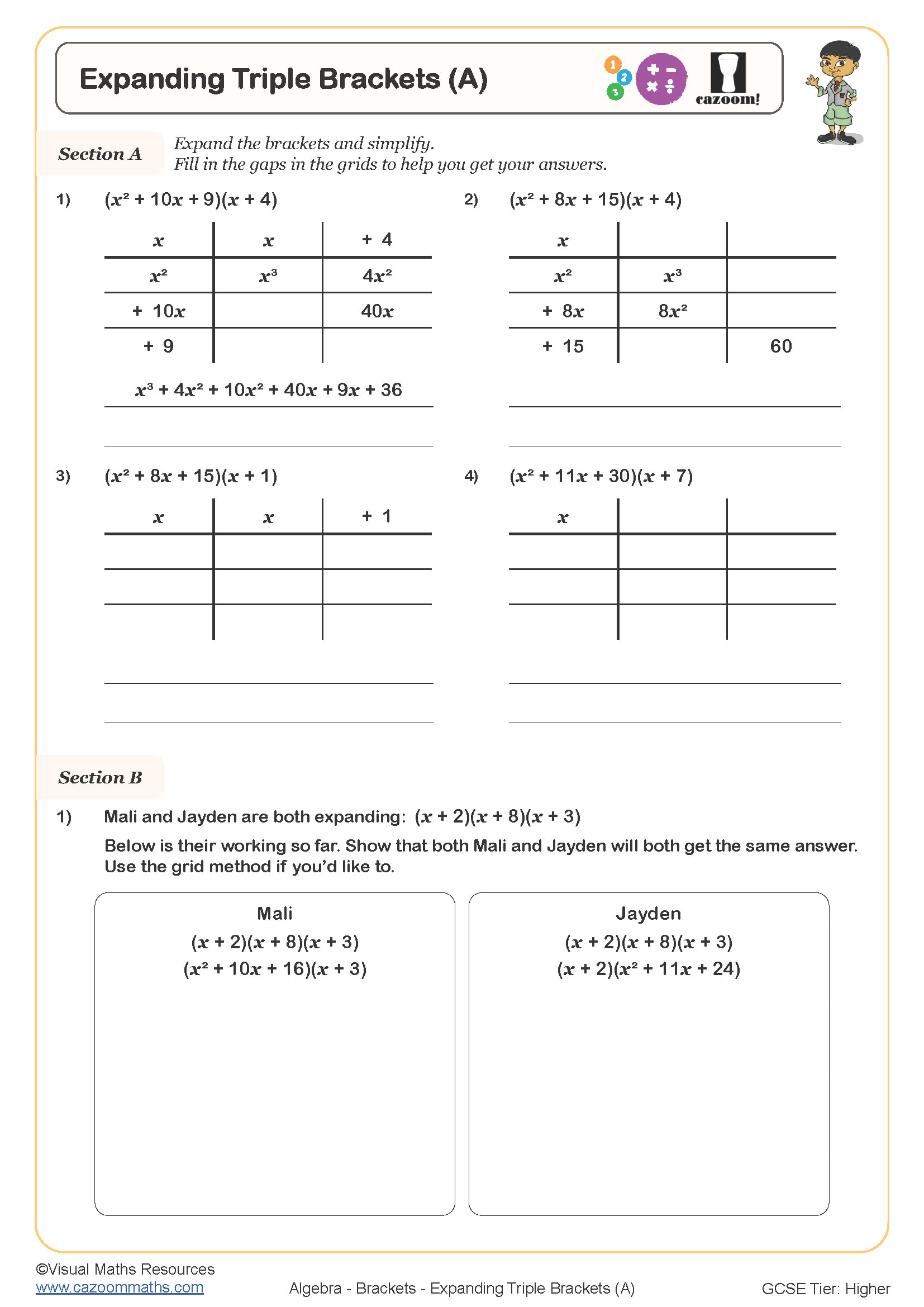
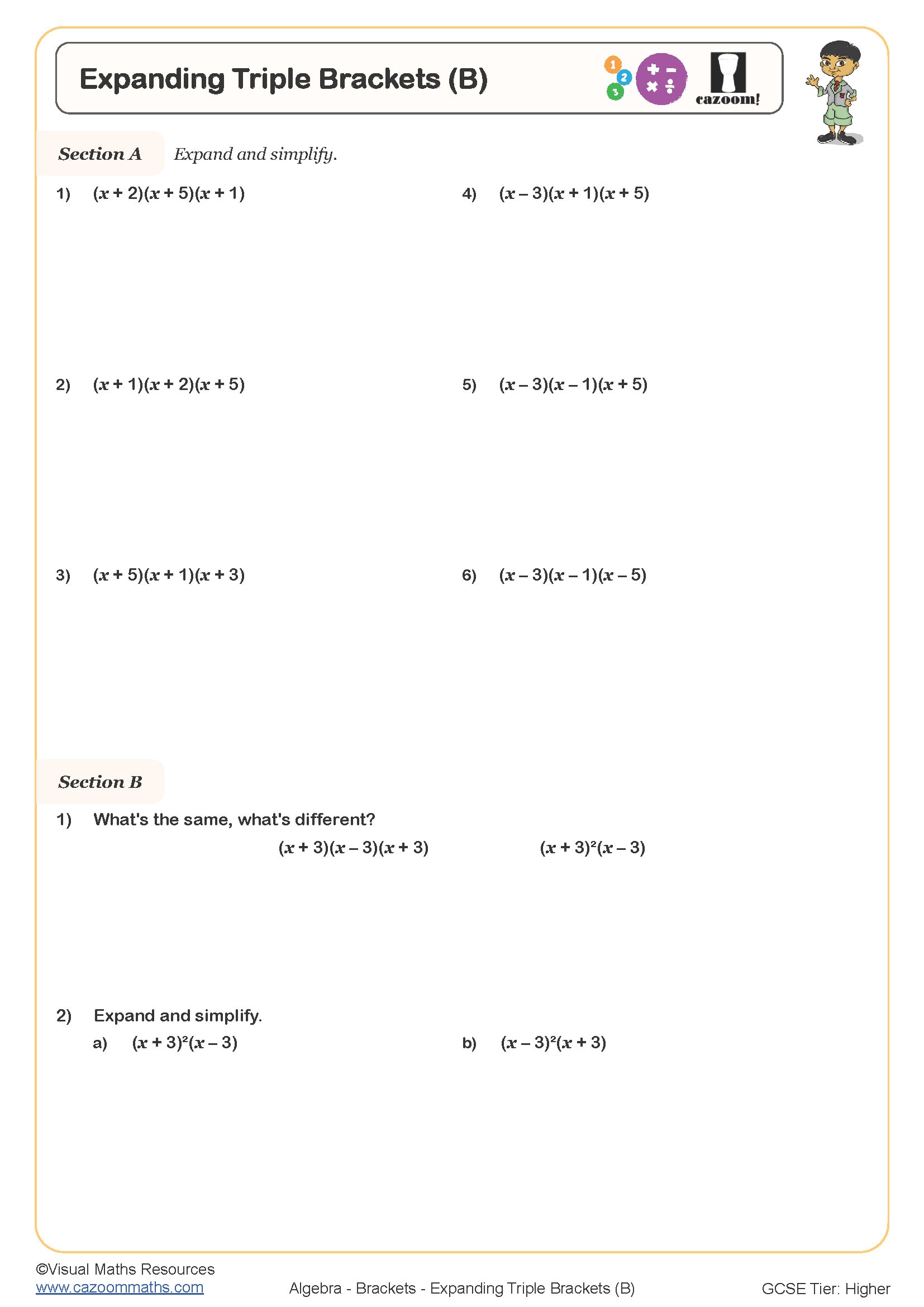
Expanding brackets worksheets typically cover single bracket expansion like 3(x + 4), double bracket multiplication such as (x + 2)(x - 3), and more challenging expressions involving indices and negative terms. At Year 11 level, these worksheets align with GCSE algebra requirements and often include expanding three brackets or expressions with fractional coefficients.
Teachers notice that students frequently struggle with the distributive property when negative signs are involved, often writing 2(x - 3) as 2x - 3 instead of 2x - 6. Quality expanding brackets questions progress systematically from basic examples to exam-style problems that require students to expand and then simplify expressions.
Which year groups should use expanding brackets worksheets?
Expanding brackets begins in Year 8 with simple single brackets, progresses through Years 9-10 with double brackets and quadratic expansion, and reaches its most complex form in Year 11 with three brackets and algebraic fractions. The algebraic foundation built in earlier years becomes crucial for GCSE success.
Year 11 students need extensive practice with expand double brackets worksheet content because this skill directly impacts their ability to solve quadratic equations, complete the square, and work with algebraic proof questions. Teachers find that students who haven't mastered basic bracket expansion in earlier years struggle significantly with Higher tier GCSE algebra papers.
How do students expand double brackets effectively?
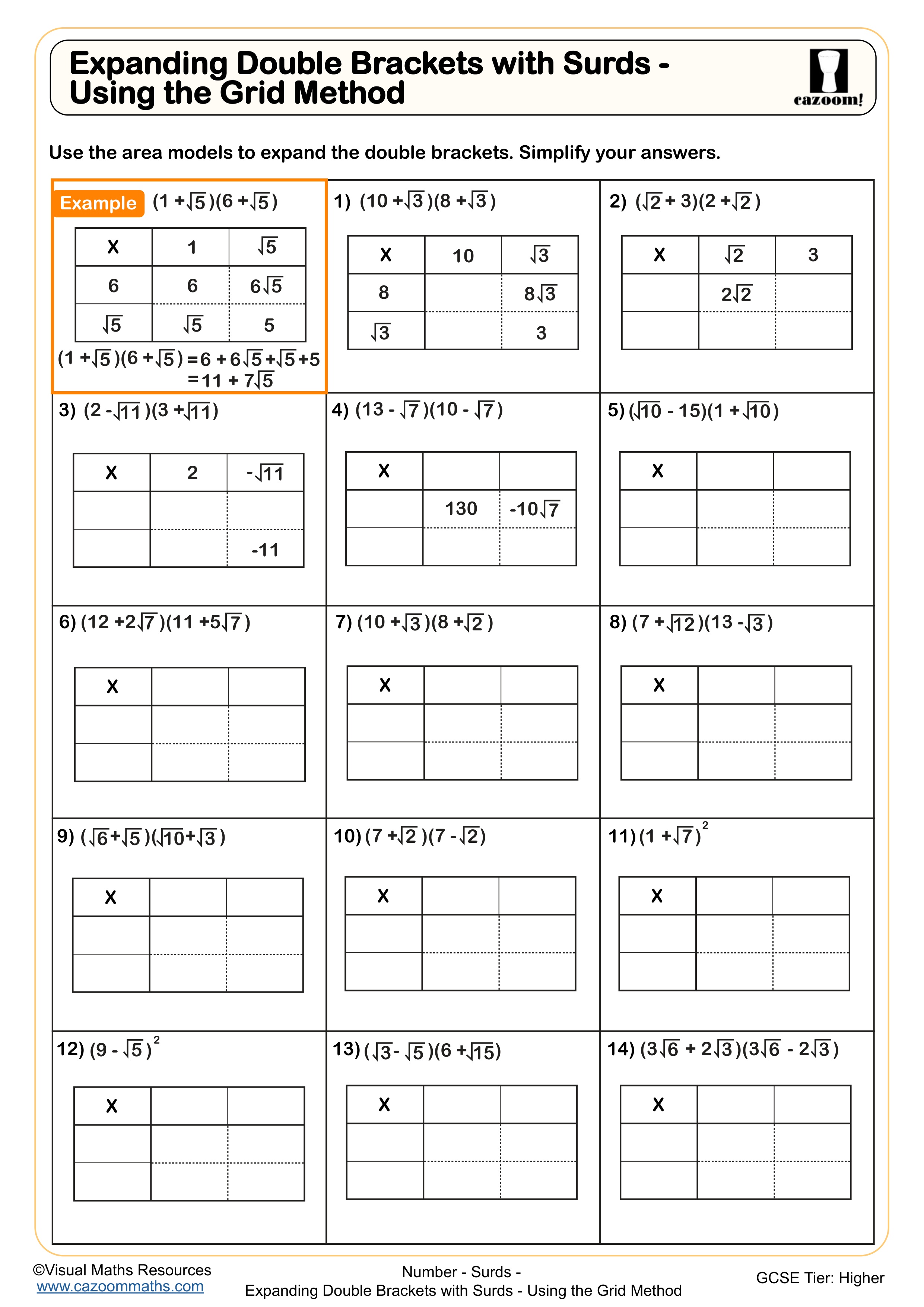
Double bracket expansion requires systematic application of the distributive property, where each term in the first bracket multiplies each term in the second bracket. The FOIL method (First, Outside, Inside, Last) provides a reliable structure, though teachers increasingly use the grid method as it reduces errors with complex expressions.
A common misconception occurs when students attempt shortcuts like (x + 3)² = x² + 9, missing the middle term entirely. Quality expand brackets worksheet materials emphasise that (x + 3)² = (x + 3)(x + 3) = x² + 6x + 9, helping students recognise that squaring a binomial always produces three terms unless the middle term cancels.
How should teachers use algebra expanding brackets worksheets effectively?
Effective use involves starting with diagnostic questions to identify gaps, then providing targeted practice that builds systematically from single to double brackets. Teachers should model the expansion process explicitly, emphasising the underlying mathematical reasoning rather than just procedural steps.
Structured worksheets work best when combined with peer discussion and error analysis activities. Teachers report success when students work through incorrect examples, explaining why common mistakes occur and how to avoid them. Regular low-stakes practice using these worksheets helps maintain fluency while building towards more complex algebraic manipulation required in mechanics and further mathematics.