Year 11 Functions Worksheets
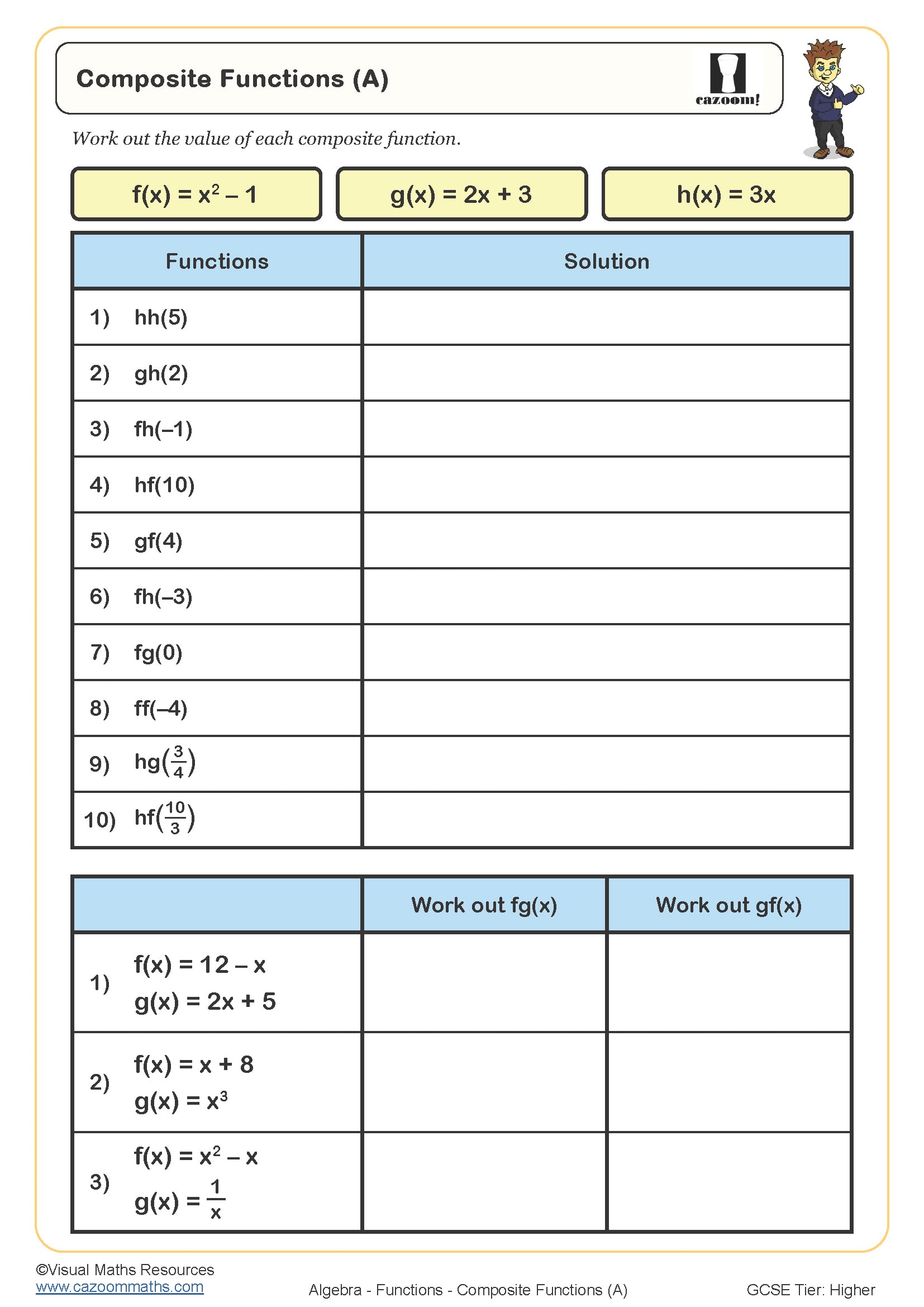
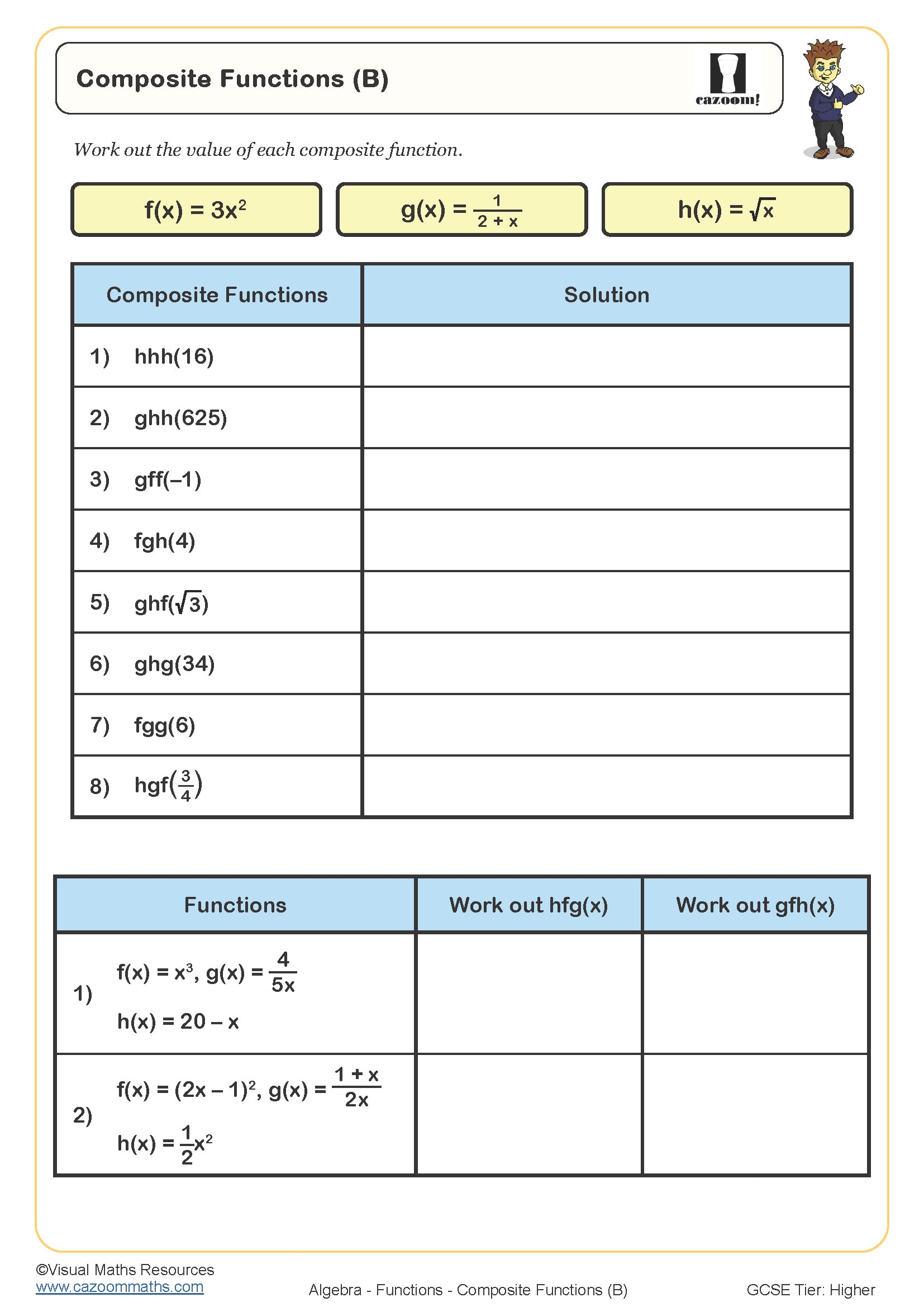
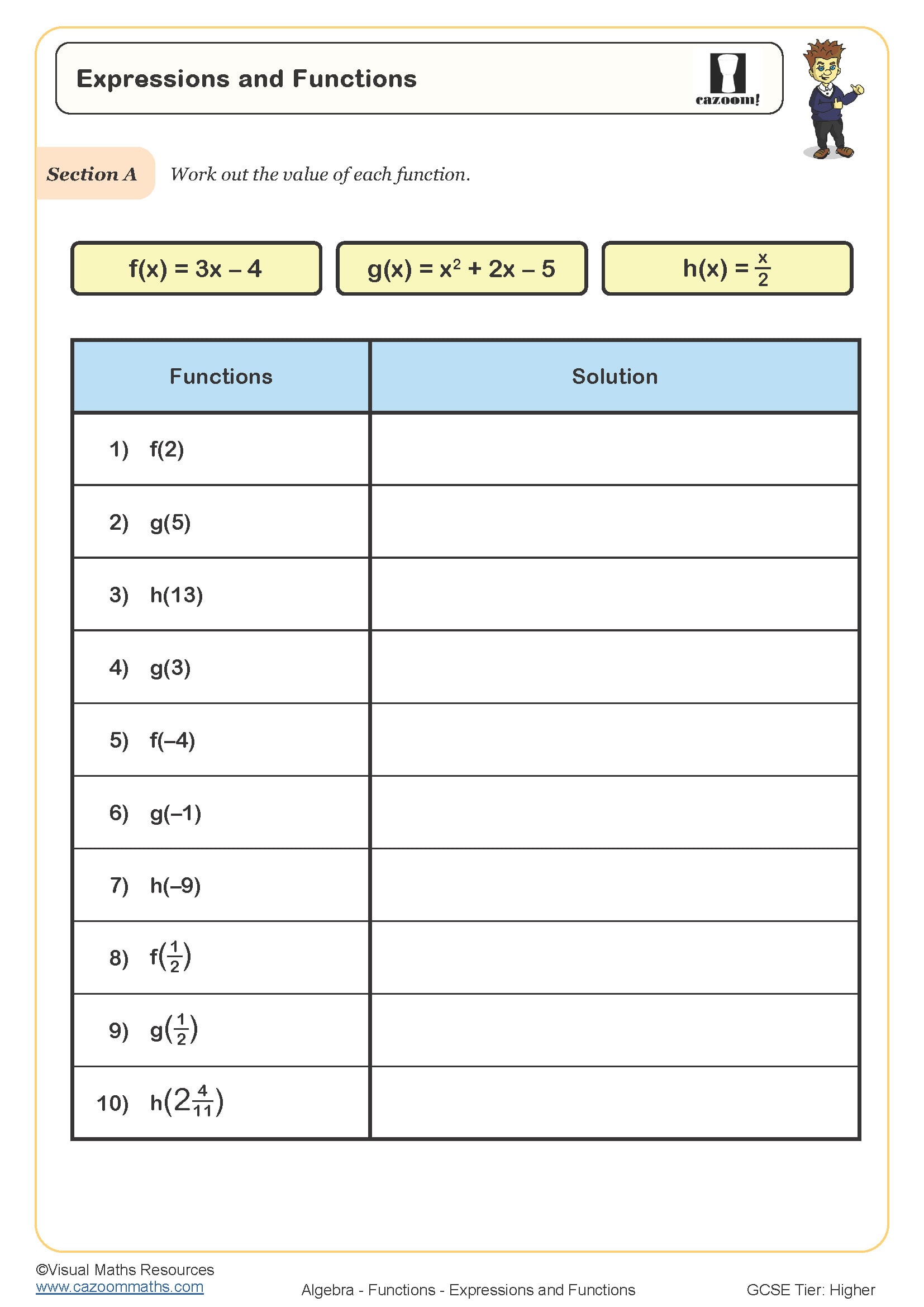
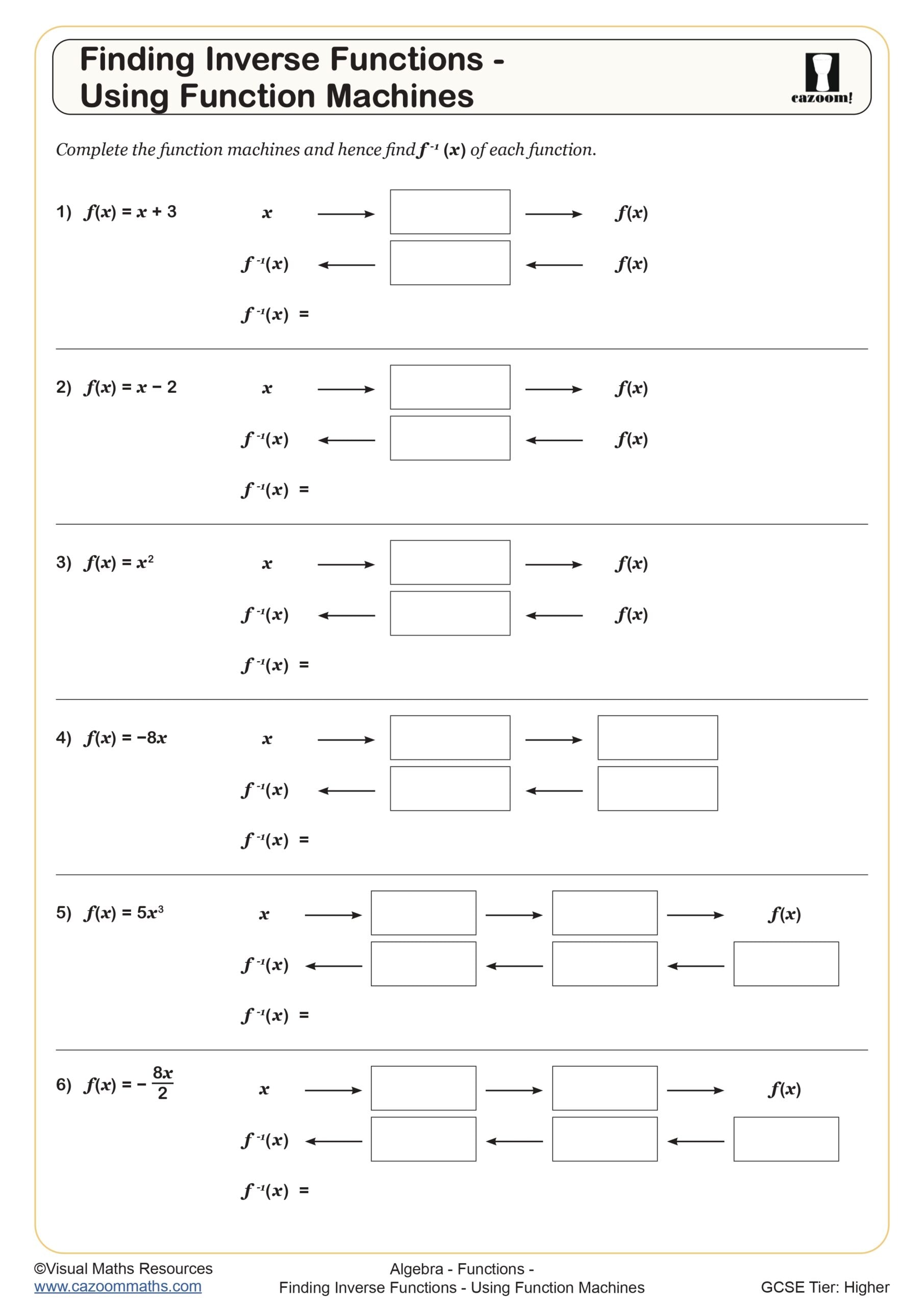
All worksheets are created by the team of experienced teachers at Cazoom Maths.
What topics are covered in a functions worksheet for GCSE students?
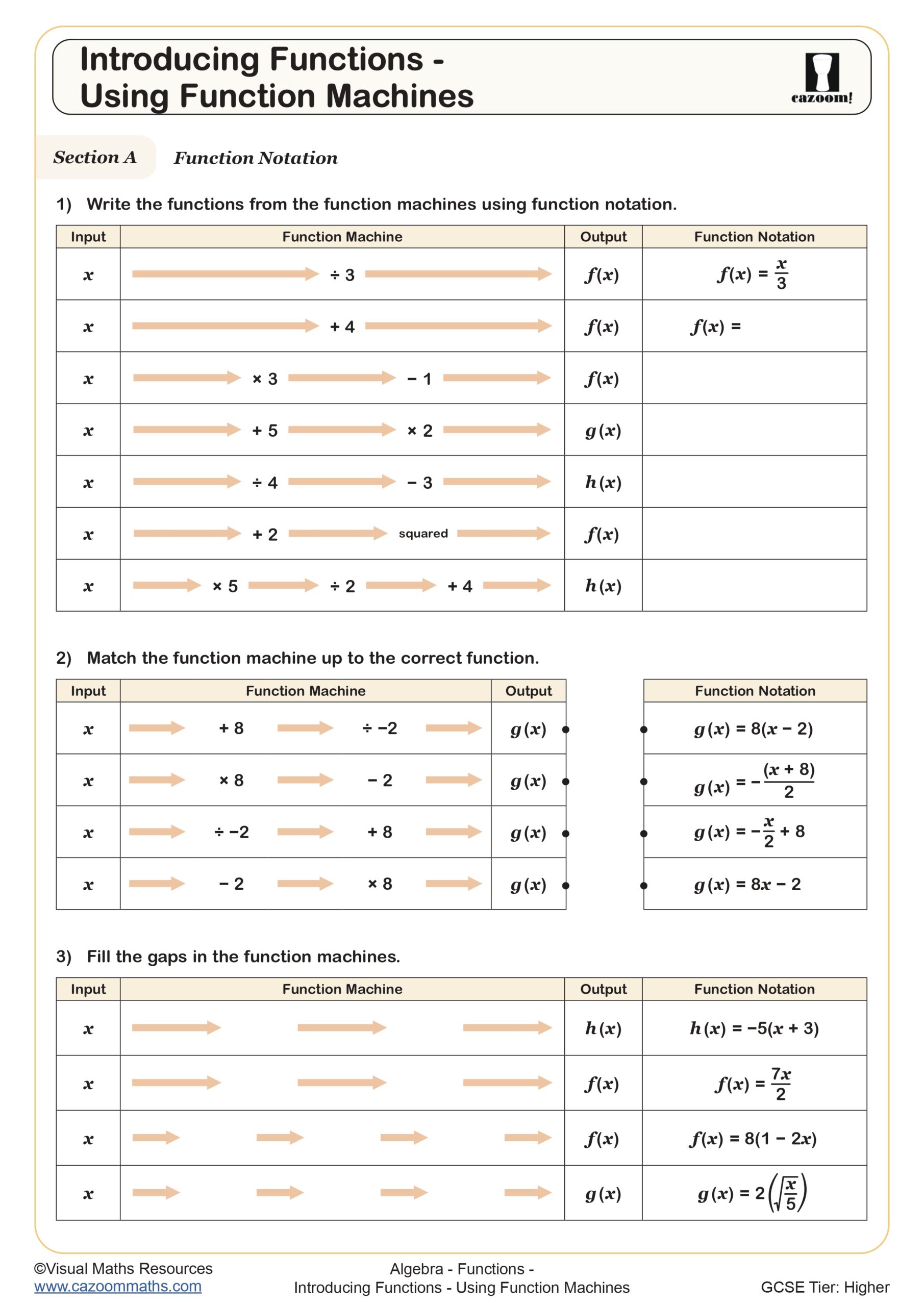
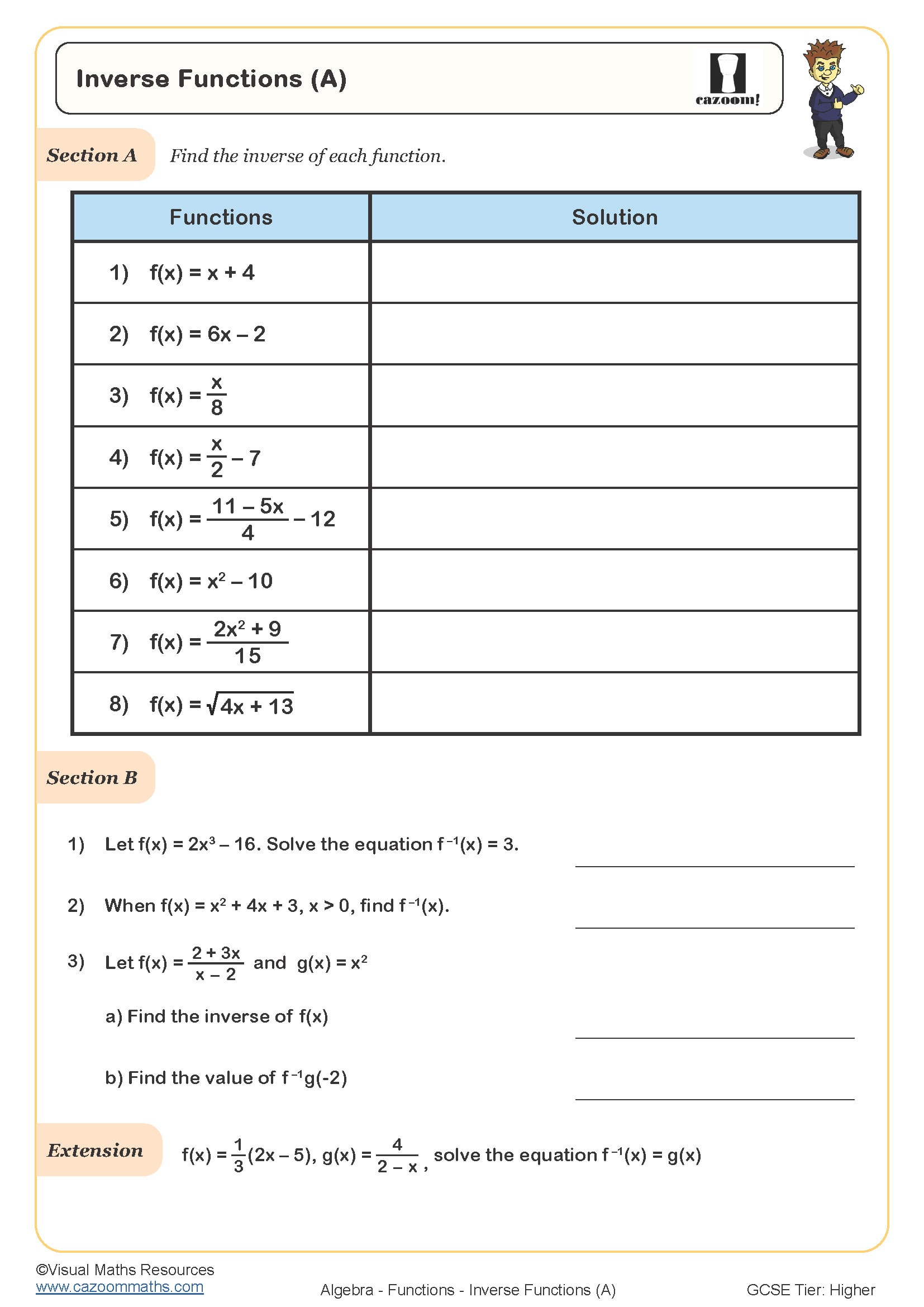
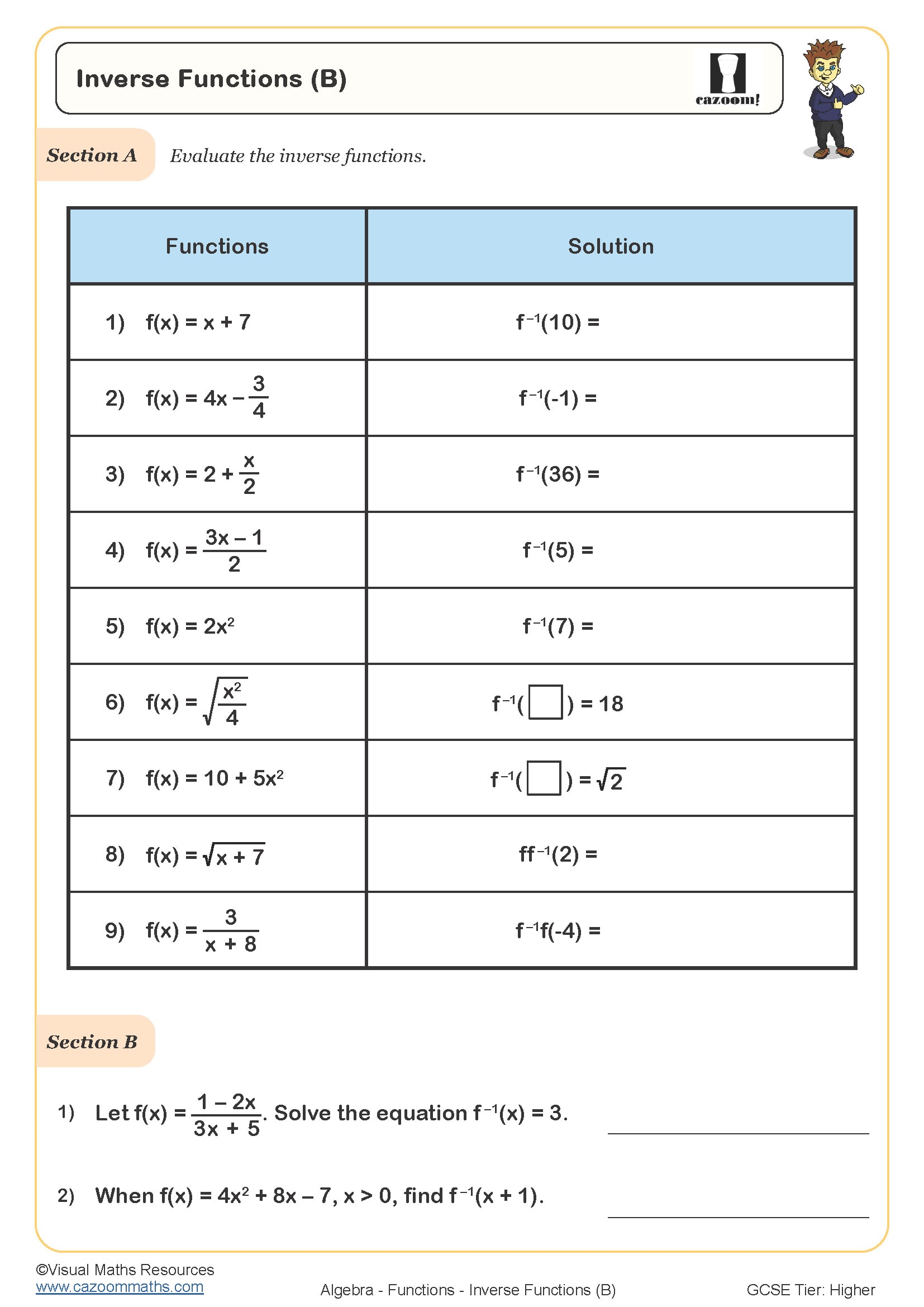
A thorough functions worksheet typically covers function notation f(x), evaluating functions for given values, finding composite functions like f(g(x)), and determining inverse functions. Students also practise identifying domains and ranges, working with one-to-one and many-to-one mappings, and solving equations involving functions.
Teachers frequently notice that students confuse the notation for composite functions, writing f(g(x)) when they mean (f ∘ g)(x), or incorrectly assuming that fg(x) means the same as f(g(x)). Regular practice with function worksheets helps students distinguish between these different notations and understand that function composition requires careful attention to the order of operations.
Why do students study functions in Year 11 rather than earlier key stages?
Functions require a solid foundation in algebraic manipulation and abstract thinking that typically develops during Key Stage 4. Year 11 students have the mathematical maturity to understand that functions represent relationships between variables, not just equations to solve. The topic builds on earlier work with linear and quadratic expressions while introducing more sophisticated concepts.
The timing aligns with Year 11 functions curricula internationally, allowing students to develop conceptual understanding before tackling more advanced topics like calculus. Teachers find that introducing function notation too early can create confusion, as students need experience with algebraic substitution and the ability to think about variables as placeholders rather than unknown numbers to find.
How should students approach composite and inverse functions problems?
When working with composite functions, students should start by identifying the inner function and evaluating it first, then applying the outer function to that result. For inverse functions, they need to understand that f⁻¹(f(x)) = x and use algebraic methods like swapping x and y variables, then solving for y.
A common error teachers observe is students attempting to find inverses by simply reciprocating the function, writing f⁻¹(x) = 1/f(x). This misconception stems from confusion with negative indices. Effective practice involves checking inverse functions by composition, demonstrating that f(f⁻¹(x)) = x, which helps students verify their algebraic work and understand the fundamental relationship between a function and its inverse.
What makes functions worksheet with answers effective for independent study?
Answer sheets allow students to check their working immediately and identify specific areas where they need additional support. Functions worksheets with complete solutions help students understand the step-by-step process for evaluating composite functions and finding inverses, which is particularly valuable for this abstract topic.
Teachers recommend that students attempt all questions before consulting the answers, then use the solutions to identify where their method differs from the expected approach. The immediate feedback helps students recognise whether they're making procedural errors or conceptual mistakes, allowing them to focus their revision efforts on the specific aspects of function manipulation that require more practice.