Year 7 Sequences Worksheets
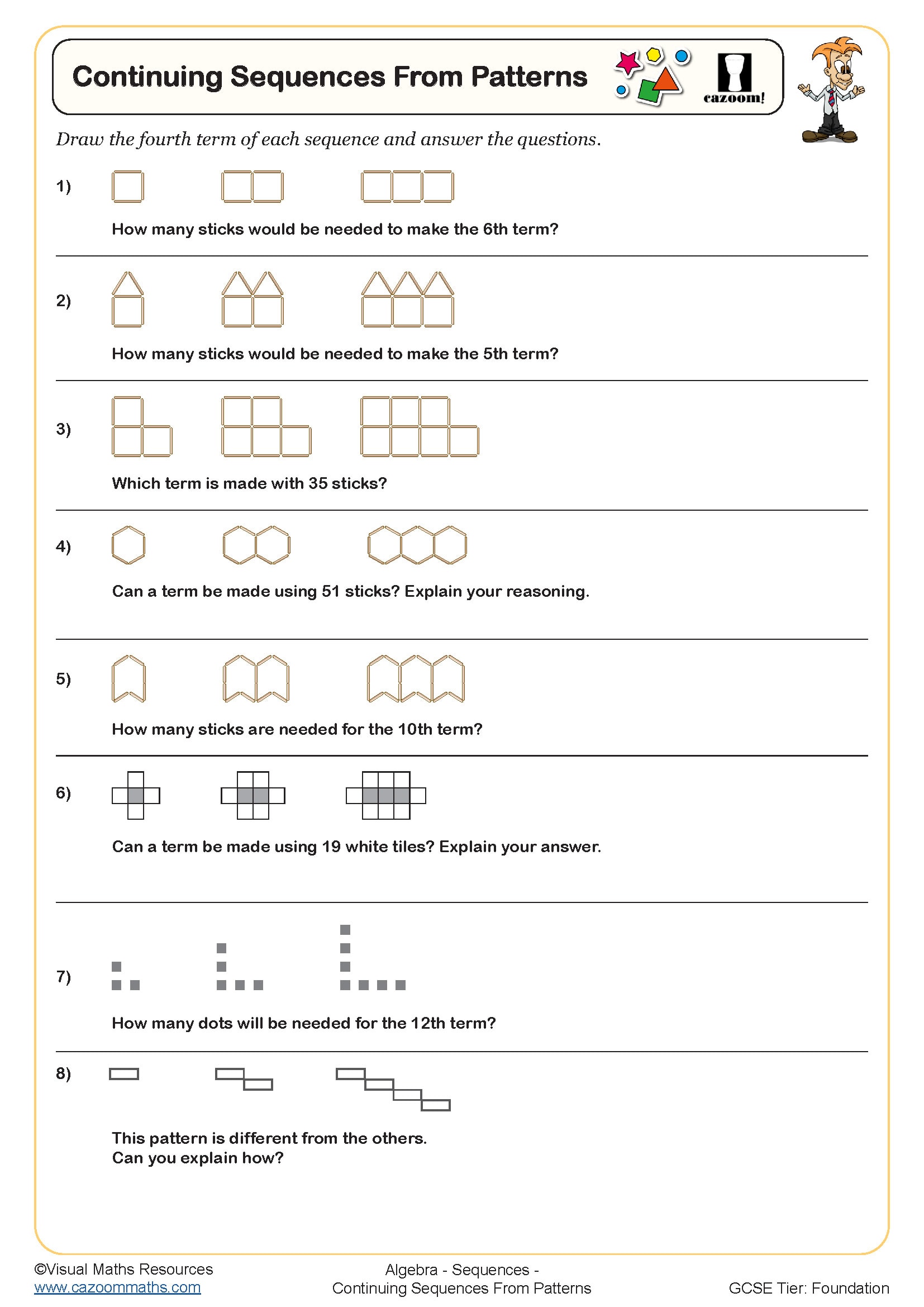
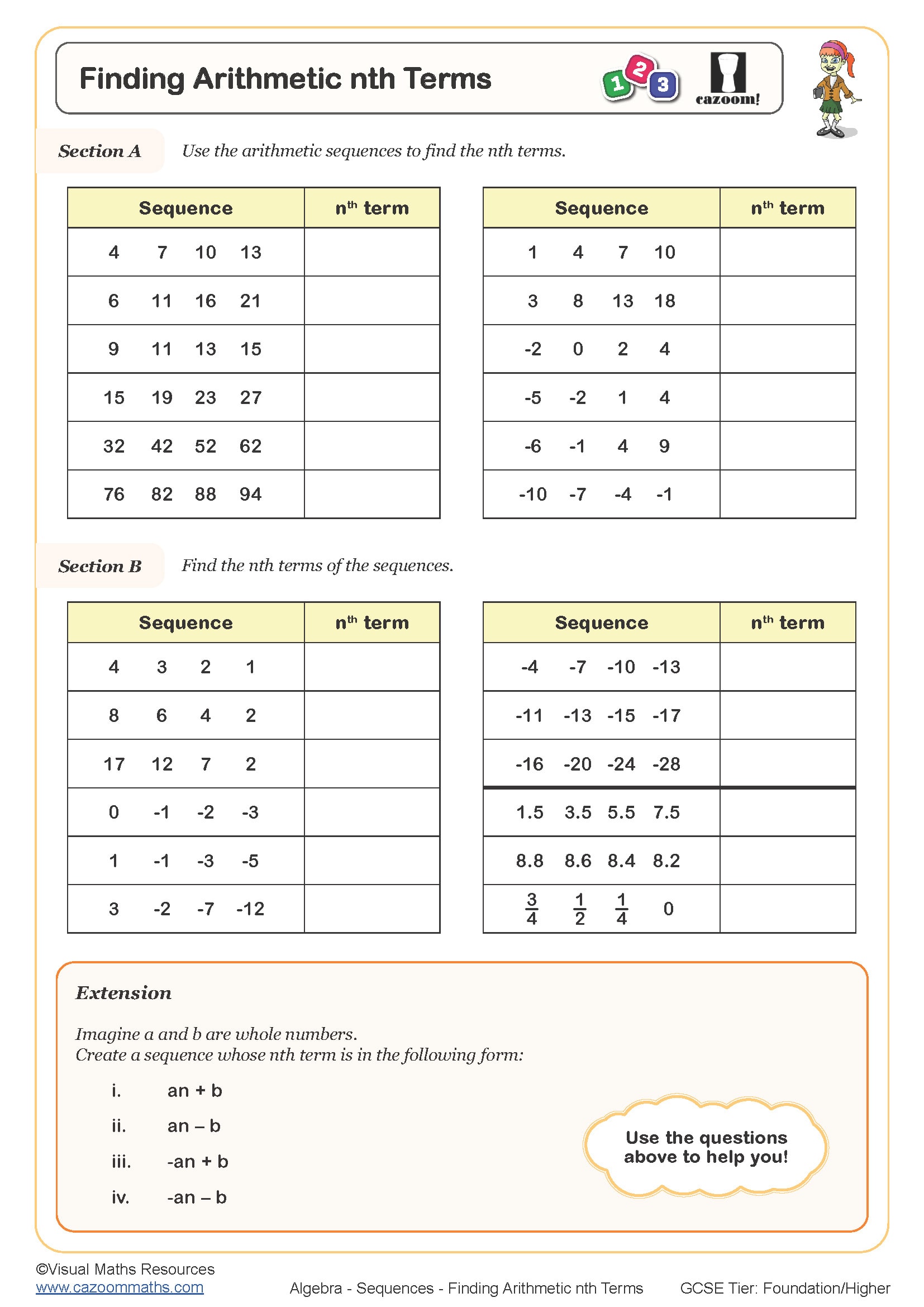
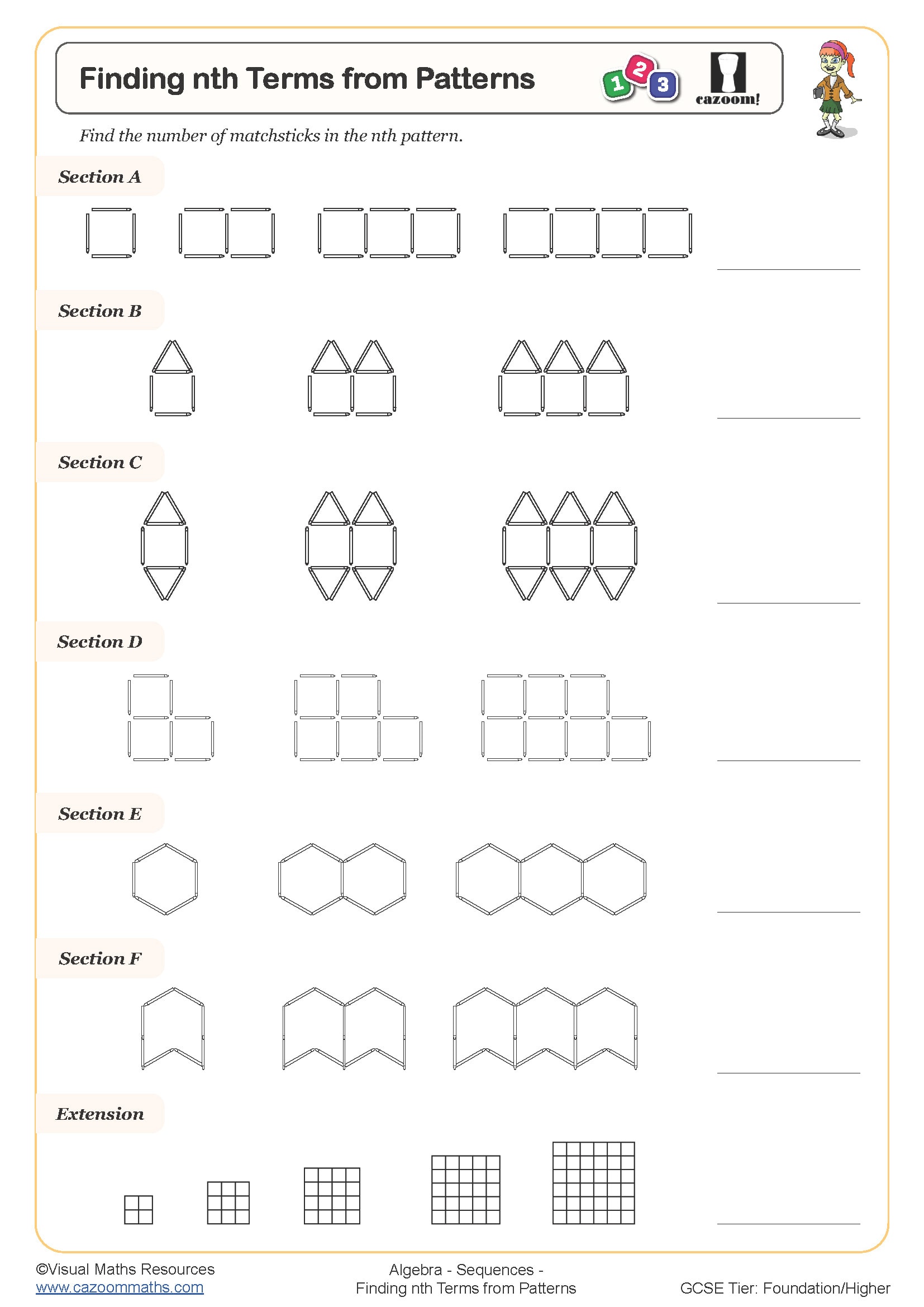
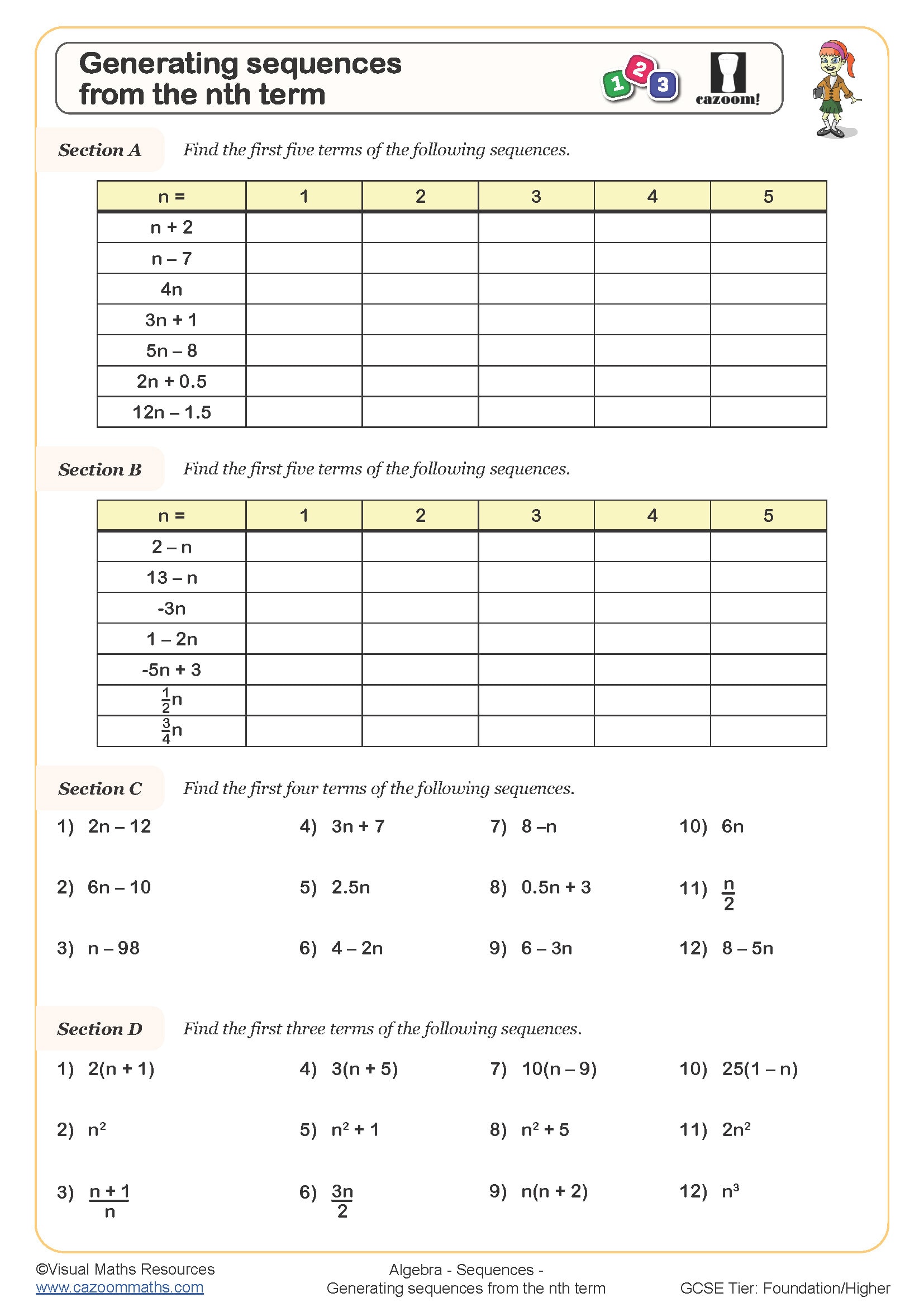
All worksheets are created by the team of experienced teachers at Cazoom Maths.
What makes an effective sequence worksheet for Year 7 students?
An effective sequence year 7 worksheet balances visual pattern recognition with algebraic expression, starting with concrete number sequences before moving to abstract nth term formulas. Year 7 students need exposure to arithmetic sequences, basic geometric patterns, and simple quadratic sequences like triangular numbers to build confidence with pattern spotting. Teachers notice that the most successful worksheets include sequences presented in different formats - tables, diagrams, and number lists - to help students recognise that the same mathematical relationship can appear in various forms.
The key progression involves moving from continuing sequences to finding missing terms, then developing position-to-term rules. Students often make errors when sequences don't start from the first term, so effective worksheets include sequences beginning from different positions to challenge this misconception early in their learning.
How do Year 7 sequence topics connect to other year groups?
Sequences and functions work in Year 7 builds directly on the number patterns explored in upper Key Stage 2, where students worked with multiplication tables and simple repeating patterns. The algebraic thinking introduced through sequences provides valuable groundwork for Year 8 linear graphs and Year 9 quadratic sequences, making this topic a crucial bridge between arithmetic and algebra.
Teachers find that students who master basic sequence work in Year 7 demonstrate stronger algebraic manipulation skills later on. The pattern recognition and formula development practised with sequences directly supports function notation and coordinate geometry introduced in subsequent years, particularly when students encounter y = mx + c and quadratic graphs.
What are triangular sequences and why do students find them challenging?
Triangular sequences (1, 3, 6, 10, 15...) represent the number of dots needed to form triangular patterns, where each term adds one more row to the triangle. Students often struggle with triangular sequences because the differences between terms aren't constant, making the nth term formula more complex than simple arithmetic sequences they've encountered previously.
Teachers observe that visual representations help significantly with triangular sequence understanding. When students can see the actual triangular arrangements of dots or objects, they grasp why the sequence grows in this particular way. The nth term formula n(n+1)/2 emerges more naturally when students understand the geometric reasoning behind the pattern, rather than trying to memorise an abstract formula.
How can teachers use these worksheets most effectively in lessons?
Teachers find that starting lessons with visual patterns engages students before introducing algebraic notation, using real objects or drawings to demonstrate sequence growth. The worksheet format works well for both individual practice and paired work, where students can discuss their pattern-spotting strategies and check each other's nth term expressions against the provided answer sheets.
Differentiation becomes straightforward when teachers can select specific worksheet sections for different ability groups. Lower-attaining students benefit from continuing number sequences and finding missing terms, while higher-attaining students can tackle finding nth terms and working backwards from given terms. The PDF format allows teachers to project selected questions for whole-class discussion, particularly when addressing common misconceptions about sequence notation.