Year 9 Indices Worksheets
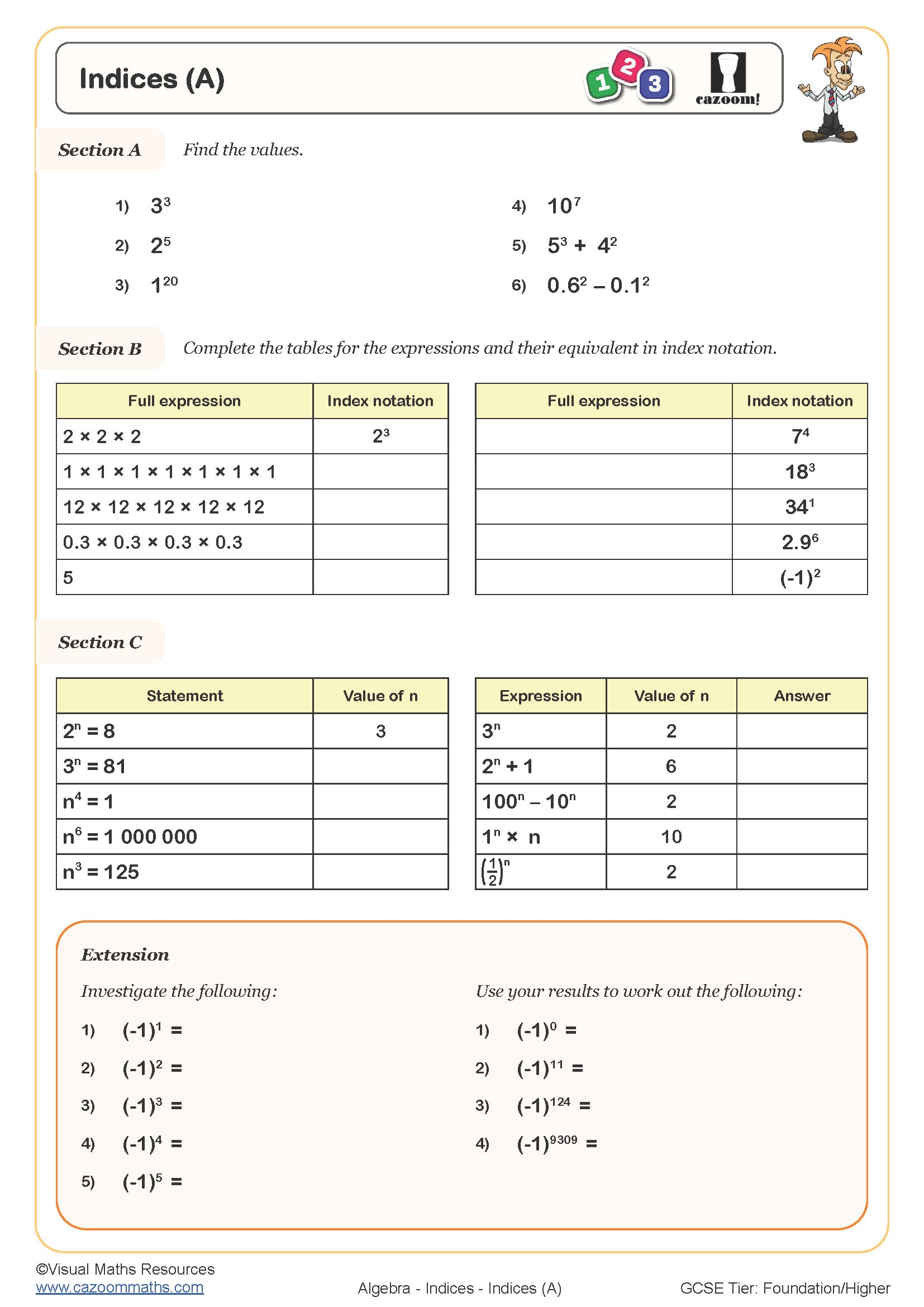
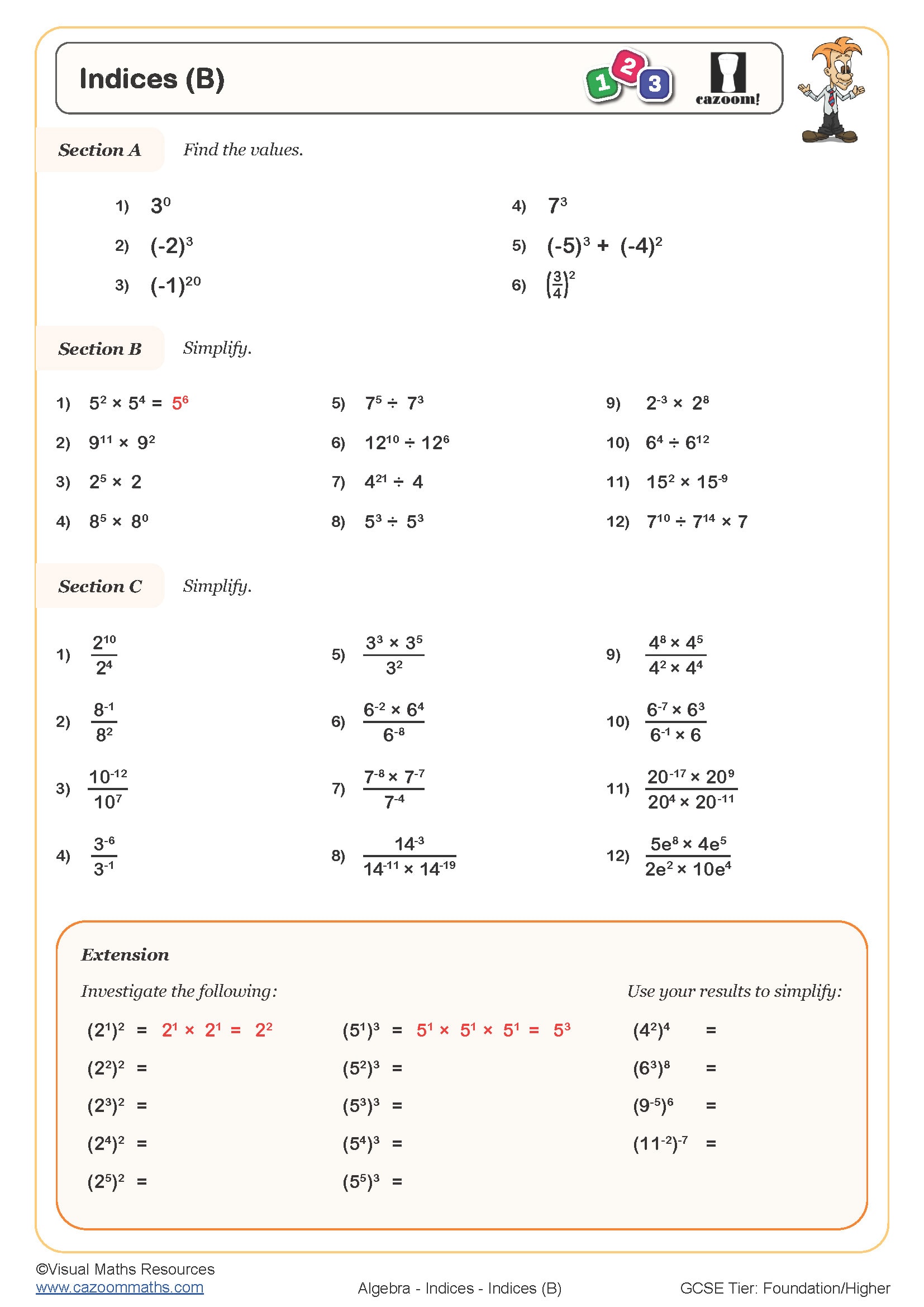
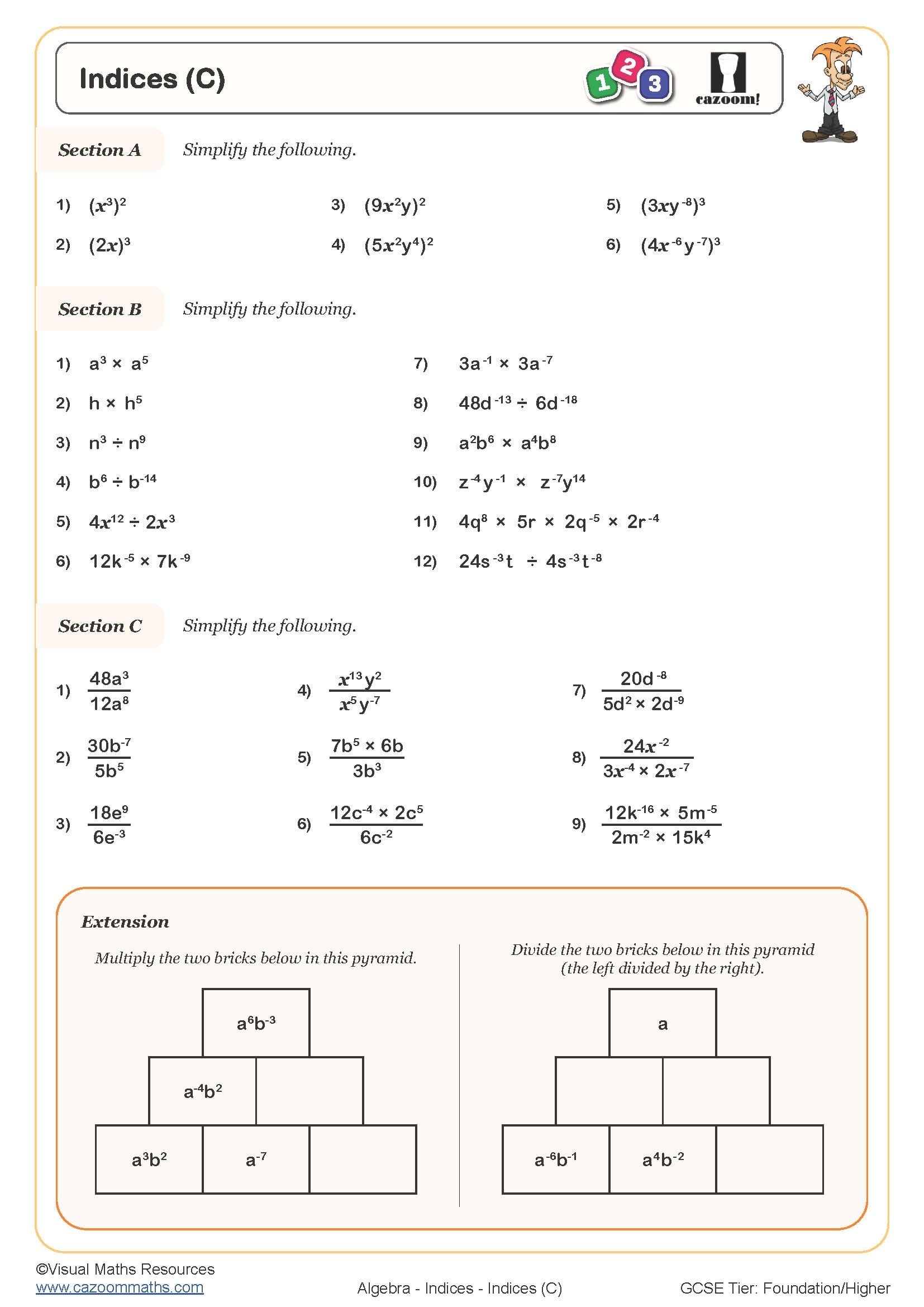
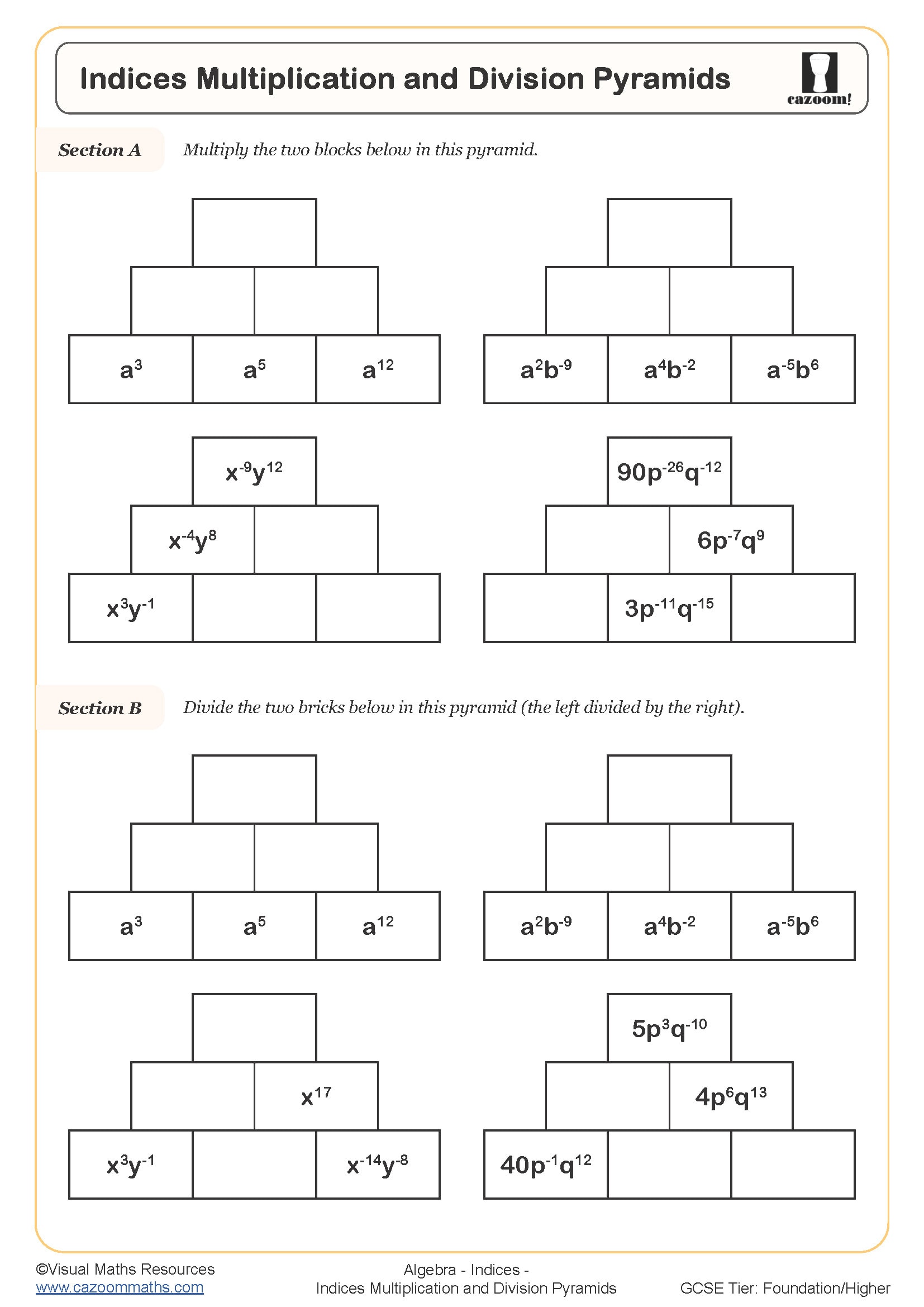
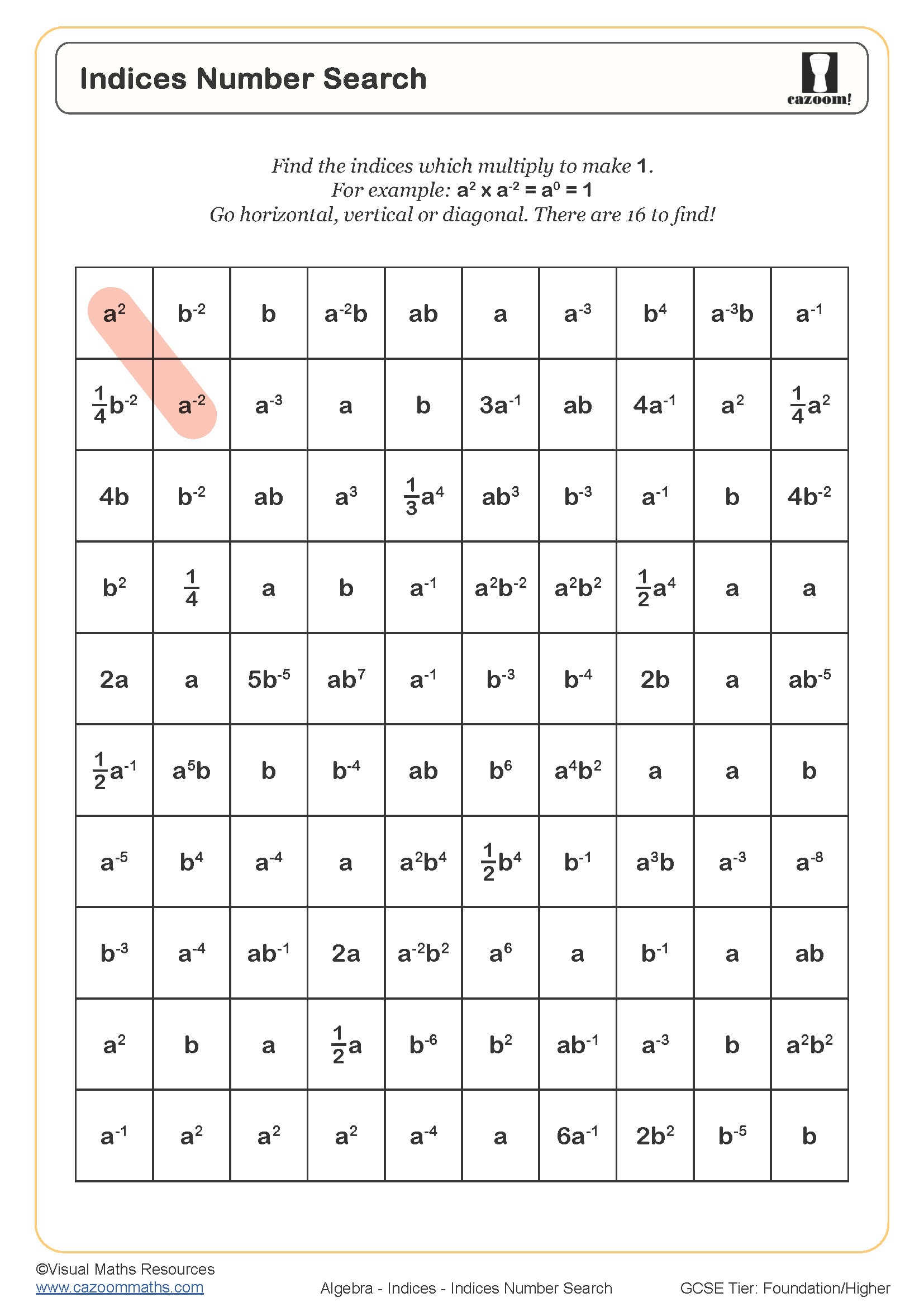
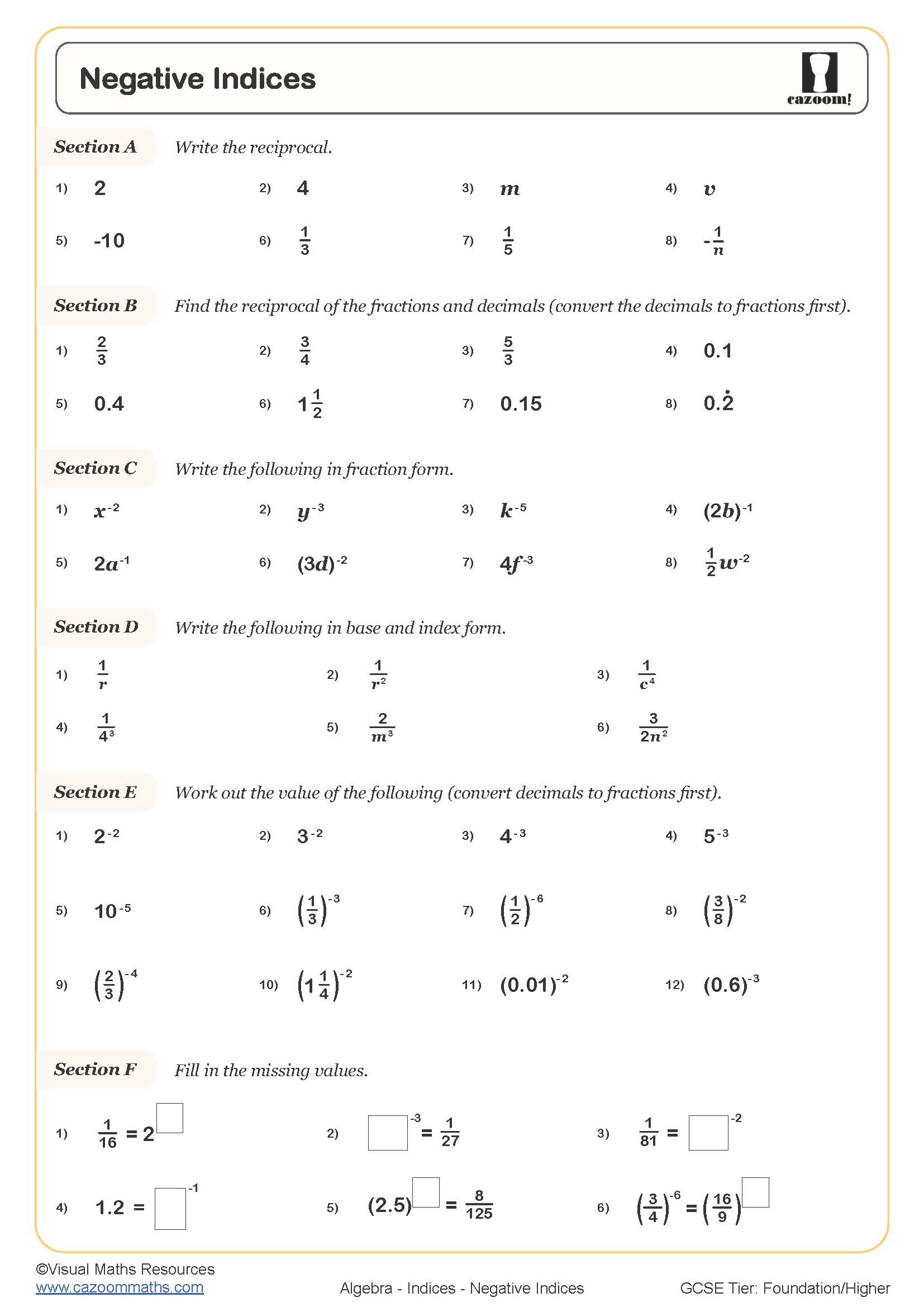
All worksheets are created by the team of experienced teachers at Cazoom Maths.
What makes a good year 9 indices worksheet for covering all index laws?
A thorough indices year 9 worksheet should cover the five main index laws systematically: multiplication (adding powers), division (subtracting powers), power of a power (multiplying indices), negative indices, and zero indices. The worksheet needs to progress from basic numerical examples to algebraic expressions, ensuring students can apply each law confidently.
Teachers find that students often confuse the multiplication and addition rules, writing 2³ × 2² = 2⁶ instead of 2⁵. Quality year 9 index laws worksheet materials address this by including mixed practice questions that require students to identify which law applies before calculating, preventing automatic responses that lead to errors.
Which year groups should use indices worksheets and how do they progress?
Index laws are typically introduced in Year 8 with basic positive integer indices, then expanded in Year 9 to include negative and fractional indices. Year 9 students need solid practice with all five index laws before progressing to more complex algebraic manipulation in Year 10 and GCSE preparation.
The progression moves from simple numerical calculations like 3² × 3³ to algebraic expressions such as x⁴ ÷ x⁻² = x⁶. Teachers observe that students who haven't mastered these foundations struggle significantly with quadratic equations and exponential functions later in their mathematical journey, making thorough Year 9 practice key.
How should students approach negative indices in their worksheet practice?
Negative indices represent reciprocals, where x⁻ⁿ = 1/xⁿ. Students should first practise converting between negative index form and fraction form using simple numbers before moving to algebraic expressions. Understanding that x⁻³ means 1/x³ rather than 'negative x cubed' prevents fundamental errors.
A common mistake teachers encounter is students writing 2⁻³ = -8 instead of 1/8. Quality index law worksheet materials include conversion exercises that help students visualise this relationship, often using examples like 10⁻² = 1/100 = 0.01 to connect with their understanding of decimal notation and place value from earlier years.
How can teachers use these worksheets most effectively in their lessons?
These worksheets work best when used after demonstrating each index law separately, allowing students to practise one rule before combining them. Teachers should encourage students to write out the rule they're using for each question initially, building automaticity gradually rather than rushing to mental calculation.
The answer sheets enable teachers to set up peer marking sessions where students explain their working to partners, helping identify misconceptions quickly. Many teachers find that dedicating time to discussing common errors from the worksheets prevents these mistakes becoming embedded, particularly the frequent confusion between x² × x³ = x⁵ and (x²)³ = x⁶.