Equivalent Fractions Worksheets
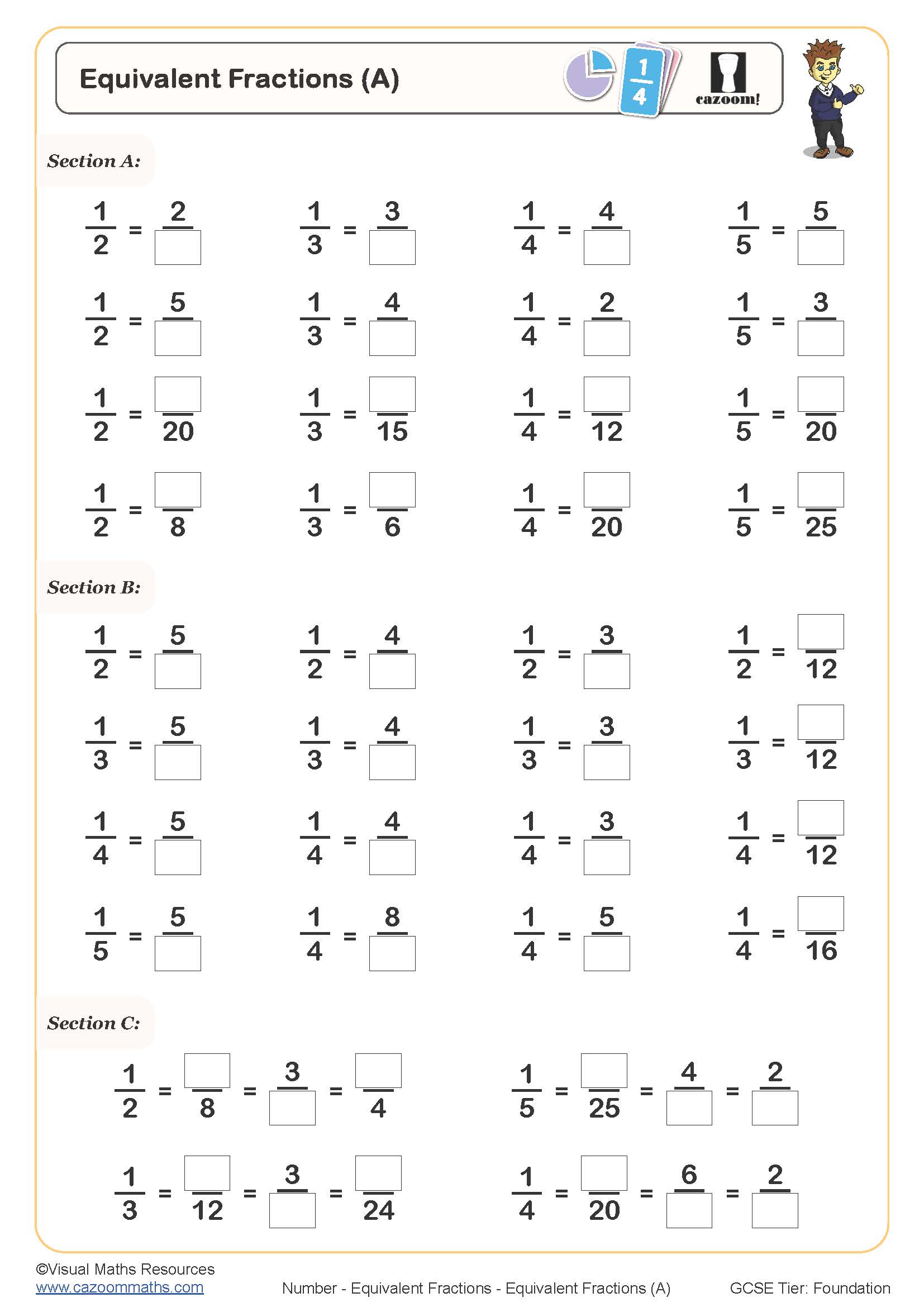
Equivalent Fractions (A)
Year groups: 7, 8
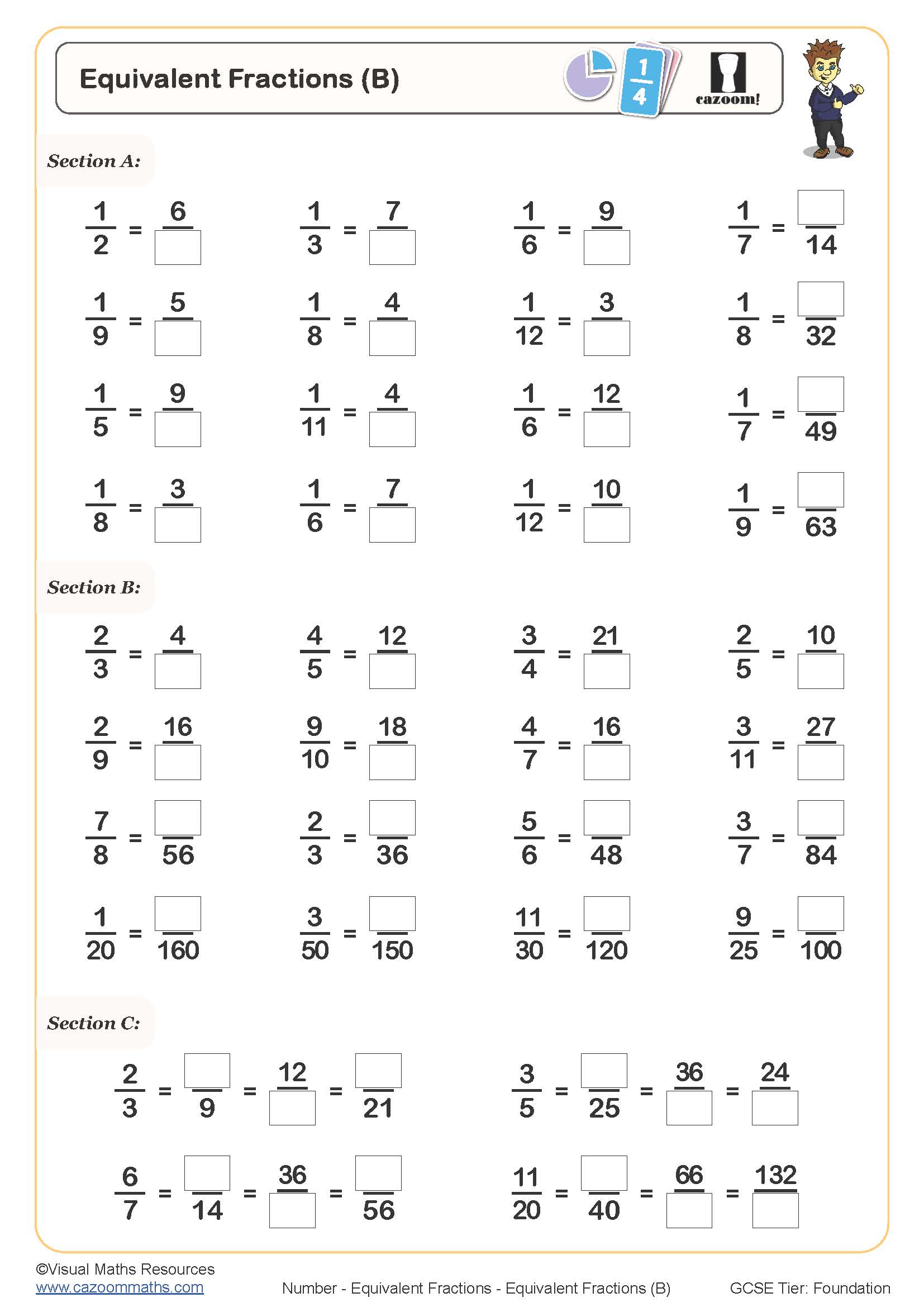
Equivalent Fractions (B)
Year groups: 7, 8
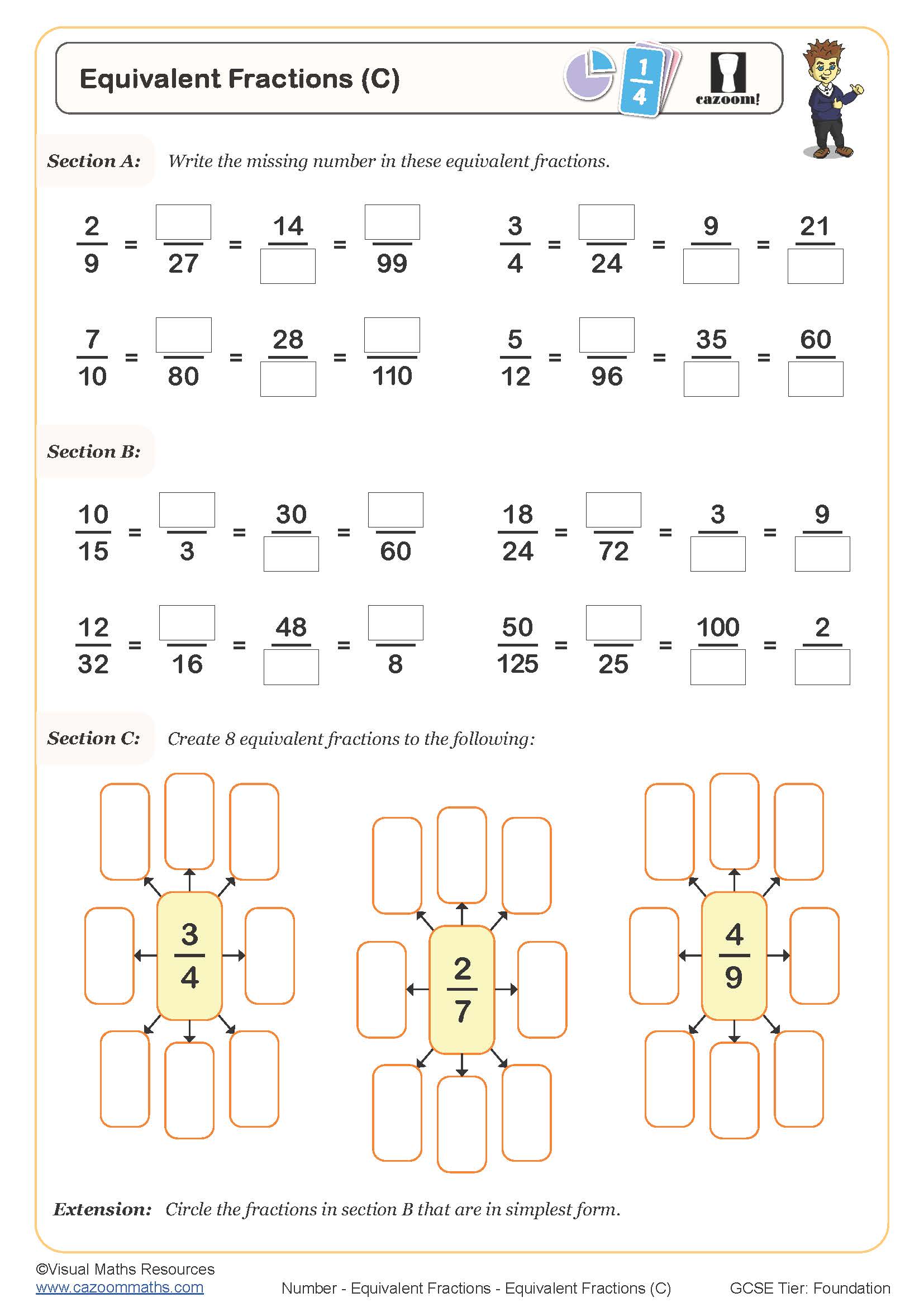
Equivalent Fractions (C)
Year groups: 7, 8, 9
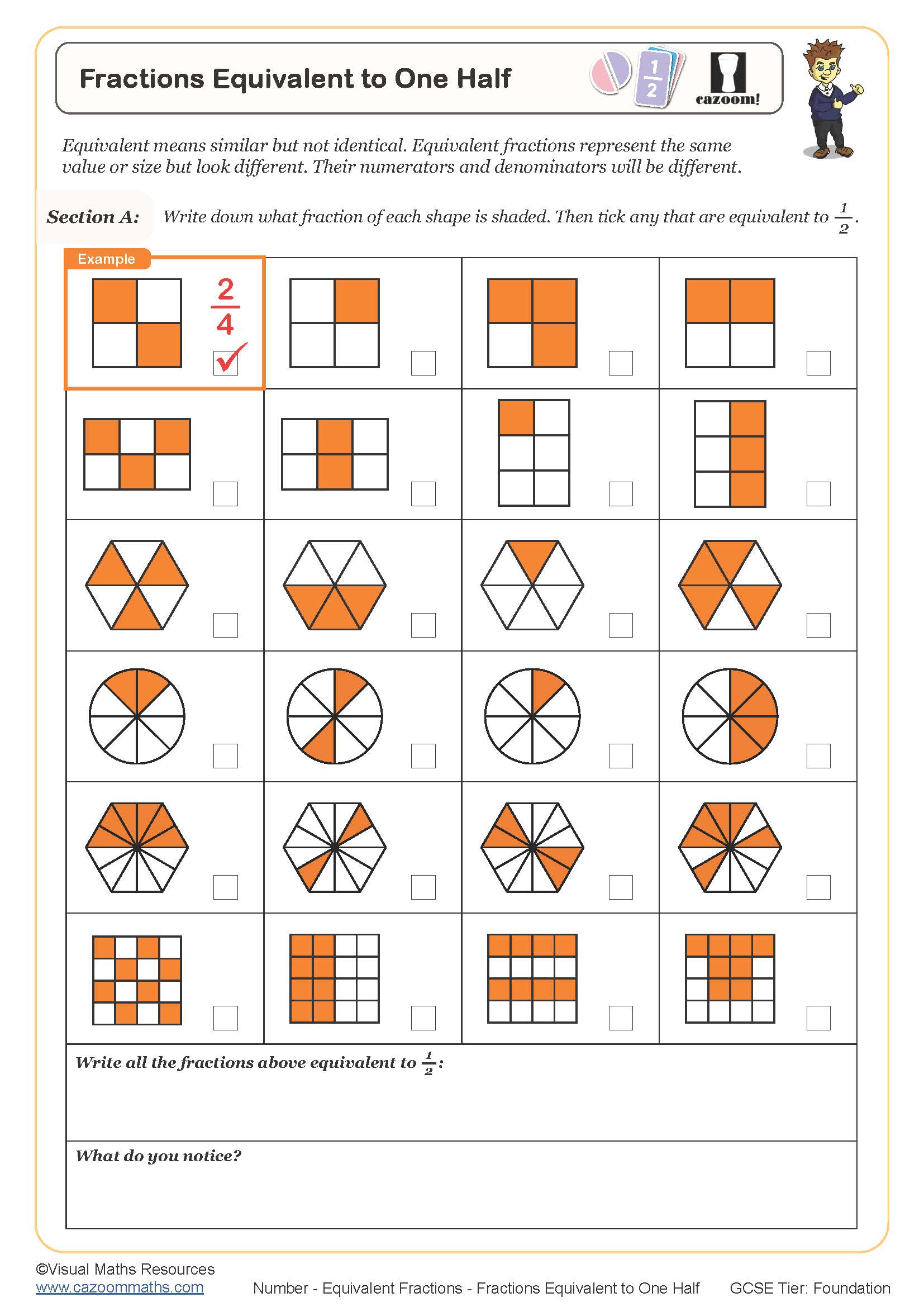
Fractions Equivalent to One Half
Year groups: 7, 8
Fractions Equivalent to One Quarter
Year groups: 7, 8
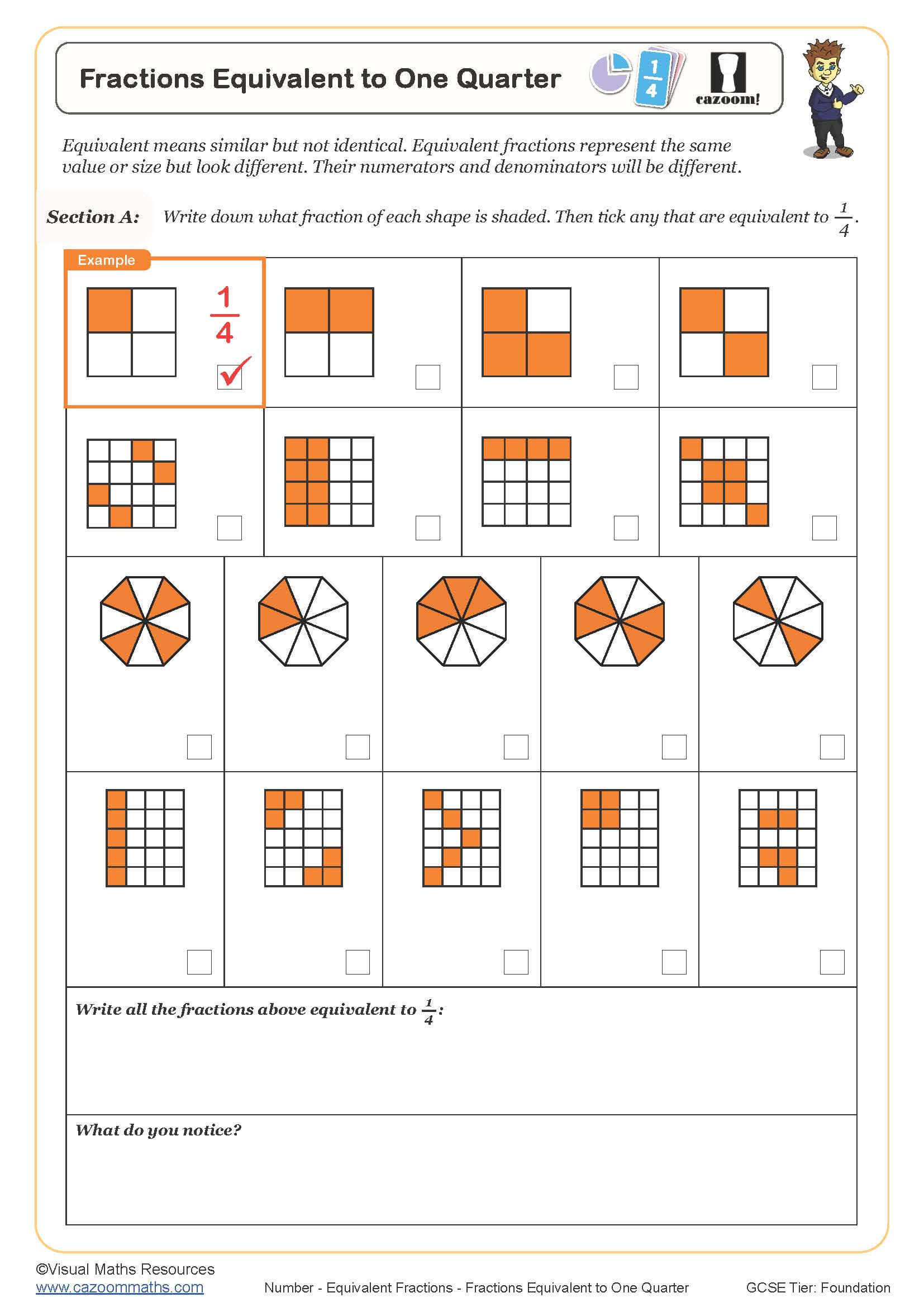
Fractions Equivalent to One Third
Year groups: 7, 8
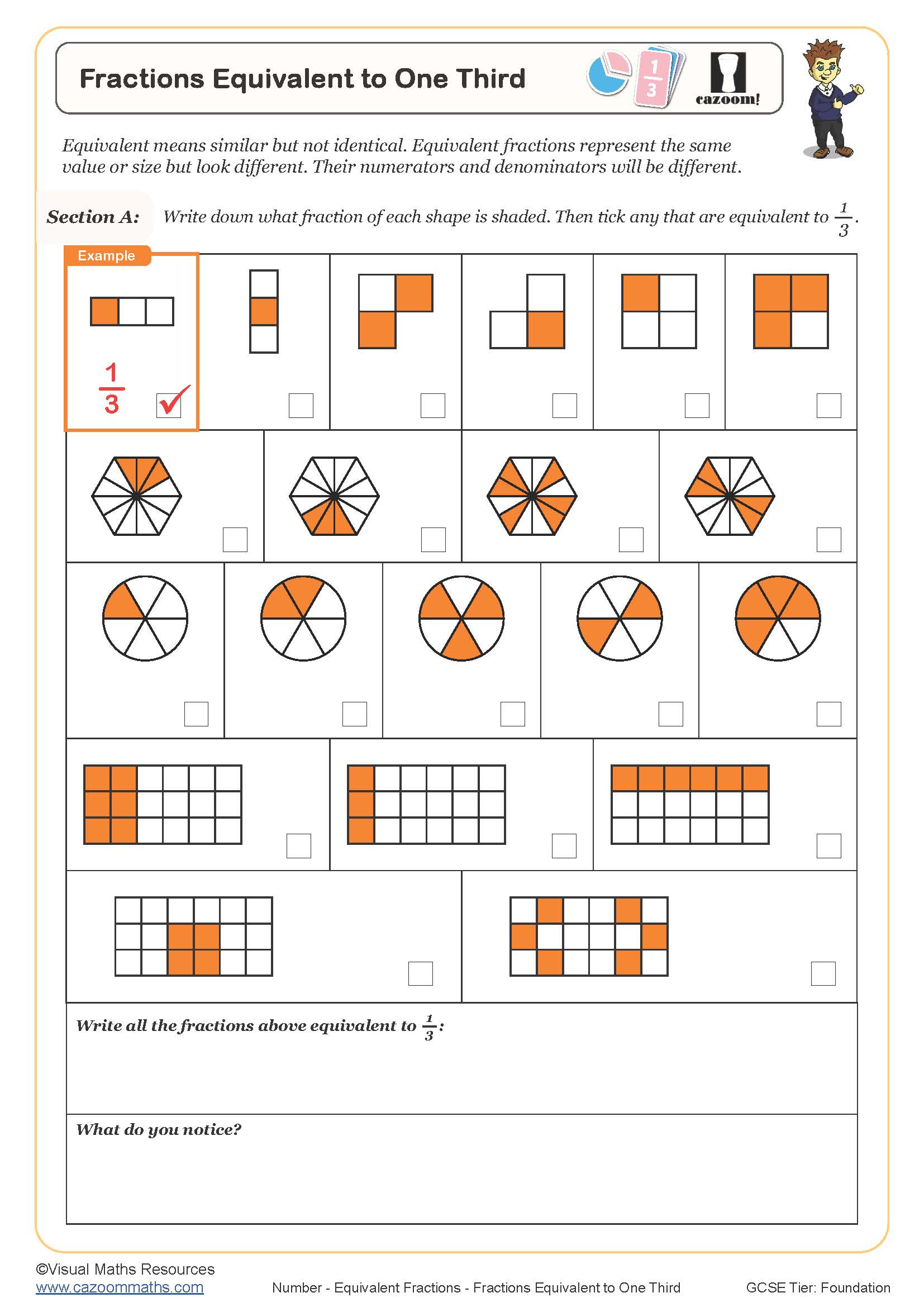
Identifying Equivalent Fractions
Year groups: 7, 8
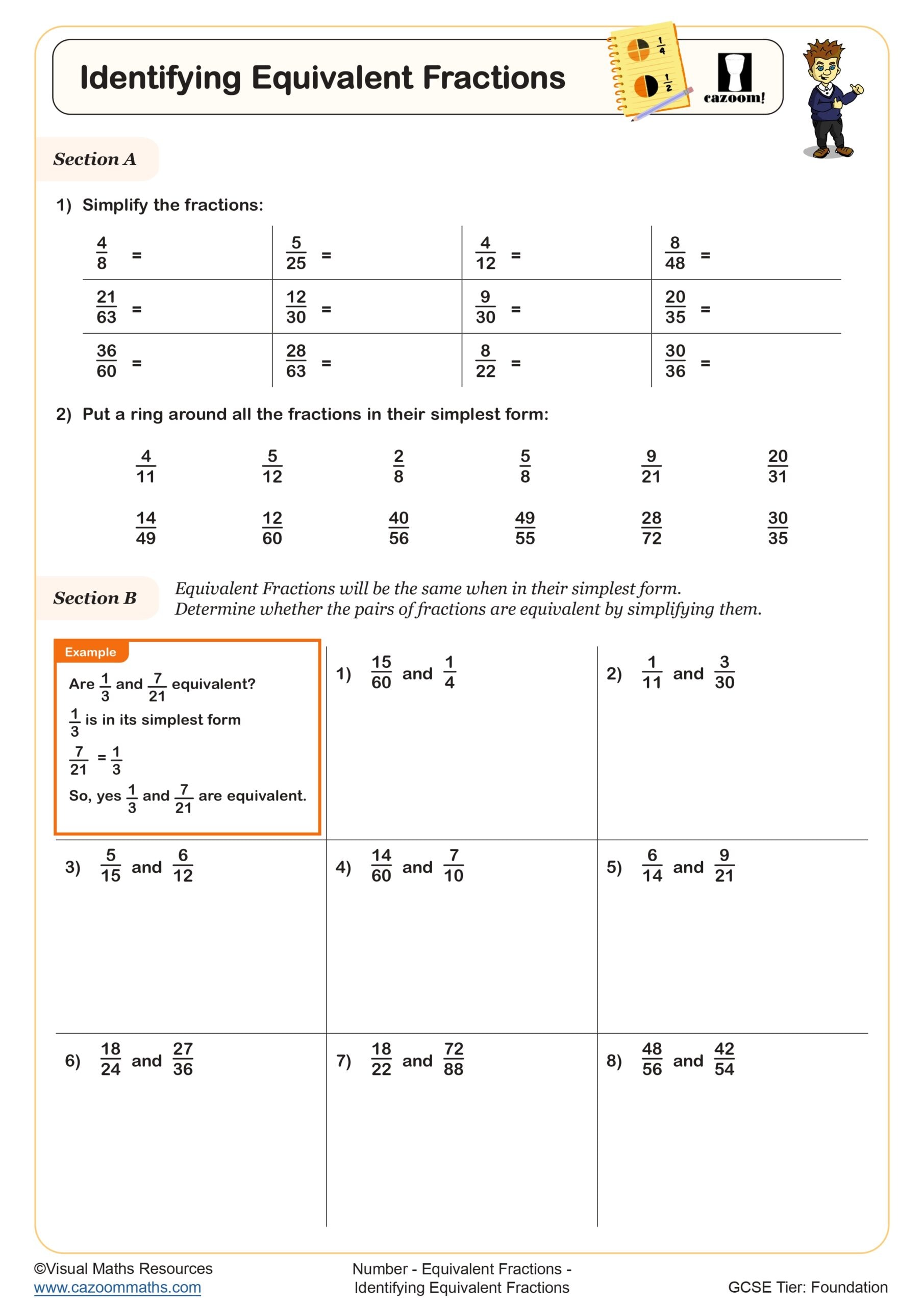
Introducing the Fraction Wall
Year groups: 7, 8
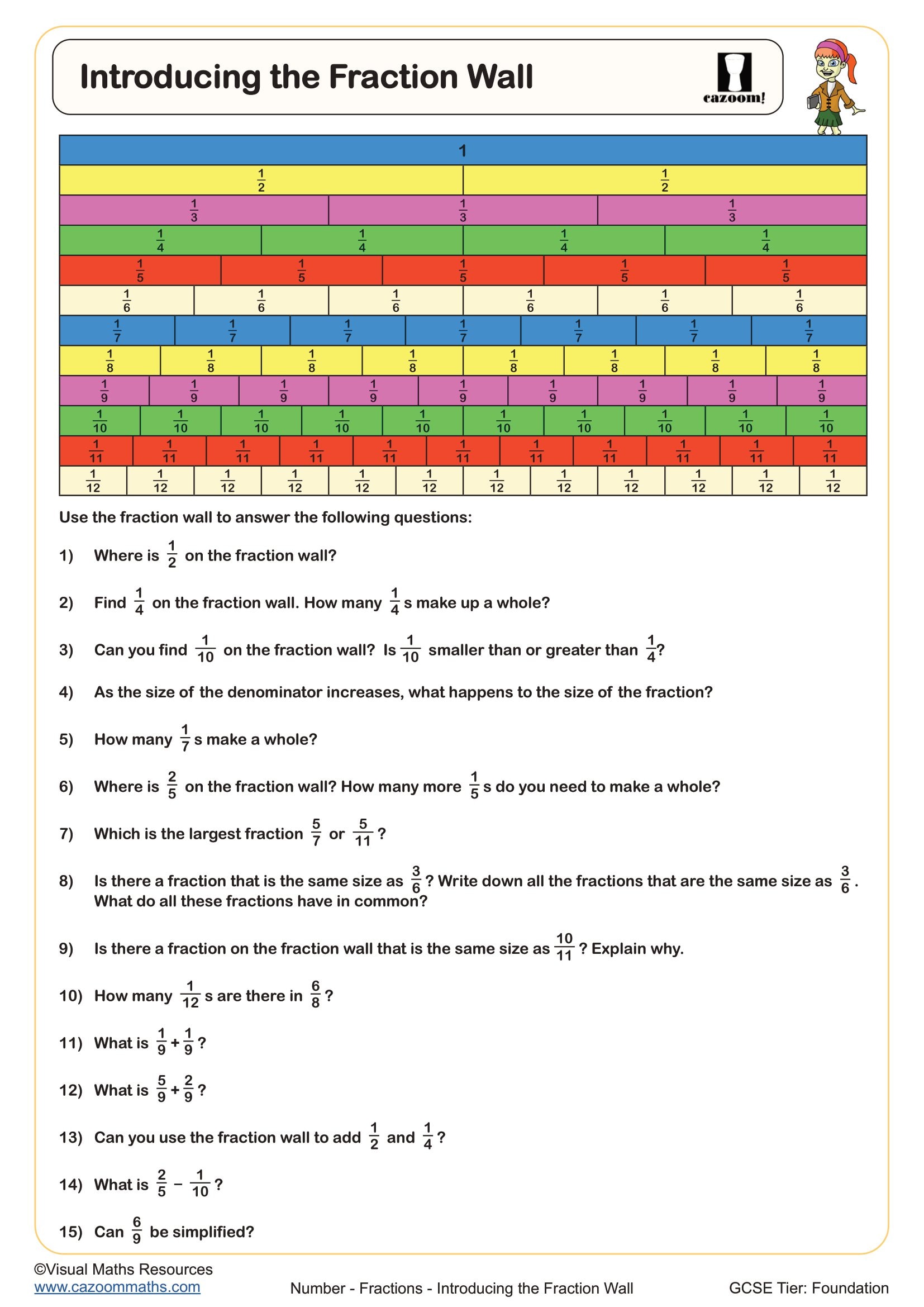
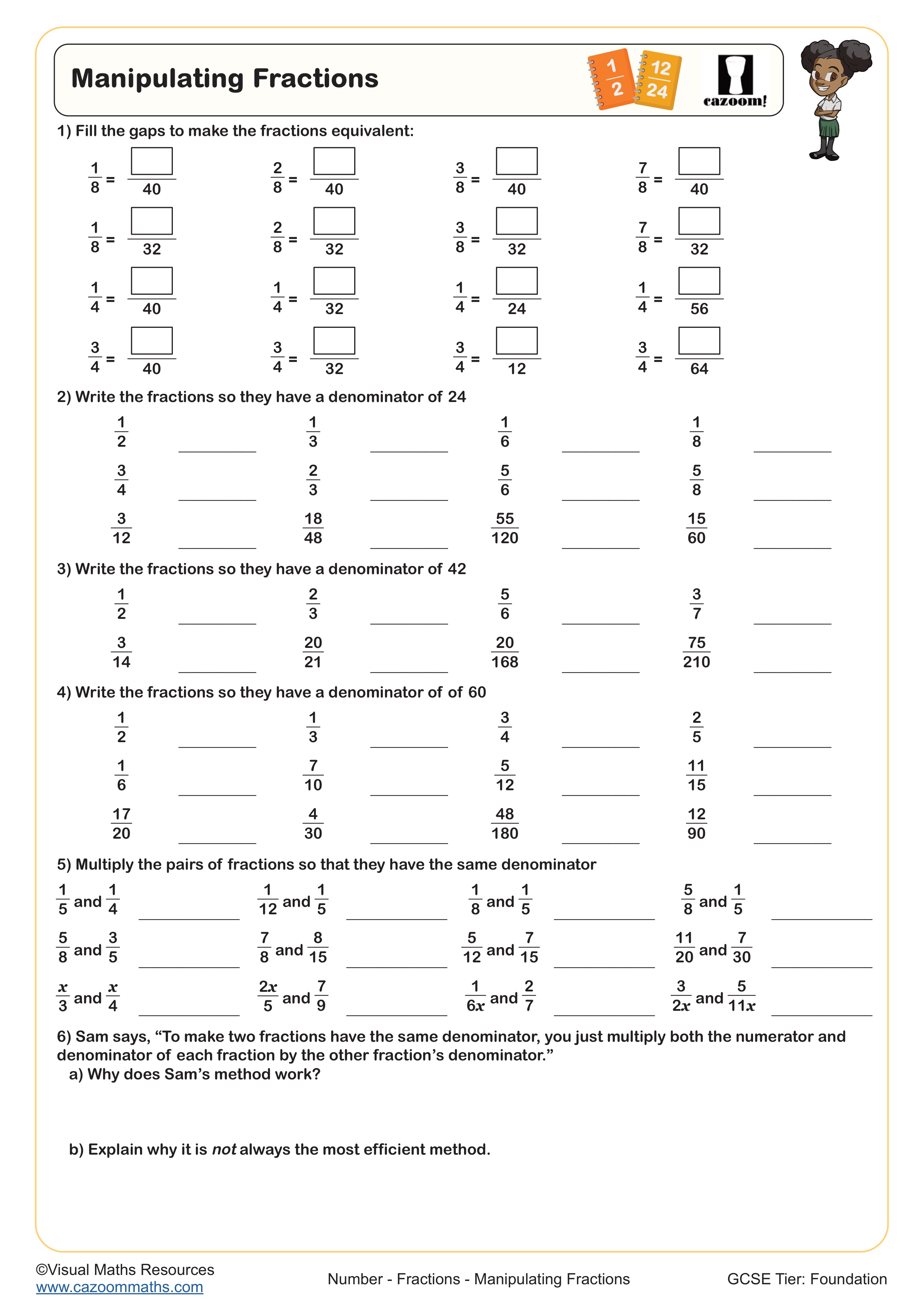
Manipulating Fractions
Year groups: 7, 8
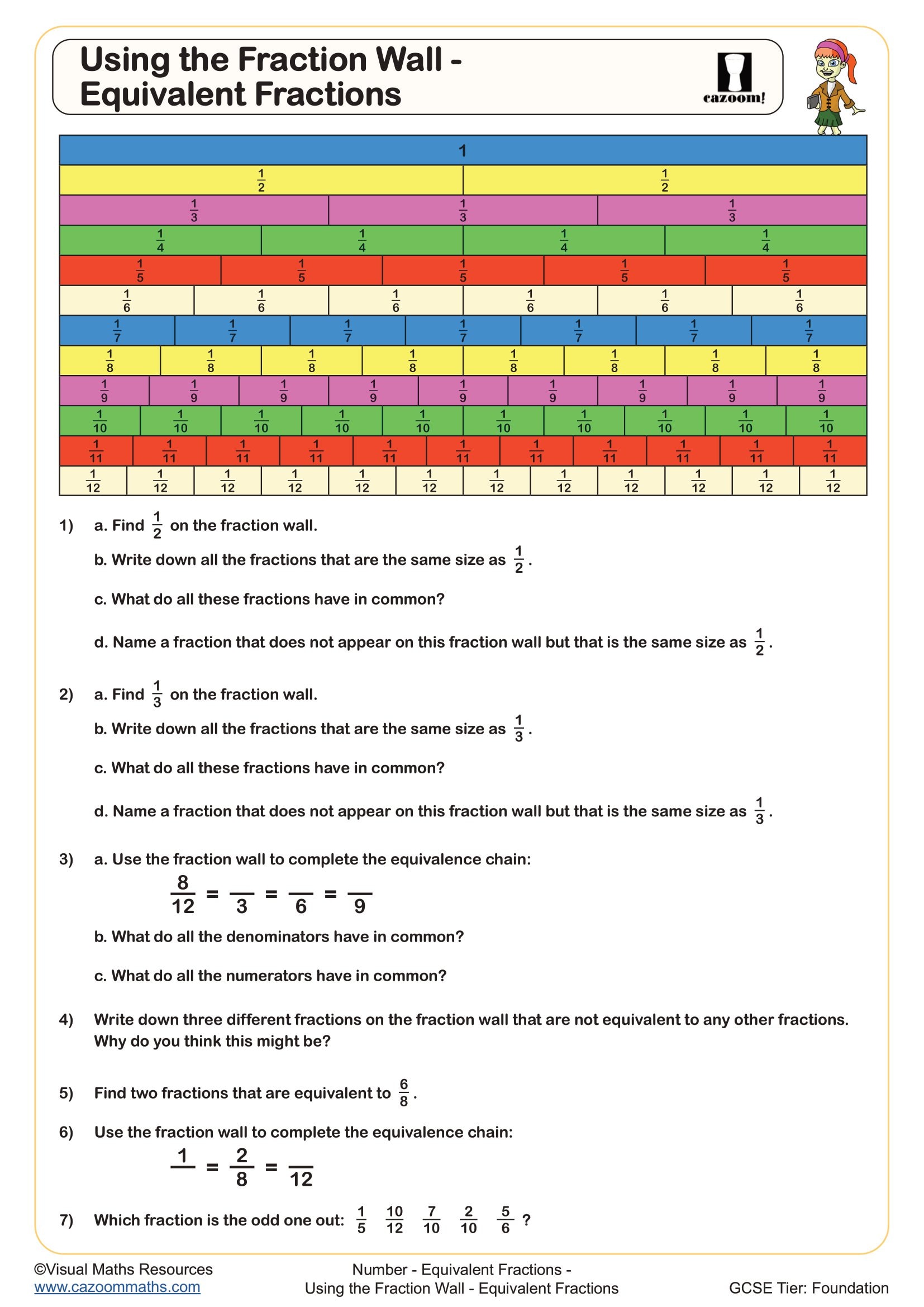
Using The Fraction Wall - Equivalent Fractions
Year groups: 7, 8
All worksheets are created by the team of experienced teachers at Cazoom Maths.
What makes a good equivalent fractions worksheet with answers PDF?
A quality equivalent fractions worksheet provides varied question types that progress from visual representations to abstract calculations. The worksheet should include clear diagrams showing fraction bars or circles, systematic practice finding equivalent fractions using multiplication and division, and opportunities to simplify fractions to their lowest terms.
Teachers report that students benefit most when worksheets include both procedural questions and conceptual challenges. The answer sheets should show working steps, not just final answers, particularly for more complex equivalent fractions examples with answers that demonstrate the reasoning process students need to develop.
Which year groups use equivalent fractions worksheets?
Equivalent fractions appear prominently in Year 7 and Year 8 mathematics, forming part of the Key Stage 3 number curriculum. Students typically encounter basic equivalent fractions in primary school but develop more sophisticated understanding during secondary years. Year 7 students focus on visual models and simple multiplication patterns, whilst Year 8 students work with larger numbers and connect equivalent fractions to ratio and proportion.
Many teachers find that Year 9 students still benefit from equivalent fraction practice when preparing for GCSE topics like algebraic fractions. The concept provides essential groundwork for understanding rational numbers and forms the foundation for fraction operations throughout secondary mathematics.
How do visual models help students understand equivalent fractions?
Visual fraction models transform abstract fraction concepts into concrete representations that students can manipulate and understand. Teachers consistently observe that students who struggle with the symbolic representation of equivalent fractions often achieve breakthrough moments when working with fraction bars, circles, or grid models that clearly show how 1/2 and 2/4 represent identical portions.
The most effective worksheets combine multiple visual approaches - fraction strips showing equal divisions, pie charts demonstrating equivalent sectors, and number line representations. Students can physically see why multiplying both numerator and denominator by the same number creates equivalent fractions, building conceptual understanding that supports later procedural fluency.
How can teachers use these worksheets most effectively in lessons?
Teachers achieve best results when they use equivalent fraction worksheets as part of a structured sequence rather than isolated practice. Beginning lessons with visual models helps students grasp the underlying concept before moving to symbolic manipulation. Many teachers pair students during worksheet activities, encouraging mathematical discussion about why certain fractions are equivalent.
The answer sheets prove invaluable for peer marking activities where students explain their reasoning to classmates. Teachers often use selected worksheet questions as starter activities in subsequent lessons, helping students retain equivalent fraction skills while building connections to new topics like fraction operations or percentages.
Worksheets for Students
Enterprising students who are committed to making the most of their education can ask their parents how they can access downloadable fractions worksheets, themselves.
Since answer sheets are also available online, they can complete as many extra worksheets as they want then check the answers for themselves. New resources are added constantly so there’s no reason to be concerned that students will run out of material to review and students can access the site from home, school, or even their friends’ houses.
Tips for Parents Who Don't Love Maths
Let’s face it: maths isn’t every adult’s strong suit any more than it is every child’s. That shouldn’t mean parents who never developed a love of maths can’t instill positive feelings about this important subject in their kids or that they can’t play an active role in their kids’ learning processes.
If you’re nervous about your mathematical abilities, try not to share those feelings with your children. Instead, make a point of reviewing basic ideas prior to helping kids with homework and simply download the answers to worksheets and correct them out of the child’s view.
When helping children with homework, make a point of asking for explanations rather than offering them. Letting students explain what they have learned in their own words is one of the best ways for parents to ensure that their kids really understand the material and get an idea of what they need help with. Those who feel that attempting to help with maths homework is completely hopeless can always hire tutors for children who are struggling.
How to Tell it's Time to Hire a Tutor?
Before hiring a tutor, parents who want to remain involved in their young students’ lives may want to sign up for a Cazoom Maths account so they can access the same learning materials available to teachers. It’s worth taking the time to review equivalent fractions as soon as children begin requesting help with fractions worksheets or homework assignments. If the information on the worksheets remains inaccessible even after parents have reviewed the answers and the additional resources available online, it might be time to consider a tutor.
Children who attend public school or private schools typically bring home report cards. Even parents who are terrible at maths will be able to evaluate their children’s progress by checking on their grades periodically. Those who hire other, older students to mentor their children in maths can even provide their kids’ tutors with the same resources described above. This will help tutors, parents and students stay on the same page. It will also allow tutors to spend more time teaching and less time working out the answers themselves because they’ll have access to answer sheets the parents have provided.
Tips for Teaching Equivalent Fractions at Home
Teachers, tutors and parents can use other teaching techniques in conjunction with worksheets to facilitate learning. Some parents use food to teach equivalent fractions, dividing oranges or even chocolate bars in different ways and then sharing them with their children. Teachers often use fraction tiles, number lines, or pattern blocks that offer students a visual representation of how different fractions are equivalent.
These lessons allow children to learn through observation instead of relying on explanations of abstract ideas alone, but they can’t replace ongoing practice when it comes to cementing the ideas in students’ minds. Only repetition can ensure that children will remember the lessons they have learned when it’s time to take their tests. With repetitive practice, there’s really no replacing printable worksheets.
Make Fractions Fun with Visual Learning Devices
The best way for any adult to help a young student is to make the process more fun. When they are assigned an equivalent fractions worksheet, students are more likely to enjoy the learning process, which will encourage them to engage actively with the material. Although lectures and classroom exercises can be helpful, many young children find taking a visual approach to learning maths is more fun and more rewarding.
Fractions worksheets often come with helpful diagrams, which can make learning even easier. Children can begin with fractions that are equivalent to one-half, one-quarter or one-third by learning how to use shading grids and using them as a visual aid for understanding equivalency. Once the basic concept of equivalency has been established in a student’s mind, he or she will have the tools required to move on to harder worksheets and solve more challenging problems.
Teach Practical Applications
Just about every parent, teacher, tutor or adult who regularly meets school-aged kids has been posed the age-old question, “but why do I have to learn maths?” These adults know that an understanding of basic maths, including fractions, will come in handy later in life, but it can be hard to explain how abstract concepts like equivalency are relevant to children’s lives. The best worksheets should offer students the chance to see some of the practical applications of equivalent fractions.
Examples include telling time as an equivalent fraction of one hour and worksheets that present fractions of amounts. These kinds of real-world applications let students see how the material they are being taught can be used in their everyday lives, offering context that can inspire them to devote more time and energy to thoroughly learning these lessons.
Access Additional Resources
Parents and teachers can benefit from additional online resources that can be used in conjunction with downloadable worksheets. These include diagrams, blank fraction shading grids, fraction comparisons, division help sheets, and more.
Teachers can use these resources to develop more-effective lesson plans that cater to their students’ levels of understanding. Parents can use them as a refresher course before they sit down to help their children with homework assignments.
Given the reasonable price and easy accessibility of the online worksheets available through Cazoom Maths, there’s no reason that any child should be left without the additional help he or she needs to understand even abstract mathematical concepts. Parents who want to home-school their kids or just stay involved in their children’s educations as they attend public schools will find these resources equally helpful.