Fractions, Decimals and Percentages Worksheets
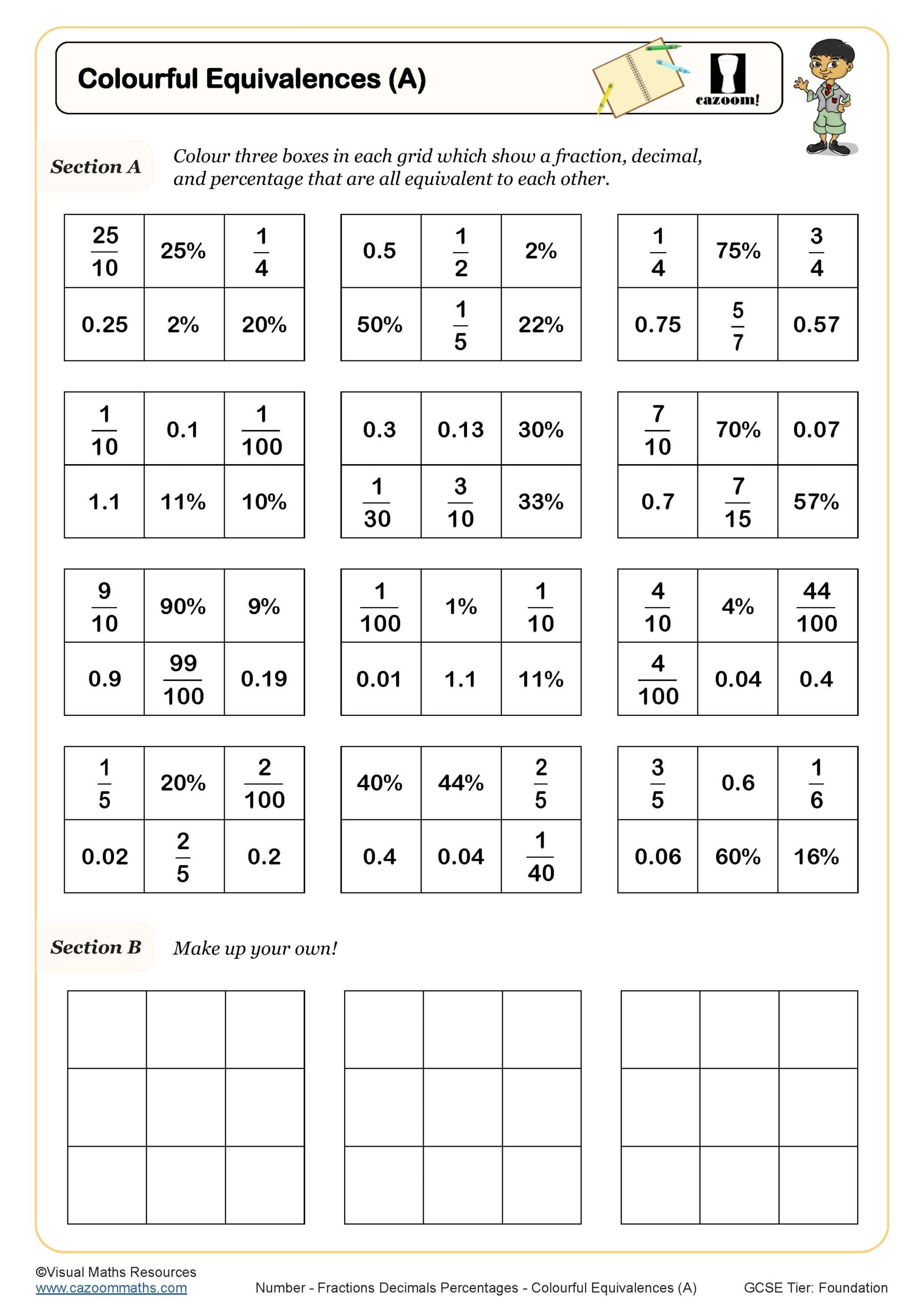
Colourful Equivalences (A)
Year groups: 7, 8
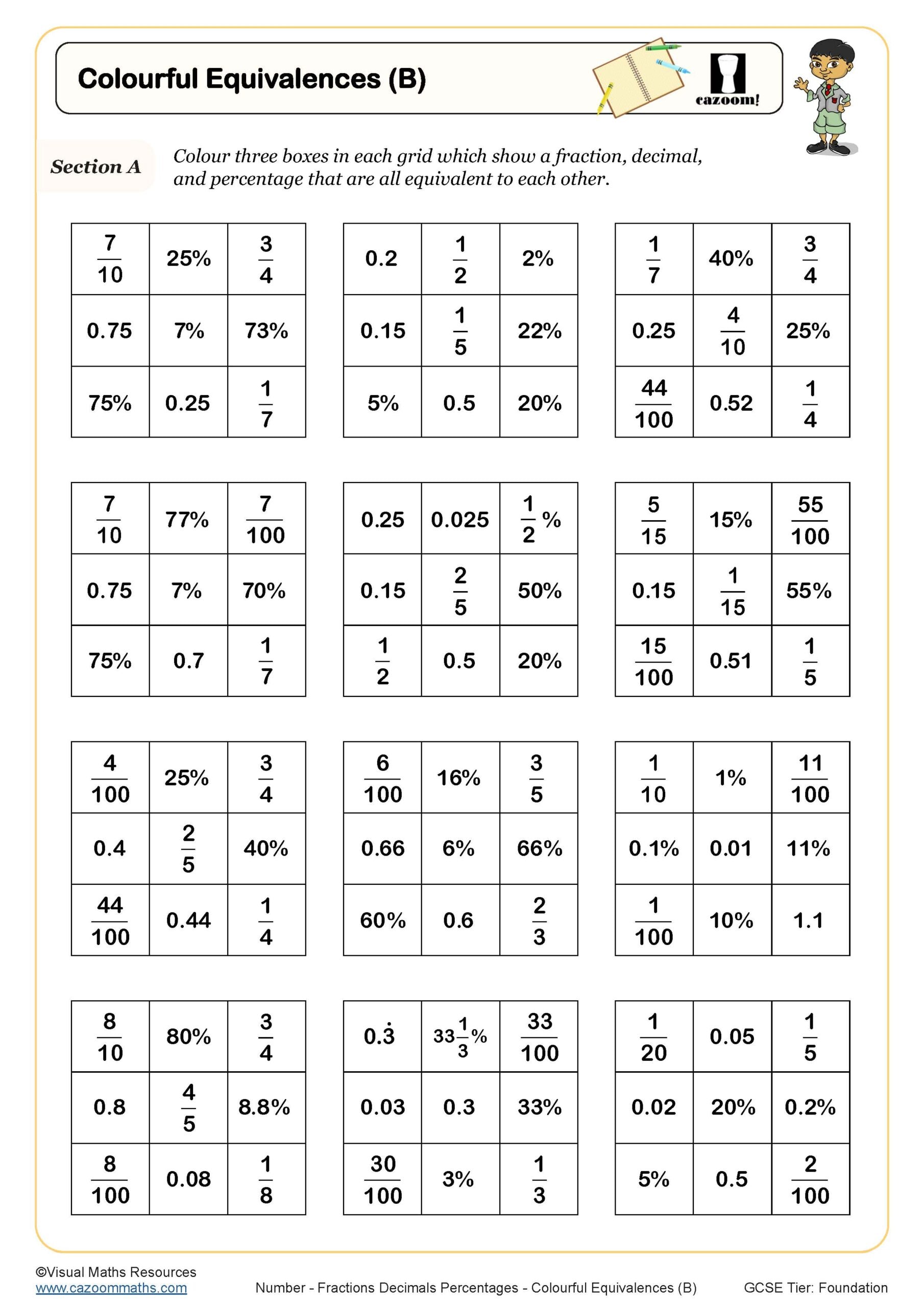
Colourful Equivalences (B)
Year groups: 7, 8, 9
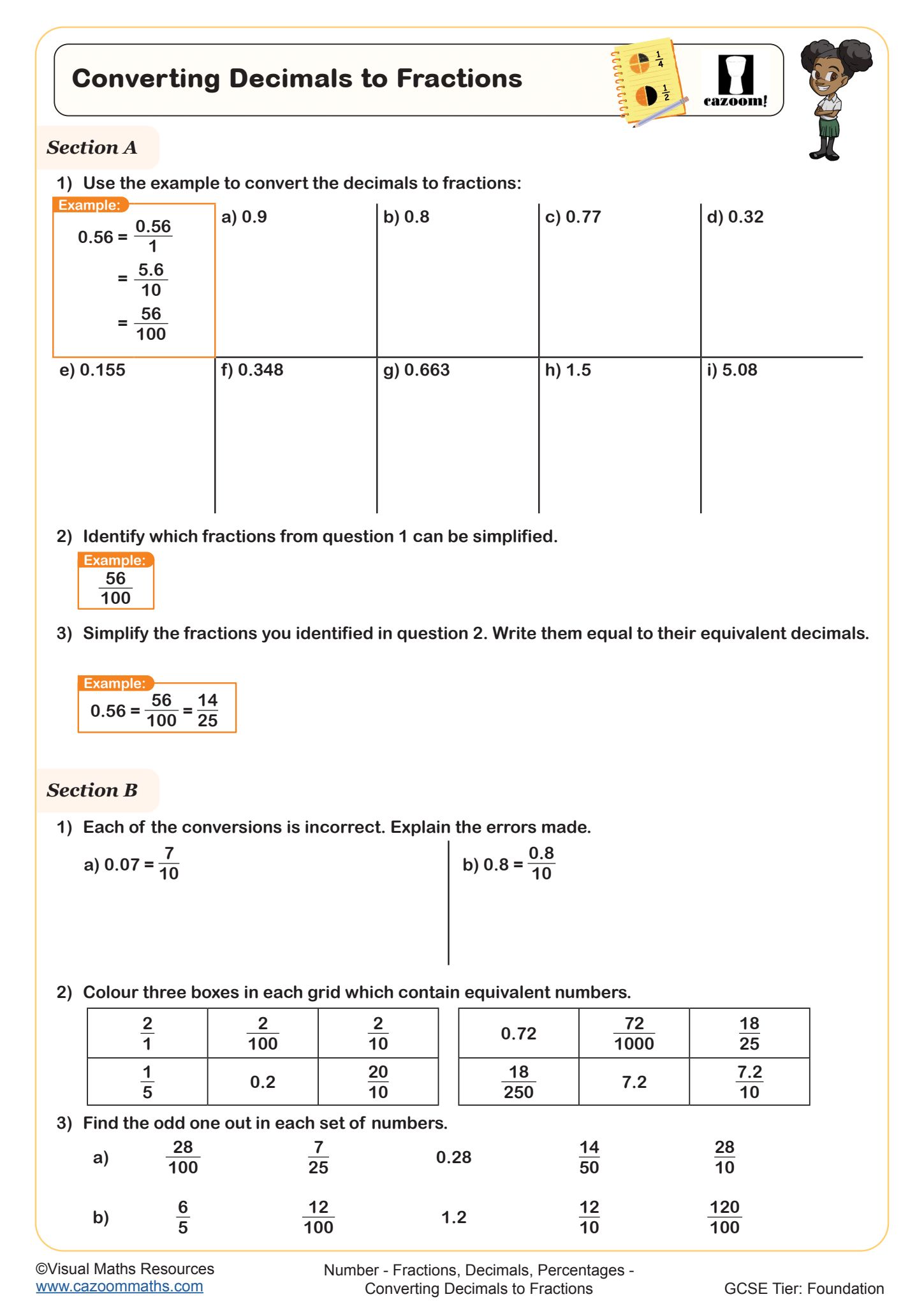
Converting Decimals to Fractions
Year groups: 7, 8
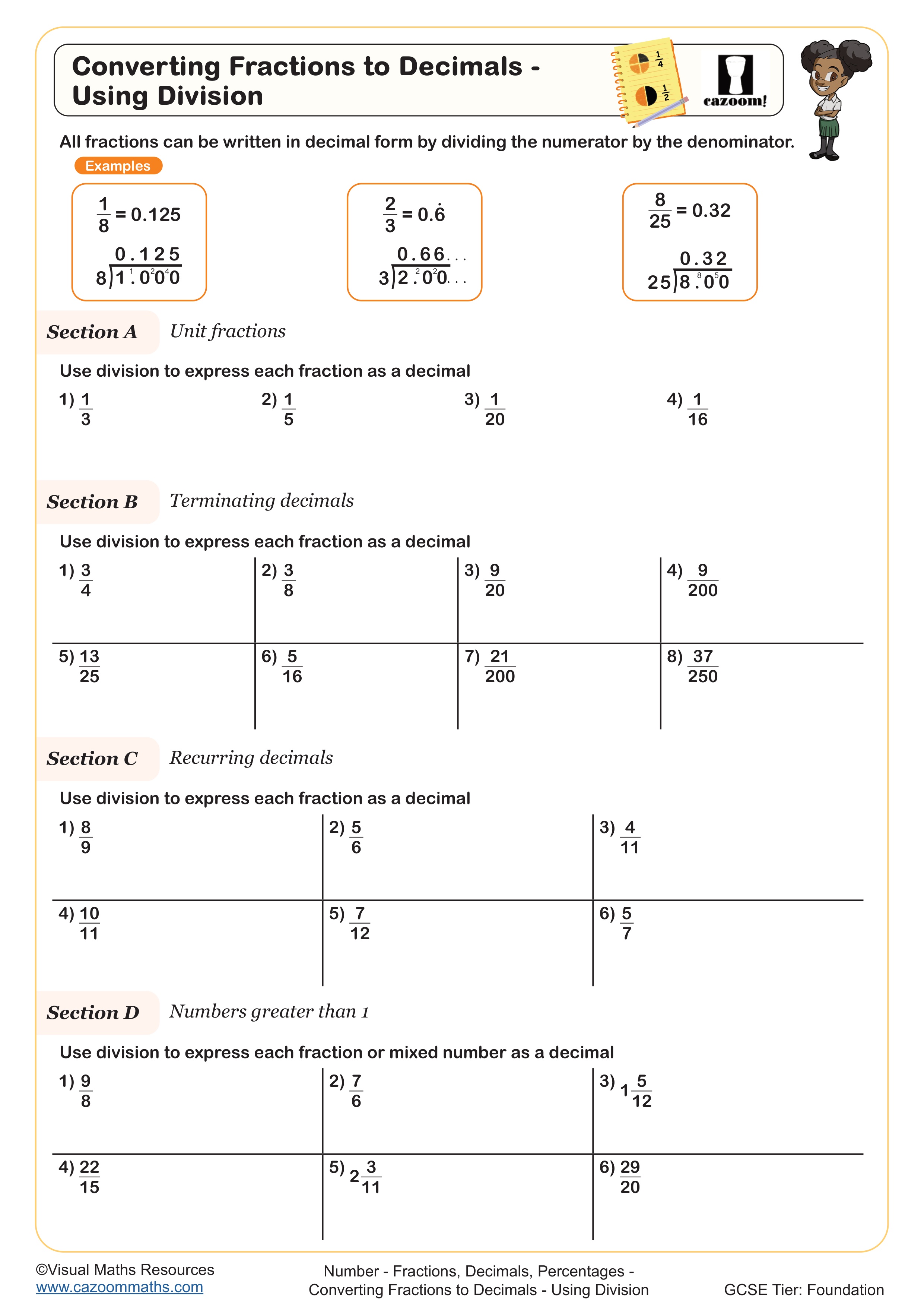
Converting Fractions to Decimals - Using Division
Year groups: 7, 8
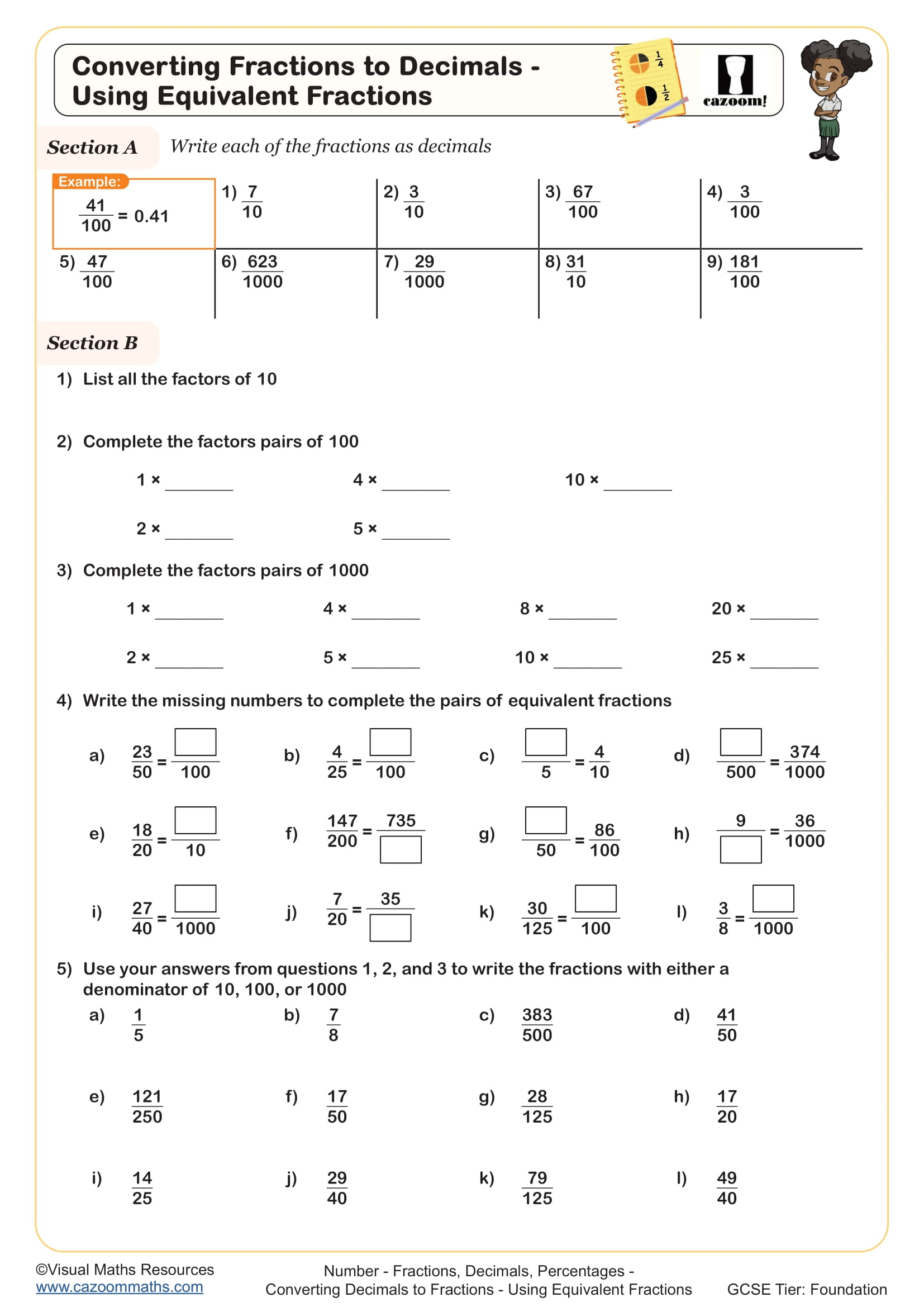
Converting Fractions to Decimals - Using Equivalent Fractions
Year groups: 7, 8
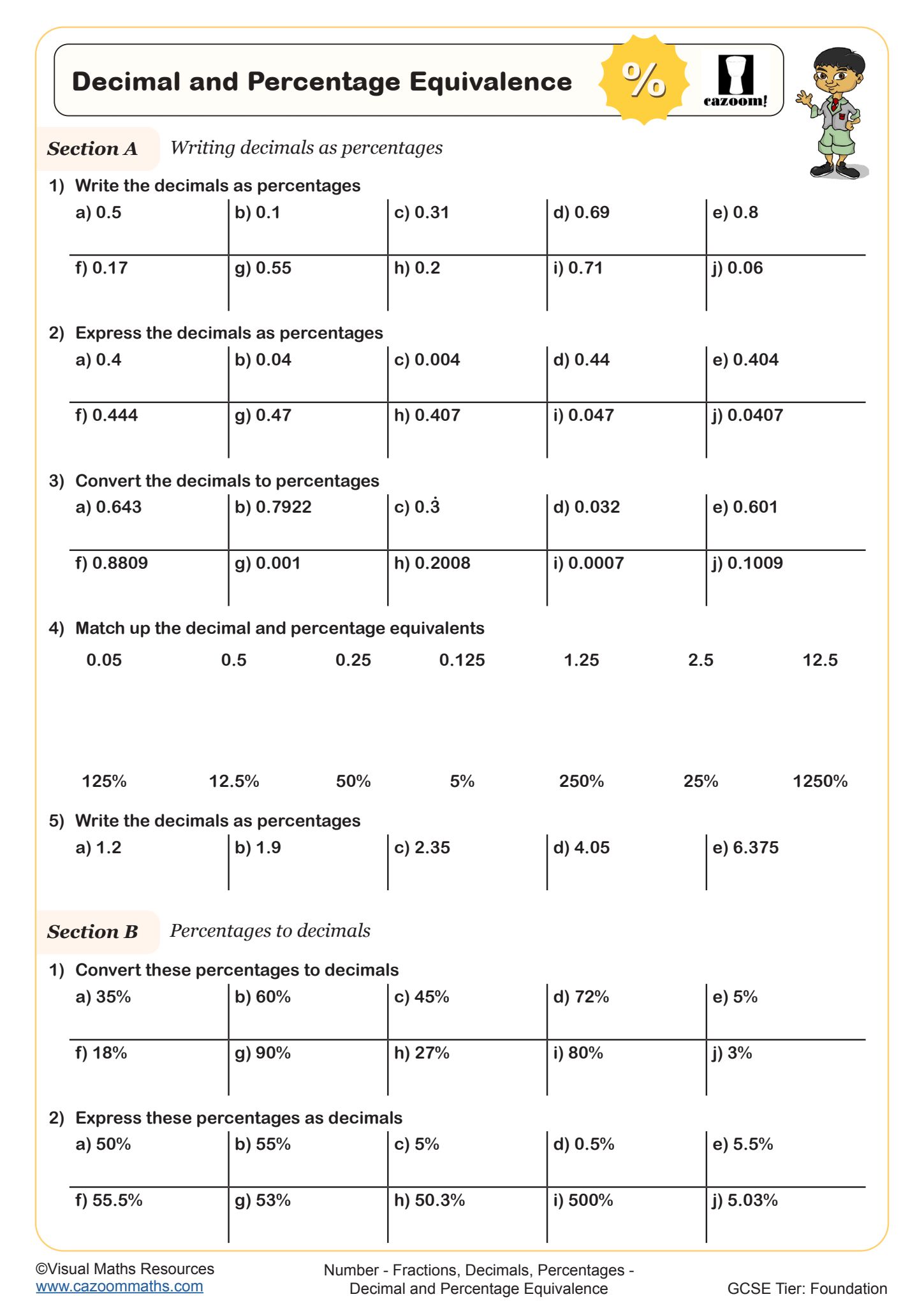
Decimal and Percentage Equivalence
Year groups: 7, 8
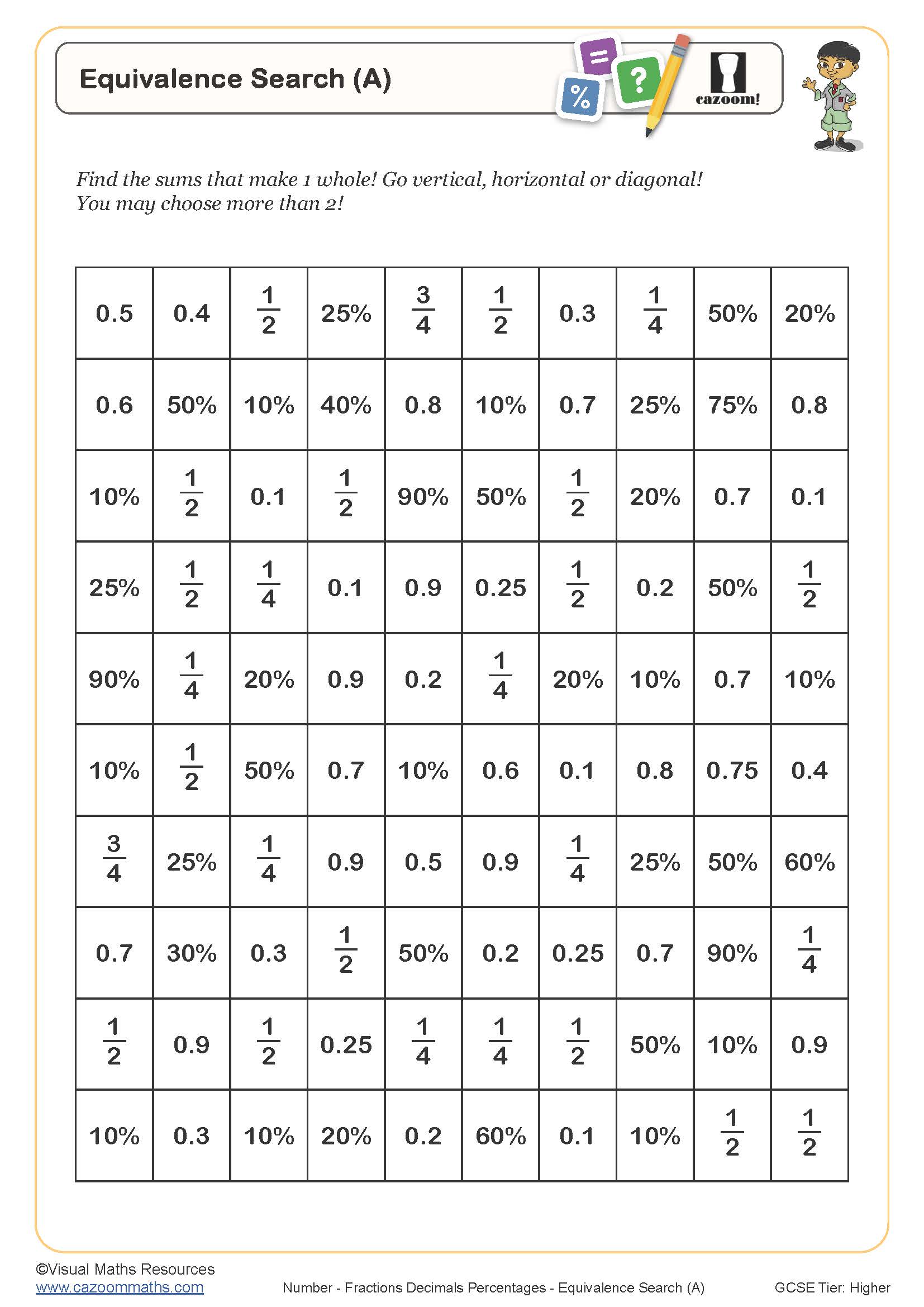
Equivalence Search (A)
Year groups: 7, 8
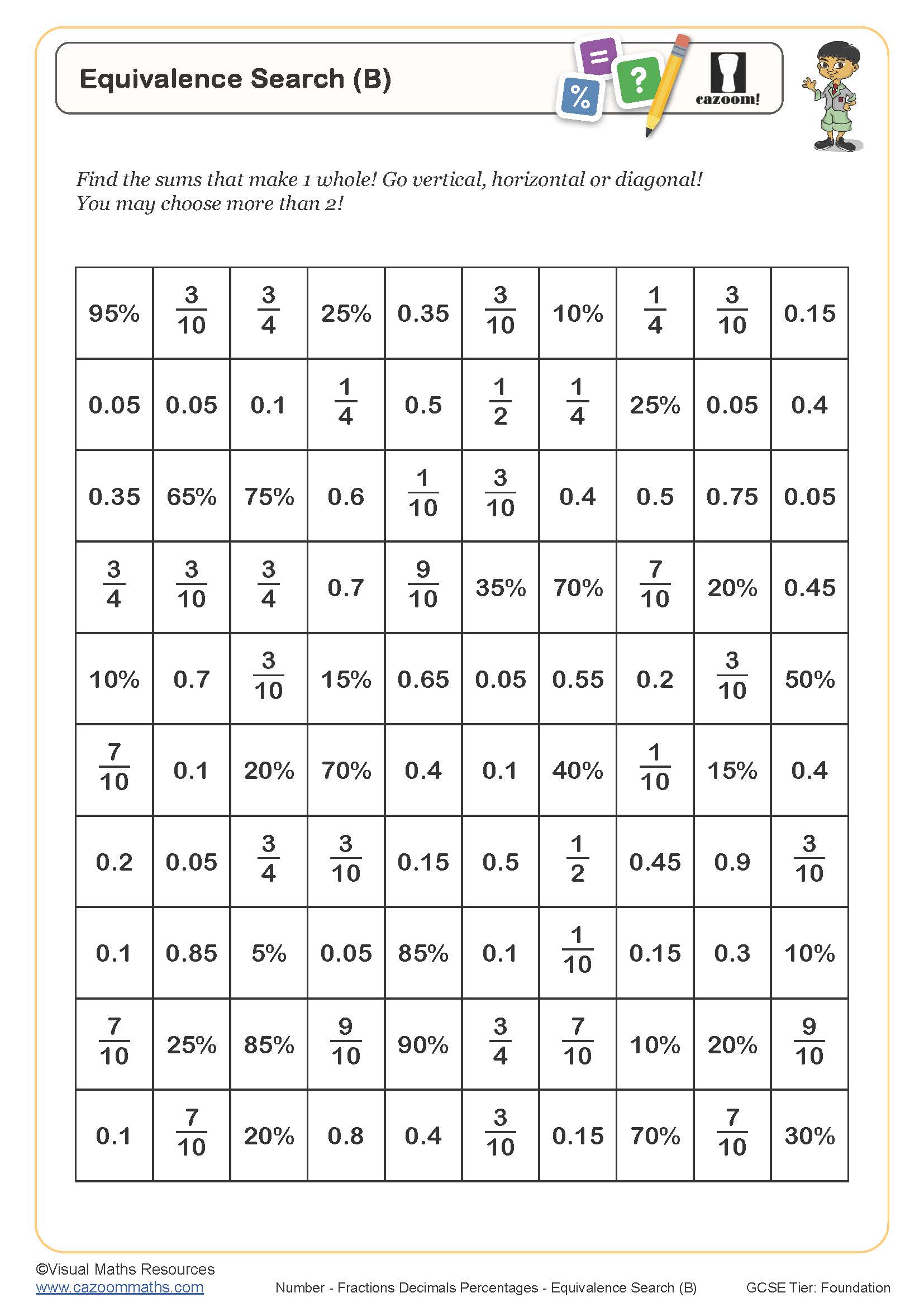
Equivalence Search (B)
Year groups: 7, 8, 9
Equivalence Search (C)
Year groups: 7, 8, 9
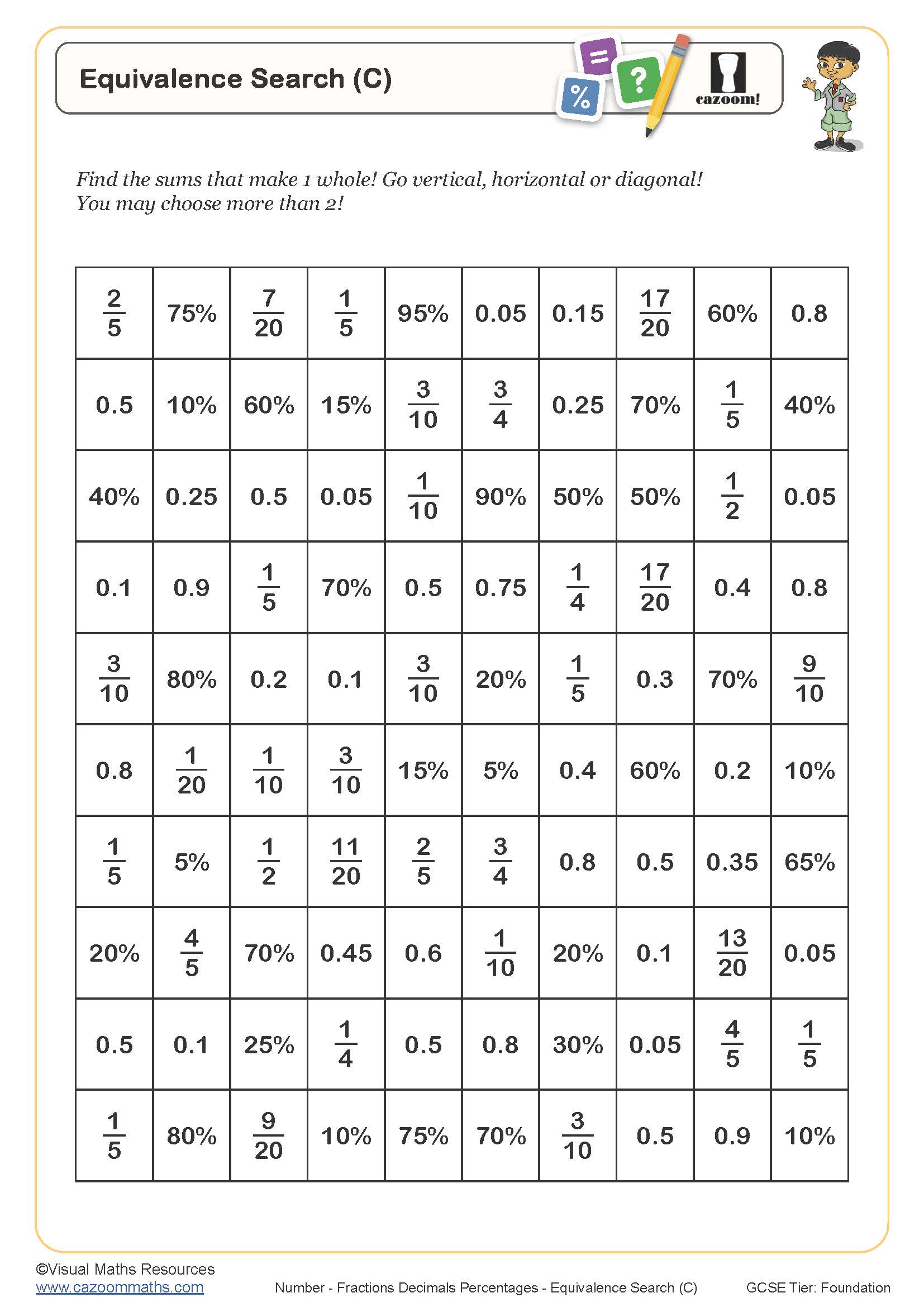
Fraction and Percentage Equivalence
Year groups: 7, 8
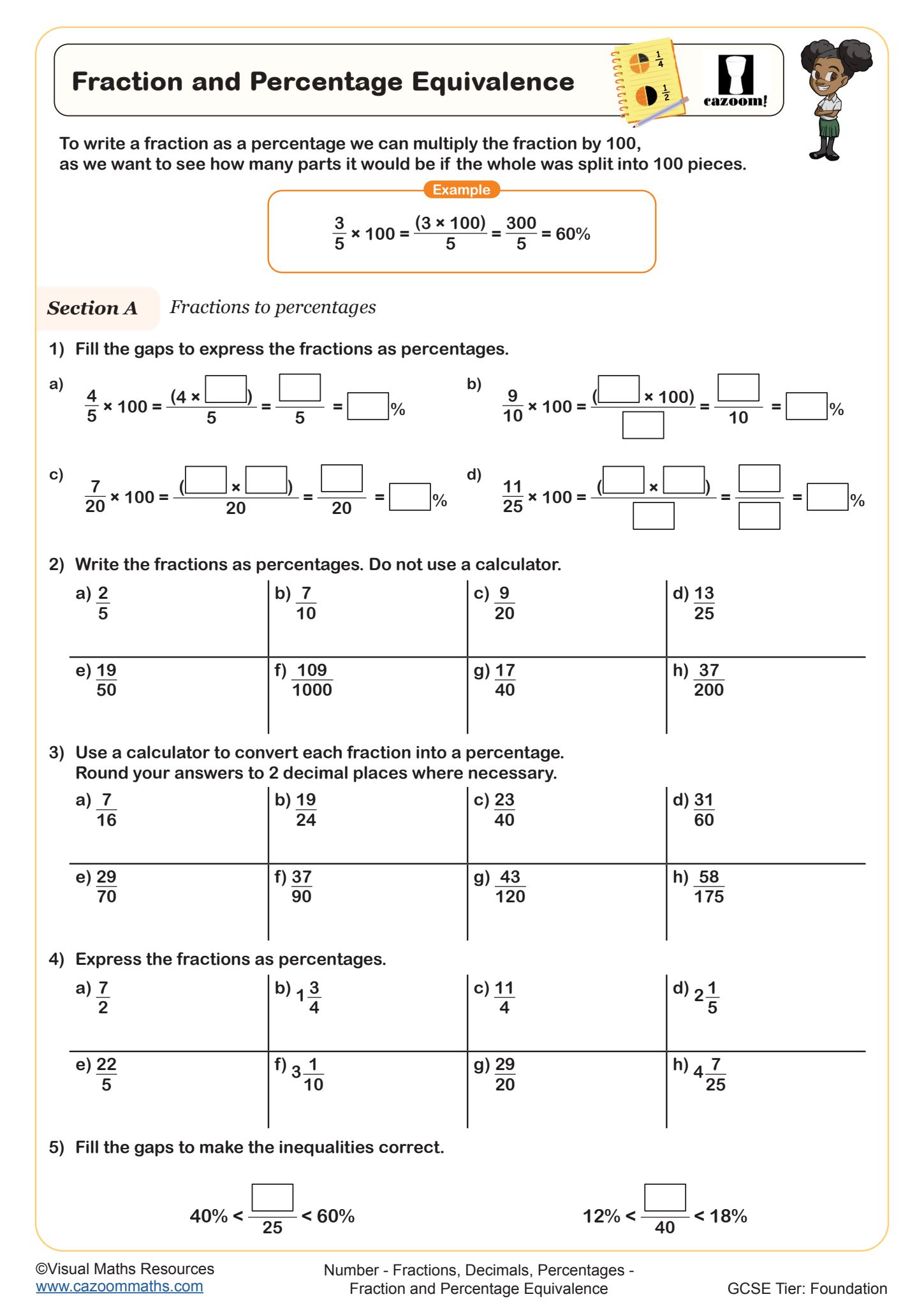
Fractions Decimals Percentages (A)
Year groups: 7, 8
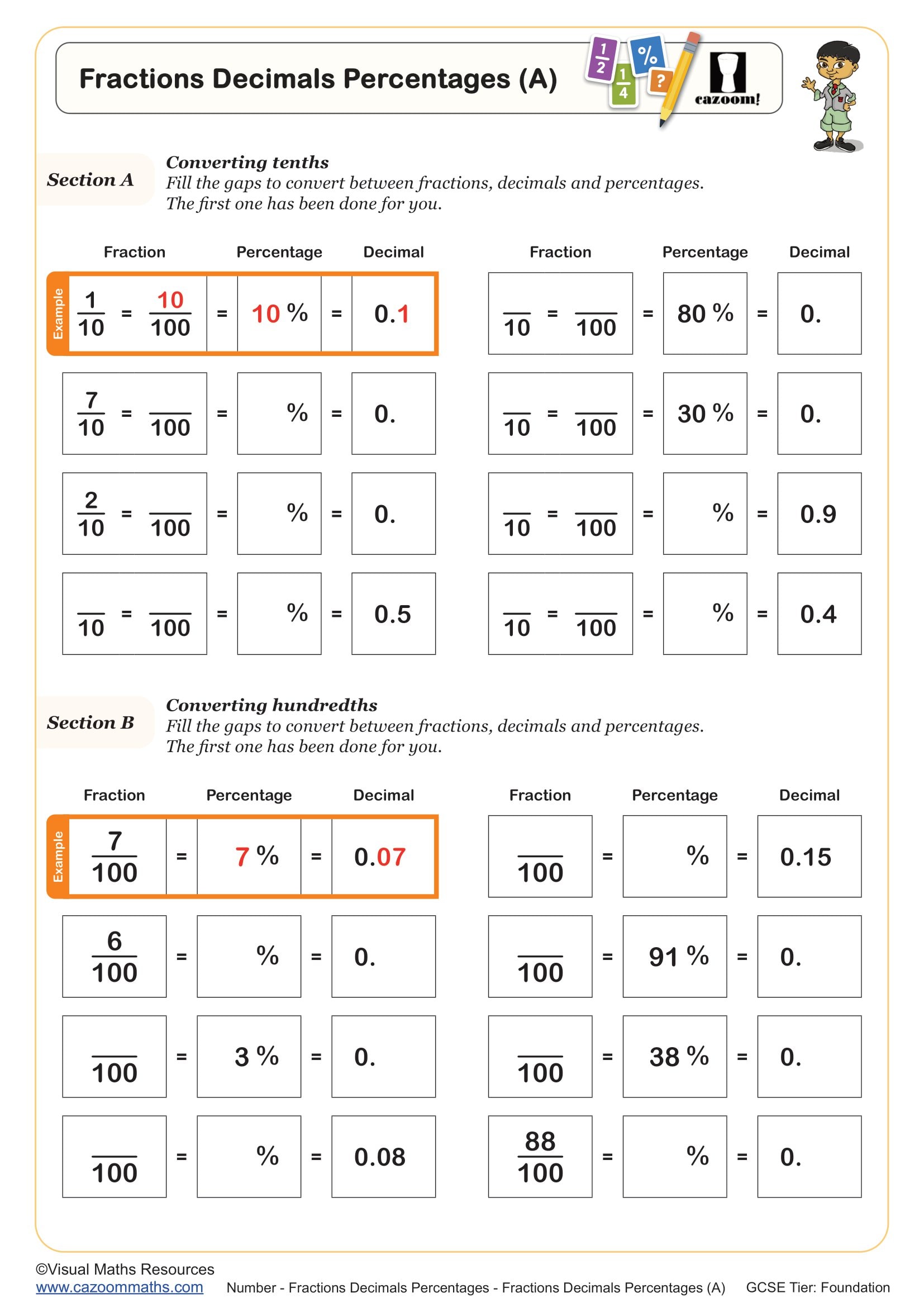
Fractions Decimals Percentages (B)
Year groups: 7, 8, 9
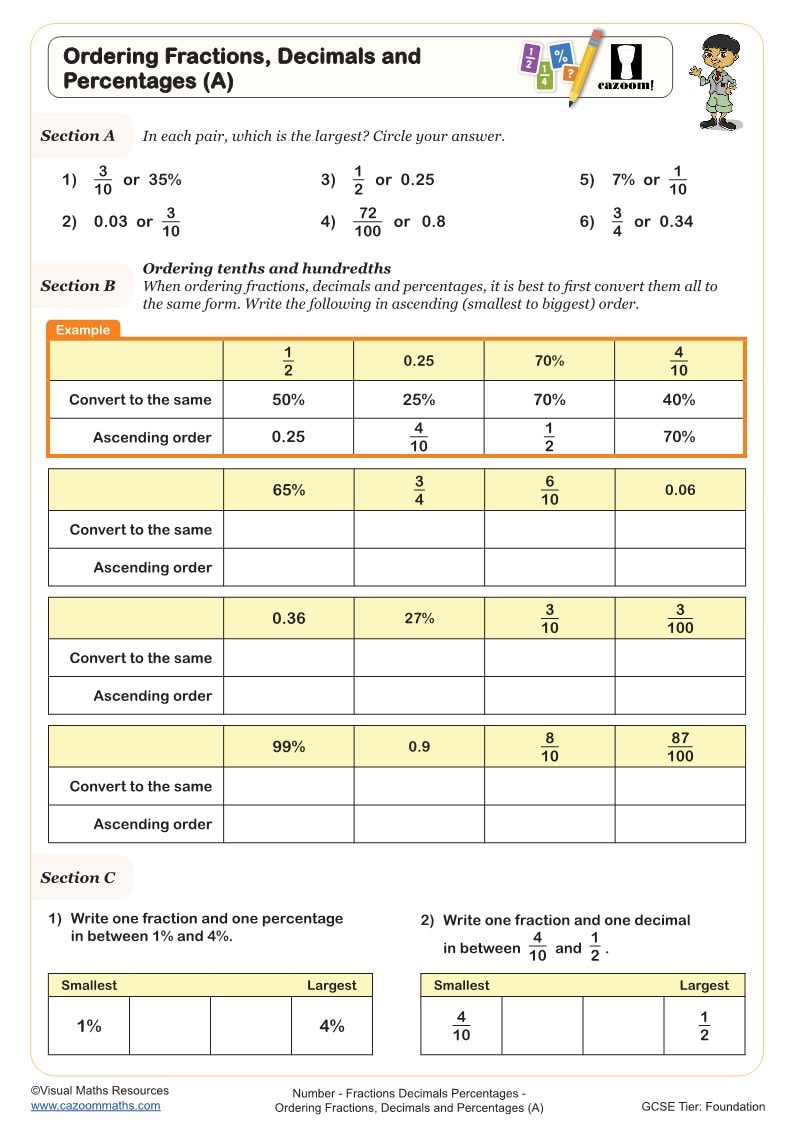
Ordering Fractions Decimals and Percentages (A)
Year groups: 7, 8
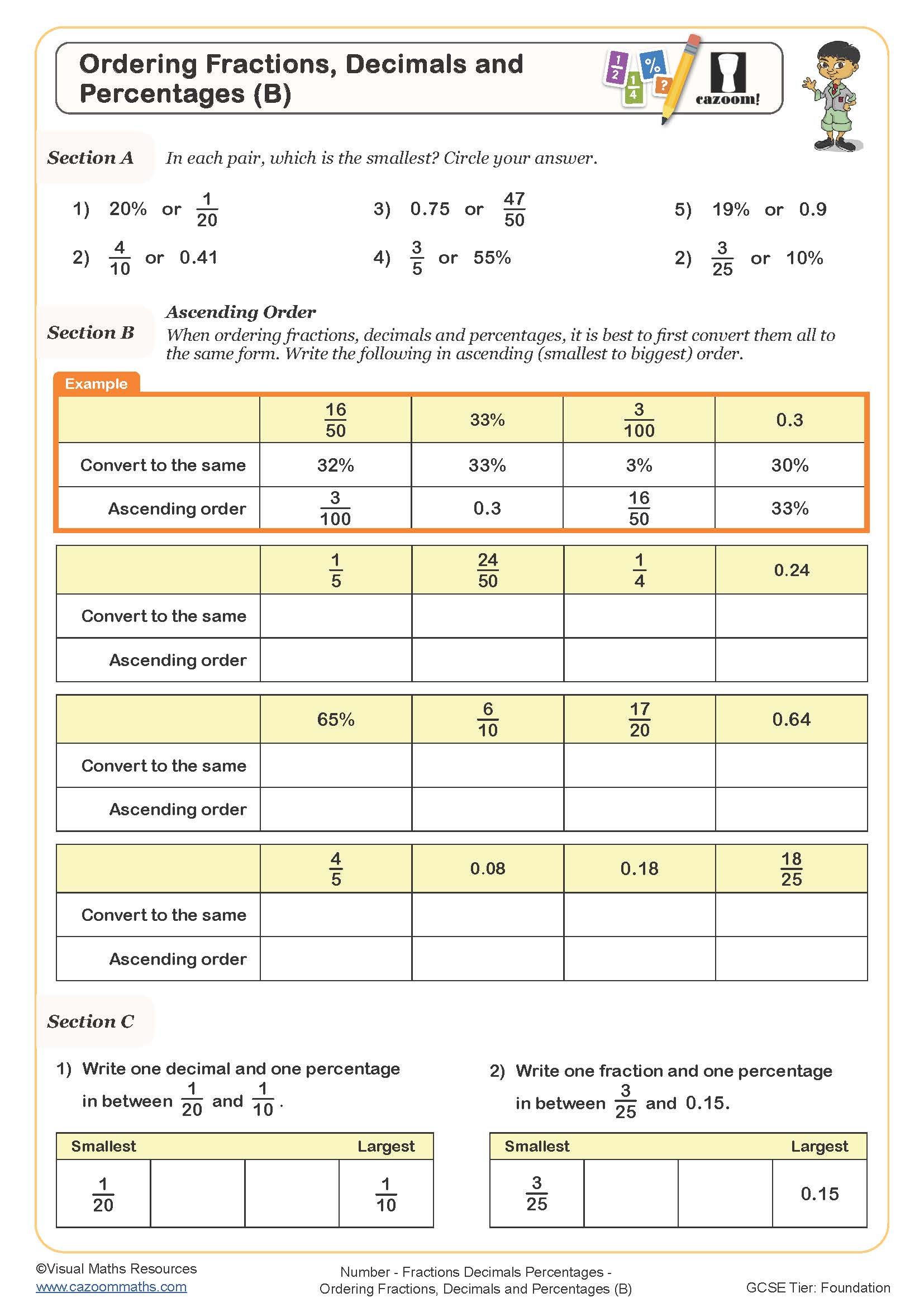
Ordering Fractions Decimals and Percentages (B)
Year groups: 7, 8, 9
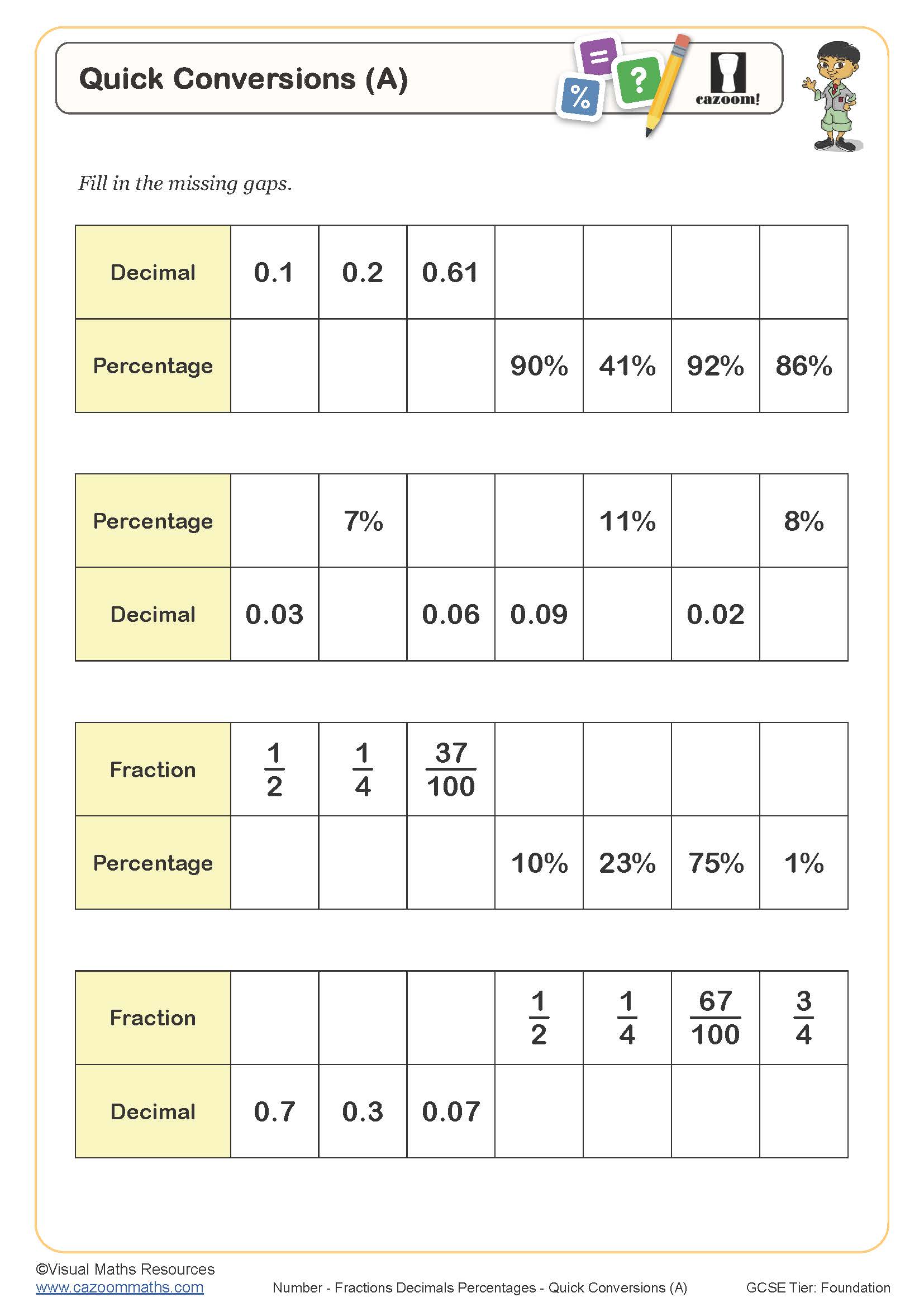
Quick Conversions (A)
Year groups: 7, 8
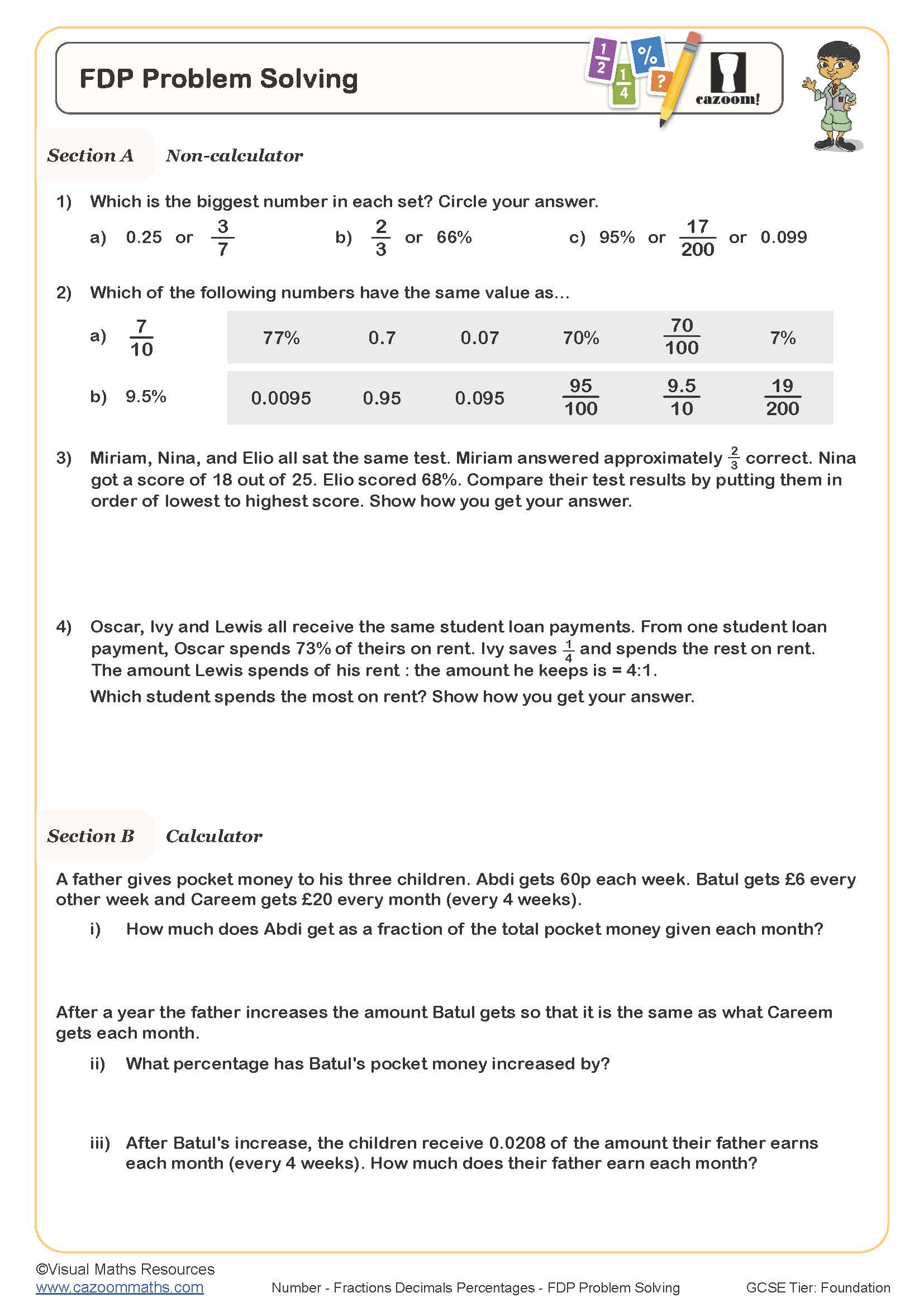
FDP Problem Solving
Year groups: 8, 9
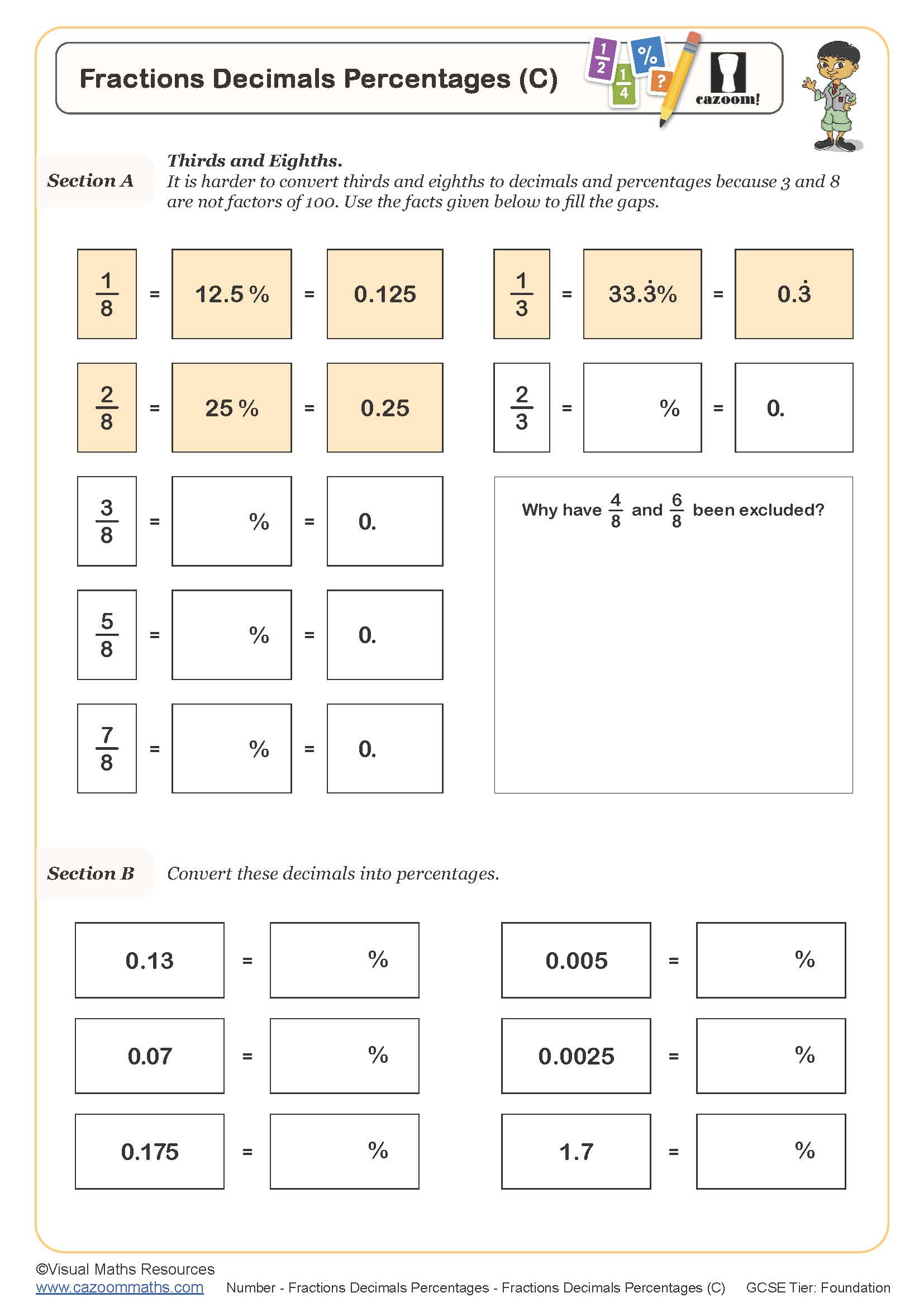
Fractions Decimals Percentages (C)
Year groups: 8, 9
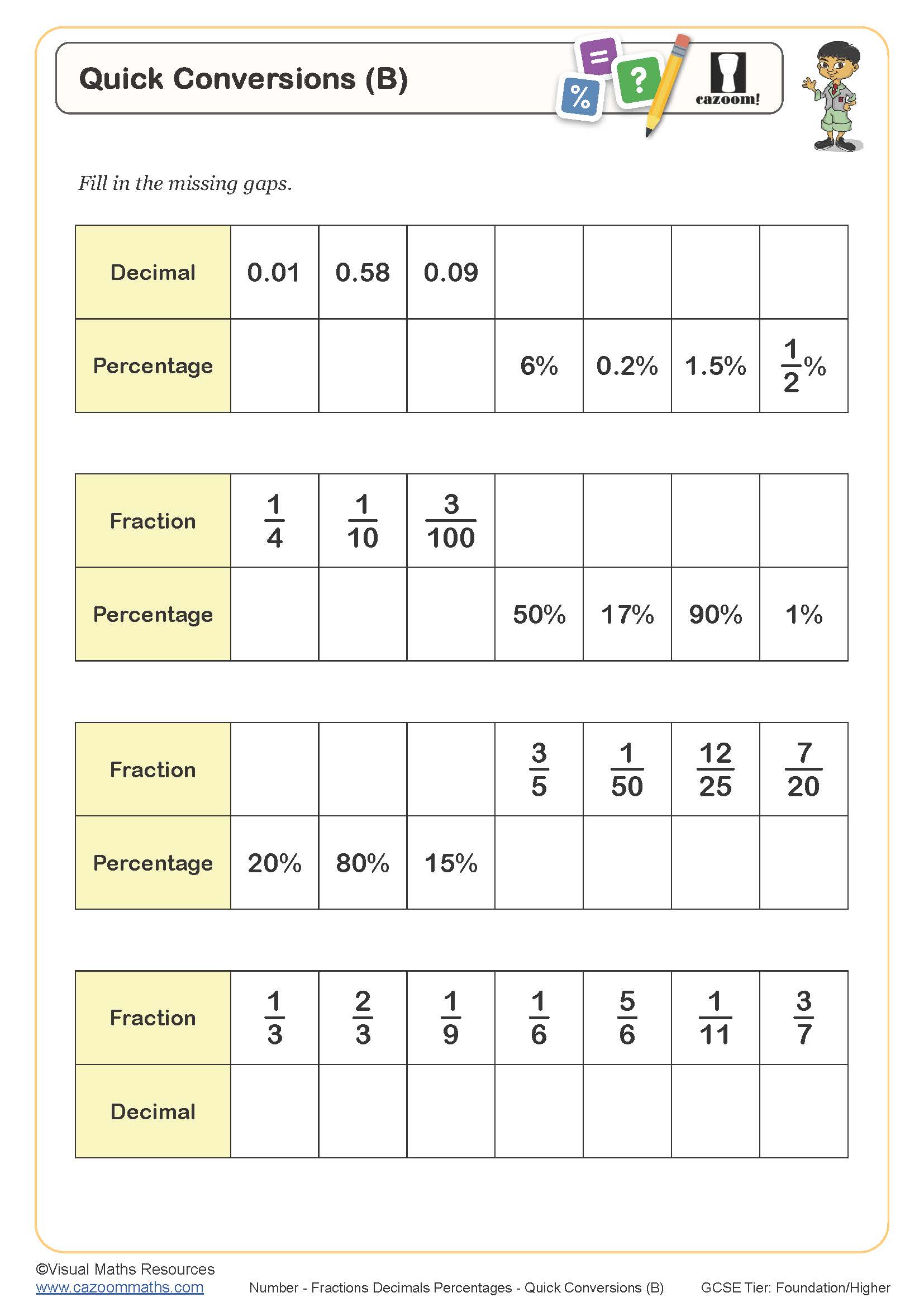
Quick Conversions (B)
Year groups: 8, 9
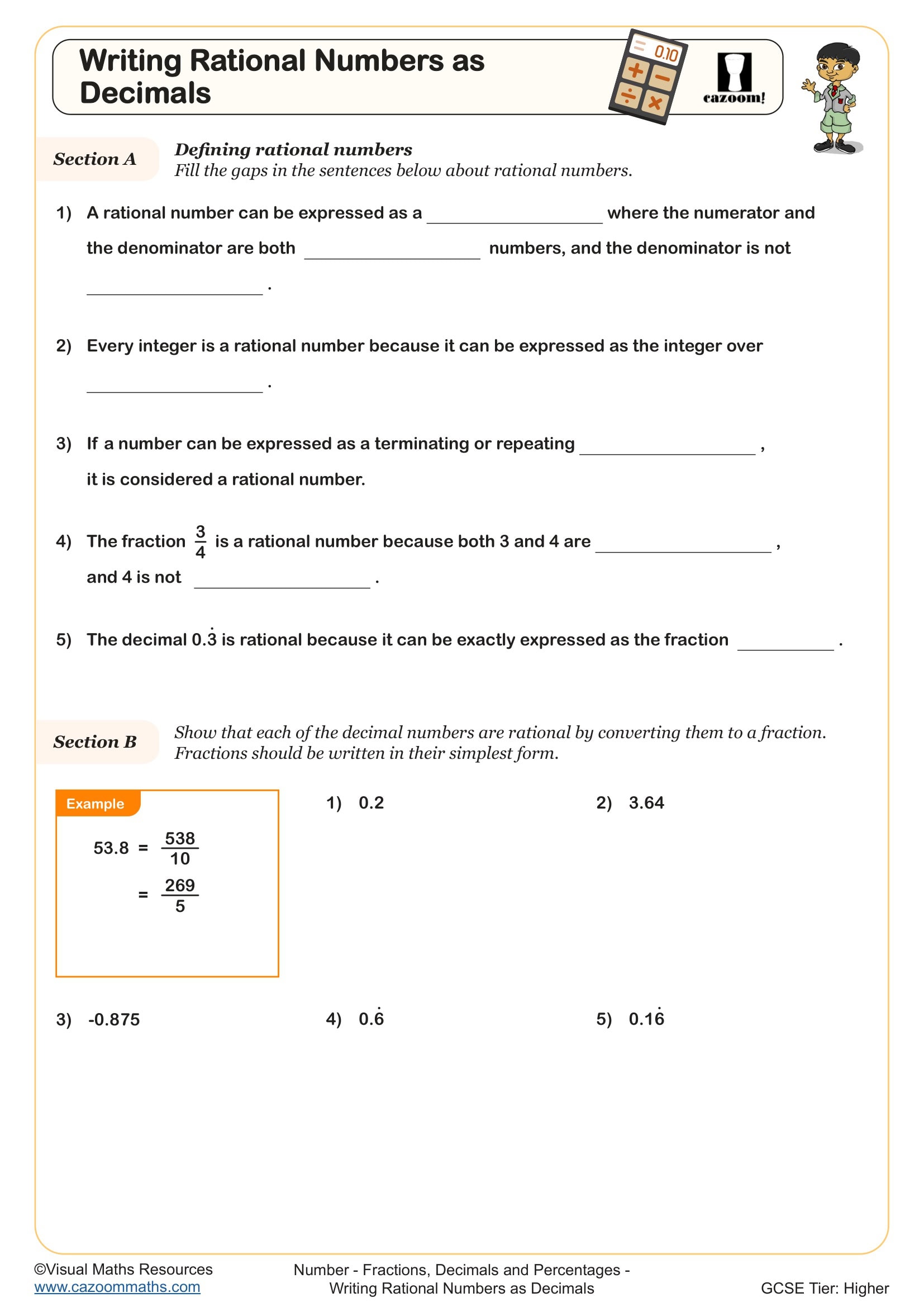
Writing Rational Numbers as Decimals
Year groups: 9, 10
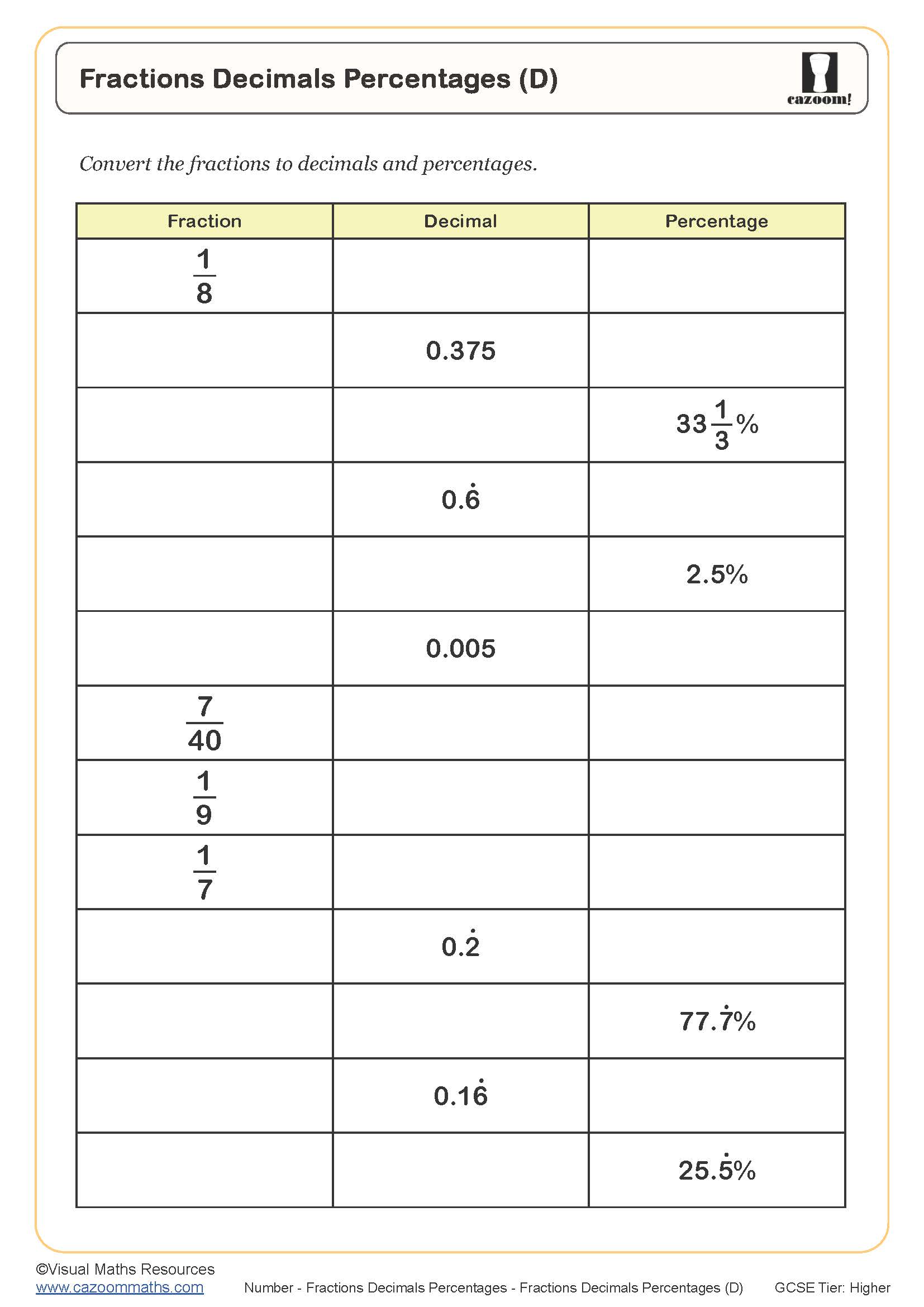
Fractions Decimals Percentages (D)
Year groups: 10, 11
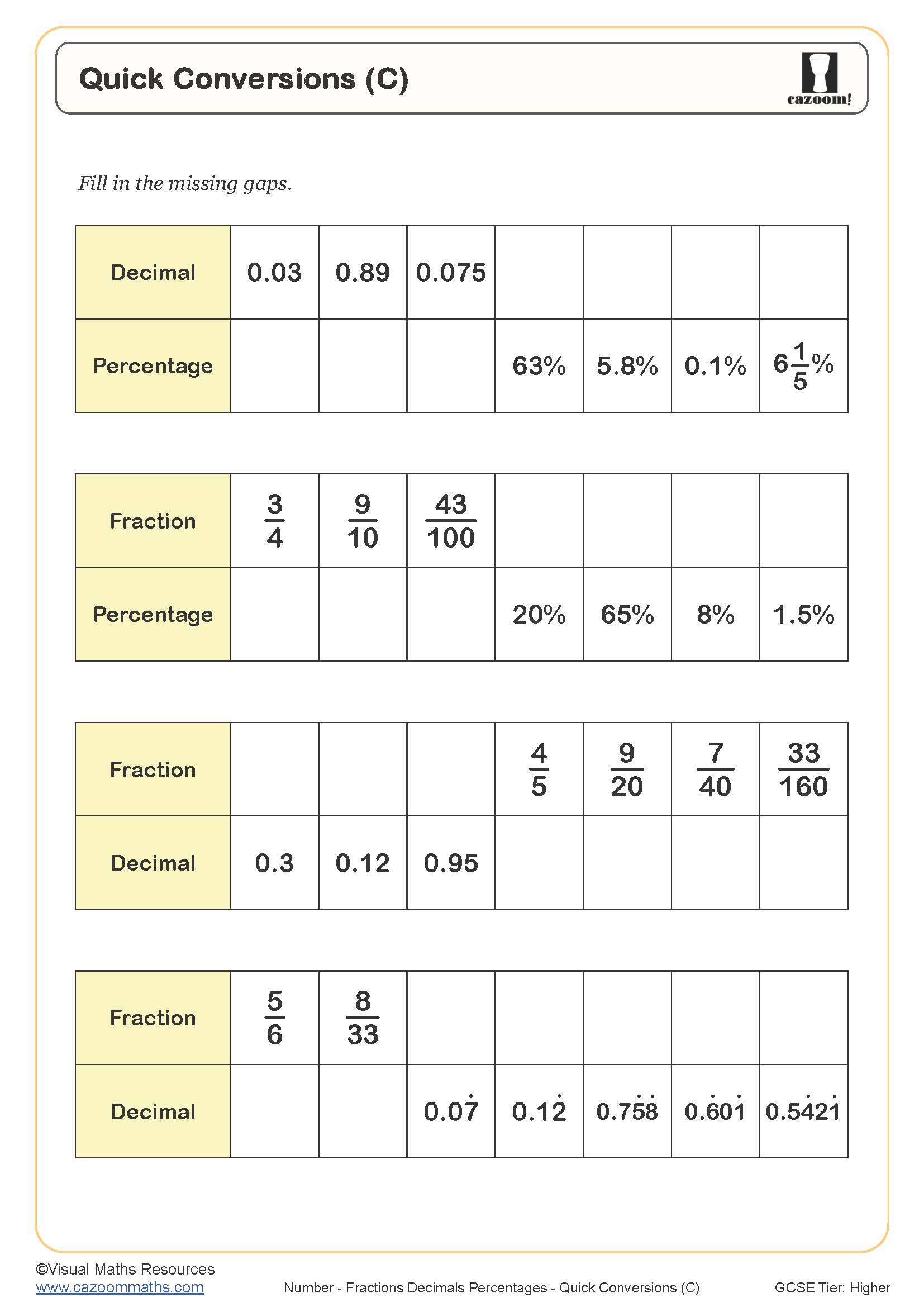
Quick Conversions (C)
Year groups: 10, 11
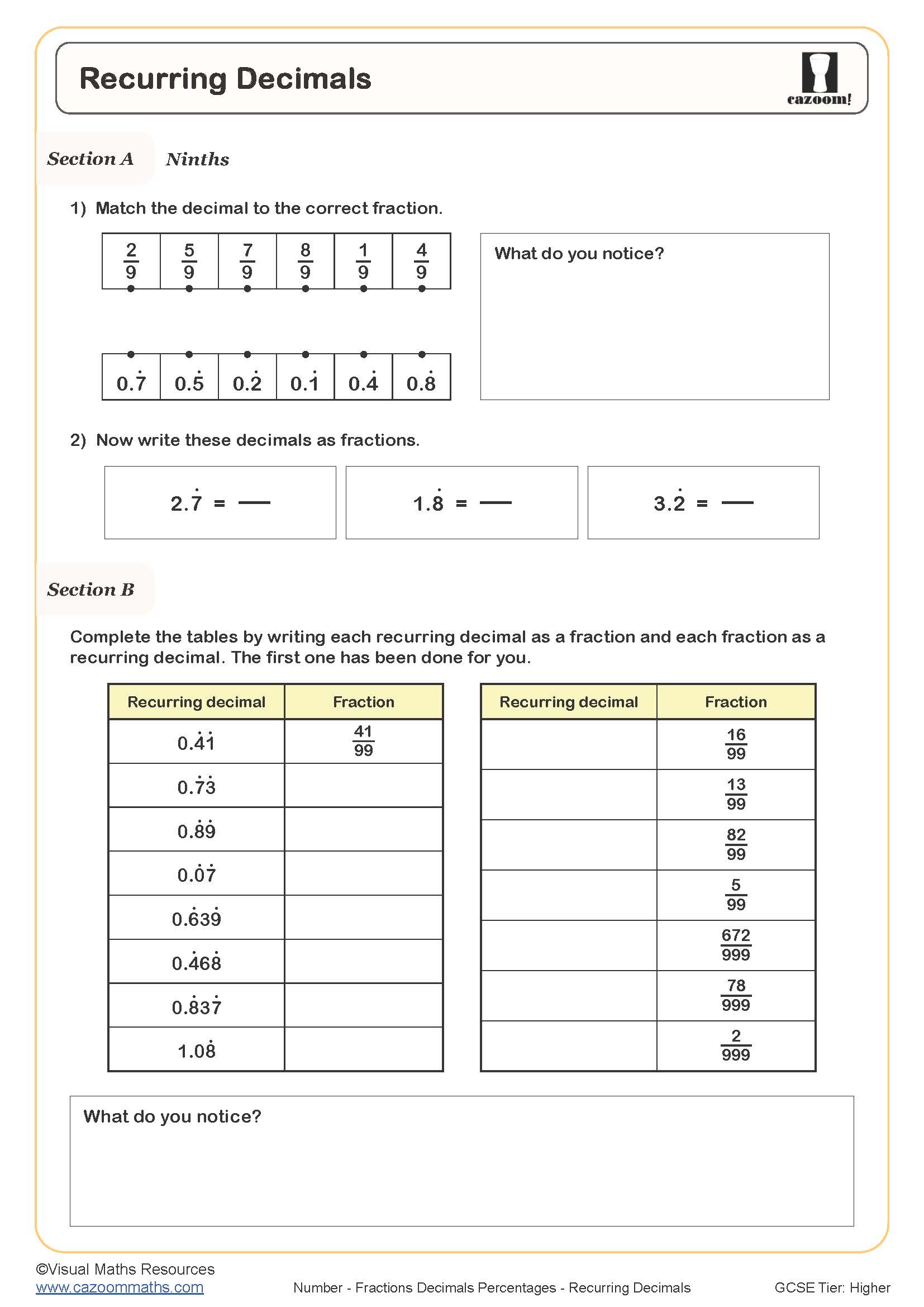
Recurring Decimals
Year groups: 10, 11
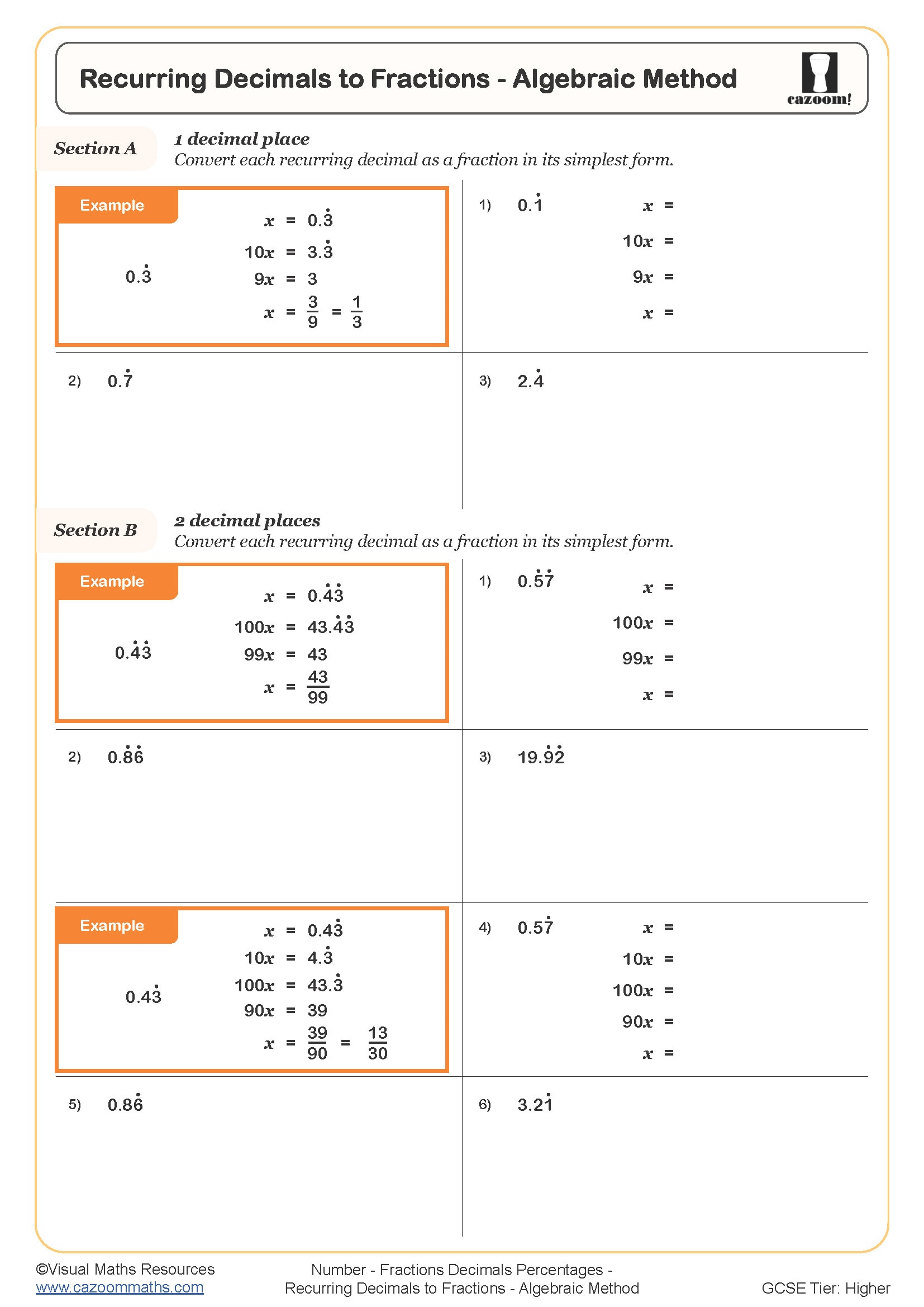
Recurring Decimals to Fractions - Algebraic Method
Year groups: 10, 11
All worksheets are created by the team of experienced teachers at Cazoom Maths.
What makes an effective fractions decimals percentages worksheet?
An effective fdp worksheet combines systematic conversion practice with opportunities to compare and order mixed number forms. The National Curriculum expects Key Stage 3 students to move confidently between fractions, decimals and percentages, building towards GCSE requirements where these skills underpin topics like compound interest and probability calculations.
Teachers notice that students often memorise common equivalences like 1/2 = 0.5 = 50% but falter when converting less familiar fractions such as 3/8. Quality worksheets include both standard conversions and those requiring method application, helping students develop procedural fluency alongside conceptual understanding of what these different representations actually mean.
Which year groups benefit most from converting fractions decimals and percentages practice?
Year 7 and 8 students typically encounter formal conversion methods after building fractional understanding in primary school. The transition from Key Stage 2 to Key Stage 3 requires students to work with more complex fractions and develop systematic approaches to decimal and percentage conversions that extend beyond the tenths they knew previously.
Year 9 students consolidate these skills before GCSE coursework begins, whilst Year 10 and 11 students often return to fraction, decimal and percentage work when tackling compound measures, financial mathematics, and statistical representations. Teachers find that regular retrieval practice prevents students from losing fluency in these fundamental conversions during their GCSE studies.
How do students master equivalent fractions decimals and percentages comparisons?
Students develop confidence with equivalences by practising conversions to a common form before making comparisons. Teachers observe that converting everything to decimals often provides the clearest route for ordering mixed collections, though students should understand multiple approaches including percentage conversion for some contexts.
Common errors include placing 0.7 after 0.65 when ordering decimally, or incorrectly converting 3/5 to 35% instead of 60%. Worksheets that combine ordering tasks with conversion practice help students spot these mistakes whilst building the fluency needed for GCSE problem-solving where quick equivalence recognition becomes essential.
How can teachers use these worksheets most effectively in lessons?
Many teachers begin lessons with retrieval practice using quick conversion questions, then progress to more complex comparison and ordering tasks. The included answer sheets enable peer marking sessions where students explain their conversion methods to classmates, reinforcing understanding through mathematical dialogue.
Differentiation works well by assigning simpler fractions like halves and quarters to some students whilst others tackle sevenths and elevenths that require long division. Teachers find that linking conversions to real-world contexts such as sale percentages, sports statistics, or recipe scaling helps students appreciate why fluency between these three number forms matters beyond the mathematics classroom.