Problem Solving GCSE Revision Worksheets
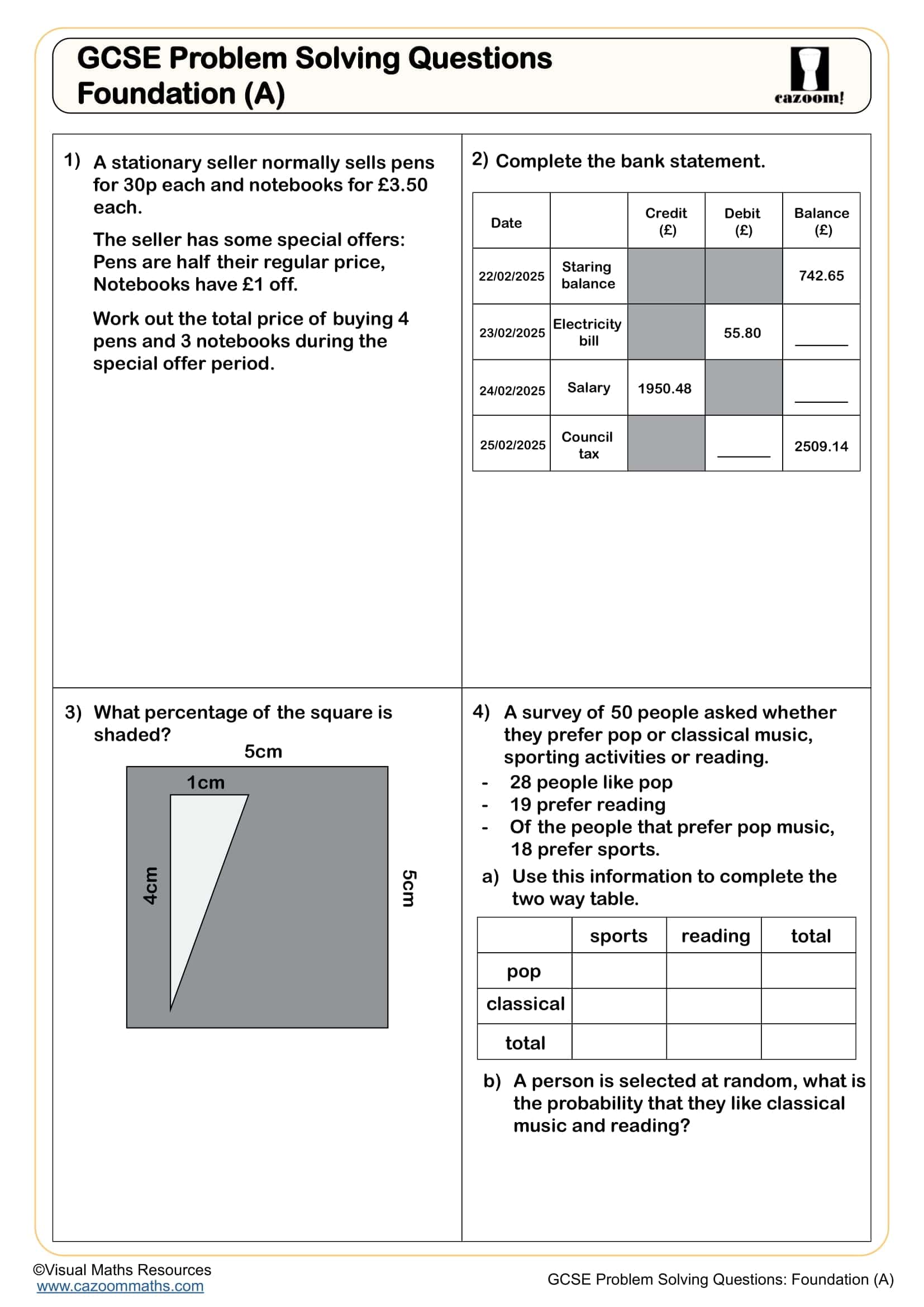
GCSE Problem Solving Questions: Foundation (A)
Target Grade: 1-3
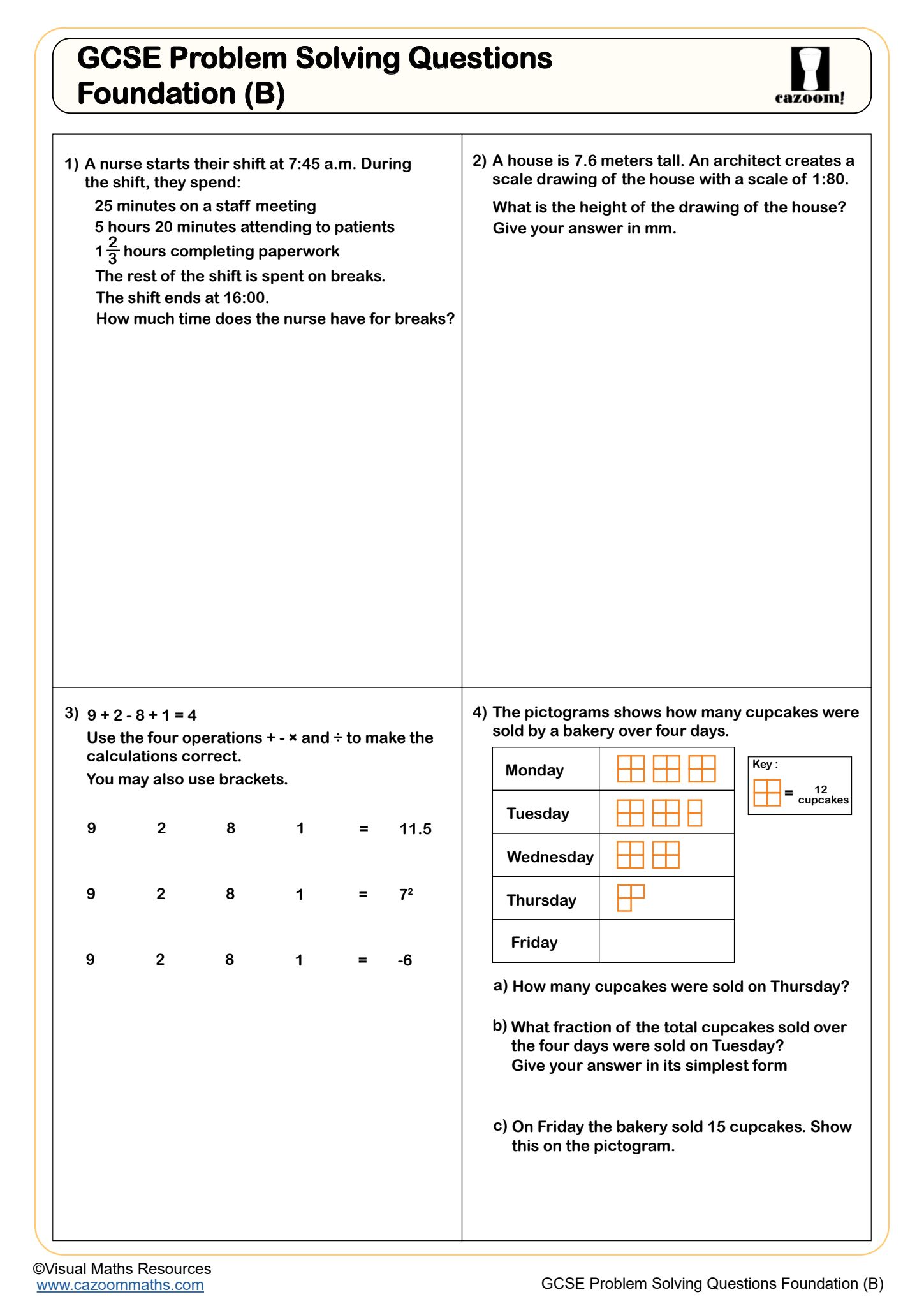
GCSE Problem Solving Questions: Foundation (B)
Target Grade: 1-3
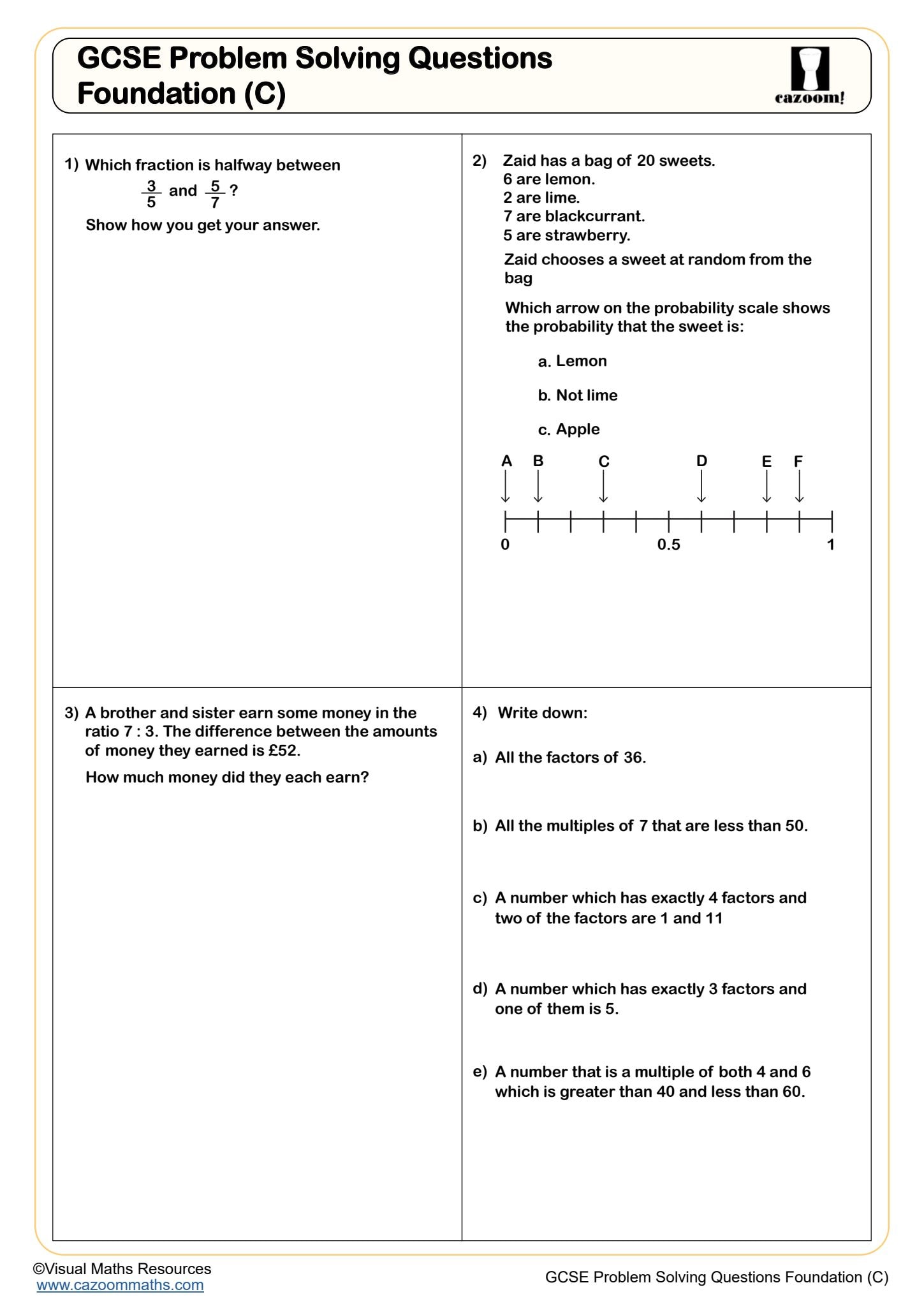
GCSE Problem Solving Questions: Foundation (C)
Target Grade: 1-3
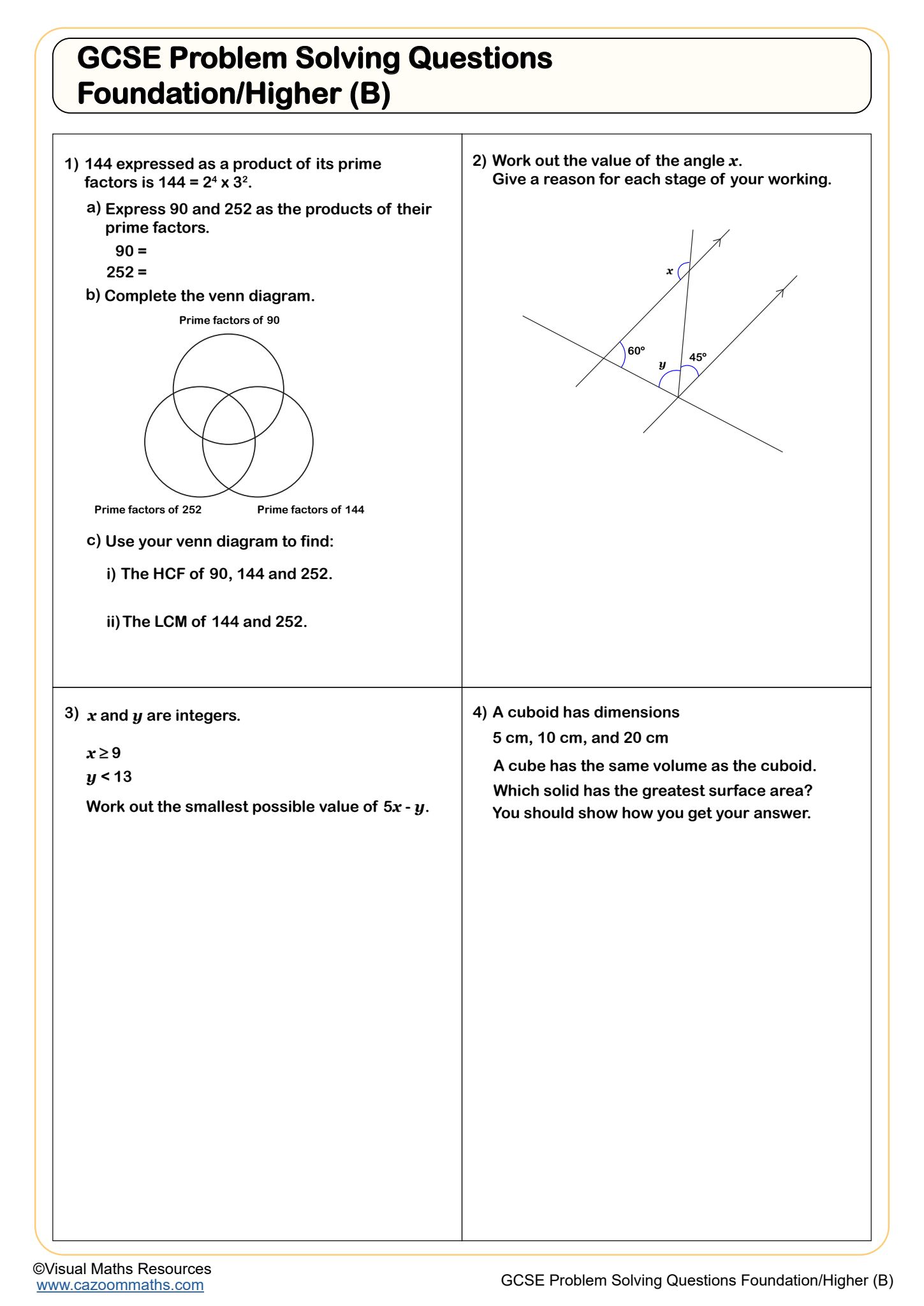
GCSE Problem Solving Questions Foundation/Higher (B)
Target Grade: 4-5
GCSE Problem Solving Questions Foundation/Higher (C)
Target Grade: 4-5
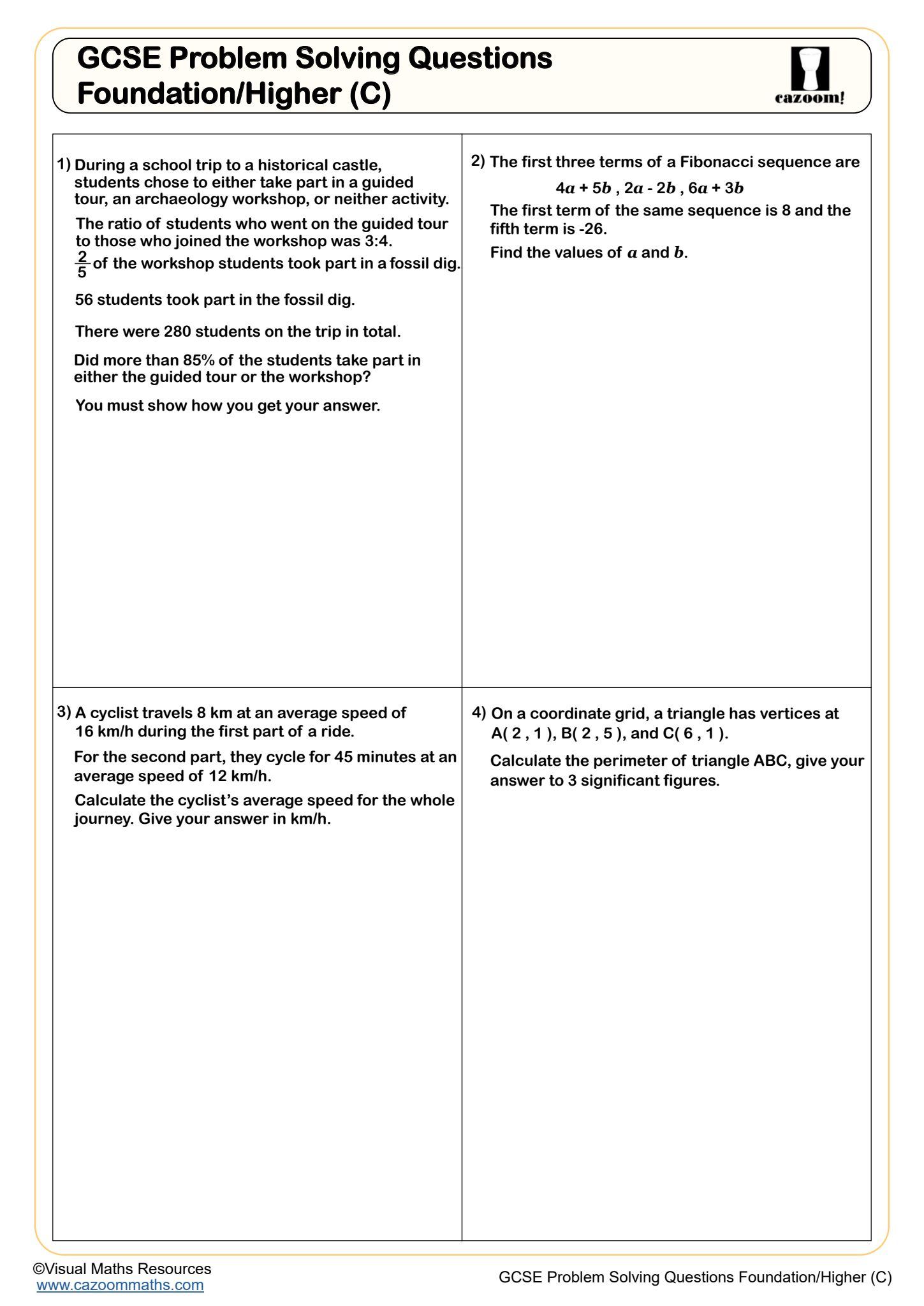
GCSE Problem Solving Questions Higher (A)
Target Grade: 6-7
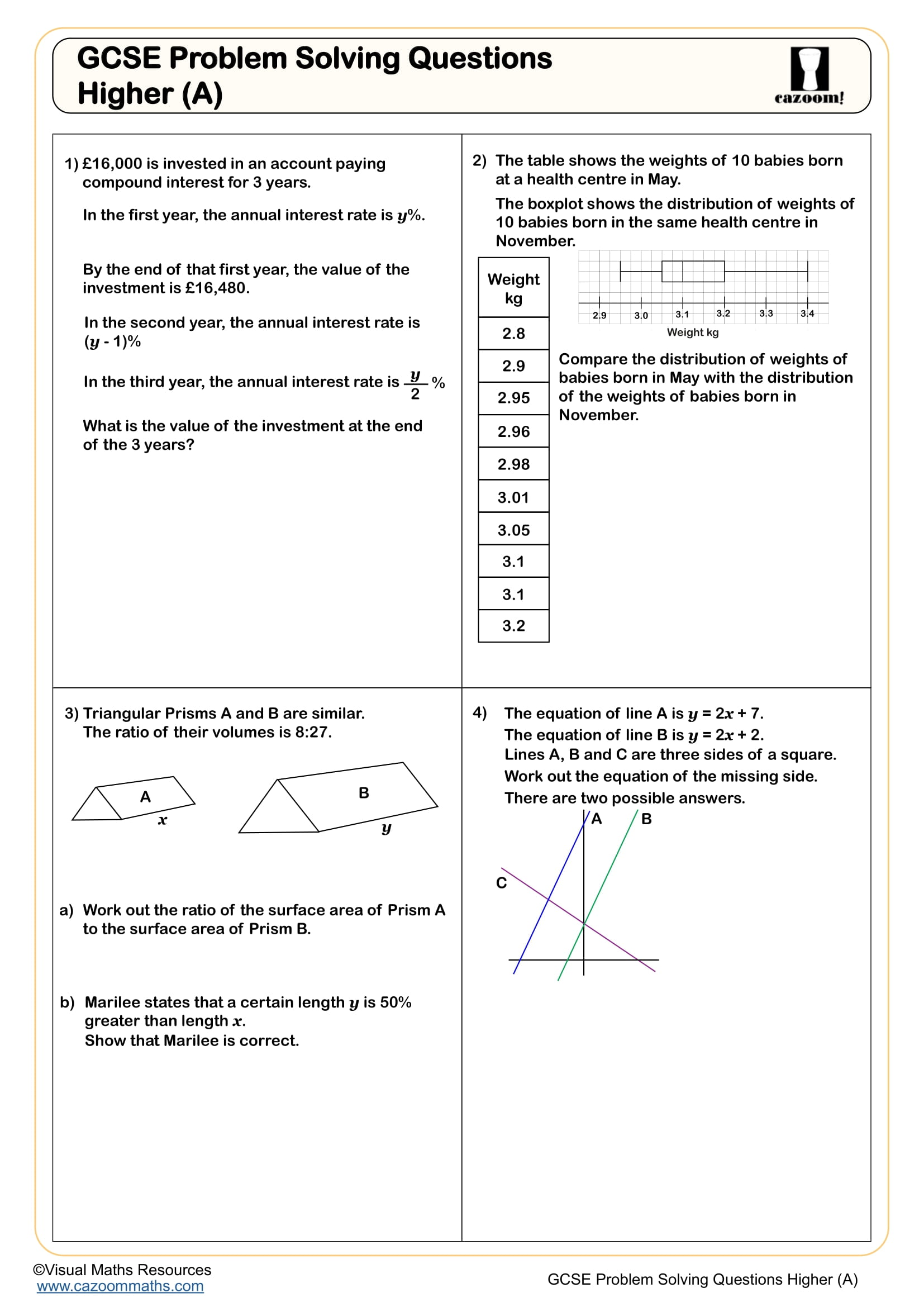
GCSE Problem Solving Questions Higher (B)
Target Grade: 6-7
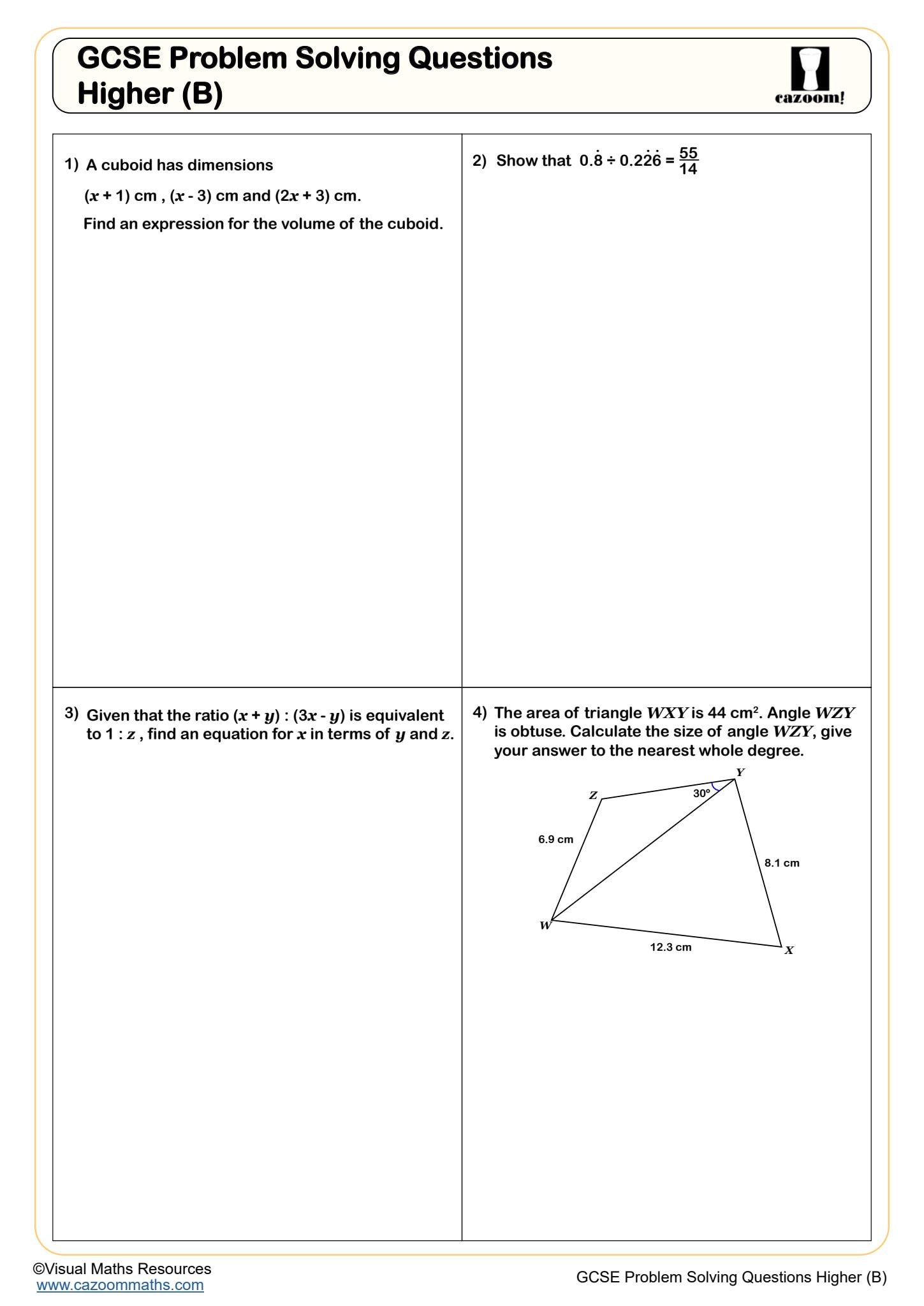
GCSE Problem Solving Questions Higher (C)
Target Grade: 6-7
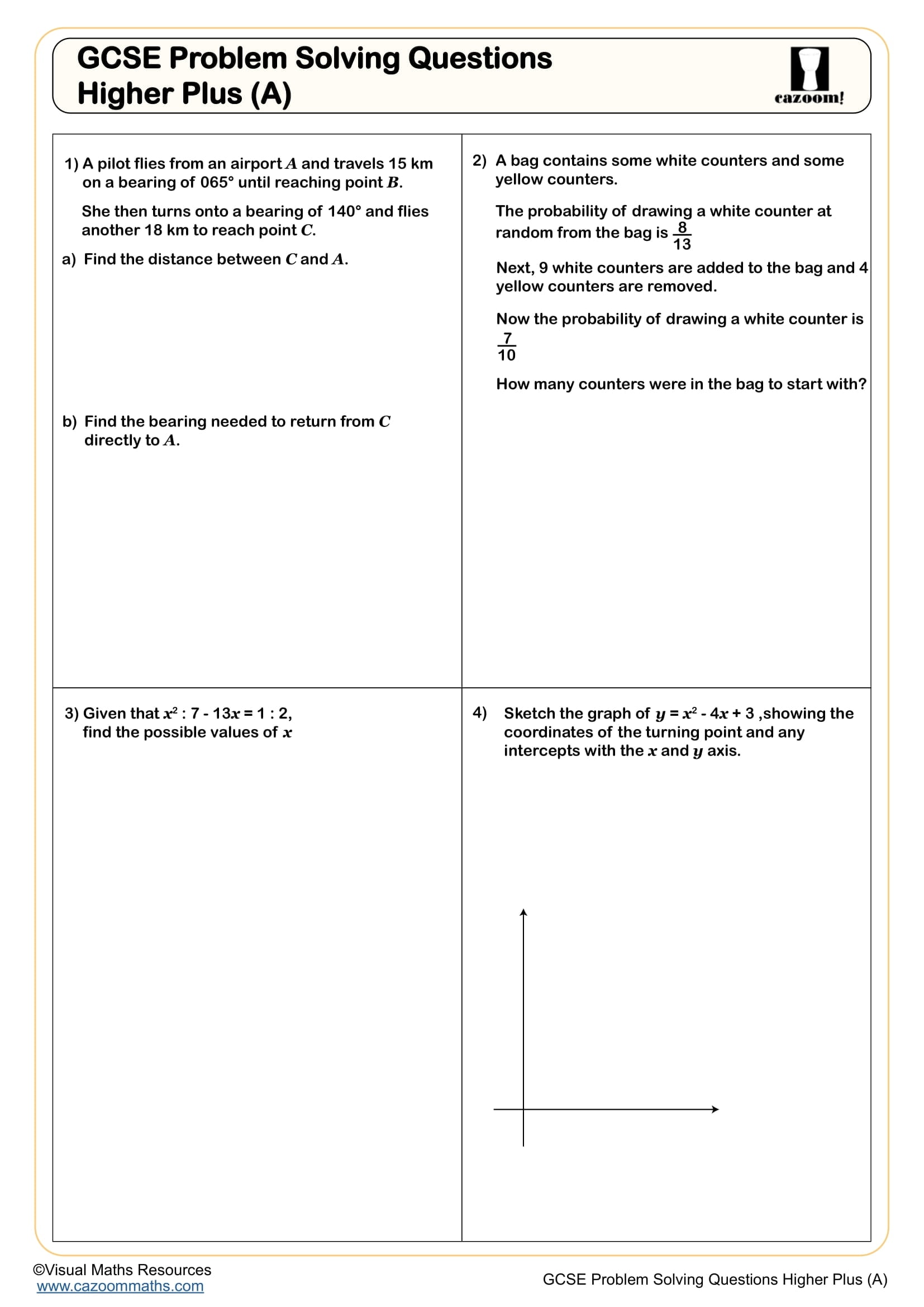
GCSE Problem Solving Questions Higher Plus (A)
Target Grade: 8-9
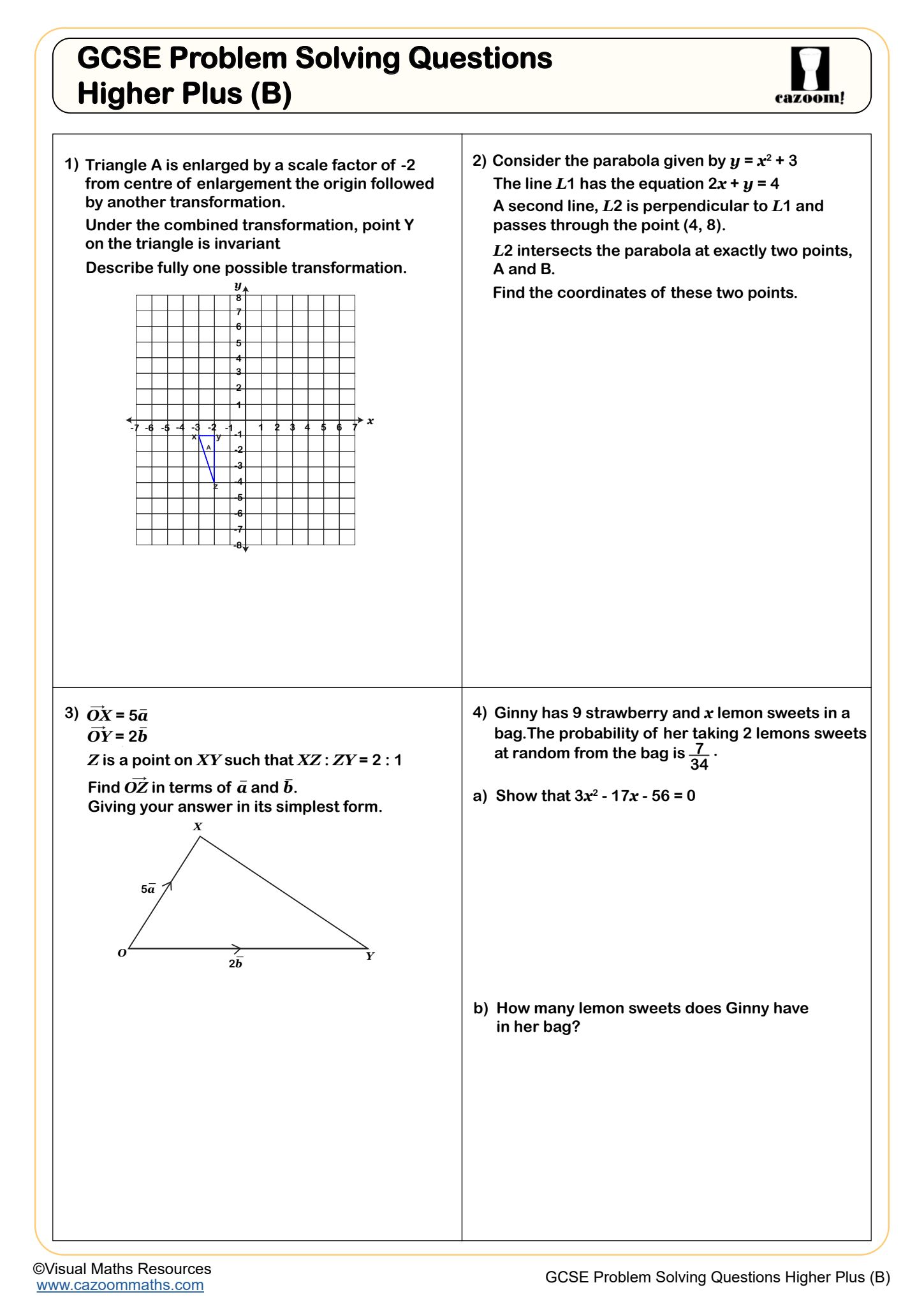
GCSE Problem Solving Questions Higher Plus (B)
Target Grade: 8-9
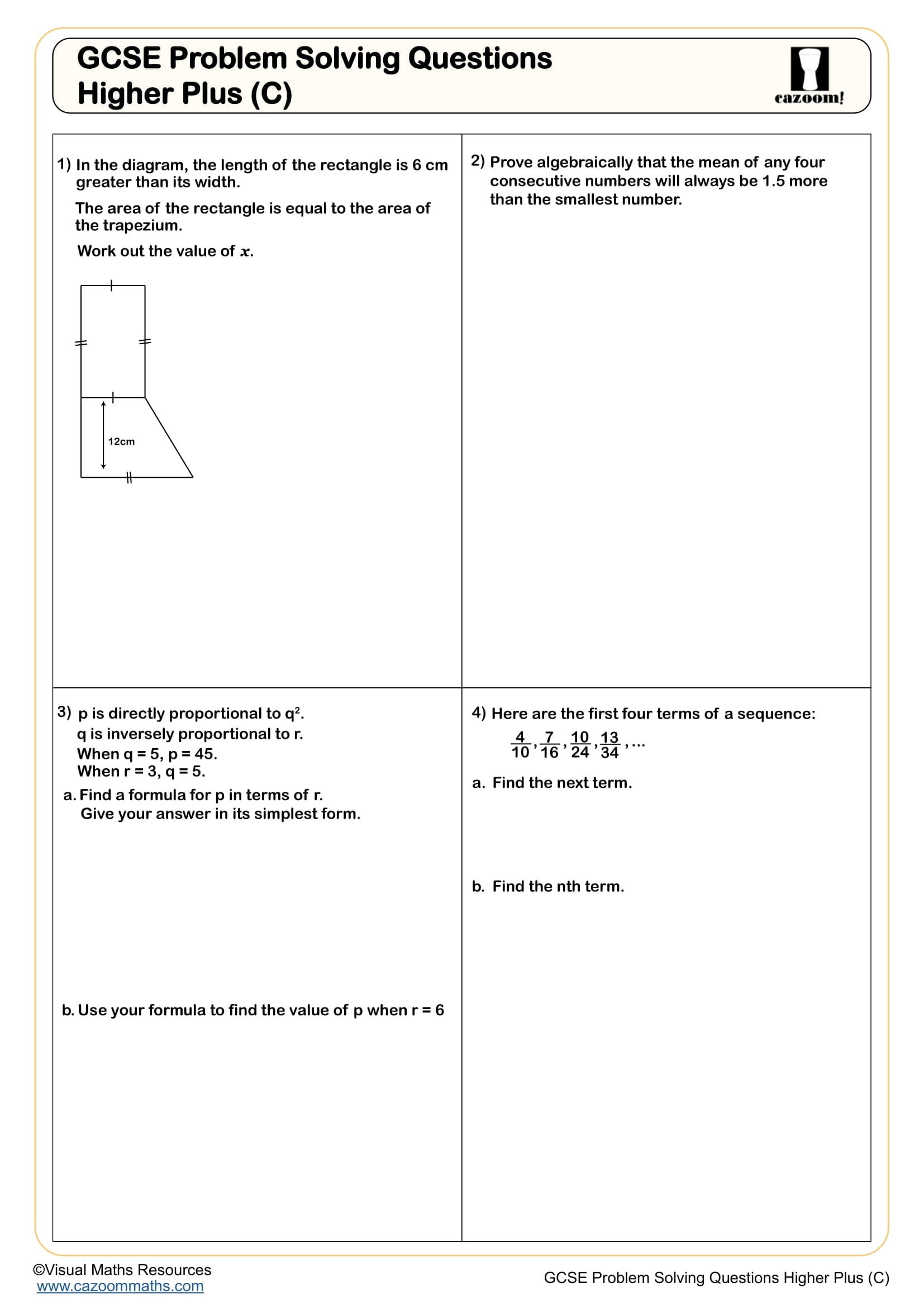
GCSE Problem Solving Questions Higher Plus (C)
Target Grade: 8-9
All worksheets are created by the team of experienced teachers at Cazoom Maths.
What makes GCSE maths problem solving questions different from routine practice?
GCSE problem solving questions test whether students can apply mathematical knowledge in unfamiliar contexts without step-by-step instructions. Unlike routine exercises that state which method to use, problem solving gcse maths questions require students to interpret scenarios, identify relevant techniques, and sequence multiple steps. Exam boards deliberately design these questions to assess mathematical reasoning rather than procedural recall.
Students often lose marks not through calculation errors but by failing to show their method clearly or stopping one step short of the final answer. Mark schemes reward systematic working even when final answers are incorrect. Teachers notice that regular practice with gcse maths problem solving worksheets helps students develop the persistence and strategic thinking needed to tackle unfamiliar question formats under exam pressure.
How are the problem solving worksheets organised by GCSE grade?
The worksheets span four grade bands: grades 1-3 covering Foundation basics like ratio, percentages and angle problems; grades 4-5 bridging Foundation and Higher with topics like simultaneous equations and Pythagoras' theorem; grades 6-7 focusing on Higher tier content including circle theorems, vectors and algebraic proof; and grades 8-9 tackling Higher Plus material such as quadratic inequalities and trigonometric graphs. Each grade band contains problem solving questions at the appropriate difficulty level alongside topic-specific practice.
Foundation tier students (targeting grades 1-5) should concentrate on grades 1-3 and 4-5 materials, whilst Higher tier students need grades 4-5 to consolidate foundations before attempting grades 6-7 and 8-9 content. This structure allows teachers to assign targeted revision based on mock exam performance and identified gaps.
How is problem solving assessed in GCSE maths exams?
Problem solving questions appear across all three GCSE papers (two non-calculator, one calculator) and typically carry 2-6 marks depending on complexity. Examiners use AO2 (reasoning and application) and AO3 (problem solving) assessment objectives for these questions, looking for evidence that students can interpret contexts, choose appropriate methods, and execute multi-step solutions. Unlike standard questions where one mark rewards each step, problem solving questions often allocate marks for setting up equations, showing complete reasoning, or interpreting numerical answers within the original context.
Students frequently lose marks by rushing to calculate without planning their approach or failing to convert their answer back to the question's context (for instance, calculating total cost but not giving change). Exam mark schemes expect students to show every step of their working. Teachers notice that students who practise identifying what the question actually asks before starting calculations perform significantly better.
What revision strategies work best for GCSE problem solving?
Effective problem solving revision requires varied practice under exam-like conditions rather than repeating the same question types. Students benefit from attempting worksheets in timed sessions, allowing roughly one minute per mark, then reviewing their approach against worked solutions to identify where their method diverged. Spaced repetition proves more effective than marathon sessions, with students revisiting challenging question types across multiple revision periods to build lasting understanding.
Teachers often set problem solving worksheets as low-stakes homework to diagnose misconceptions before dedicating lesson time to common difficulties. Pairing worksheet practice with past paper questions helps students recognise how familiar concepts appear in unfamiliar contexts. Many departments use revision mats for starter activities, keeping previously mastered topics fresh whilst building exam stamina through regular exposure to multi-step reasoning.