Algebra and Area Worksheets
All worksheets are created by the team of experienced teachers at Cazoom Maths.
What is algebra and area in KS3 maths?
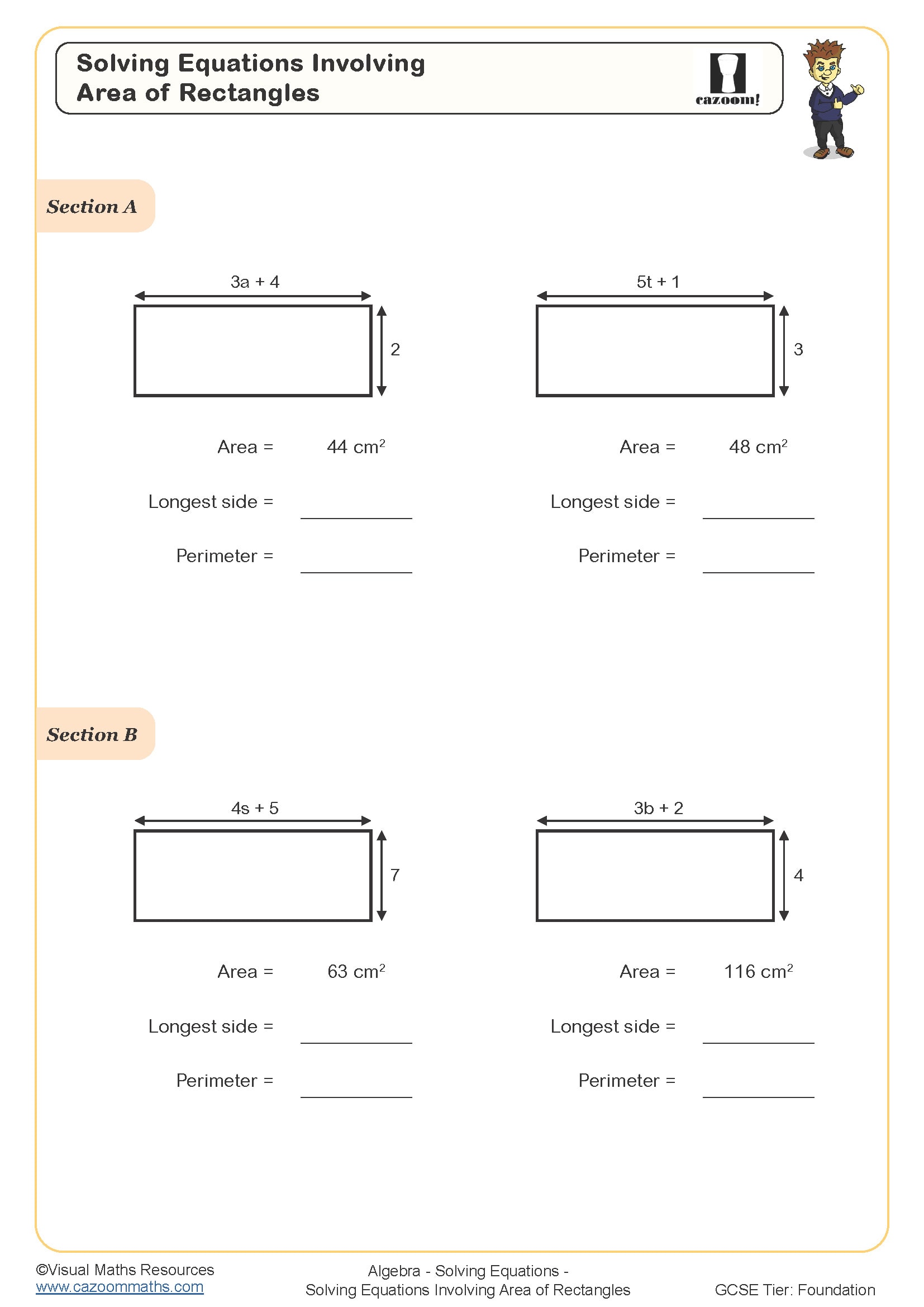
Algebra and area combines two key strands of the National Curriculum: using algebraic notation to represent unknown quantities and calculating areas of 2D shapes. Students work with shapes where one or more dimensions are expressed algebraically, such as a rectangle with width x and length 2x + 3, then use area formulae to create equations they must solve. This connects procedural algebra skills with geometric understanding.
The most common error occurs when students multiply out expressions incorrectly, particularly when both dimensions contain variables. Teachers frequently see students write (x + 2)(x + 3) = x² + 6 instead of x² + 5x + 6, leading to incorrect equations. Students also lose marks when they forget to state units in their final answers or fail to check whether their solutions make sense in the geometric context, such as arriving at negative lengths.
Which year groups study algebra and area?
These worksheets target Year 8 and Year 9 students at Key Stage 3, where the curriculum expects students to apply their algebraic skills to geometric contexts. Year 8 work typically focuses on simpler expressions where one dimension is algebraic, building confidence in forming equations from area information before solving them. Year 9 content extends this to more complex scenarios involving compound shapes, simultaneous dimensions with algebra, and problems requiring manipulation of quadratic expressions.
Progression across these year groups involves increasing algebraic complexity and shape variety. Year 8 students might work with rectangles where length = 3x and width = x + 4, creating linear equations when area is given. By Year 9, students tackle problems involving expanding brackets within area calculations, dealing with trapeziums and compound shapes, and working backwards from area to find specific dimensions, preparing them for GCSE problem-solving questions.
How do you form equations from area problems?
Forming equations from area problems requires identifying the appropriate area formula for the shape, substituting algebraic expressions for the dimensions, then setting this equal to the given area value. For a rectangle with length (2x + 1) cm and width x cm, students apply Area = length × width to write 2x² + x = area. When the area is specified, such as 15 cm², they create the equation 2x² + x = 15, which they rearrange and solve using factorisation or the quadratic formula depending on complexity.
This skill connects directly to architectural planning and design technology, where professionals work with constrained spaces and must calculate dimensions algebraically. Garden designers might need to determine pathway widths around rectangular lawns when total area is fixed, while packaging engineers optimise box dimensions to achieve specific volumes whilst minimising material costs. These real-world applications demonstrate why combining algebraic and geometric reasoning matters beyond the classroom.
How can teachers use these algebra and area worksheets effectively?
The worksheets scaffold learning by starting with shapes where dimensions are clearly stated in algebraic form before progressing to problems requiring interpretation and equation formation. Questions build systematically from single-step problems to multi-step challenges, allowing students to develop confidence with the method before tackling more demanding contexts. Answer sheets enable students to check their working independently, helping them identify where algebraic manipulation or geometric reasoning breaks down.
Many teachers use these worksheets during intervention sessions with students who struggle to connect different mathematical topics, as the visual nature of area problems helps make abstract algebra more concrete. They work well for homework following initial teaching, allowing students to consolidate the method independently. In mixed-ability classes, teachers often set these as paired work where stronger students explain their reasoning, reinforcing algebraic vocabulary and problem-solving strategies whilst supporting peers who find the topic challenging.