Angle Notation Worksheets
All worksheets are created by the team of experienced teachers at Cazoom Maths.
What is angle notation and why does it matter in maths?
Angle notation is the system of using letters to identify and name angles precisely in geometric diagrams. The notation follows specific conventions: angles are written with three letters (such as ∠ABC) where the middle letter indicates the vertex, or with a single letter when only one angle exists at that point. This notation becomes essential from Year 7 onwards when students progress beyond simply measuring angles to using them in calculations and proofs.
Students often make the error of writing angle letters in the wrong order, not recognising that ∠ABC and ∠CBA represent different angles when multiple angles share the same vertex. Teachers notice this particularly when diagrams show intersecting lines or angles within polygons. Mark schemes in assessments expect students to use notation accurately, and marks are frequently lost when angle names are incorrect even if the numerical answer is right.
Which year groups study angle notation?
Angle notation appears in the KS3 curriculum, with these worksheets covering Year 7 and Year 8 content. Students are introduced to the three-letter notation system in Year 7 as they move beyond primary school angle work, where angles were often just labelled with single letters or described in words. This notation underpins much of the geometry strand in the National Curriculum, linking directly to work on angle facts, parallel lines, and polygons.
The progression across Year 7 and Year 8 involves increasing complexity in diagrams. Early work uses simple angles with clear vertices, whilst later practice includes more challenging scenarios with overlapping triangles, angles on parallel lines, and situations where students must identify which three letters correctly name a specific angle. By Year 8, students are expected to use this notation fluently when solving multi-step angle problems and writing geometric reasoning.
How do you measure angles using proper notation?
Measuring angles with correct notation involves two skills: accurately reading a protractor and recording the measurement with the appropriate angle name. When measuring ∠ABC, students place the protractor's centre point on vertex B, align the baseline with ray BA, and read where ray BC crosses the scale. The notation tells you exactly which angle to measure, which becomes crucial when multiple angles share the same vertex or when reflex angles are involved.
This skill has direct applications in construction, engineering, and design work. Architects use angle notation in building plans to specify roof pitches and structural angles precisely. In navigation and surveying, professionals use three-point angle notation to describe bearings and positions where landmarks create specific angles. Engineers working with mechanical linkages or robotics use this same notation to programme movement angles, demonstrating why precision in mathematical language matters beyond the classroom.
How can these angle notation worksheets support student learning?
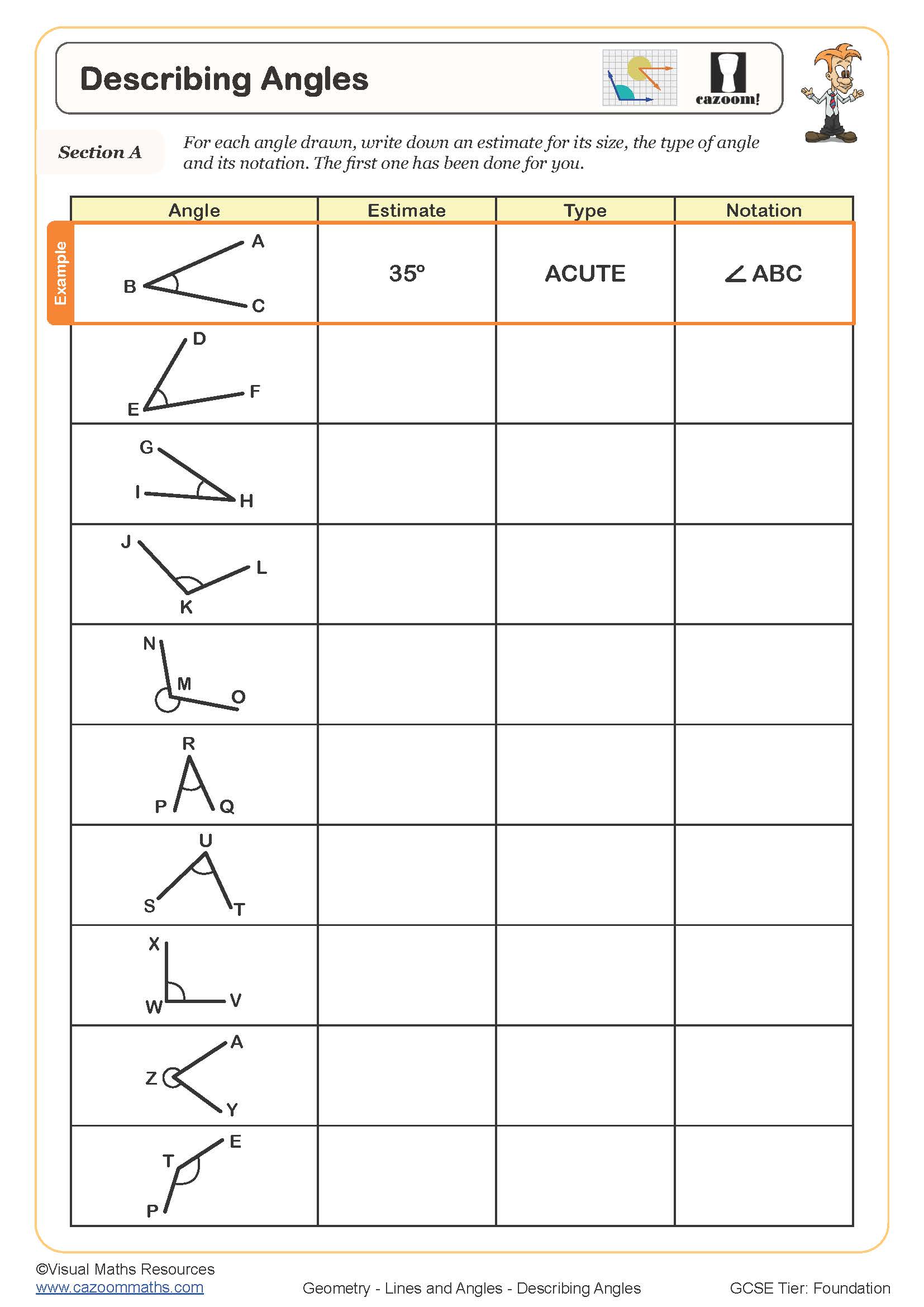
The worksheets build competence through structured practice that moves from identifying pre-labelled angles to writing notation independently. Questions typically start with diagrams where students match angle notation to the correct angle shown, then progress to naming angles themselves and finally measuring angles whilst applying correct notation. This scaffolded approach helps students develop both the conceptual understanding of what the notation represents and the procedural skill of writing it accurately.
Teachers use these resources effectively as introductory material when first teaching geometric reasoning, or as retrieval practice before topics requiring angle notation such as angles in parallel lines or circle theorems. The worksheets work well for paired activities where students take turns naming angles for their partner to identify, reinforcing the communication aspect of mathematical notation. With answer sheets provided, they suit homework tasks or intervention sessions where students need to consolidate this fundamental skill before tackling more complex geometry.