Area of a Triangle Using the Sine Rule Worksheets
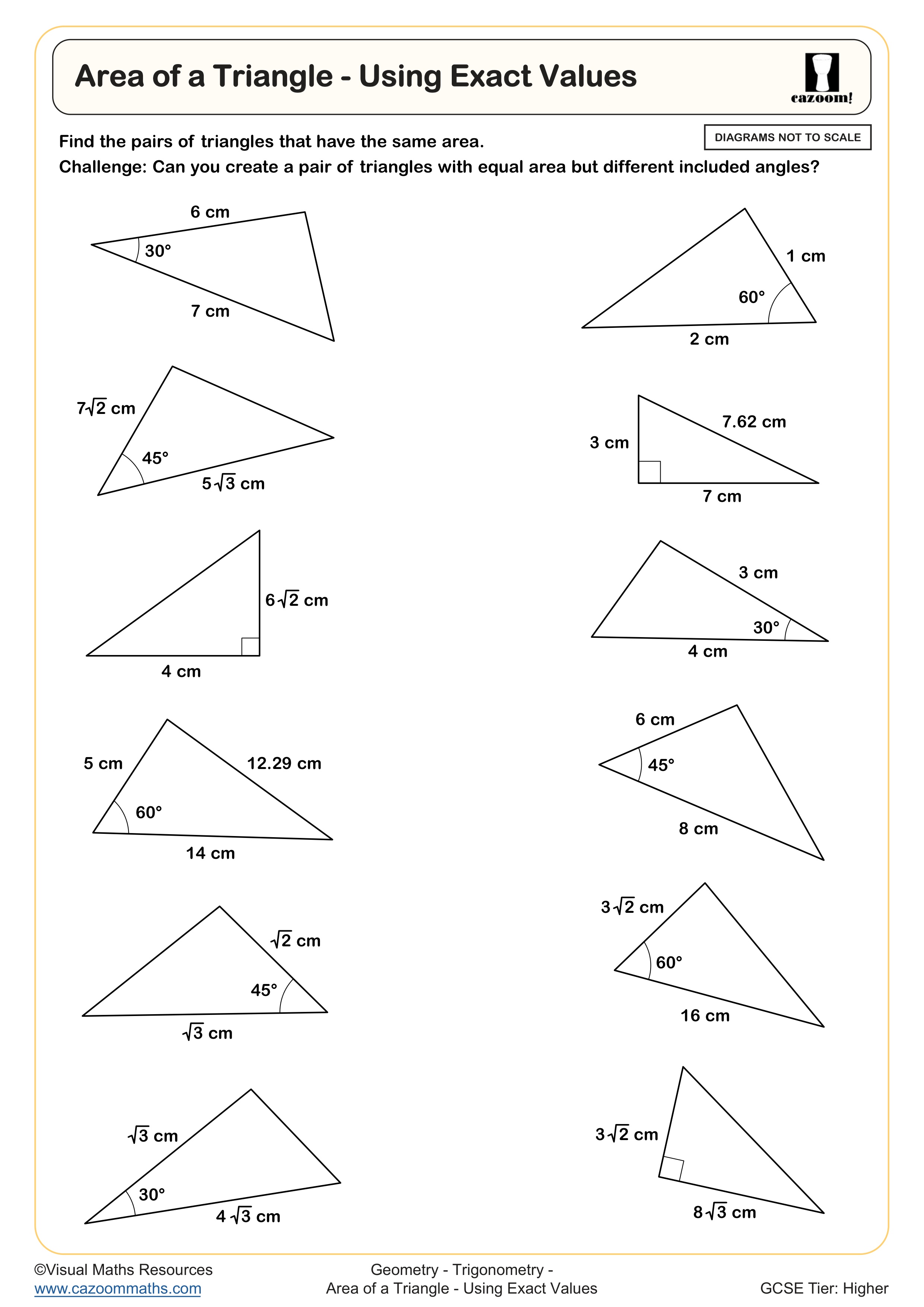
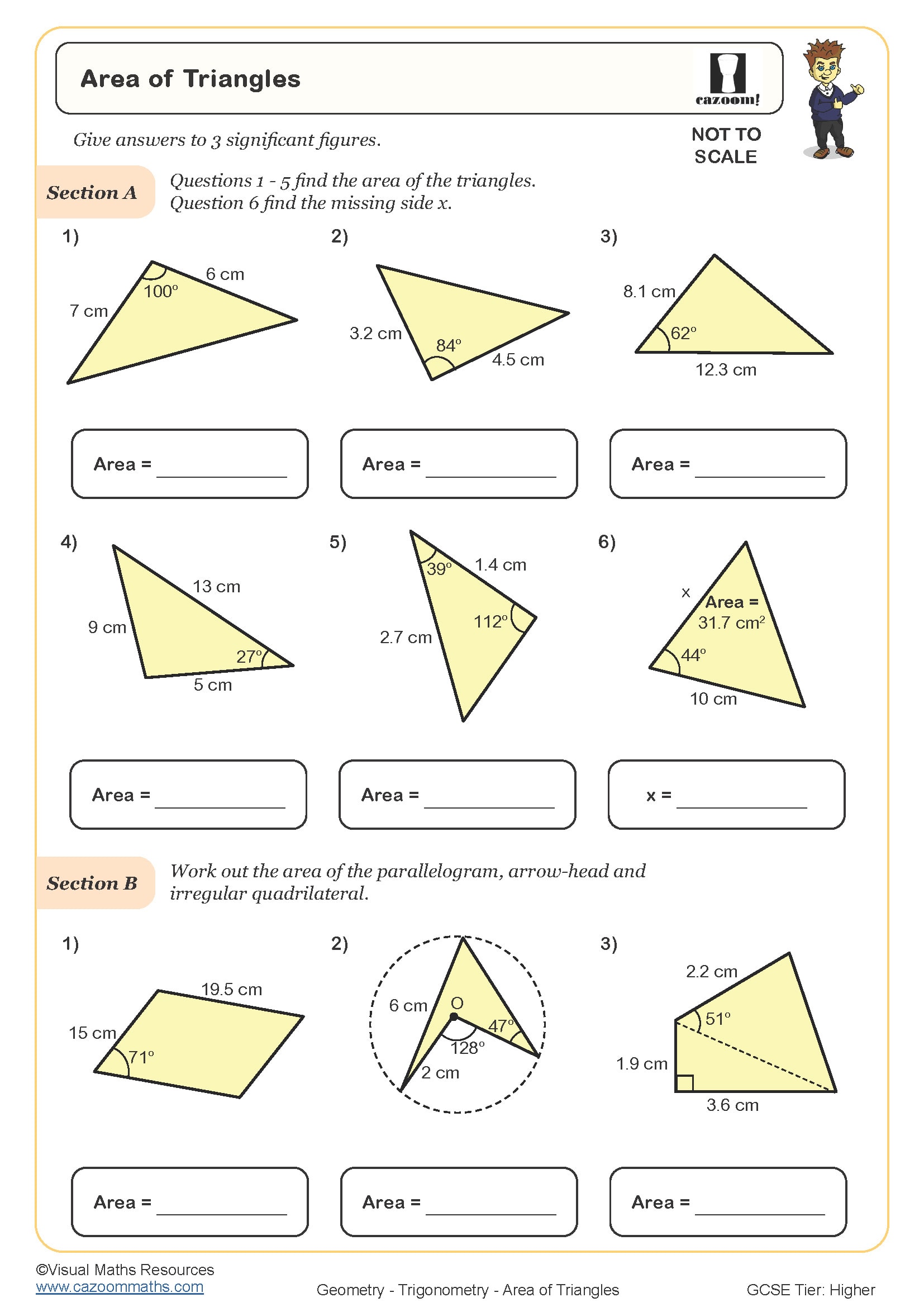
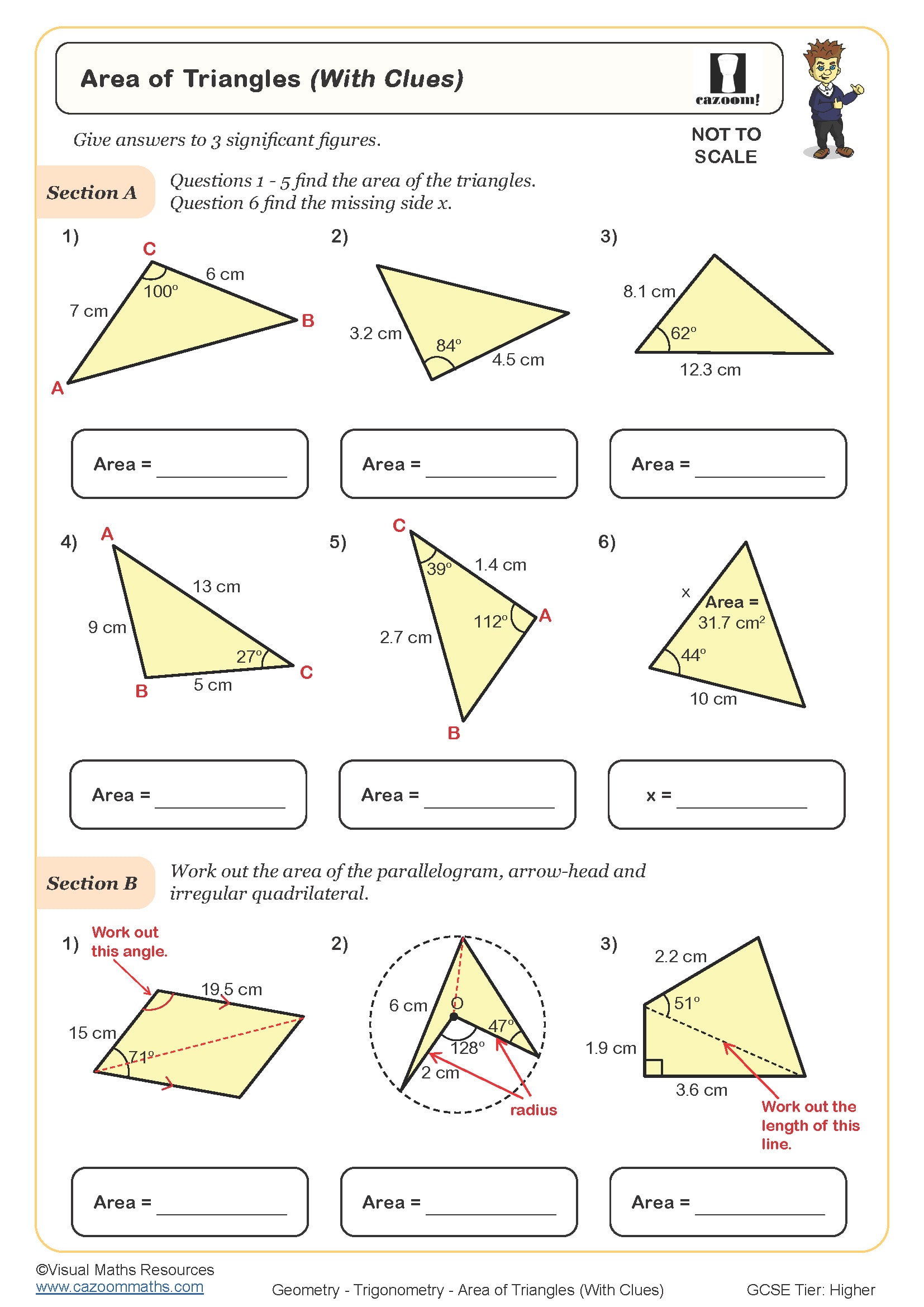
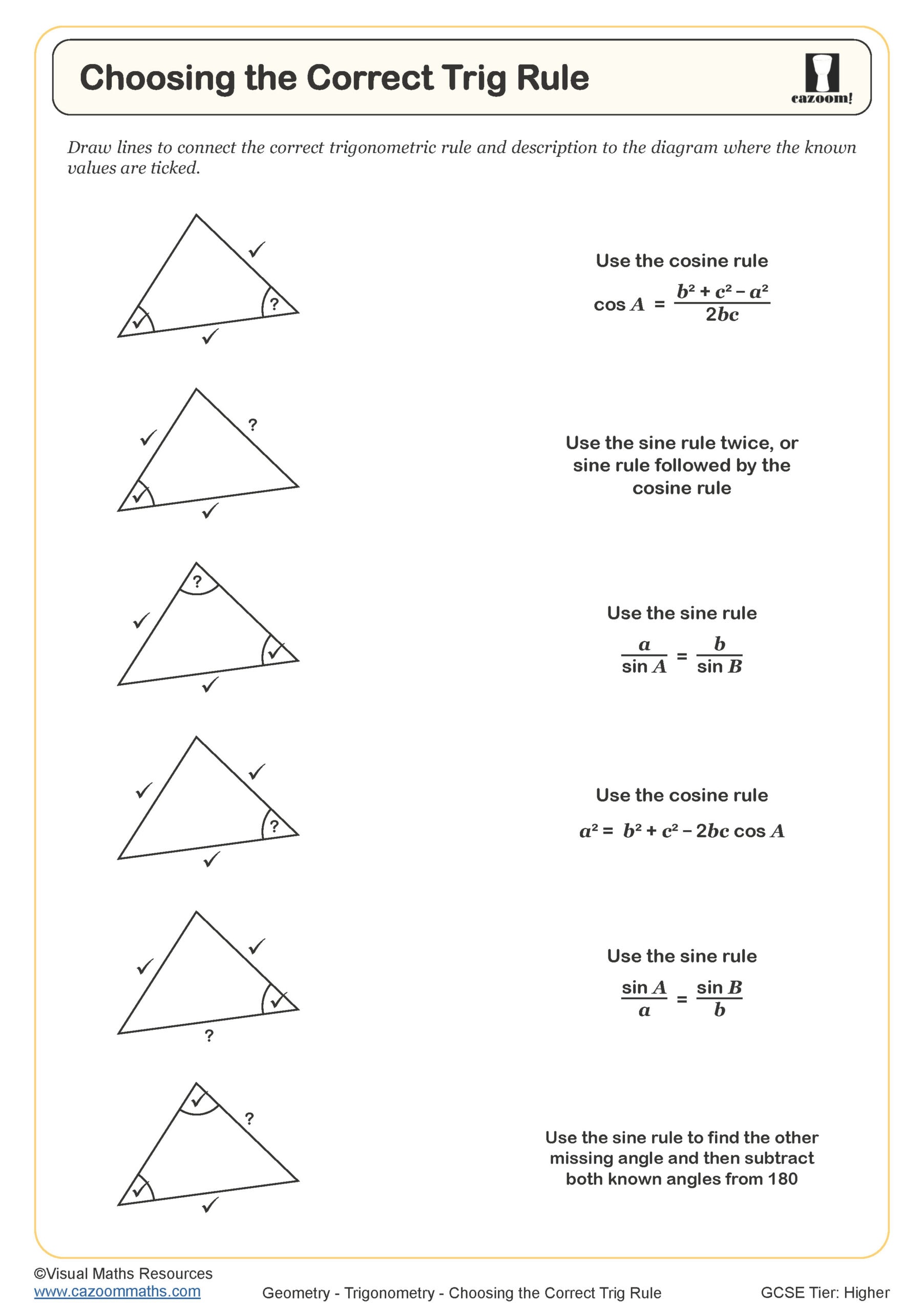
All worksheets are created by the team of experienced teachers at Cazoom Maths.
What is the formula for area of a triangle using sine?
The formula is Area = ½ab sin C, where a and b are two sides of the triangle and C is the included angle between those sides. This formula extends the basic area calculation to situations where you know two sides and the angle between them, rather than the base and perpendicular height. Students must recognise that the angle used in the formula must be the one sitting between the two known sides.
A common error occurs when students use any angle from the triangle rather than the included angle. For example, given sides of 8 cm and 10 cm with a 50° angle between them, students sometimes mistakenly use a different angle if one is marked elsewhere on the diagram. Exam mark schemes consistently penalise this error, even if the calculation itself is performed correctly, because selecting the wrong angle produces an entirely different area.
Which year groups study area of a triangle using the sine rule?
This topic appears in Year 10 and Year 11 as part of the KS4 Higher tier curriculum, typically after students have covered basic trigonometry and the standard area formula. The National Curriculum places this within the geometry and measures strand, requiring students to calculate areas using trigonometric methods. It's exclusively a Higher tier skill, so Foundation tier students won't encounter it in their GCSE examinations.
Progression across these year groups focuses on increasing contextual complexity rather than formula variation. Year 10 work often presents straightforward triangles with clearly labelled sides and angles, whilst Year 11 questions embed the skill within compound shapes, real-world contexts, or multi-step problems requiring algebraic manipulation. Students might need to rearrange the formula to find missing sides or angles, or apply it to calculate areas within trapeziums or parallelograms.
How does sine relate to triangle area?
The sine rule for area derives from the perpendicular height relationship within the triangle. When you know two sides and the included angle, sin C represents the ratio that allows you to calculate the perpendicular height from one side to another. Essentially, the formula combines the traditional ½ × base × height with trigonometry: the height equals one side multiplied by the sine of the angle, giving ½ab sin C as a direct calculation method.
This formula has practical applications in surveying and navigation, where measuring perpendicular heights directly is often impossible. Land surveyors use this method to calculate plot areas when they can measure boundary lengths and angles between them using theodolites or GPS equipment. Similarly, architects apply it when designing triangular roof sections or structural supports, where they know beam lengths and the angles between joints but cannot easily access perpendicular measurements on elevated structures.
How do these worksheets help students practise area calculations?
The worksheets provide structured progression from basic applications of A = ½ab sin C through to questions requiring angle or side identification from diagrams. Questions typically include triangles in various orientations, ensuring students don't rely on visual patterns but genuinely understand which angle must be the included angle. Answer sheets show complete working, helping students identify whether errors stem from formula application, angle selection, or calculator use with trigonometric functions.
Many teachers use these worksheets for targeted intervention with students who've grasped standard area formulae but struggle with trigonometric applications. They work well as homework following initial teaching, allowing students to consolidate the method independently before tackling more complex exam-style questions. The resources also suit paired work, where students can compare their angle selections and discuss why certain angles are appropriate whilst others would give incorrect results, building deeper understanding through mathematical dialogue.