Area of Triangles Worksheets
All worksheets are created by the team of experienced teachers at Cazoom Maths.
What makes an effective area of triangle worksheet with answers?
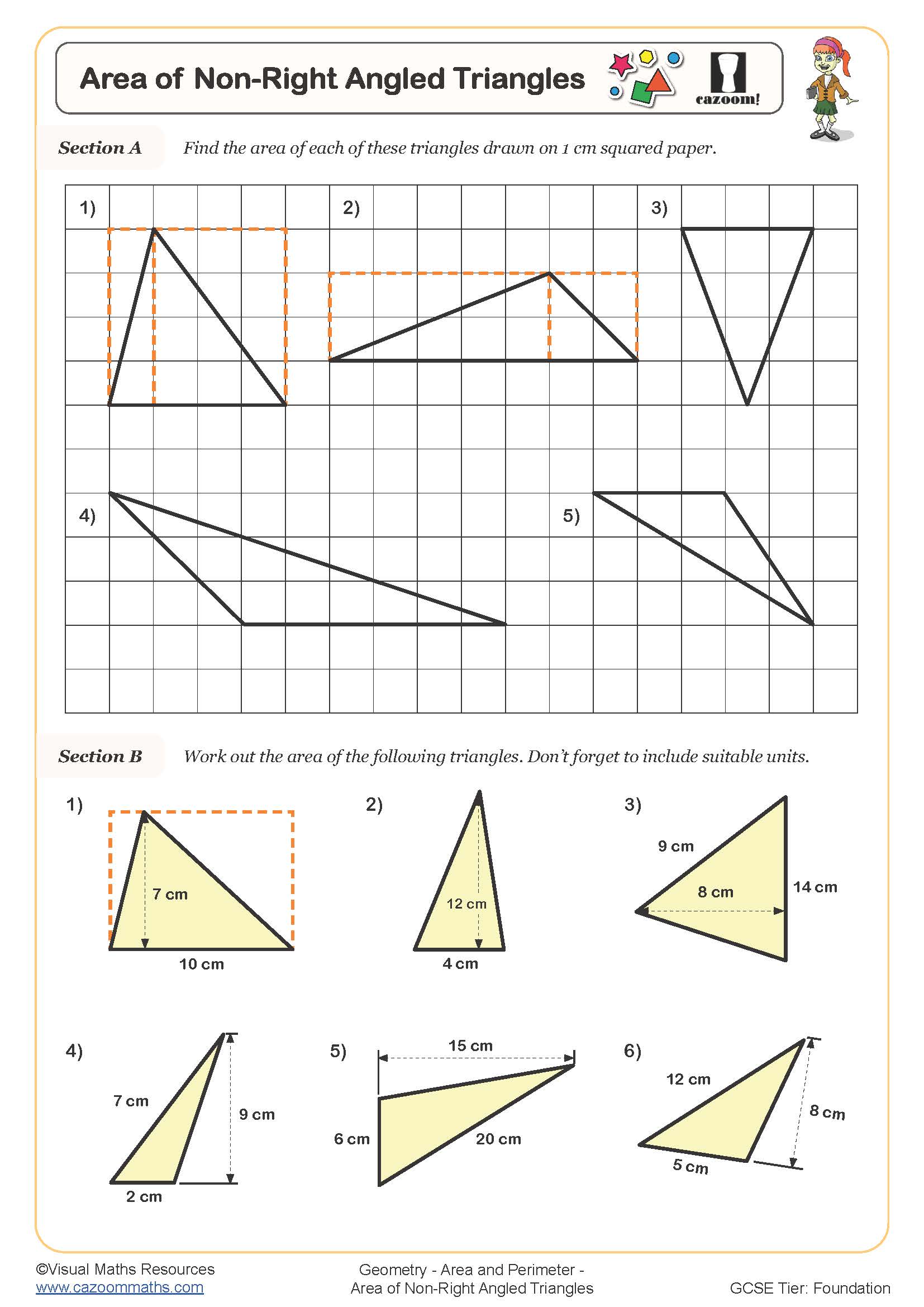
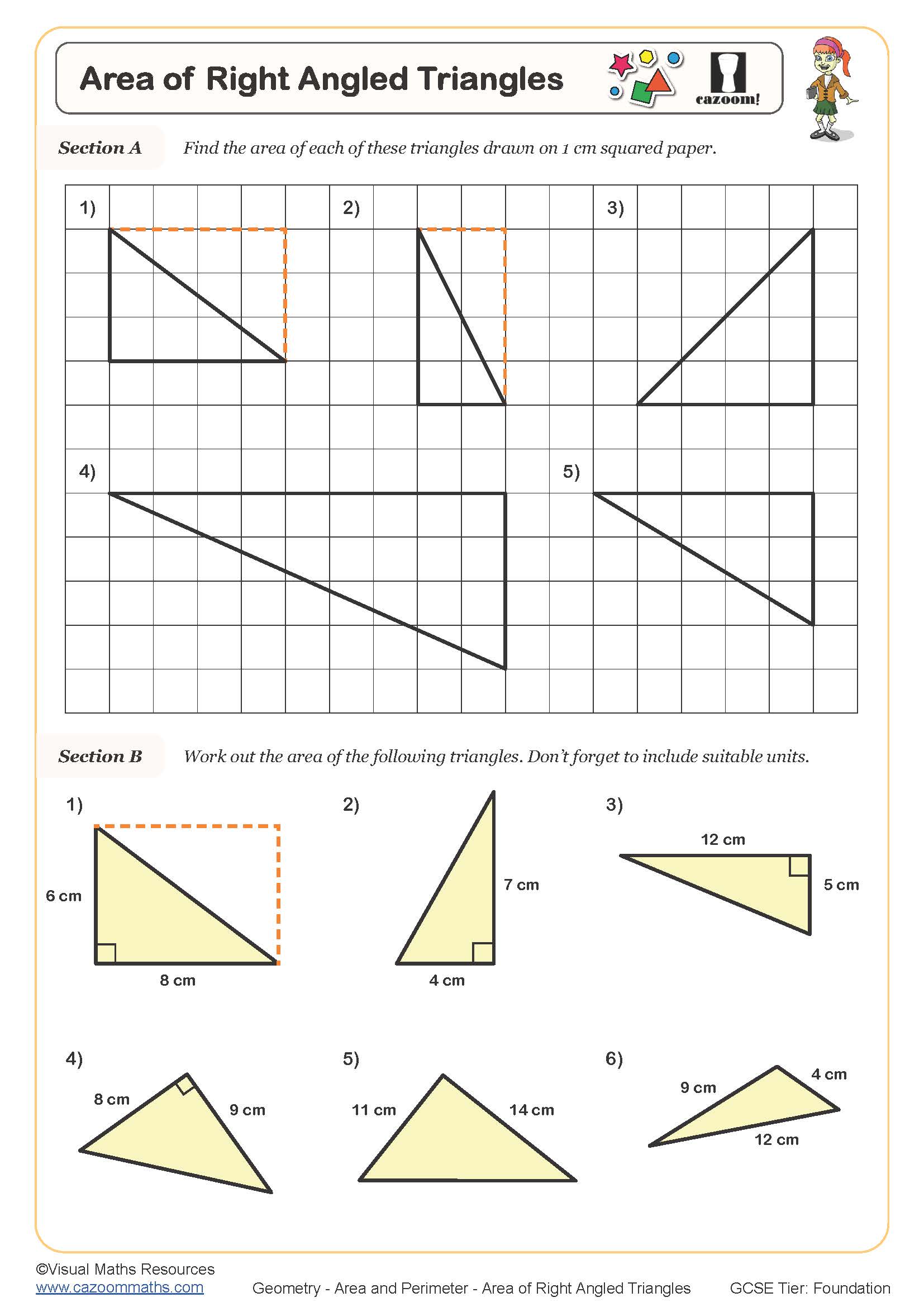
An effective area of triangle worksheet with answers provides clear diagrams with measurements clearly labelled, progressing from straightforward calculations to multi-step problems. The worksheet should include different triangle orientations to prevent students from assuming the base is always horizontal, whilst answer sheets must show working methods alongside final answers.
Teachers notice that students perform better when worksheets include a quick reference to the area formula at the top of each page. The most effective area of triangles worksheet resources also incorporate mixed practice with other shapes, helping students distinguish when to use triangle area calculations versus other geometric formulas during examinations.
Which year groups benefit most from area of triangle worksheets?
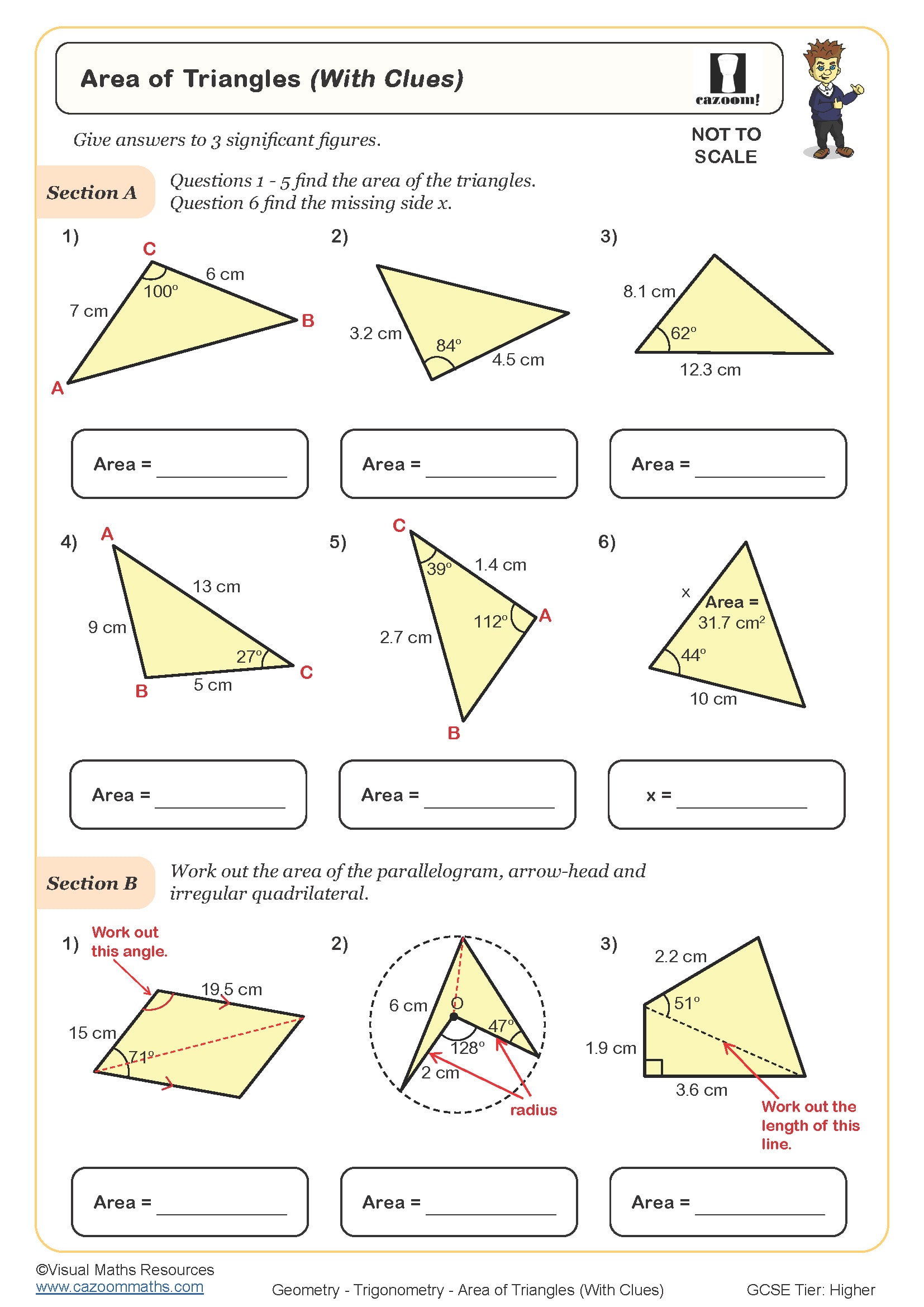
Area of triangle worksheets typically appear in Year 7 and 8 as part of the Key Stage 3 geometry curriculum, with students building on their understanding of area concepts from primary school. The topic resurfaces in Years 9-11 within more complex GCSE contexts, including trigonometric area calculations and composite shape problems.
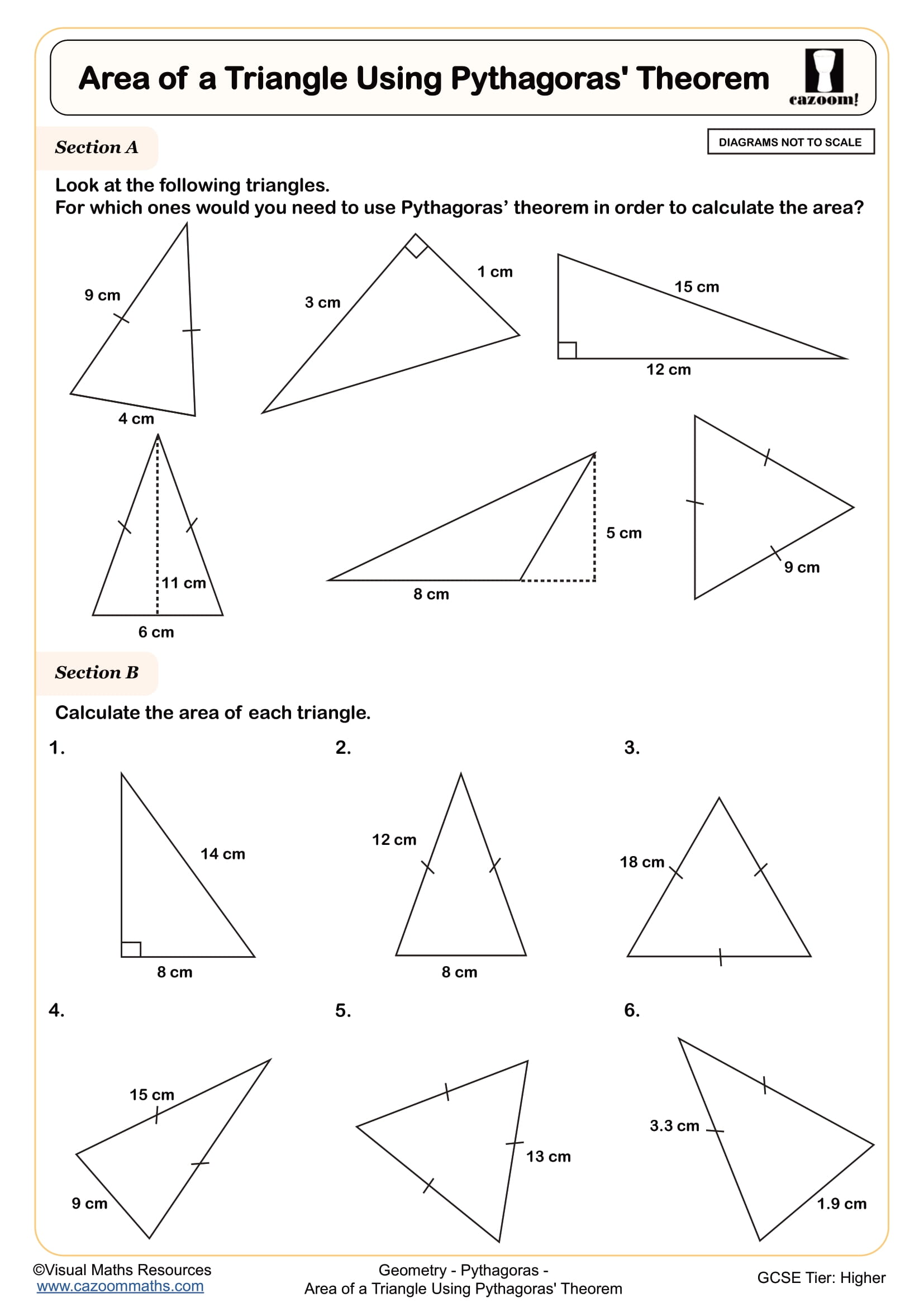
The progression requires careful scaffolding - Year 7 students often struggle with identifying the perpendicular height when it's not drawn vertically. By Year 9, students should confidently handle triangles where heights must be calculated using Pythagoras' theorem or trigonometry, making area of a triangle worksheets important for reinforcing these connections between different mathematical topics.
How do worksheets address triangles with missing measurements?
Quality triangle area worksheet resources include problems where students must first find missing dimensions before calculating area. These questions often combine Pythagoras' theorem, trigonometry, or similar triangles concepts, reflecting the interconnected nature of GCSE geometry topics.
Students frequently attempt to use any two given measurements as base and height, ignoring whether they're perpendicular. Teachers report success when worksheets explicitly show both correct and incorrect height measurements on similar triangles, helping students visualise why only perpendicular heights work in the standard area formula. This visual approach significantly reduces errors in examination conditions.
How can teachers maximise the impact of area of triangle worksheets?
Teachers achieve better results by starting each lesson with a brief discussion about real-world triangle areas - from roof spaces to triangular road signs - before introducing worksheet activities. This contextual approach helps students understand why accurate area calculations matter beyond the classroom, particularly for students considering construction, engineering, or design careers.
The most effective approach involves students working through problems in pairs, with one student calculating whilst the other checks using the answer sheets. This peer-checking process catches the common 'forgotten half' error immediately, whilst the collaborative discussion reinforces the mathematical reasoning behind each step of the area calculation process.